Mount Thor, officially gazetted as Thor Peak, is a mountain with an elevation of 1,675 metres (5,495 ft) located in Auyuittuq National Park, on Baffin Island, Nunavut, Canada. The mountain is located 46 km (29 mi) northeast of Pangnirtung and features Earth’s greatest vertical drop of 1,250 m (4,101 ft), with the cliff overhanging at an average angle of 15 degrees from vertical. Despite its remoteness, this feature makes the mountain a popular rock climbing site. Camping is allowed, with the only official site being at the entrance to the Akshayuk Valley near Overlord Peak.
I don’t know about climbing it, maybe a parachute jump from the top.
The UFO researcher known as the “Crypto Hunter,” John Rhodes discusses Reptilian humanoids and the secret underworld empire, which consists of alien cultures and lost civilizations. Rhodes reported on an extensive network of underground bases constructed by various nations, emphasizing their use for safety and security in case of cosmic disasters or other threats. He believes these bases are inhabited by small groups of advanced cultures, both human and non-human, living underground to preserve themselves.
Rhodes delved into the concept of reptilian beings, describing their physical attributes as approximately 6.5 to 8 feet tall, muscular, with scales covering their bodies. These beings have a large head, almond-shaped eyes with vertical slit pupils, three fingers with an opposing thumb on their hands, and no lips or ears. He suggested these beings have evolved differently from humans, with distinct brain types and different ways of perceiving science and learning. Rhodes mentioned that reptilian beings might be coexisting with humanity underground, possibly for their own safety and to monitor human activities.
He shared the story of the Lizard Man of Bishopville, South Carolina, as an example of encounters with reptilian creatures. This story involved a young boy’s encounter with a creature that matches the physical description of reptilian beings. “When he got back home, he was so scared he couldn’t talk… he started going into a fit,” Rhodes said. The local sheriff, a who investigated the case, emphasized that the swamps in the area are difficult to access, making it possible for unknown creatures to reside there.
Here is a very big one attacking the capital of Manitoba in Winnipeg.
Rare footage captured one of the largest groups of spinner dolphins ever filmed, known as a megapod, hunting flying fish in the Pacific Ocean off Costa Rica as part of PBS’s “Spy in the Ocean” nature miniseries. The team used a “spy dolphin” equipped with a camera and an animatronic bird drone to infiltrate and observe the dolphins. Known as the acrobats of the dolphin world, spinner dolphins can leap over 10 feet high out of the water and spin seven times in a single jump. The megapod communicated through clicks and whistles, and the gathering covered an extensive area both on the surface and underwater, consisting of thousands of dolphins at its peak. The use of spy cameras on animatronic animals provided a unique perspective on the dolphins’ behavior without disrupting them with large, obtrusive cameras.
Walking and texting is leading to a spate of collision-related injuries. Could a new app be the answer?
We’ve all done it. You’re walking down the street and the familiar beep of an incoming text becomes too tempting to resist. As you start to fire off a quick reply – bam! You clash shoulders with a fellow pedestrian doing exactly the same.
Alex Stoker is a Clinical Fellow in Emergency Medicine at Frimley Park Hospital, Surrey. “If it’s a tall object like a wall or a lamp-post that someone walks into, then one might expect facial injuries such as a broken nose or fractured cheekbone,” he told the BBC.
“If on the other hand the collision results in falling over, then they’re much more liable to things like hand injuries and broken wrists. There’s a complete spectrum but it is possible to sustain a really serious injury.”
Man hole avoidance
A new app called CrashAlert aims to help save people from themselves. It involves using a distance-sensing camera to scan the path ahead and alert users to approaching obstacles.
The camera acts like a second pair of eyes – looking forward while the user is looking down.
CrashAlert is at prototype stage
Just as a Nintendo Wii or Xbox can detect where and how a player is moving, CrashAlert’s camera can interpret the location of objects on the street.
When it senses something approaching, it flashes up a red square in a bar on top of the phone or tablet. The position of the square shows the direction of the obstacle – giving the user a chance to dodge out of the way.
“What we observed in our experiments is that in 60% of cases, people avoided obstacles in a safer way. That’s up from 20% [without CrashAlert],” says CrashAlert’s inventor Dr Juan David Hincapié-Ramos from the University of Manitoba.
What’s more, the device doesn’t distract the user from what they’re doing. Hincapié-Ramos’s tests showed it can be used alongside gaming or texting without any cost to performance.
Despite designing CrashAlert, Hincapié-Ramos accepts that the best solution of all is for people to stop checking their phones in the first place.
“We should encourage people to text less while they’re walking because it isolates them from their environment. However people are doing it and there are situations where you have to do it. It’s for situations like this that CrashAlert can have a positive impact.”
But Dr Joe Marshall, a specialist in Human-Computer Interaction from the University of Nottingham, says that it’s not necessarily people who are to blame – but the phones themselves.
“The problem with mobile technology is that it’s not designed to be used while you’re actually mobile. It involves you stopping, looking at a screen and tapping away.”
Dr Marshall believes that if we want to stop people being distracted by their phones, then designers need to completely rethink how we interact with them. But so far, there is no completely satisfactory alternative.
“Google glass solves the problem of looking down by allowing you to look ahead. But you still have to pay attention to a visual display,” he told the BBC.
So for now at least, it seems vigilance is the key to avoiding lamp-posts and unexpected manholes.
But as mobile technology continues to dominate everyday life, it might not be too ludicrous to expect to rely on smart cameras to steer us in the right direction.
The Ghost Army was a United States Army tactical deception unit during World War II imitating earlier British operations, officially known as the 23rd Headquarters Special Troops. The 1,100-man unit was given a unique mission within the U.S Army: to impersonate other U.S. Army units to deceive the enemy. From a few weeks after D-Day, when they landed in France, until the end of the war, they put on a “traveling road show” utilizing inflatable tanks, sound trucks, fake radio transmissions and pretence. They staged more than 20 battlefield deceptions, often operating very close to the front lines. Their mission was kept secret until 1996, and elements of it remain classified.
Inspiration for the unit came from the British units who had honed the deception technique for the battle of El Alamein in late 1942. The U.S. unit had its beginnings at Camp Forrest, Tennessee, and was fully formed at Pine Camp, NY (now Fort Drum), before sailing for the United Kingdom in early May 1944. In Britain they were based near Stratford upon Avon, and troops participated in Operation Fortitude, the British-designed and led D-Day deception of a landing force designated for the Pas-de-Calais.
Some troops went to Normandy two weeks after D-Day, where they simulated a fake Mulberry harbour at night with lights which attempted to draw German artillery from the real ones. After which the entire Unit assisted in tying up the German defenders of Brest by simulating a larger force than was actually encircling them.
Inflatable Tanks and Truck
Ghost soldiers were encouraged to use their brains and talent to mislead, deceive and befuddle the German Army. Many were recruited from art schools, advertising agencies and other venues that encourage creative thinking. In civilian life, ghost soldiers had been artists, architects, actors, set designers and engineers.
Although the 23rd Headquarters Special Troops consisted of only 1,100 soldiers, the contingent used equipment pioneered by British forces such as dummy tanks and artillery, fake aircraft and giant speakers broadcasting the sounds of men and artillery to make the Germans think it was upwards of a two-division 30,000 man force. The unit’s elaborate ruses helped deflect German units from the locations of larger allied combat units.
The unit consisted of the 406th Combat Engineers (which handled security), the 603rd Camouflage Engineers, the 3132 Signal Service Company Special and the Signal Company Special.
As the Allied armies moved east, so did the 23rd, and it eventually was based within Luxembourg, from where it engaged in deceptions of crossings of the Ruhr river, positions along the Maginot Line, Hürtgen Forest, and finally a major crossing of the Rhine to draw German troops away from the actual sites.
Inflatable canon
From the air the deception was very convincing.
The visual deception arm of the Ghost Army was the 603rd Camouflage Engineers. It was equipped with inflatable tanks, cannons, jeeps, trucks, and airplanes that the men would inflate with air compressors, and then camouflage imperfectly so that enemy air reconnaissance could see them. They could create dummy airfields, troop bivouacs (complete with fake laundry hanging out on clotheslines), motor pools, artillery batteries, and tank formations in a few hours. Many of the men in this unit were artists, recruited from New York and Philadelphia art schools. Their unit became an incubator for young artists who sketched and painted their way through Europe. Several of these soldier-artists went on to have a major impact on art in the post-war U.S.A . Bill Blass, Ellsworth Kelly, wildlife artist Arthur Singer and Art Kane were among the many artists who served in the 603rd.
The 3132 Signal Service Company Special handled sonic deception. The unit coalesced under the direction of Colonel Hilton Railey, a colorful figure who, before the war, had “discovered” Amelia Earhart and sent her on her road to fame.
Aided by engineers from Bell Labs, a team from the 3132 went to Fort Knox to record sounds of armored and infantry units onto a series of sound effects records that they brought to Europe. For each deception, sounds could be “mixed” to match the scenario they wanted the enemy to believe. This program was recorded on state-of-the-art wire recorders (the predecessor to the tape recorder), and then played back with powerful amplifiers and speakers mounted on halftracks. The sounds they played could be heard 15 miles (24 km) away.
500 pound speakers that could be heard 15 miles (24 kilometres) away.
“Spoof radio”, as it was called, was handled by the Signal Company. Special Operators created phony traffic nets, impersonating the radio operators from real units. They were educated in the art of mimicking a departing operator’s method of sending Morse Code so that the enemy would never detect that the real unit and its radio operator were long gone.
To complement existing techniques, the unit often employed theatrical effects to supplement the other deceptions. Collectively called “atmosphere”, these included simulating actual units deployed elsewhere by the application of their divisional insignia, painting appropriate unit insignia on vehicles and having the individual companies deployed as if they were regimental headquarters units. Trucks/Lorries would be driven in looping convoys with just two troops in the seats near the rear, to simulate a truck full of infantry under the canvas cover. “MP’s” (Military Police) would be deployed at cross roads wearing appropriate divisional insignia and some officers would simulate divisional generals and staff officers visiting towns where enemy agents were likely to see them. A few actual tanks and artillery pieces were occasionally assigned to the unit to make the “dummies” in the distance appear more realistic.
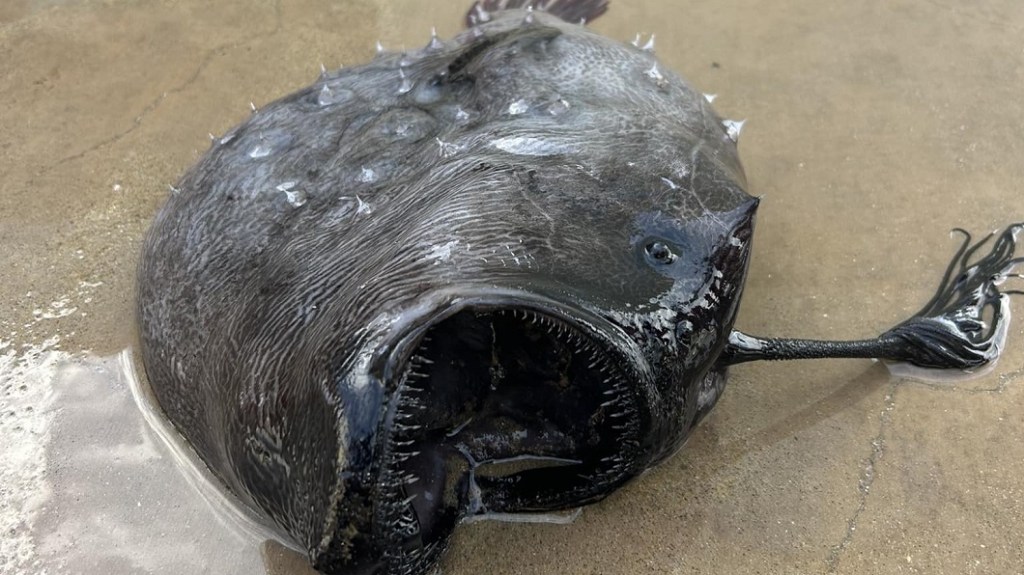
A deep-sea Pacific footballfish found on Moro Beach in Crystal Cove State Park is the second of this species to wash up in recent years, but the reason behind the strandings remains a mystery.
A ghoulish, pitch-black fish with a long stalk on its head recently washed up on a beach in Southern California — the second of its kind to end up onshore there in recent years, Crystal Cove State Park officials announced Oct. 17.
A ghoulish, pitch-black fish with a long stalk on its head recently washed up on a beach in Southern California — the second of its kind to end up onshore there in recent years, Crystal Cove State Park officials announced Oct. 17.
Experts identified the bizarre-looking animal as a female Pacific footballfish (Himantolophus sagamius), a species of anglerfish that lives in the Pacific Ocean at depths of 2,000 to 3,300 feet (600 to 1,000 meters). It follows an earlier stranding in May 2021, when a visitor at the state park discovered another fish of the same species on the shore.
“To see an actual anglerfish intact is very rare and it is unknown how or why these fish ended up onshore,” Crystal Cove State Park officials wrote in a Facebook post. “Their teeth, like pointed shards of glass, are transparent and their large mouth is capable of sucking up and swallowing prey the size of their own body.”
Pacific footballfish are one of more than 300 species of anglerfish living in the deep sea worldwide, according to the California Academy of Sciences. Female anglerfish can grow up to 24 inches (61 centimeters) long — about 10 times as large as some of their male counterparts, which have evolved to latch onto females and act as lifelong parasitic providers of sperm on-tap.
“Only females possess a long stalk on the head with bioluminescent tips used as a lure to entice prey,” park officials wrote in the post. The males of some species merge their bloodstreams with their host’s, “eventually coalescing with the female until nothing is left of their form but their testes for reproduction,” they added.
That is definitely one very Ugly fish.
A seasonal lifeguard discovered the dead anglerfish on Moro Beach close to the lifeguard headquarters, “just in time for Friday the 13th,” the officials wrote. It was later picked up by the California Department of Fish and Wildlife for analysis.
The specimen measured about 14 inches (36 cm) from mouth to tail fin, Michelle Horeczko, a senior environmental scientist supervisor with the Department of Fish and Wildlife, told the Los Angeles Times. Only 30 or so specimens of this species have been collected globally, she said, so the discovery will provide valuable information about the life of Pacific footballfish.
After examining the fish, scientists handed it over to the Natural History Museum in Los Angeles, where the Pacific footballfish discovered in 2021 is also housed, “so that the specimen can be preserved and available for scientific research,” Horeczko said.
While the reason for the stranding remains a mystery, “seeing this strange and fascinating fish is a testament to the curious diversity of marine life lurking below the water’s surface in California’s marine protected areas,” the Facebook post said.






 The MarkoZen Blog