Bigfoot Filmed From Train in Colorado?

An intriguing video filmed from a passenger train in Colorado shows a curious bipedal creature that some believe to be Bigfoot lurking on a mountain. The remarkable footage came to light this week by way of Shannon Parker, who explained to a local media outlet that the sighting took place on Sunday as she and her husband, Stetson, were riding on the Narrow Gauge Railroad which connects the communities of Durango and Silverton. As the trip was winding down, the couple looked out the window of the train and were stunned to see what appeared to be a creature walking along a mountainside on two feet before squatting down in some brush.

Fortunately, the couple were not the only passengers to see the possible Sasquatch as a man sitting next to them also observed the peculiar creature and managed to film it with his cell phone. According to Shannon, she later showed the footage and some pictures from the sighting to workers on the train and they had no explanation for what the oddity on the mountainside could have been. “When we spoke to the conductor on the train he told us he hasn’t ever seen anything like it before,” she recalled to Newsweek, “and he himself has experienced unexplainable things while snowshoeing in those mountains.”

Since being posted online, the footage has spread like wildfire with many marveling at how clear it is in comparison to the average purported Bigfoot video. That said, response to the sighting has been largely mixed with some suggesting that the creature in the scene is a genuine Sasquatch, while more skeptical observers have posited that perhaps it was some kind of prank either orchestrated by the train company or a mischievous individual hoping to pull a fast one on the passengers. 

Grazer is third female winner of Fat Bear Week

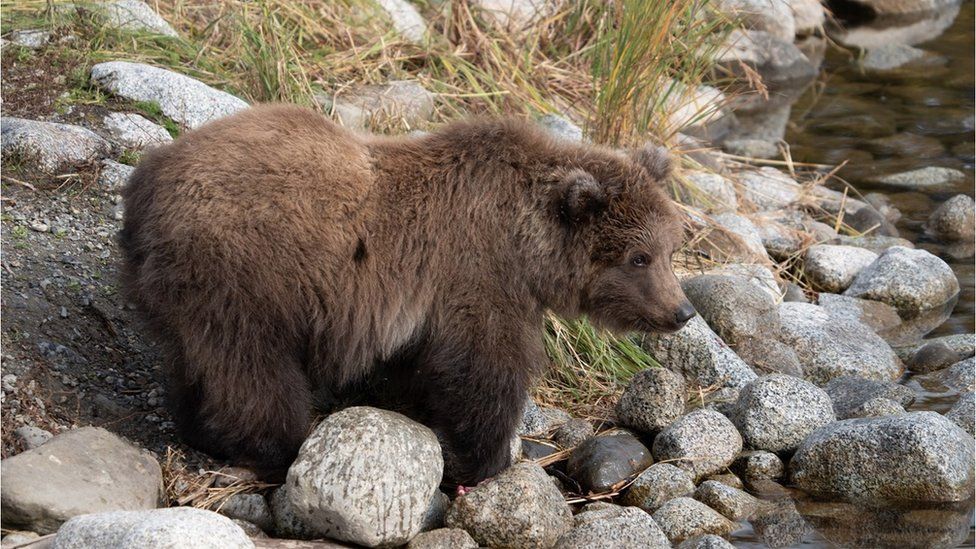
Grazer the bear
Image caption,Grazer is a proud mother to two litters of cubs and one of the best fishers on the water

By Madeline Halpert

BBC News, New York

The wait is over. After a highly anticipated week of competition, voters have crowned a new winner of Fat Bear Week.

They chose 128 Grazer, a defensive mother bear and first-time winner of the sought-after title.

She beat second placed 32 Chunk, a larger bear, by more than 85,000 votes.

“The gutsy girl grounded the guy with a gut,” the Alaska Katmai National Park & Preserve, which hosts the event, said in a tweet.

“32 Chunk, proved his prominent posterior was worthy of a whopping win. But in the end, Chunk got Grazered,” the park service added.

Fat Bear week, an online event founded in 2014 by former park ranger Mike Fitz, has become an internet sensation, attracting millions of viewers each year.

Each year, fans pick their favourite of 12 plump brown bears from Alaska’s Katmai National Park that have gathered along the Brooks River to chomp on salmon and pack on as many pounds before winter.

This year, Grazer received a whopping total of 108,321 votes, according to Explore.org, which tracks the contest for the park service.

A large mother to two litters of cubs with a long muzzle and “conspicuously blonde ears”, Grazer is one of the fattest bears to hunt for salmon in the Brooks River, the National Park Service said.

She was introduced to the area as a young cub in 2005, and has since become one of the most successful fishers on the waters.

“She can chase down fleeing salmon in many parts of the river or patiently scavenge dead and dying salmon after they spawn,” the National Park Service said.

She has guts, too. The National Park Service said Grazer often preemptively confronts and attacks much larger and more dominant male bears to ensure her cubs’ safety.

This year, she beat two favourites for the title: 480 – aka Otis – a 27-year-old brown bear weighing roughly 1,200lb, and 747 – or Colbert – a two-time Fat Bear Week champion weighing about the same.

Her final rival, Chunk – a large adult male with a low-hanging belly – has come out of his shell in recent years, growing from a fairly deferential bear to one of the river’s largest and most dominant males.

Still, he proved no match for Grazer, whose “combination of skill and toughness makes her one of Brooks River’s most formidable, successful, and adaptable bears”, the National Park Service said.

Bear 806 Jr is a fluffy mid-brown cub with a short muzzle and shaggy furIMAGE SOURCE,NPS PHOTO / F. JIMENEZImage caption,

Can the newcomer make his mark? Bear 806 Jr is less than a year old, but shows significant promise (and fluff)

Graphic showing bear weight v human weight

10,000 Bedroom Nazi Hotel intended to give workers a holiday at the beach

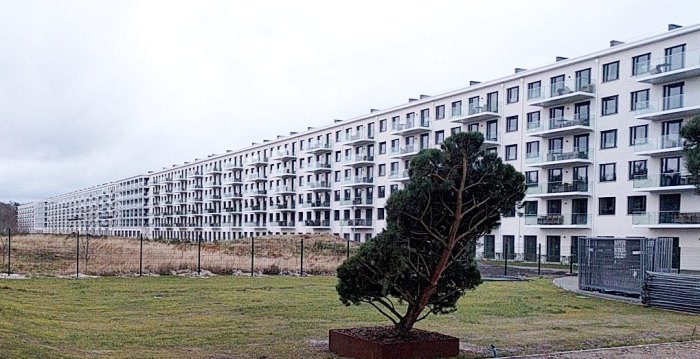
Stretching for over three miles along the white sandy beach on Germany’s Baltic Sea island of Ruegen, lies the world’s biggest hotel with 10,000 bedrooms all facing the sea. But for 70 years since it was built, no holiday maker has ever stayed there. This is hotel Prora, a massive building complex built between 1936 and 1939 by the Nazis as part of their “Strength through Joy” (“Kraft durch Freude,” KdF) programme. The aim was to provide leisure activities for German workers and spread Nazi propaganda. Locals call Prora the Colossus because of its monumental structure.

Prora lies on an extensive bay between the Sassnitz and Binz regions, known as the Prorer Wiek, on the narrow heath (the Prora) which separates the lagoon of the Großer Jasmunder Bodden from the Baltic Sea. The complex consist of eight identical buildings that extend over a length of 4.5 kilometres and are roughly 150 metres from the beach. A workforce of 9,000 took three years to build it, starting in 1936, and the Nazis had long-term plans for four identical resorts, all with cinema, festival halls, swimming pools and a jetty where Strength Through Joy cruise ships would dock.

prora-16[6]

Dr. Robert Ley envisaged Prora as a parallel to Butlins – British “holiday camps” designed to provide affordable holidays for the average worker. Prora was designed to house 20,000 holidaymakers, under the ideal that every worker deserved a holiday at the beach. Designed by Clemens Klotz (1886–1969), all rooms were planned to overlook the sea, while corridors and sanitation are located on the land side. Each room of 5 by 2.5 metres (16’5″ x 8’3″) was to have two beds, an armoire (wardrobe) and a sink. There were communal toilets and showers and ballrooms on each floor.

Hitler’s plans for Prora were much more ambitious. He wanted a gigantic sea resort, the “most mighty and large one to ever have existed”, holding 20,000 beds. In the middle, a massive building was to be erected. At the same time, Hitler wanted it to be convertible into a military hospital in case of war. Hitler insisted that the plans of a massive indoor arena by architect Erich Putlitz be included. Putlitz’s Festival Hall was intended to be able to accommodate all 20,000 guests at the same time. His plans included two wave-swimming pools and a theatre. A large dock for passenger ships was also planned.

During the few years that Prora was under construction, all major construction companies of the Reich and nearly 9,000 workers were involved in this project. With the onset of World War II in 1939, building on Prora stopped and the construction workers transferred to the V-Weapons plant at Peenemünde. The eight housing blocks, the theatre and cinema stayed as empty shells, and the swimming pools and festival hall never materialised. During the Allied bombing campaign, many people from Hamburg took refuge in one of the housing blocks, and later refugees from the east of Germany were housed there. By the end of the war, these buildings housed female auxiliary personnel for the Luftwaffe.

Beach side

Prorax

In 1945 the Soviet Army took control of the region and established a military base at Prora. The Soviet Army’s 2nd Artillery Brigade occupied block 5 of Prora from 1945 to 1955. The Soviet military then stripped all usable materials from the building.  In the late 1940s two of the housing blocks – one on the North and one on the South – were demolished and the remains mostly removed.

In the late 1950s the East German military rebuilt several of the buildings. Since the buildings had been stripped to the bare brick in the late 1940s, most of the exterior and interior finish that can be seen today was done under East German control. After the formation of the German Democratic Republic’s (GDR’s) National Peoples Army in 1956, the buildings became a restricted military area housing several East German Army units. The most prominent were the elite 40. Fallschirmjägerbataillon Willi Sänger (40th Parachute Battalion “Willi Sänger”) which was housed in block 5 from 1960 to 1982. Block 4 on the north side was used for urban combat training by the Parachute Battalion and others. Large sections remain as ruins to this day. Also housed in the building from 1982 to 1990 was the East German Army Construction Battalion “Mukran”, where conscientious objectors served as noncombatant Construction Soldiers (Bausoldaten) to meet their military service obligation. A part of the building also served as the East German Army’s “Walter Ulbricht” convalescent home.

prora-3[2]
prora-13[5]

In 2013, a German company, Metropole Marketing, bought the rights to refurbish Prora and market the units as summer homes. By that year, refurbished apartments in the so-called Colossus were on sale for as much as 700,000 euros ($900,000) apiece. The completion date was estimated as 2016. In 2016, the first of the new apartments opened in Block 1. The Prora Solitaire hotel in Block 2 opened in time for summer 2016, and some reconstructed flats were for sale in that Block by mid 2017. At that time, four of the buildings were in the process of redevelopment, a fifth was used as a youth hostel while the remaining three remained in ruins.

A November 2017 update indicated that most of the units (flats) in Block 1 had been sold, having been marketed as summer homes for those who live in Hamburg and Berlin. Many were listed by owners as short term rentals on sites such as Airbnb and HomeAway.

Prora_renoviert_1_crop

Renovated part in 2016

prora1

Renovations after 2019:

Falowiec: The Wave Building of Gdańsk

In the late 1960s and the early 1970s, a series of peculiarly shaped apartment blocks were constructed in the Polish city of Gdańsk. They were collectively called “Falowiec”, from the Polish word “fala,” which means “wave,” and whose plural form is “falowce.” These buildings earned the name Falowiec due to their distinctive wave-like pattern as they alternate between blocks.

There are eight such buildings in Gdańsk, with the most renowned located in the Przymorze block. It has 11 floors, 16 staircases, 1,792 apartments in which nearly six thousand tenants live. It’s like a small town.

Photo credit: Reddit

The dimensions of the building—32 meters high, 13 meters wide, and 860 meters long—place it among the leading residential giants. The building stretches like a huge train with three bus stops along its length, and four addresses. The building is so large that it affects the air movement creating a microclimate around it. In the north it is colder, and snow and frost last longer. In the south, the average temperature is slightly higher, and in hot weather, grass and trees dry faster.

The Falowiec were built during a period when there was an acute housing shortage. The buildings were meant to be a temporary solution. However, they became embedded in the seaside landscape for many years.

The blocks were designed and erected according to a similar scheme. Most of the apartments are accessed from open galleries that run along the north wall. In the beginning, it was possible to walk from one end of the building to the other. But then, boarders erected walls separating the individual apartments from each other.

There are a total of eight Falowce in Gdańsk. All of them were built in the 1960s and 1970s, when there was a huge housing shortage. They were meant to be a temporary solution. However, they became embedded in the seaside landscape for many years.

The blocks were designed and erected according to a similar scheme. Most of the apartments are accessed from open galleries that run along the north wall. They used to be able to walk from one end of the building to the other. Then, on the galleries, walls grew up, separating the individual cages from each other. The blocks have balconies on the south side.

The shape of the buildings resembles a sea wave. Hence their name. Vice-President Wojtkowiak still remembers when the largest of the wave houses, at Obrońców Wybrzeża Street, was settled. — It was done in stages. When the residents moved into the first segment, the next ones were still being finished, he recalls.

The giant’s surroundings resembled a construction site for a long time. There were piles of sand around, concrete slabs lying around, one could only dream of lawns or even a sidewalk. But for most people, their own apartment was quite an ennoblement. Especially living in a place like this. From the upper floors of the block you can see the sea, and in good weather even the Hel Peninsula.

The Widest Freeway in the World 

Where else? Houston, Texas of course.

katy1

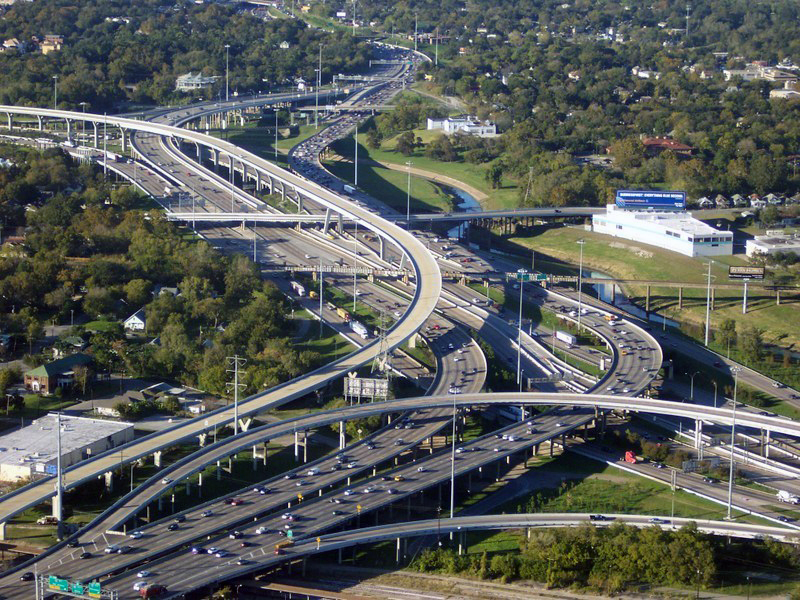
When constructed during the 1960s, the I-10 Katy from Houston, known as the Katy Freeway, was built with six to eight lanes wide barring side lanes, being modest by Houston standards because existing traffic demand to the farming area of West Houston was relatively low. As the population and economic activity increased in the area vehicular traffic increased, reaching an annual average daily traffic (AADT) of 238,000 vehicles just west of the West Loop in 2001.

In 2000 increased traffic levels and congestion led to plans being approved for widening of the freeway to 16 lanes with a capacity for 200,000 cars per day. An old railway running along the north side of the freeway was demolished in 2002 in preparation for construction which began in 2004. The interior two lanes in each direction between SH 6 and west I-610, the Katy Freeway Managed Lanes or Katy Tollway, were built as high-occupancy toll lanes and are managed by the Harris County Toll Road Authority. The section just west of SH 6 to the Fort Bend–Harris county line opened in late June 2006. Two intersections were rebuilt (Beltway 8 and I-610), toll booths were added, together with landscaping as part of Houston’s Highway Beautification Project. Most of the section between Beltway 8 and SH 6 had been laid by September 2006 and work was completed in October 2008.

Tolls on the managed lanes vary by vehicle occupancy, axle count and time of day. High occupancy vehicles may travel for free at certain times.

Katy-Freeway

katy4

Interstate 10 (I-10) is the major east–west Interstate Highway in the Southern United States. In the U.S. state of Texas, it runs east from Anthony, at the border with New Mexico, through El Paso, San Antonio and Houston to the border with Louisiana in Orange, Texas. At just under 880 miles (1,420 km), the Texas segment of I-10, maintained by the Texas Department of Transportation, is the longest continuous untolled freeway in North America that is operated by a single authority, a title formerly held by Ontario Highway 401. 

katy2

katy3

OLYMPUS DIGITAL CAMERA

katy interstate-10-map