In Winnipeg the bitterly cold winters are not conducive for road construction. It gets so cold that the ground freezes up to 5-6 feet below the surface. The ground is so frozen equipment cannot penetrate through. And cement cannot be poured in those brutal temps. Therefore, all road and highway construction has to be done during the late spring, summer and early fall.
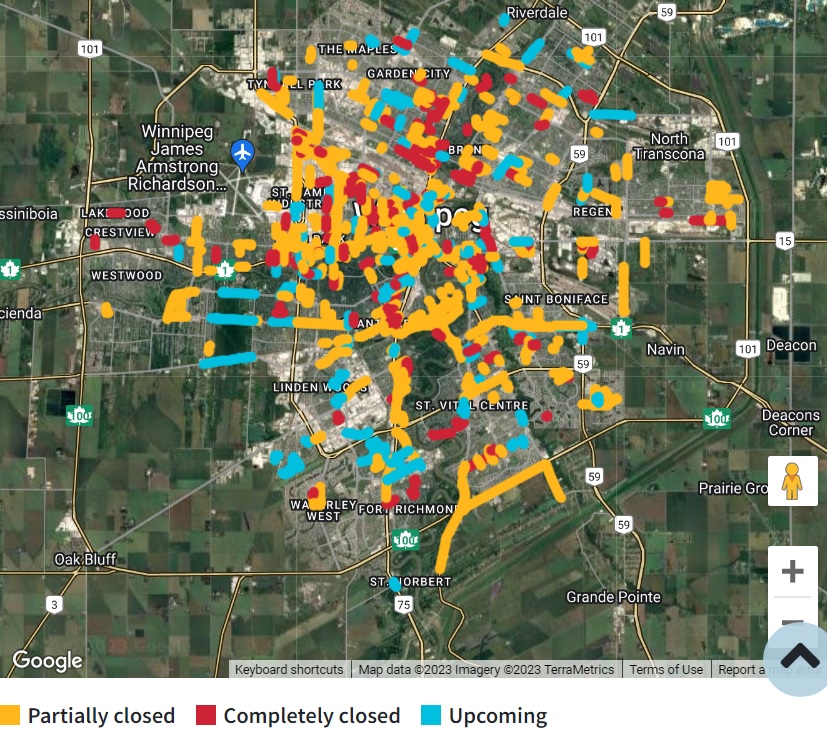
It creates such chaos that many streets are closed or down to 1 lane. Makes it an obstacle course to get around. Regular 20 minute commutes turn into 50 minute marathons. Such is existence in the Great White North.
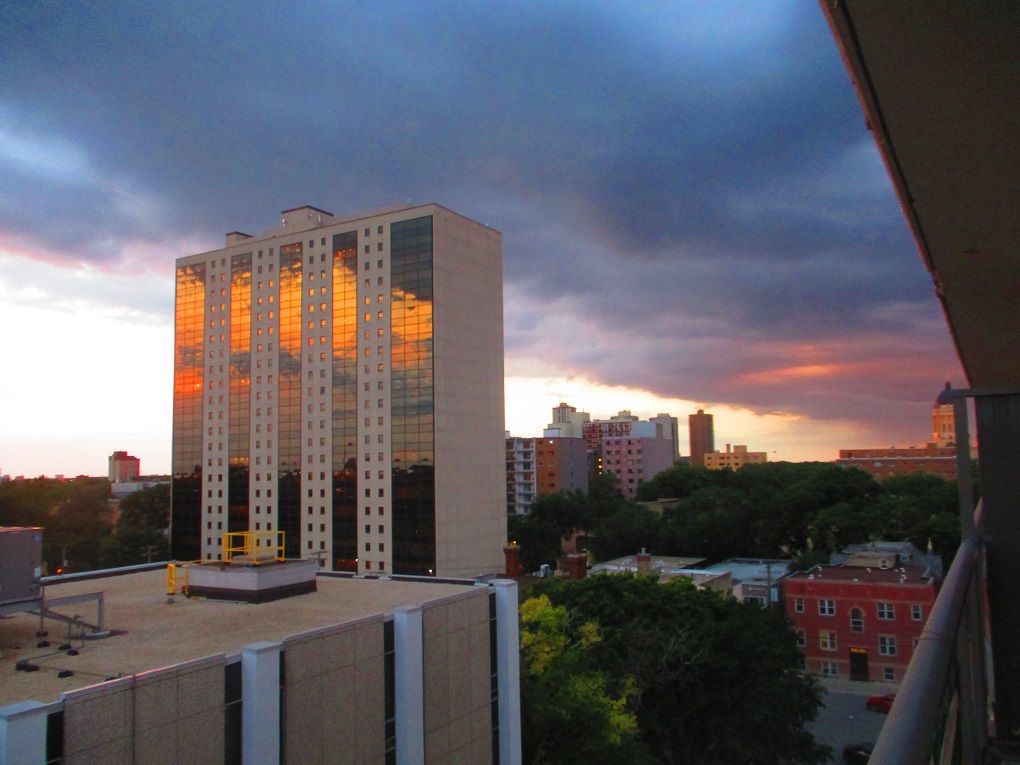
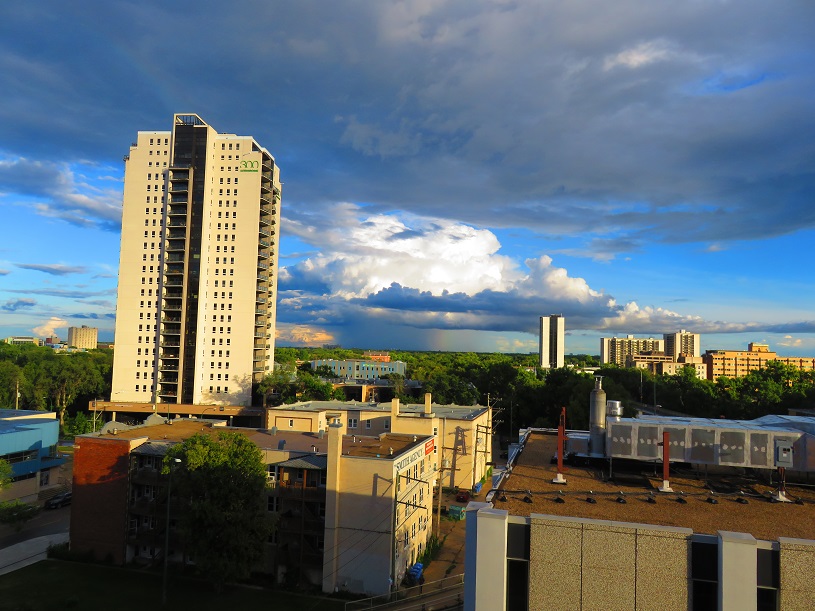
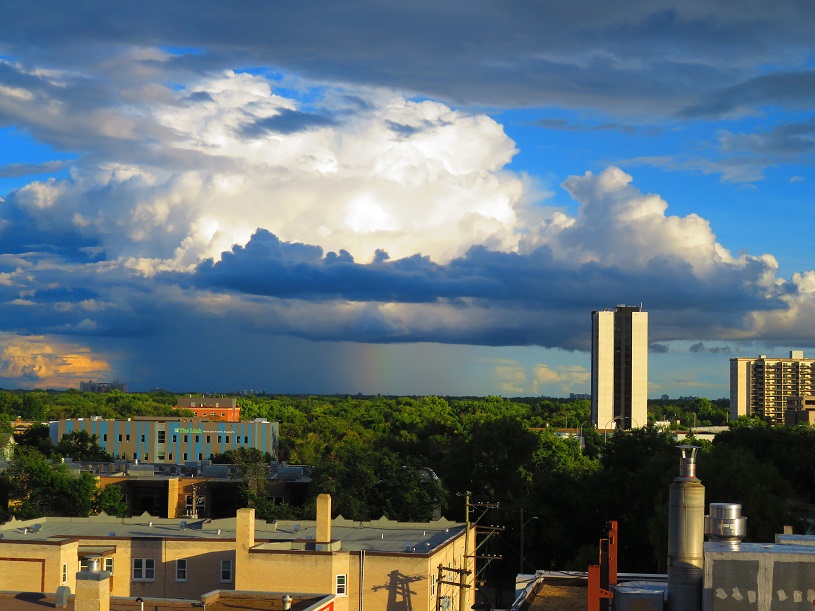
Summer street in Winnipeg
Today’s Winnipeg street construction map.
Looks like this craziness happens in other jurisdictions:
‘This city is beautiful,’ says posting on YouTube video by daredevil who scales Winnipeg crane
At one point, the man in a YouTube video can be seen hanging from the crane, his legs swinging freely over the Winnipeg cityscape. (YouTube)
A new video of Winnipeg shows the city from a high vantage point, but in a way that’s not entirely legal.
In the YouTube video that’s not for the weak-kneed, a man scales buildings and walks along rooftops in the Exchange District before climbing a construction crane high above Portage Avenue.
The video, which claims to have been shot at 5:30 a.m., was posted Aug. 16.
Winnipeg police spokesman Const. Jason Michalyshen said no formal complaint has been made about the incident, but “this behaviour/stunt is very concerning, not only for the safety of the individuals involved but the potentially dangerous position innocent bystanders are being put in.”
In addition to trespassing, the people involved in the video could face charges of break and enter and mischief.
Bockstael Construction, which is in charge of the crane and building project, would not comment.
Similar videos have surfaced in other cities and there were arrests earlier this year of six men in North Vancouver, B.C., who were caught climbing a crane.
Christopher Schneider, a Wilfrid Laurier University professor, has said social media may be fuelling the rise in so-called urban climbers, who like to post videos or selfies of their dangerous activities.
“One thing we’re really seeing here is that there are no media gatekeeper” to discourage the climbers’ behaviour, Schneider told CBC News in July.
“This is encouraging anyone who wants to participate in these kinds of activities to record themselves and put it on online.”
The Katskhi pillar is a natural limestone monolith located at the village of Katskhi in western Georgian region of Imereti, near the town of Chiatura. It is approximately 40 metres (130 ft) high, and overlooks the small river valley of Katskhura, a right affluent of the Q’virila.
The rock, with visible church ruins on a top surface measuring c. 150 m2, has been venerated by locals as the Pillar of Life and a symbol of the True Cross, and has become surrounded by legends. It remained unclimbed by researchers and unsurveyed until 1944 and was more systematically studied from 1999 to 2009. These studies determined the ruins were of an early medieval hermitage dating from the 9th or 10th century. A Georgian inscription paleographically dated to the 13th century suggests that the hermitage was still extant at that time. Religious activity associated with the pillar was revived in the 1990s and the monastery building had been restored within the framework of a state-funded program by 2009.
The Katskhi pillar complex currently consists of a church dedicated to Maximus the Confessor, a crypt (burial vault), three hermit cells, a wine cellar, and a curtain wall on the uneven top surface of the column. At the base of the pillar are the newly built church of Simeon Stylites and ruins of an old wall and belfry.
The church of St. Maximus the Confessor is located at the south-easternmost corner of the top surface of the Katskhi pillar. A small simple hall church design with the dimensions of 4.5 × 3.5 m., it is a modern restoration of the ruined medieval church built of stone. Beneath and south of the church is an elongated rectangular crypt with the dimensions of 2.0 × 1.0 m., which had served as a burial vault. Digs at the ruined wine cellar revealed eight large vessels known in Georgia as k’vevri. Also of note is a rectangular cellar grotto with the entrance and two skylights—on the vertical surface of the rock, some 10-metre (33 ft) below the top. At the very base of the pillar there is a cross in relief, exhibiting parallels with similar early medieval depictions found elsewhere in Georgia, particularly at Bolnisi.
In July 1944 a group led by the mountaineer Alexander Japaridze and the writer Levan Gotua made the first documented ascent of the Katskhi pillar. Vakhtang Tsintsadze, an architecture specialist with the group, reported in his 1946 paper that the ruins found on top of the rock were remains of two churches, dating from the 5th and 6th centuries and associated with a stylite practice, a form of Christian asceticism. Since 1999, the Katskhi pillar has become the subject of more systematic research. Based on further studies and archaeological digs conducted in 2006, Giorgi Gagoshidze, an art historian with the Georgian National Museum, re-dated the structures to the 9th–10th century. He concluded that this complex was composed of a monastery church and cells for hermits. Discovery of the remnants of a wine cellar also undermined the idea of extreme ascetism flourishing on the pillar. In 2007, a small limestone plate with the asomtavruli Georgian inscriptions was found, paleographically dated to the 13th century and revealing the name of a certain “Giorgi”, responsible for the construction of three hermit cells. The inscription also makes mention of the Pillar of Life, echoing the popular tradition of veneration of the rock as a symbol of the True Cross.[1]
Religious activity started to revive in 1995, with the arrival of the monk Maxim Qavtaradze, a native of Chiatura. Between 2005 and 2009, the monastery building on the top of the pillar was restored with the support of the National Agency for Cultural Heritage Preservation of Georgia. The rock was once accessible to male visitors through an iron ladder running from its base to the top, but has recently been deemed inaccessible to the public.







 The MarkoZen Blog