Saskatchewan not named after sasquatches, residents insist
CTV
Saskatchewanians are eager to correct the record after an NBA announcer insisted Wednesday that their province is named for its abundance of sasquatches.
The Fox Sports announcer made the comment while pointing out that Utah Jazz forward Trey Lyles is the first person from the province to play in the NBA.
“That region’s known for being home to a lot of sasquatches,” the announcer said, adding, “that’s what it’s named after.”
For the record, Saskatchewan comes from a Cree word for “swift flowing river.”
And as Manitoba sasquatch expert Chris Rutkowski points out, there are far fewer bigfoot sightings in the Land of the Living Skies than other regions like the Pacific Northwest.
Washington has had the most of any state or province, with 617, according to the Bigfoot Field Researchers Association. British Columbia has had the most in Canada, 130. Saskatchewan has had a mere seven.
Saskatchewan Premier Brad Wall laughed when he heard the news. “We might have more Elvis sightings,” he said.
Regina Mayor Michael Fougere also found it amusing, but saw an upside: “Now we’re going have a bunch of people that are going to come here wanting to see the sasquatch.”
Saskatchewan Tourism’s Aviva Kohen seemed more annoyed by the other things the Fox Sports announcer rattled off about her province, including that it’s cold and flat.
“That’s a myth I run into quite a bit in marketing and a myth I try to dispel.”
Sasquatch sightings in Canada
Sasquatch caught on video near Craven, Saskatchewan.
Exorcist expertise sought after Saskatoon ‘possession’
Bishop looks for inspiration from Calgary diocese
A case of what is being called possible demonic possession in Saskatoon has prompted local church officials to consider the need for an exorcist.
CBC News spoke with a Catholic priest involved in the case, which arose in March, and agreed not to identify participants in order to protect their privacy.
‘There are perhaps more stories about exorcisms in Hollywood than there are on the ground.’—Bishop Don Bolen
According to church officials, a priest was called to a Saskatoon home by a woman who said her uncle showed signs of being possessed by the devil. The woman believed a priest’s blessing could help the distraught man.
At the home, the priest encountered a shirtless middle-aged man, slouched on a couch and holding his head in his hands.
The man had used a sharp instrument to carve the word Hell on his chest.
When the priest entered the room, the man spoke in the third person, saying “He belongs to me. Get out of here,” using a strange voice.
The priest told CBC News that he had never seen anything like this and was concerned enough to call police, for safety reasons.
He said he then blessed the man, saying he belonged to the good side, to Jesus. With that, the man’s voice returned to normal for a short time.
Not a formal exorcism
The unusual voice returned when police arrived, and the priest continued to bless the man until he resumed a more normal composure.
CBC News followed up on the incident to learn if an exorcism had been performed, but church officials said a formal exorcism did not happen.
Bishop Don Bolen explained that the ritual of exorcism is a very structured exercise. He said it was not clear if the Saskatoon man was possessed or experiencing a mental breakdown.
“I would think there are perhaps more stories about exorcisms in Hollywood than there are on the ground,” Bolen said. “But the Catholic Church teaches that there is a force of darkness, and that God is stronger than that darkness.”
Church leaders in Saskatoon have been considering whether Saskatoon needs a trained exorcist.
The last person in the city with formal training, Rev. Joseph Bisztyo, retired in 2003.
Nor does the Regina archdiocese have an exorcist, so Bolen said they are looking to other locations.
“We’re kind of looking at what the diocese of Calgary does — they have a special commission for spiritual discernment,” Bolen said.
He explained that the commission meets with people connected to a possible possession, “to ask whether there’s some kind of psychological or psychiatric explanation to a situation,” he said, adding the commission is also open to the possibility of demonic possession.”
Catholics are not the only ones examining what to do when presented with possible cases of possession.
The ‘work of the devil’
Anglican priest Colin Clay, who has worked with Bisztyo, told CBC News the topic of exorcism touches on questions that go back centuries.
The issues revolve around the nature of evil and how to respond to people who claim they have the devil in them.
“The churches have to respond,” Clay said. “And they’ll either do it by saying — some churches will say — ‘Well that’s the devil, and the devil is at work in the world and we’ve got to deal with it,’ or the churches will say, ‘Well there’s certainly evil in the world, whether there’s an actual Satan or devil, there’s certainly evil in the world, and it has a terrible effect on people’s lives,’ and so we’ve got to respond to it.”
Clay said he does not dismiss how evil can affect people.
“I take evil very, very seriously,” Clay said. “I take the effect that it has on people very seriously, but I don’t think that there’s any quick fix. The word exorcism worries me a little bit, because it’s been given a Hollywood sort of flavour to it, and it’s not as simple as that. You don’t just say you’ve got the devil, I’m going to drive it out.”
Like the bishop, Clay advocates a measured approach to dealing with claims of possession.
I think what we have here is an over eager priest who takes his job too seriously. Or a more conspiratorial angle. The Catholic church is losing adherents in droves these days. The churches are becoming empty, therefore less cash in the baskets. So the church decides to fall back on a true but trusted technique, fear. Make it look like some poor pion is possessed and scare the bejesus out of some people. The people that fall for this will be high-tailing it back to church lickity split.
More returnees and recruits and the donation baskets will be full again. More revenue for the church. Bible sales go up and there is a frenzied demand for crucifixes, not to mention holy water. The church coffers will be back to pre-war levels.
But when it is finally determined that the poor soul in Saskatoon was actually having a bad acid trip everything will calm down. But then again the intense fear instilled in borderline believers by this story may linger for years to come. And holy water sales will stay hot.
Just in case there is something to this story. The Catholic church in Saskatchewan has to open the purse strings and send a recruitment team to the Vatican and bring back a take no prisoners, no holds barred Exorcist.
The Reverend Gabriele Amorth, SSP (1 May 1925 – 16 September 2016) was an Italian Roman Catholic Priest and an exorcist of the Diocese of Rome who claimed to have performed tens of thousands of exorcisms over his half a dozen plus decades as a Catholic Priest. He never served as “the Vatican’s chief exorcist” or any similar role, despite popular media headlines.
No wonder he had no hair
Amorth, who headed the International Association of Exorcists, told The Sunday Times back in 2013 that he asked Pope Francis to allow all priests the right to do exorcisms without the church’s approval. According to the report, priests currently need special approval from their bishop to perform the rite and it is rarely granted.
“I will ask the pope to give all priests the power to carry out exorcisms, and to ensure priests are properly trained for these starting with the seminary. There’s a huge demand for them,” said Father Amorth.
He explained that he was inspired to make the request after watching Pope Francis perform what he insists was an exorcism on a man “possessed by four demons” in St. Peter’s Square.
“The pope is also the Bishop of Rome, and like any bishop he is also an exorcist,” Amorth reportedly told La Repubblica newspaper. “It was a real exorcism. If the Vatican has denied this, it shows that they understand nothing.”
“There was now, more than ever, a need for exorcists to combat people possessed by ‘sorcerers’ and ‘Satanists,’” he noted in that report.
An 84-page update of exorcism rites compiled in 1614 and drawn up in 1998 stipulates how Catholic priests trained as exorcists should operate. According to the guidelines established by the church, they have to follow a ritual known as “De exorcismis et supplicationibus quibusdam,” or “Of exorcisms and certain supplications.”
Amorth explained that Pope Francis’ exorcism on May 19 helped to balance the growing atheism in the world where people don’t believe in the Devil anymore.
“We live in an age in which God has been forgotten. And wherever God is not present, the Devil rules,” said Amorth.
Amorth claimed to have sent 160,000 demons back to hell, that’s why he wanted Pope Francis to allow all priests to start performing the ritual to deal with a rising demand for exorcisms from the faithful.
Russian critics and opponents of President Putin are often punished – or worse
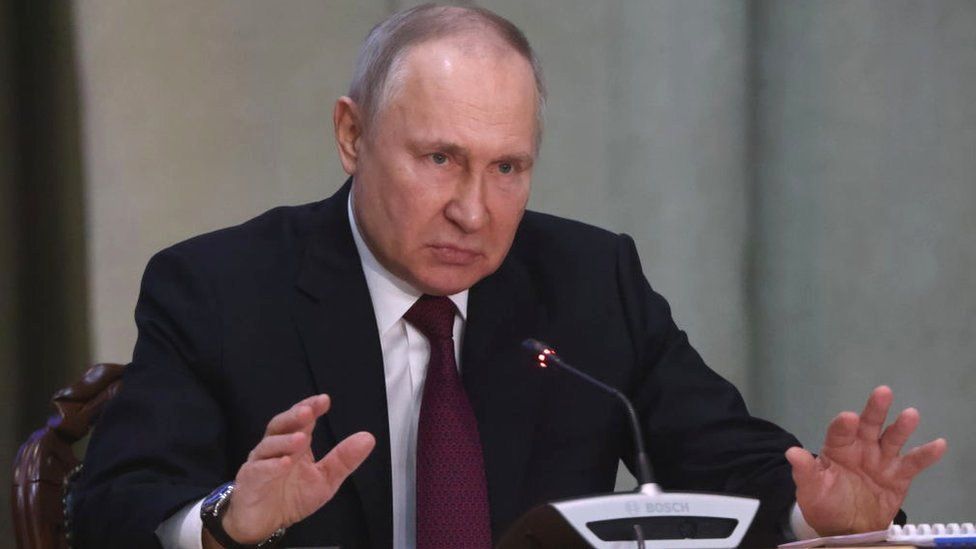
President Vladimir Putin now rules Russia virtually unchallenged. Many of the critical voices that once spoke out have since been forced into exile, while other opponents have been jailed – or in some cases killed.
By the time he launched his full-scale invasion of Ukraine in February 2022, more than two decades of stamping out dissent had all but annihilated opposition in Russia.
At the very start of President Putin’s rule, he brought to heel Russia’s powerful oligarchs – immensely rich people with political ambitions.
Mikhail Khodorkovsky, once head of the Russian oil giant Yukos, was arrested in 2003 and spent 10 years in prison for tax evasion and theft after funding opposition parties. Upon his release, he left Russia.
Boris Berezovsky, another oligarch who even helped bring Putin to power – fell out with him later and died in exile in the UK in 2013, reportedly by suicide.
All key media in Russia gradually fell under the control of the state or toed the official Kremlin line.
Alexei Navalny
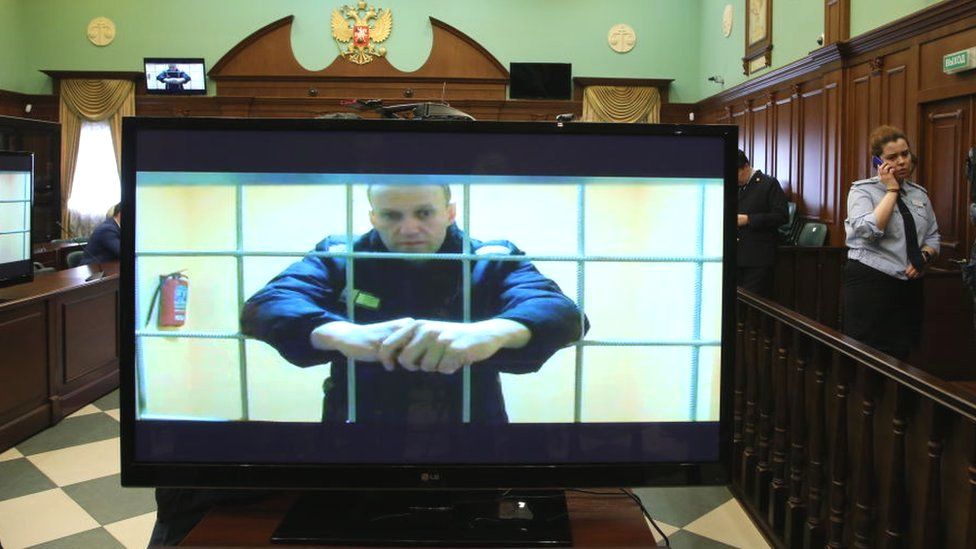
By far the most prominent opposition figure in Russia is now Alexei Navalny, who has accused Putin from jail of aiming to smear hundreds of thousands of people in his “criminal, aggressive” war.
In August 2020, Navalny was poisoned with Novichok, a military-grade nerve agent, while on a trip to Siberia. The attack nearly killed him, and he had to be flown to Germany for treatment.
In May 2022, Alexei Navalny unsuccessfully appealed against a nine-year prison sentence
His return to Russia in January 2021 briefly galvanised opposition protesters, but he was immediately arrested for fraud and contempt of court. He is now serving nine years in prison, and was the focus of an Oscar-winning documentary.
In the 2010s Navalny was actively involved in mass anti-government rallies and the many exposes by Navalny’s main political vehicle, the Anti-Corruption Foundation (FBK), have attracted millions of views online. In 2021 the foundation was outlawed as extremist and Navalny has repeatedly dismissed allegations of corruption as politically motivated.
Many of his associates have come under pressure from security services, and some have fled abroad, including former FBK head Ivan Zhdanov, former top FBK lawyer Lyubov Sobol and most, if not all, of the heads of the extended network of Navalny’s offices across Russia.
Navalny’s right-hand man Leonid Volkov left Russia when a money laundering case was launched against him in 2019.
Opposition to the war
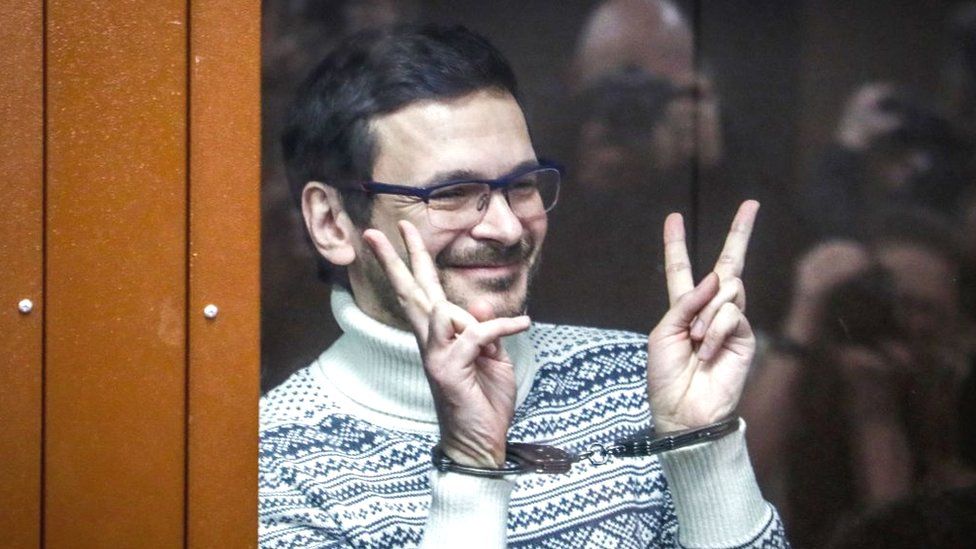
Another key Putin critic behind Russian bars is Ilya Yashin, who has been sharply critical of Russia’s war. In a live stream on YouTube in April 2022, he urged an investigation into possible war crimes committed by Russian forces and called President Putin “the worst butcher in this war”.
That live stream led to eight-and-a-half years in jail for violating a law against spreading “deliberately false information” about the Russian army. The law was rushed through parliament shortly after Russia invaded Ukraine on 24 February 2022.
Ilya Yashin was arrested in June 2022 after he condemned suspected Russian war crimes in the Ukrainian town of Bucha
Fighting for democracy
Kara-Murza was deputy chairman of Open Russia, a leading pro-democracy group set up by fugitive ex-oligarch Mikhail Khodorkovsky. It was officially designated as “undesirable” in Russia and finally closed in 2021. Open Russia’s head, Andrei Pivovarov, is serving a four-year jail sentence imposed for his involvement in an “undesirable organisation”.
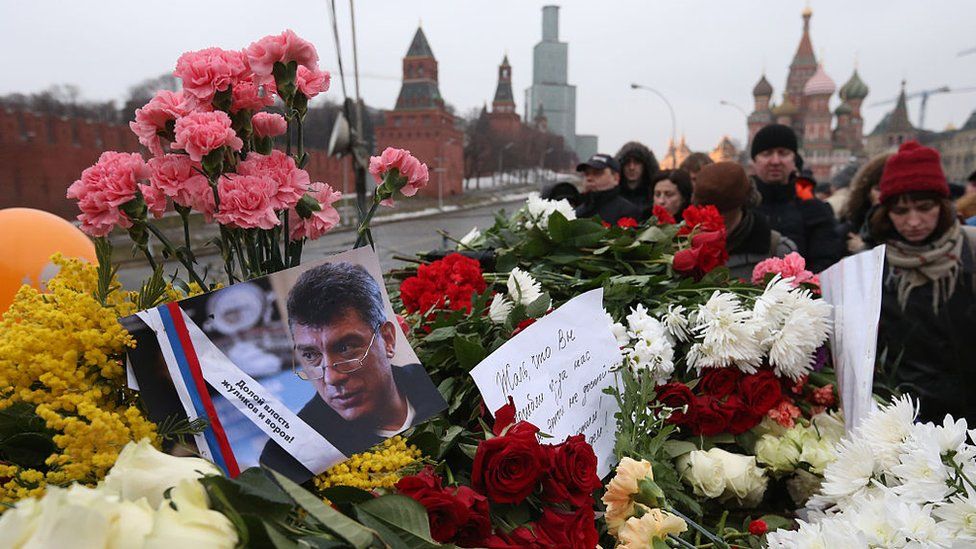
Kara-Murza may be facing a long prison sentence but at least he is alive, unlike close friend and key Russian opposition leader Boris Nemtsov.
Image caption,Boris Nemtsov was shadowed by an agent linked to a political assassination team for almost a year before he was shot dead
Before the Putin era, Nemtsov served as governor of Nizhny Novgorod region, energy minister and then deputy prime minister, and he was also elected to Russia’s parliament. Then he became increasingly vocal in his opposition to the Kremlin, and published a number of reports critical of Vladimir Putin and led numerous marches opposing him.
On 27 February 2015, Nemtsov was shot four times as he crossed a bridge outside the Kremlin, hours after appealing for support for a march against Russia’s initial invasion of Ukraine in 2014.
Five men of Chechen origin were convicted of Nemtsov’s murder, but there is still no clarity as to who ordered it or why. Seven years after his death, an investigation revealed evidence that in the months running up to the killing, Nemtsov was being followed across Russia by a government agent linked to a secret assassination squad.
These leading opposition figures are just a few of the Russians targeted for showing dissent.
Since the start of Russia’s full-scale invasion of Ukraine last year, independent media in Russia has seen further restrictions or threats. News channel TV Rain has had to move abroad, joining news site Meduza which had already left Russia. Novaya Gazeta remains in Moscow but has stopped publishing its newspaper. Others like talk radio station Echo of Moscow were closed by authorities.
Countless commentators have gone into exile, like veteran journalist Alexander Nevzorov, branded a “foreign agent” in Russia and sentenced to eight years in jail in absentia for spreading “fakes” against the Russian army.
But you do not have to have an audience of millions to be targeted. In March 2023, Dmitry Ivanov, a mathematics student who ran an anti-war Telegram channel, received an eight-and-a-half year prison sentence – also for spreading “fakes” about the army.
Meanwhile, single parent Alexei Moskalev was given a two year jail term for dissent on social media following an investigation sparked by an anti-war picture sketched by his 13-year-old daughter at school.
It took Vladimir Putin more than two decades to ensure no formidable opponents were free to challenge his power. If that was his plan, it’s worked.


 The MarkoZen Blog