Month: November 2022

The fireplace channel is back.
This mind numbing channel appears this time of year every year. It will go on until late February.
Who needs a real fireplace when there is a continuous one 24/7 on TV? And some guy keeps adding logs. The crackling sounds like firecrackers.
The Darien Gap
The Darién Gap is a break in the Pan-American Highway consisting of a large swath of undeveloped swampland and forest within Panama’s Darién Province in Central America and the northern portion of Colombia’s Chocó Department of South America. It measures just over 160 km (99 mi) long and about 50 km (31 mi) wide. Roadbuilding through this area is expensive, and the environmental toll is steep. Political consensus in favor of road construction has not emerged. Consequently there is no road connection through the Darién Gap connecting North/Central America with South America and it is the missing link of the Pan-American Highway.
The geography of the Darién Gap on the Colombian side is dominated primarily by the river delta of the Atrato River, which creates a flat marshland at least 80 km (50 mi) wide, half of this being swampland. The Serranía del Baudó occupy Colombia’s Pacific coast and extend into Panama. The Panamanian side, in sharp contrast, is a mountainous rainforest, with terrain reaching from 60 m (200 ft) in the valley floors to 1,845 m (6,053 ft) at the tallest peaks (Cerro Tacarcuna).
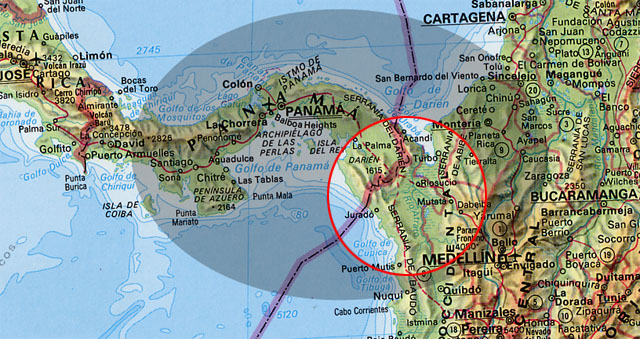
The Pan-American Highway is a system of roads measuring about 48,000 km (30,000 mi) long that crosses through the entirety of North, Central, and South America, with the sole exception of the Darién Gap. On the South American side, the highway terminates at Turbo, Colombia. On the Panamanian side, the road terminus is the town of Yaviza at. This marks a straight-line separation of about 100 km (60 mi). In between is marshland and forest.

Efforts have been made for decades to remedy this missing link in the Pan-American highway. Planning began in 1971 with the help of United States funding, but this was halted in 1974 after concerns raised by environmentalists. Another effort to build the road began in 1992, but by 1994 a United Nations agency reported that the road, and the subsequent development, would cause extensive environmental damage. There is evidence that the Darién Gap has prevented the spread of diseased cattle into Central and North America, which have not seen foot-and-mouth disease since 1954, and since at least the 1970s this has been a substantial factor in preventing a road link through the Darién Gap. The Embera-Wounaan and Kuna have also expressed concern that the road would bring about the potential erosion of their cultures. The gap has been crossed by adventurers on bicycle, motorbike, all-terrain vehicle, and foot, dealing with jungle, swamp, insects, and other hazards.
This place looks like a mosquito and snake infested hot box.

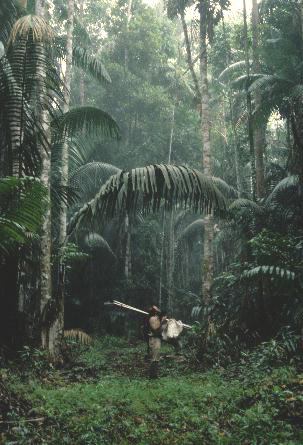
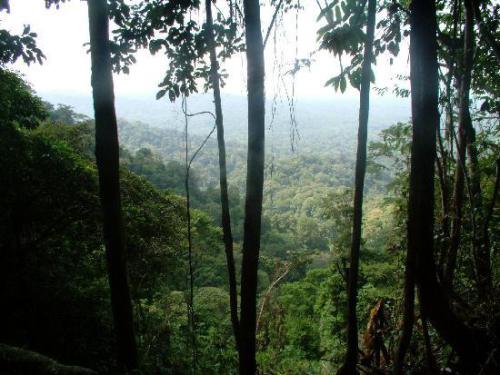
End of the road, Panama side.
Top Ten Zombie Killings


Oh, all I want to know
All I want
With just a touch of my burning hand
I send my astro zombies to rape the land
Prime directive, exterminate
The whole human race
And your face drops in a pile of flesh
And then your heart, heart pounds
Till it pumps in death
Prime directive, exterminate
Whatever stands left
All I wanted to say
And all I gotta do
Who’d I do this for
Hey, me or you
And all I wanted to say
And all I gotta do
Who’d I do this for
Hey, me or you
Oh, all I want to know
All I want
With just a touch of my burning hand
I’m gonna live my life to to destroy your world
Prime directive, exterminate
The whole fuckin’ race
Then your face drops in a pile of flesh
And then your heart, heart pounds
And it pumps in death
Prime directive, exterminate
The whole fuckin’ place well
All I wanted to say
And all I gotta do
Who’d I do this for
Hey, me or you
And all I wanted to say
And all I gotta do
Who’d I do this for
Hey, me or you
Oh, all I want to know
All I want to know
All I want to know
All I want oh
Go




The Flemish Giant Rabbit, Very Big Bunny
Often weighing in at more than 10 kilograms (22 lbs), the Flemish Giant is by far the largest rabbit breed in the world. They are also extremely docile creatures and make great pets.
Originally a utility breed raised in Flanders, Belgium for its fur and meat, the Flemish Giant eventually became a show breed, due to its high bone-to-meat ratio. Today, they are considered one of the most docile and tolerant rabbit breeds in the world and can make great pets, if raised correctly. According to breed standards, a well-developed Flemish Giant has a large head, long, erect ears, a long and powerful body, and a nicely rounded rump. Unsurprisingly, the world’s largest rabbit is a Flemish Giant rabbit that weighs 49 lb (22 kg) and measures 1.3 m (4 ft 3 in.)

Due to its large size, the Flemish Giant, the “king of rabbits”, requires substantial living quarters, as well as large quantities of food compared to other breeds of domesticated rabbits.

The Flemish Giant is a very old breed of domesticated rabbit that can be traced back to the 16th century. It is believed to have descended from a number of meat and fur breeds, including the Steenkonijn, or Belgian Stone Rabbit.

Although the breed received little international attention until about 1910, when it started appearing at small livestock shows, its impressive size made it stand out. Today, it is still bred for its meat and fur, but it is more popular as a companion. If treated correctly, these gentle giants are very docile even around small children.

Big Blast Off at Kennedy Space Center
The Space Launch System (abbreviated as SLS) is an American super heavy-lift expendable launch vehicle developed by NASA starting in 2011. The first launch, designated Artemis 1, occurred on November 16, 2022 from Kennedy Space Center. It replaces the Ares I and Ares V launch vehicles, which were cancelled along with the rest of the Constellation program, a previous program aimed to return to the Moon. The SLS is the successor to the retired Space Shuttle, and the primary launch vehicle of NASA’s deep space exploration plans through the 2020s. The SLS has the highest payload capacity of any currently operational launch vehicle and the second-highest capacity of any rocket ever to reach orbit, trailing the Saturn V. Crewed lunar flights are planned as part of the Artemis program, leading to a possible human mission to Mars. The SLS is being developed in three major phases with increasing capabilities: Block 1, Block 1B, and Block 2. As of August 2019, SLS Block 1 launch vehicles are to launch the first three Artemis missions and[29] five subsequent SLS flights are planned to use Block 1B, after which all flights will use Block 2.

Mysterious X-37B spaceplane returns to Earth after staggering long mission
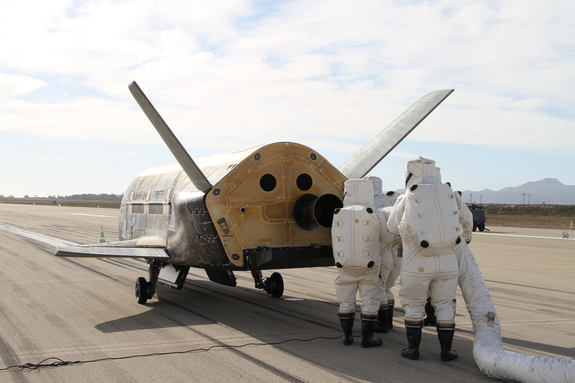
The U.S. military’s mysterious X-37B has returned to Earth following a record-setting 908 days in orbit around the planet, though what it was doing for all that time largely remains a closely guarded secret. The curious unmanned craft reportedly touched down at NASA’s Kennedy Space Center early Friday morning and was preceded by a pair of powerful sonic booms that rattled residents, who were left scratching their heads until the source of the sounds was ultimately revealed. The landing marked the conclusion of the X-37B’s sixth mission, which began when it was launched back in May of 2020.
While details surrounding the X-37B mission are somewhat scant, a U.S. Space Force press release touting the craft’s return gave some insight into some of the work that had been conducted during the 908 days it was orbiting the Earth. They revealed that one experiment aboard the space plane “successfully harnessed solar rays outside of Earth’s atmosphere and aimed to transmit power to the ground in the form of radio frequency microwave energy.” Meanwhile, a NASA study utilizing the craft’s marathon mission length looked at “the effect of long-duration space exposure on seeds.” The space plane’s 908 days in orbit smashed the record previously set by the X-37B fifth mission, which lasted 780 days.

 The MarkoZen Blog
