












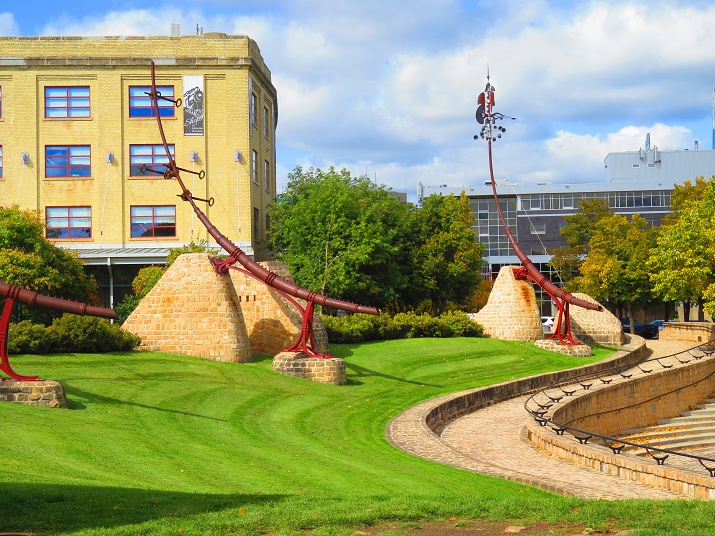

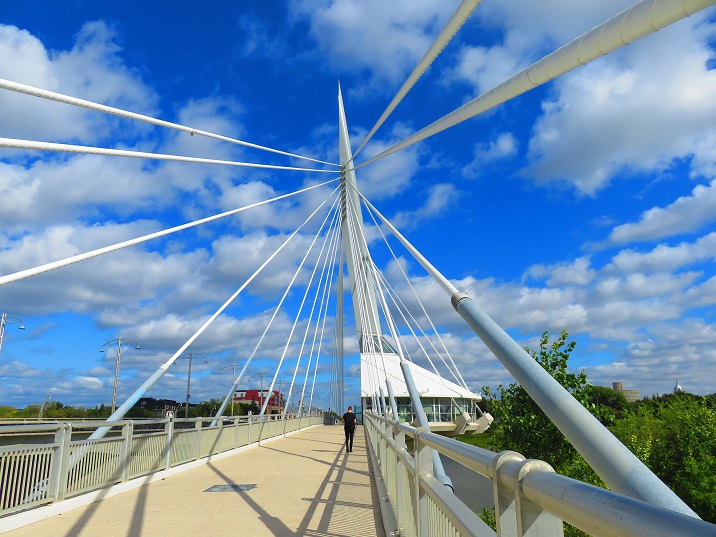



This fountain makes the most weird noises. Almost makes your stomach turn.


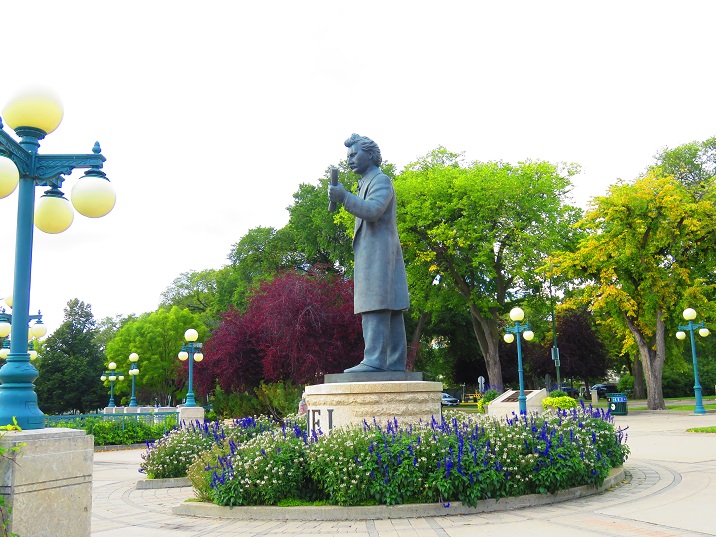
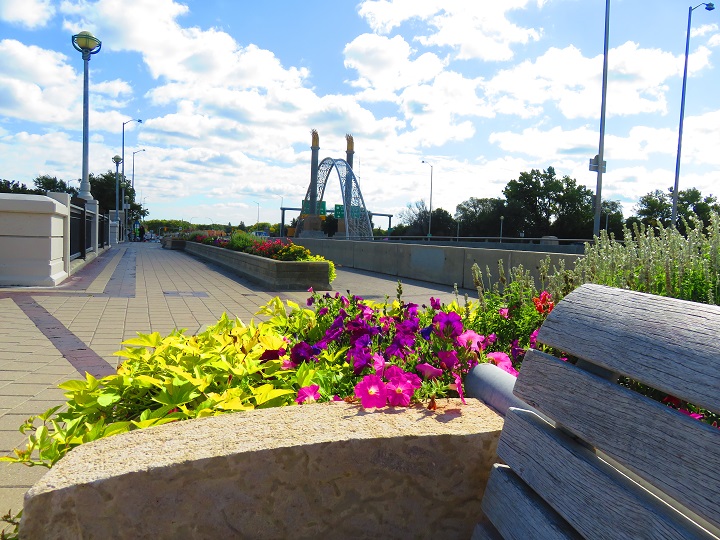


The Blue Lagoon geothermal spa is one of the most visited attractions in Iceland, and certainly always one of my favourite things to do when visiting the country. The spa is located in a lava field in Grindavik on the Reykjanes Peninsula, southwestern Iceland. Although it’s location looks like a setting from another planet, it’s surprisingly easy to reach. Just a 20 minute drive from Keflavik airport, and a 40 minute drive from Reykjavik.

Driving on Iceland’s smooth roads is an utter joy as the traffic is always extremely light. We find it always makes sense to plan a visit, either on your way into town, or on your way back to the airport. This time, having come to Reykjavik to see Yoko Ono switch on the Imagine Peace Tower (see here), we squeezed in a visit en route back to the airport.
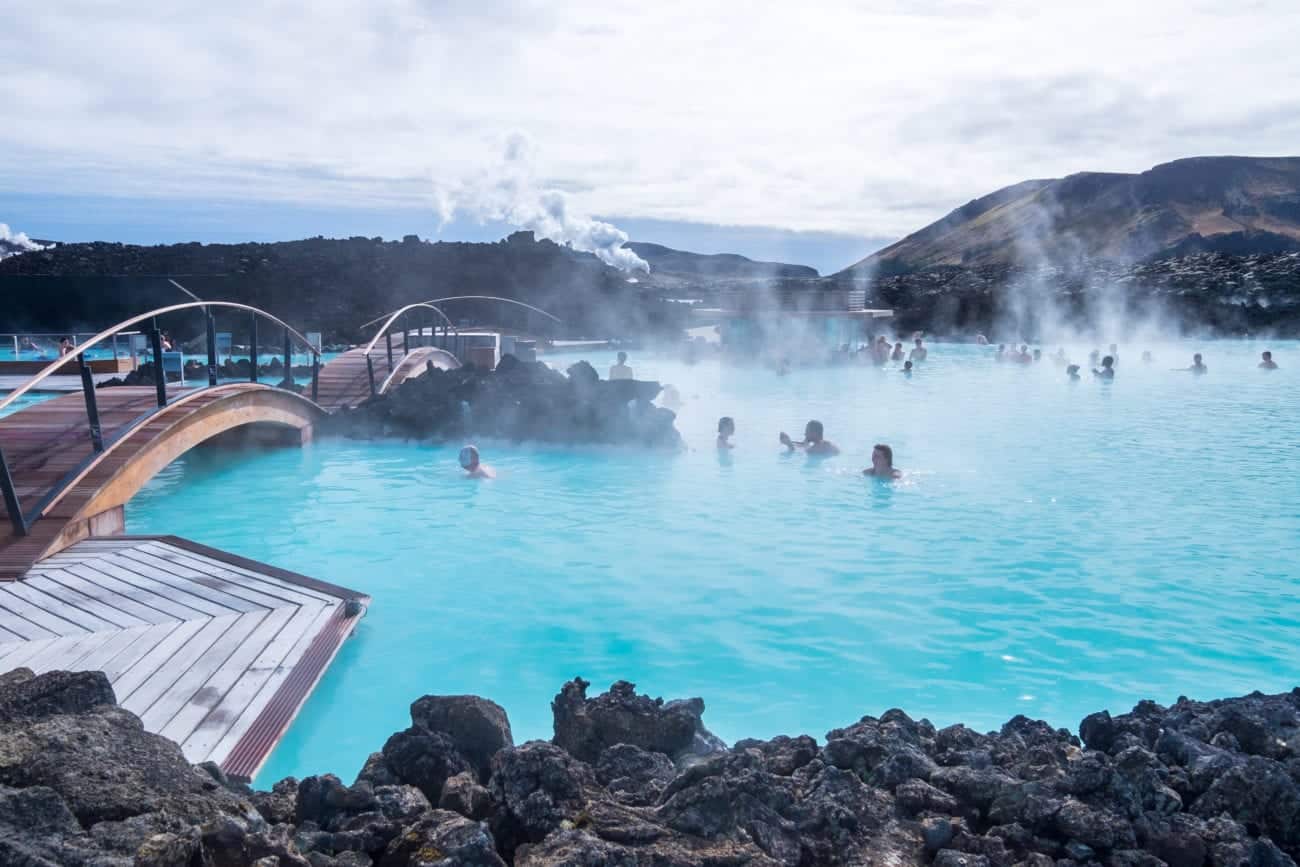
The warm water is a distinct milky blue colour due to its rich content of minerals such as silica and sulphur, which have been proven to help certain skin disorders, including psoriasis. In fact, the Blue Lagoon operates a research and development centre and clinic to help find cures for skin ailments using the mineral-rich water – which in the bathing areas – averages 37–39 °C. The separate clinic has 15 spacious double rooms and a private lagoon.

The lagoon is fed by the water output of the nearby geothermal plant and is renewed every two days. Superheated water is vented from the ground near a lava flow and used to run turbines that generate electricity. After going through the turbines, the steam and hot water passes through a heat exchanger to provide heat for a municipal water heating system. Then the water is fed into the lagoon for recreational and medicinal users to bathe in.


“Wienermobile” is a series of automobiles shaped like a hot dog on a bun which are used to promote and advertise Oscar Mayer products in the United States. The first version was created in 1936 by Oscar Mayer’s nephew, Carl G. Mayer, and variants are still used by the Oscar Mayer company today. Drivers of the Wienermobiles are known as Hotdoggers and often hand out toy whistles shaped as replicas of the Wienermobile, known as Wienerwhistles.


The Oscar Mayer Wienermobile has evolved from Carl Mayer’s original 1936 vehicle to the vehicles seen on the road today. Although fuel rationing kept the Wienermobile off the road during World War II, in the 1950s Oscar Mayer and the Gerstenslager Company created several new vehicles using a Dodge chassis or a Willys Jeep chassis. One of these models is on display at the Henry Ford Museum in Dearborn, Michigan. These Wienermobiles were piloted by “Little Oscar” (portrayed by George Molchan) who would visit stores, schools, orphanages, and children’s hospitals and participate in parades and festivals.
In 1969, new Wienermobiles were built on a Chevrolet motor home chassis and featured Ford Thunderbird taillights. The 1969 vehicle was the first Wienermobile to travel outside the United States. In 1976 Plastic Products, Inc., built a fiberglass and styrofoam model, again on a Chevrolet motor home chassis.
In 1988, Oscar Mayer launched its Hotdogger program, where recent college graduates were hired to drive the Wienermobile through various parts of the nation and abroad. Using a converted Chevrolet van chassis, Stevens Automotive Corporation and noted industrial designer Brooks Stevens built a fleet of six Wienermobiles for the new team of Hotdoggers.
With the 1995 version, the Wienermobile grew in size to 27 feet long and 11 feet high. The 2004 version of the Wienermobile includes a voice-activated GPS navigation device, an audio center with a wireless microphone, a horn that plays the Wiener Jingle in 21 different genres from Cajun to Rap to Bossa Nova, according to American Eats, and sports fourth generation Pontiac Firebird taillights.


There are currently eight active Wienermobiles, six of which are the full-sized familiar models (the other two are the Mini and the food truck versions) with each assigned a part of the country. The “hotdogger” position of driving the Wienermobile is open to U.S. citizens, and the job lasts from the first of June until the following first of June. Only college seniors who are about to graduate are eligible. Both current hotdoggers and Oscar Mayer recruiters visit college campuses across the country in search of the next round of hotdoggers. Candidates are screened from an average of 2000 applicants. Every March, a pool of thirty final-round candidates are brought to Kraft Foods and Oscar Mayer headquarters in Madison, Wisconsin, for interviews. Each vehicle can hold two hotdoggers, and twelve people are chosen. Currently there are about 300 hotdogger alumni.


They apparently come in all sizes.
300 Main Street. Winnipeg’s newest tall building. It is now the tallest building in the city at 450 feet and 40 stories. It is an apartment building.

Balconies at 400 feet up.

Somebody lost their boots.










The interior of the Orient Express. This long-distance passenger train was created in 1883.


On January 26, 1972, the JAT Yugoslav Airlines Flight 367 flying from Stockholm to Belgrade became the target of a terrorist attack. A suitcase bomb tucked inside the baggage compartment of the McDonnell Douglas DC-9-32 aircraft exploded when the airplane was cruising at an altitude of 33,000 feet over East Germany. The explosion tore through the fuselage of the narrow-body jetliner, breaking it apart into three pieces. The wreckage then crashed near the village of Srbská Kamenice in Czechoslovakia. Typically, there should have been no survivors, but this time around there was one—a flight attendant named Vesna Vulovic.
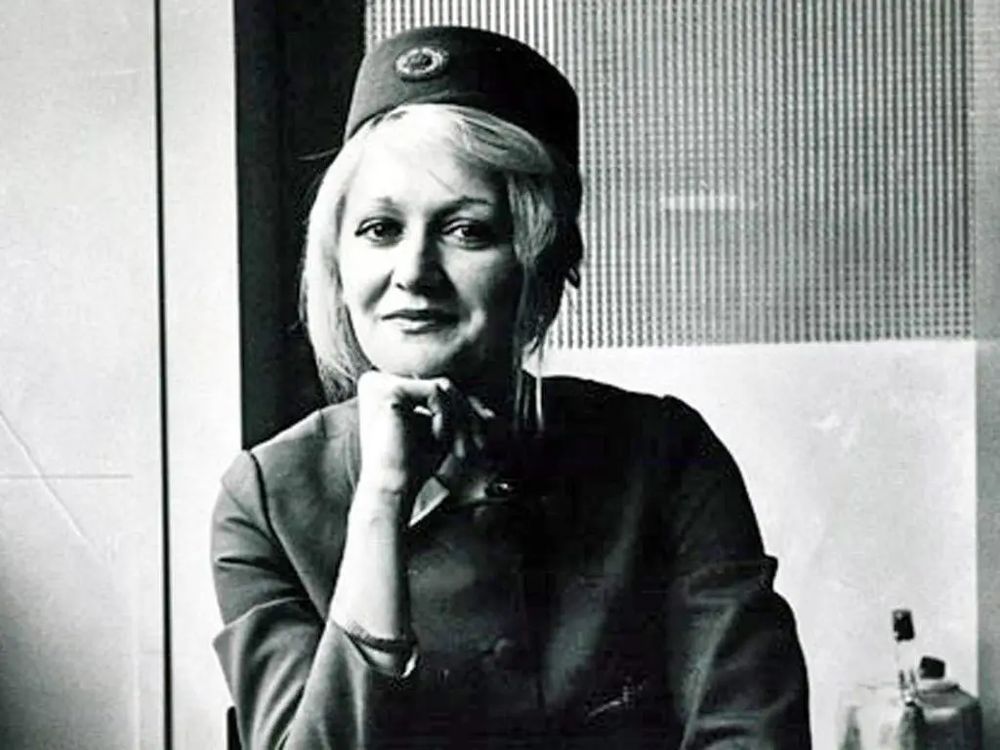
The 22-year old Serbian flight attendant Vesna Vulovic was part of the secondary cabin crew who boarded the airplane in Copenhagen, where the flight made a brief stopover en route to Belgrade. But Vulovic was not supposed to be on the doomed flight. Vulovic’s schedule got mixed up with that of another stewardess named Vesna, and she was subsequently placed on the wrong flight. Nevertheless, Vulović was happy for the mistake because it allowed her to travel to Denmark, a country she had never been to before.
At 4:01 pm, forty-six minutes after take off from Copenhagen Airport, the bomb placed in the baggage compartment went off, and the airplane broke apart. As the cabin depressurized, the passengers and other flight crew were sucked out of the plane into freezing temperatures and fell to their deaths. Vulovic miraculously got trapped inside one of the broken sections of the fuselage by a food cart, protecting her from frigid temperatures, as it plummeted towards the ground. The fuselage section with Vulovic trapped inside crash landed in thick snow in a heavily wooded area, which cushioned the impact.
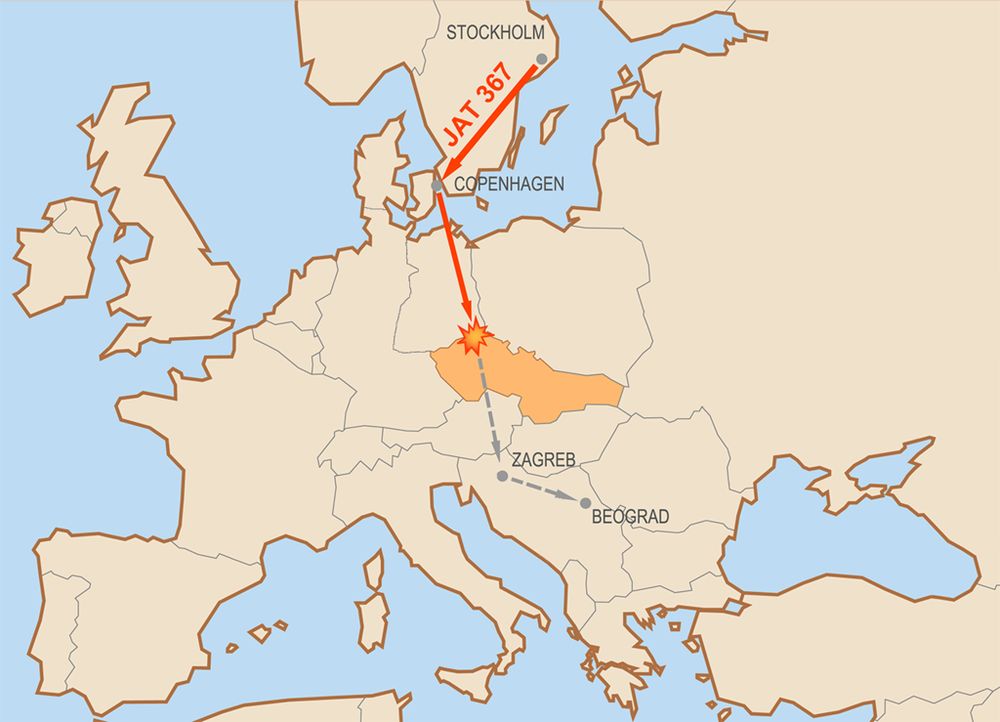
The route of flight JAT367. Image: Karel x/Wikimedia
A villager named Bruno Honke discovered Vulovic when he heard her screaming amid the wreckage. Honke had been a medic during World War II and was able to keep Vulović alive until rescuers arrived. She suffered a fractured skull, two broken legs, and three broken vertebrae, one of which was crushed completely. Her pelvis was fractured and several ribs were also broken. Her injuries resulted in her being temporarily paralyzed below the waist, and she spent several days in coma. Doctors later told her that her history of low blood pressure caused her to pass out quickly after the cabin depressurized and kept her heart from bursting on impact.
Vulovic couldn’t remember anything about her flight and the ordeal. The last thing she remembered was greeting passengers as they boarded. The next thing she remembered was seeing her parents in her hospital room about one month later. She had to be told that she survived a plane crash, and when shown a newspaper headline by her doctor, she reportedly fainted.

Photo: CTK / Alamy Stock Photo
After several surgeries, and ten months later, Vulovic was able to walk again although the accident left her with a permanent limp. By September 1972, and less than nine months after the incident, Vulovic was eager to go back to work, but JAT gave her a desk job instead, because they didn’t want Vulovic drawing too much publicity.
Back home, Vulovic became a national celebrity and received a decoration from Yugoslav President Josip Tito. The Serbian folk singer Miroslav Ilić even wrote a song in her honor. In 1985, Vulovic ended up in the Guinness Book of World Records for surviving the highest fall without a parachute, at 10,160 meters (33,330 feet).
For decades after the crash, Vulovic struggled with survivor’s guilt. “Whenever I think of the accident, I have a prevailing, grave feeling of guilt for surviving it and I cry … Then I think maybe I should not have survived at all,” she told The Independent in 2012. Vulovic declined therapy to help cope with her experiences and instead turned to religion, becoming a devout Orthodox Christian. She stated that her ordeal had turned her into an optimist. “If you can survive what I survived, you can survive anything,” she said.
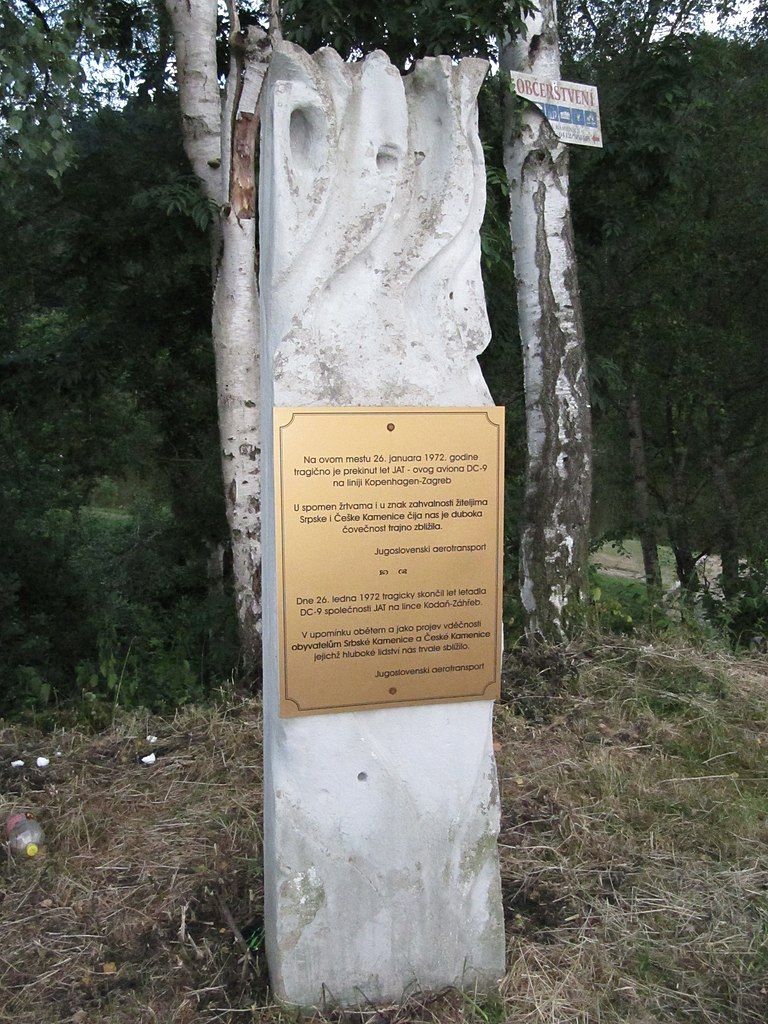
Monument to victims of the Yugoslav aircraft tragedy of 1972, in Srbská Kamenice. Photo: palickap/Wikimedia
When she was asked whether she considered herself lucky, she replied: “No, I’m not. I’m not lucky. Everybody thinks I am lucky, but they a mistaken. If I were lucky I would never had this accident and my mother and father would be alive. The accident ruined their lives too.”
Vulovic became a political activist in later life, that cost her her job—she was fired from JAT for speaking out against Serbian statesman Slobodan Milošević and taking part in anti-government protests. She avoided arrest because the government was concerned about the negative publicity that her imprisonment would bring. She later campaigned on behalf of the Democratic Party and advocated for Serbia’s entry into the European Union, which she believed would bring economic prosperity.
Vesna Vulovic died in 2016 at the age of 66.












 The MarkoZen Blog

