Drugs tunnel connecting US and Mexico found

Drugs tunnel
The cross-border passage was described as “sophisticated” by prosecutors

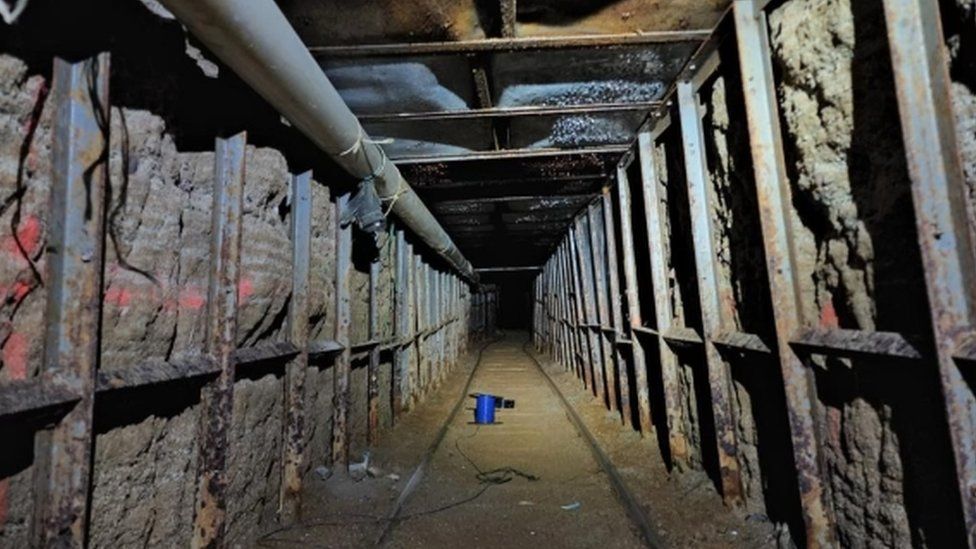
A huge drugs tunnel has been found running from Tijuana in Mexico to a warehouse in San Diego in the US.

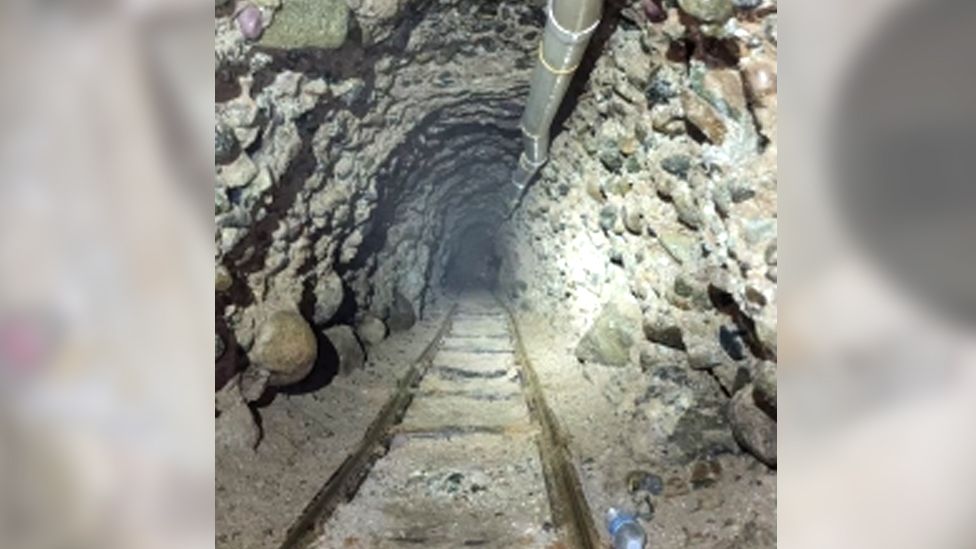
With a length of 1,744ft (531m), the passage had a rail track, electricity and a ventilation system.

US authorities had been carrying out surveillance at a property previously used as a stash house for smuggling cocaine when they made the discovery.

They seized cocaine, methamphetamine and heroin. Six people are being held on drug-trafficking charges.
Drugs tunnel
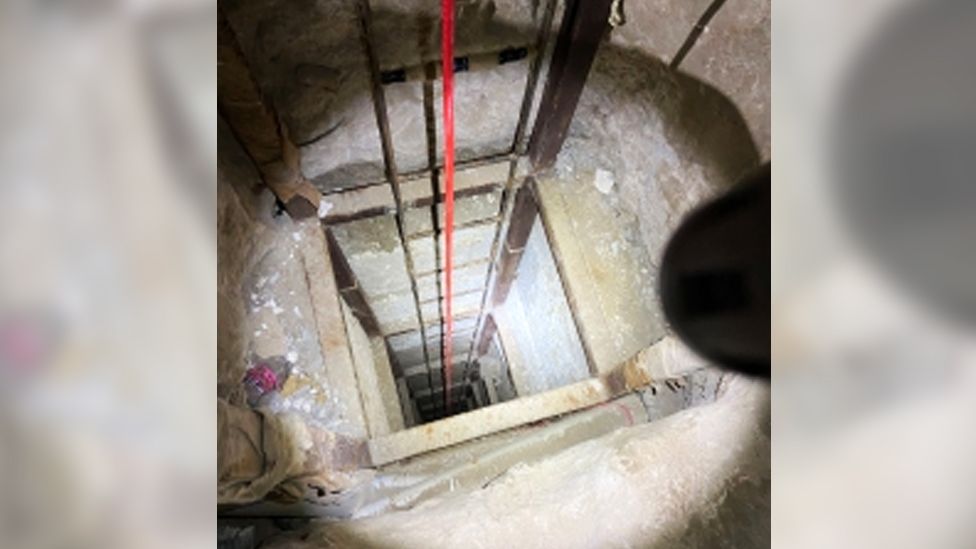
Image caption,A similar tunnel to this (but much longer) was discovered in 2020

The US Attorney’s Office for the Southern District of California said the tunnel was 61ft (18m) deep and 4ft (1m) in diameter.

Prosecutors say that before the discovery, officers saw several vehicles come and go from the property in Tijuana and the warehouse on Friday 13 May.

They were then stopped and searched, the drugs were seized and arrests were made.

When officers entered the warehouse, the cross-border tunnel exit point was found carved out of the floor.
Drugs tunnel
Image caption,A rail track runs through the tunnel

The attorney’s office said 1,762lb (799 kg) of cocaine, 164lb (74kg) of methamphetamine and 3.5lb (1.5kg) of heroin had been seized.

The suspects, aged between 31 and 55, could face a life sentence in prison and a $1m fine if found guilty.

“There is no more light at the end of this narco-tunnel,” said US Attorney Randy Grossman.

“We will take down every subterranean smuggling route we find to keep illicit drugs from reaching our streets and destroying our families and communities.”

The last tunnel found in California was in 2020. That one is also the longest to date, measuring 4,309ft (1,313m) in length. Since 1993, 90 of these types of secret passage have been discovered.

Drugs seized in the tunnel operation

A picture of the drugs seized during this investigation

BBC

Car Racetrack on the roof!

Lingotto is a district of Turin, Italy, and the location of the Lingotto building in Via Nizza. This building once housed an automobile factory built by Fiat. Construction started in 1916 and the building opened in 1923. The design (by young architect Matté Trucco) was unusual in that it had five floors, with raw materials going in at the ground floor, and cars built on a line that went up through the building. Finished cars emerged at rooftop level, where there was a rooftop test track. It was the largest car factory in the world at that time. For its time, the Lingotto building was avante-garde, influential and impressive—Le Corbusier called it “one of the most impressive sights in industry”, and “a guideline for town planning”. 80 different models of car were produced there in its lifetime, including the Fiat Topolino of 1936.

Fiat_Lingotto_Rooftop_Racetrack_2

fiat5

The factory became outmoded in the 1970s and the decision was made to finally close it in 1982. The closure of the plant led to much public debate about its future, and how to recover from industrial decline in general. An architectural competition was held, which was eventually awarded to Renzo Piano, who envisioned an exciting public space for the city. The old factory was rebuilt into a modern complex, with concert halls, theatre, a convention centre, shopping arcades and a hotel. The eastern portion of the building is the headquarter of the Automotive Engineering faculty of the Polytechnic University of Turin. The work was completed in 1989. The track was retained, and can still be visited today on the top floor of the shopping mall and hotel.

fiat

fiatlingotto
Fiat_Lingotto_Rooftop_Racetrack_1

Weird Facts

I fact checked all of these using Snopes.com and Wikipedia and they seem to be accurate.

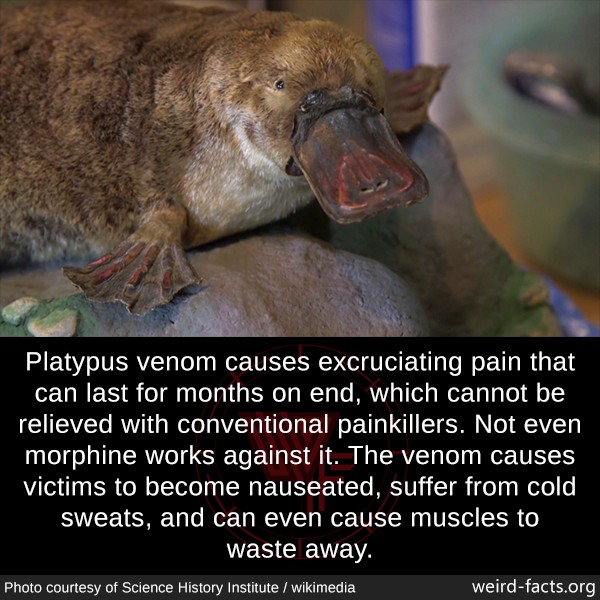
The platypus is one of the few living mammals to produce venom. The venom is made in venom glands that are connected to hollow spurs on their hind legs; it is primarily made during the mating season. While the venom’s effects are described as extremely painful, it is not lethal to humans.

The different chemicals in the venom have a range of effects from lowering blood pressure to causing pain and increasing blood flow around the wound. Coagulating effects have been seen during experiments on laboratory animals, but this has not been observed consistently. Unlike snake venom, there appears to be no necrotising component in the platypus’s venom. While some muscle wastage has been observed in cases of envenomation in humans, it is likely due to the inability to use the limb while the effects of the venom persist. It is unknown whether the pain caused is a result of the associated edema around the wound or the venom has a component that acts directly on the pain receptors.

Although powerful enough to paralyse smaller animals, the venom is not lethal to humans. Yet, it produces excruciating pain that may be intense enough to incapacitate a victim. Swelling rapidly develops around the entry wound and gradually spreads outward. Information obtained from case studies shows that the pain develops into a long-lasting hyperalgesia that can persist for months but usually lasts from a few days to a few weeks. A clinical report from 1992 showed that the severe pain was persistent and did not respond to morphine.

In 1991 Keith Payne, a former member of the Australian Army and recipient of the Victoria Cross (Australia’s highest award for valour), was struck on the hand by a platypus spur while trying to rescue the stranded animal. He described the pain as worse than being struck by shrapnel. A month later he was still experiencing pain in that hand. In 2006, Payne reported discomfort and stiffness when carrying out some physical activities such as using a hammer. Wikipedia.

Ray Harryhausen: The Film-Maker Who Made The Impossible Possible  

Dangerous Minds

If it wasn’t a monster movie, then it wasn’t worth watching. That was my narrow view of films when I was a child. There was the usual list of werewolves, and vampires, and stitched-together cadavers from Frankenstein’s lab, but there was nothing quite as thrilling as seeing Ray Harryhausen’s name on a film.

Harryhausen’s name meant memorable special effects that made any film extraordinary. Before VHS or DVD recorders, we memorized those key scenes to replay in our heads, and discuss at our leisure. The ghoulish, resurrected skeletons that fought Jason and the Argonauts; the Rhedosaurus that tore up New York in The Beast from 20,000 Fathoms; the Terradactyl  that terrorized Raquel Welch in One Million Years B.C.; the sinewed goddess Khali that fought Sinbad; these were memories that made many a childhood special – mine included.

It was seeing the original version of King Kong that started Harryhausen off on his career. His ability to duplicate some of Willis O’Brien’s groundbreaking effects led the young Harryhausen to meet and then work with his idol on Mighty Joe Young, in 1949. Their collaboration won an Oscar, and set Harryhausen off on his career.

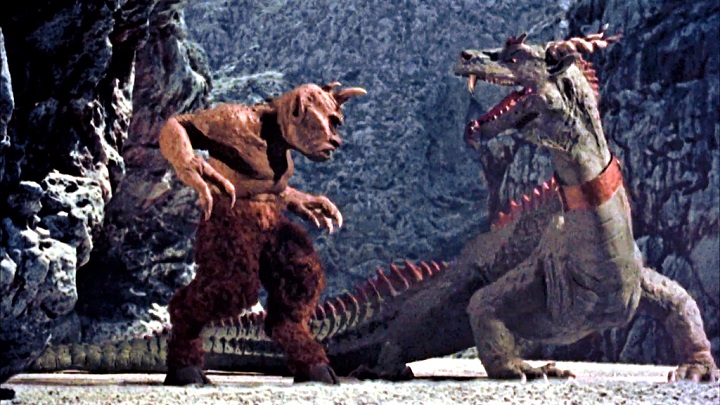
The Cyclops and Dragon battle sequence from The 7th Voyage of Sinbad (1958)

Raymond Frederick Harryhausen (June 29, 1920 – May 7, 2013) was an American animator and special effects creator who created a form of stop motion model animation known as “Dynamation”. His works include the animation for Mighty Joe Young (1949) with his mentor Willis H. O’Brien (for which the latter won the Academy Award for Best Visual Effects); his first color film, The 7th Voyage of Sinbad (1958); and Jason and the Argonauts (1963), which featured a sword fight with seven skeleton warriors. His last film was Clash of the Titans (1981), after which he retired.

Hotel of Doom 

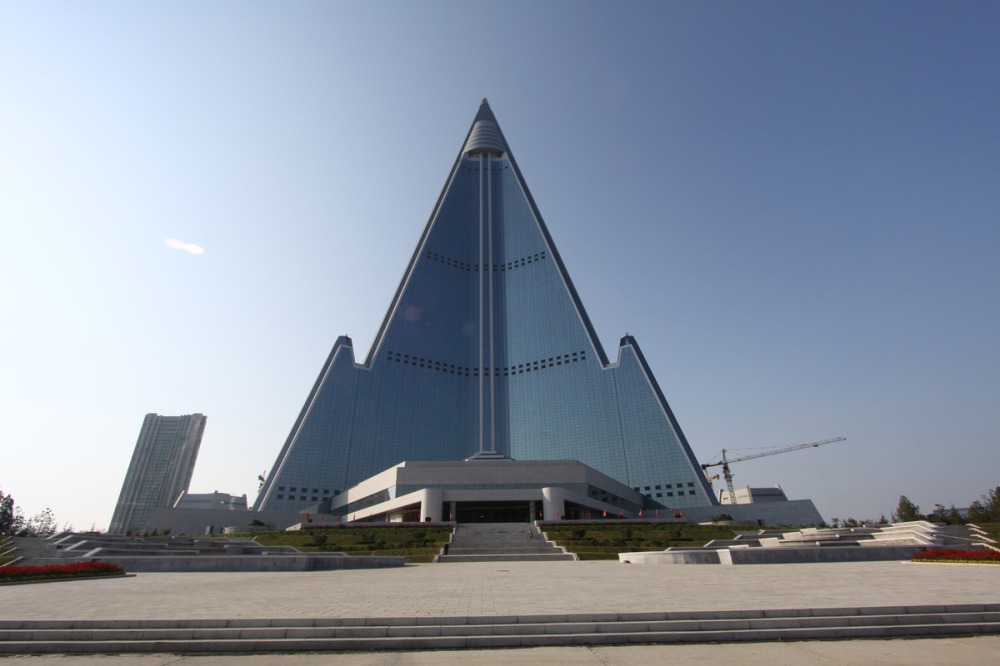
The Ryugyong Hotel (Korean: 류경호텔; sometimes spelled as Ryu-Gyong Hotel), or Yu-Kyung Hotel, is an unfinished 105-story, 330-metre-tall (1,080 ft) pyramid-shaped skyscraper in Pyongyang, North Korea. Its name (“capital of willows”) is also one of the historical names for Pyongyang. The building is also known as the 105 Building, a reference to its number of floors. The building has been planned as a mixed-use development, which would include a hotel.

Construction began in 1987 but was halted in 1992 as North Korea entered a period of economic crisis after the dissolution of the Soviet Union. After 1992, the building stood topped out, but without any windows or interior fittings. In 2008, construction resumed, and the exterior was completed in 2011. The hotel was planned to open in 2012, the centenary of Kim Il-sung’s birth. A partial opening was announced for 2013, but this was cancelled. In 2018, an LED display was fitted to one side, which is used to show propaganda animations and film scenes.

Pictures have emerged showing the inside of a 105-storey pyramid-shaped hotel that has been under construction in Pyongyang for 25 years.

North Korea began building the Ryugyong hotel in 1987, but construction was halted for 16 years when funds ran out.

Although work restarted in 2008, the hotel has become, for many, a symbol of North Korea’s thwarted ambitions.

The tour company that took the pictures say the hotel is now due to open in two or three years time.

Few people have been allowed inside the notorious hotel, which has been variously dubbed the “The Hotel of Doom” or “The Phantom Hotel”.

When conceived, the Ryugyong was intended to communicate to the world an impression of North Korea’s burgeoning wealth.

But other economic priorities meant that the hotel had to be put to one side, and it remained untouched until a city-wide “beautification scheme” was introduced five years ago.

At that time, external construction was forecast to take until the end of 2010, with work on the inside being completed in 2012 at the earliest.

But the photo of the interior taken by Koryo Tours, a Beijing-based company that specialises in travel to North Korea, shows a vast concrete lobby with barriers around the edge of each floor.

The bare interior has no sign of cabling, wiring or pipes, let alone furnishings

General information
StatusOn hold
Architectural styleNeo-futurism
LocationRyugyong-dong, Potonggang-guyokPyongyangNorth Korea
Coordinates39°02′12″N 125°43′51″ECoordinates39°02′12″N 125°43′51″E
Construction started28 August 1987[
Topped-out1992
Estimated completionUnknown
(Exterior construction completed: 14 July 2011[2])
Height
Roof330.02 metres (1,082.7 ft)
Technical details
Floor countAbove ground 105, Underground 3
Floor area360,000 m2 (3,900,000 sq ft)