Mäusebunker: Berlin’s Mouse Bunker

This is one very very strange looking building.

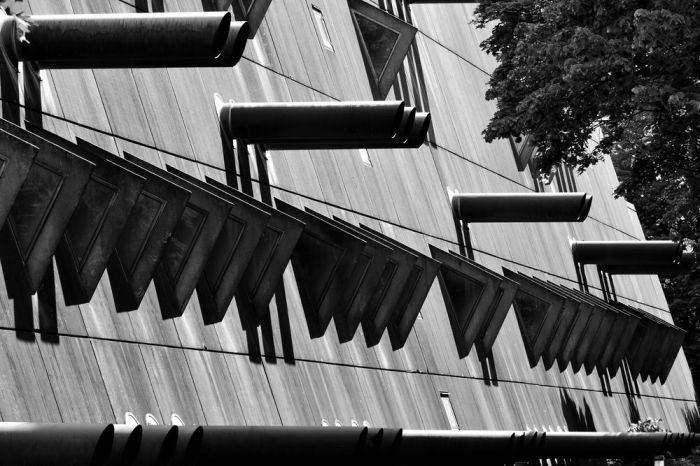
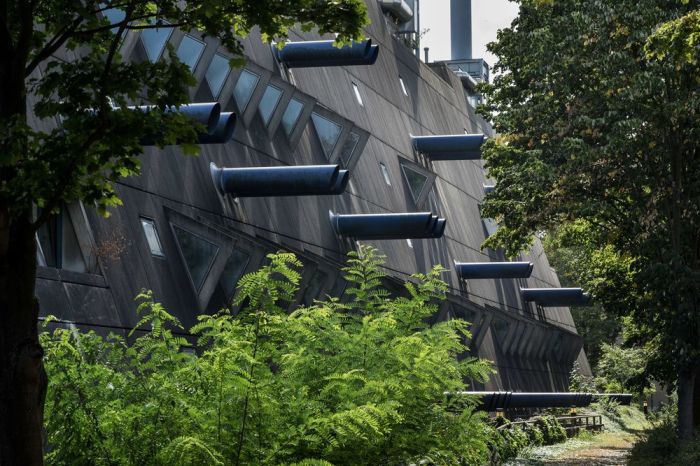
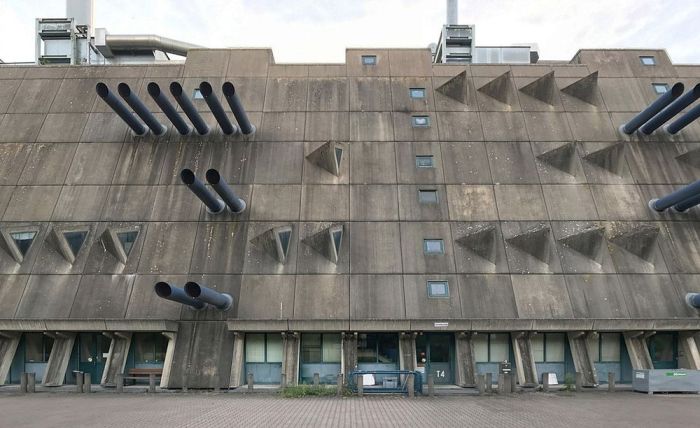
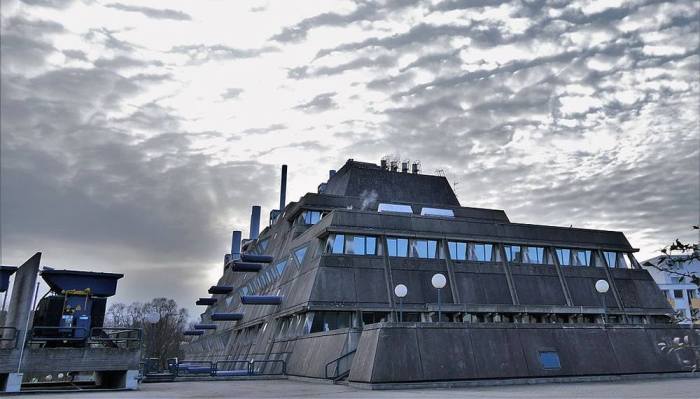
Sitting squarely in the middle of Berlin is a monstrous-looking building with façade of solid grey concrete, punctured by long ventilation turrets that sticks out in all direction like some sort of a beached battleship. This is Mäusebunker, or “Mouse Bunker”, a Brutalist former animal research laboratory that at some point held over 45,000 mice and 20,000 rats along with a variety of other rodents.

Officially the Central Animal Laboratory of the Free University of Berlin, the Mäusebunker was completed in 1981 as part of the Institute for Hygiene and Microbiology. It’s connected to the latter via an underground tunnel. The sinister-looking building was designed by the husband-and-wife duo of Gerd and Magdalena Hänska. Construction of the bunker began in 1971, and would have been completed at least three years earlier if cost had not gone spiraling out of control.

Mäusebunker


The Mäusebunker was built to look like a fortress, although it is more often compared to a warship because of its inclined walls and blue-painted ventilation shafts that protrude from the sides like cannon barrels. The roof is crowned by several large chimneys, and on the side facing the Institute for Hygiene and Microbiology, there are rows of recessed windows that give the impression of a command bridge. The German Architecture Museum in Frankfurt once called Mäusebunker “the most sinister building of German post-war modernism.”

The use of the building is just as uncanny as the threatening appearance of the building: The mouse bunker was built by the Free University to carry out scientific experiments with live animals and to breed the animals required for this on site. For safety reasons, the animal testing laboratories are located deep in the building and are ventilated with cannon-like air intake pipes.

Mäusebunker

The building was closed in 2010, and since then has been lying vacant. It was long derided as an eyesore and was slated for demolition, along with the Institute for Hygiene and Microbiology building that stands nearby. But a few years ago a couple of residents, architects and other activists launched a campaign against its destruction and successfully stalled the demolition. The building will now be reviewed to explore reuse options.


Mäusebunker


Mäusebunker


Mäusebunker


Mäusebunker

Why The Soviet Union Exchanged Warships For Pepsi

The American soft drink giant Pepsi has a long presence in Russia dating back to the early 1970s when Russia was still a part of the Soviet Union. It was the first capitalistic product to gain entry into the communist market. At that time rivalry between the two countries was high, so how did an American soft drink company get its foot in the door to build a major market in Russia?

Bottles of Soviet Pepsi at a Moscow-based plant, 1991. Photo: Vladimir Akimov/Sputnik

The story of how Pepsi came to be sold widely in Russia began in 1959, when the then-Vice President Richard Nixon came visiting the Soviet Union for an exhibition in Sokolniki Park, Moscow, and met with Soviet leader Nikita Khrushchev. The American National Exhibition was organized to promote American art, fashion, cars, and capitalism. Among many other things, the exhibition featured an entire model American house filled with modern conveniences and recreational devices such as washing machine, vacuum cleaners and color television. It was there, standing inside the mock-up of an American kitchen, the two leaders had a heated debate on the merits and demerits of communism and capitalism.

“You plan to outstrip us, particularly in the production of consumer goods. If this competition is to do the best for both of our peoples and for people everywhere, there must be a free exchange of ideas,” Nixon told Khrushchev. Later, Nixon led Khrushchev over to a booth dispensing Pepsi and gave Khrushchev a glass of the brown, fizzy, sugary drink that the Russian had never tasted before.

Richard Nixon and Nikita Khrushchev at the infamous “Kitchen Debate.” Photo: National Archives

The Pepsi booth had two different versions of the drink—one made with American water and another made with Russian water. Khrushchev declared that the one made with Russian water was clearly superior and “quite refreshing”. As Khrushchev drank he insisted that his Russian colleagues around him partake in the sugary tonic, and photographers surrounding the small group fired off their flash bulbs.

No amount of advertising spend could have brought Pepsi this much publicity what these photographs brought when they were published all over America and Soviet Russia. It eventually catapulted Kendall from an executive at the Pepsi-Cola Corporation to the company’s CEO in 1965.

Kendall did play a larger role in the events of 1959 than the photos implied. Nixon bringing Khrushchev to the Pepsi fountain and Kendall serving the addictive drink to the Soviet leader was not an impromptu move, after all. It was Kendell’s idea, and so was Pepsi’s participation at the exhibition against the wishes of his superiors, who felt that trying to sell an American product to a Communist country was wastage of effort and money. The night before, Kendall met with Nixon, with whom he shared a long-term friendship, and told him that he “had to get a Pepsi in Khrushchev’s hand.”
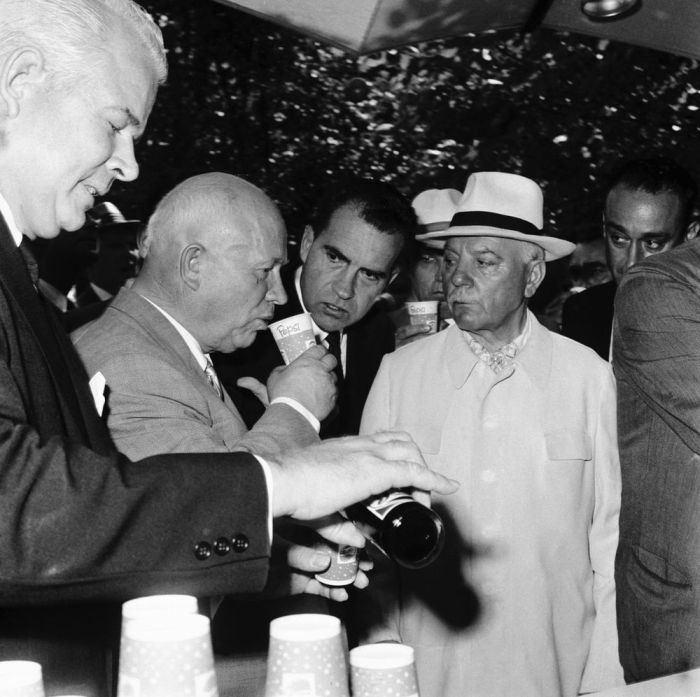
Nikita Khrushchev takes a sip of Pepsi in 1959 at the U.S. National Exhibition in Moscow, while U.S. Vice President Richard Nixon watches and Donald Kendall pours another glass. Photo: Fai/Legion Media

Thirteen years later, in 1972, Kendall scored an exclusive deal with the the Soviet Union shutting out Coke from the communist market. There was, however, a snag—Soviet currency was worthless outside the USSR, because the Soviet ruble did not function like a real currency in a market economy, but more like tokens or company vouchers because the value of the currency was determined by the government and not by market forces. As a result, Kendall had to use an alternative method of payment—the good old barter system.

It was decided that in exchange for the manufacture and sale of Pepsi in the Soviet Union, Pepsi would obtain exclusive distribution rights for Stolichnaya vodka in the US. The company would profit only from vodka sales in the US. It was not to receive any benefit from Pepsi sales in the Soviet Union.

A salesman shows a bottle of Stolichnaya vodka. Photo: Getty Images

Pepsi’s market grew by leaps and bounds and by the late 1980s, the company had more than twenty bottling plants in the USSR, and the Russians were drinking one billion servings a year—far more than the Americans were drinking Stolichnaya vodka. The American vodka market being limited, Kendall began to look for other Soviet products to procure in exchange of Pepsi. What about decommissioned warships? the Soviet Union suggested.

So in 1989, Kendall signed a new agreement, according to which the Soviets would transfer to PepsiCo an entire armada consisting of 17 submarines, a cruiser, a frigate, and a destroyer. Some joked that at that point in time Pepsi owned the world’s sixth largest Navy. On the contrary, these vessels were hardly sea worthy. Pepsi quickly sold them for scrap. Each submarine fetched them $150,000.

“We’re disarming the Soviet Union faster than you are,” Kendall once quipped to Brent Scowcroft, President George H.W. Bush’s national security adviser.
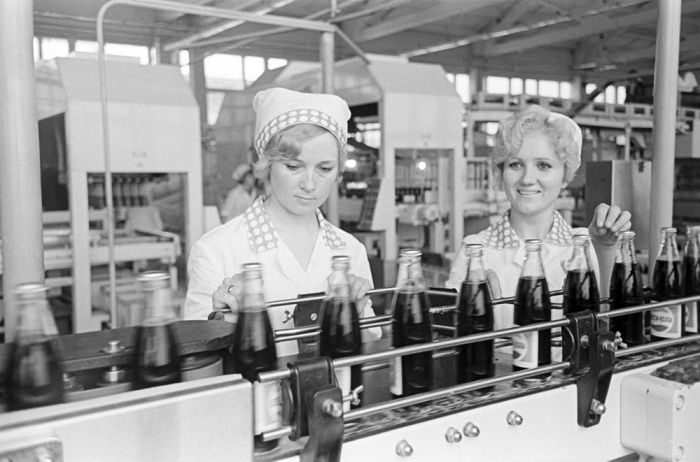
Workers inspect Pepsi bottles at a bottling plant somewhere in the Soviet Union. Photo: N. Arkhangelskiy/Sputnik

The following year, PepsiCo signed an even bigger deal with the Soviet Union, amounting to USD 3 billion worth of soda. As payment, the Soviet Union would build at least 10 ships, mostly oil tankers, which would be sold or leased by PepsiCo on the international market. The deal would have doubled PepsiCo’s sale of its sugary drink in Russia to nearly a billion dollars. A year later, the Soviet Union broke up and the deal fell though.

Russia is still Pepsi’s second biggest market outside of the United States, but most Russians today prefer to drink Coca-Cola instead. Pepsi has a market share of only 18 percent (as of 2013), against their rival Coca-Cola which holds twice as much. Pepsi now sells less than many domestic beverages.

Teenagers celebrate the end of school, Moscow, 1981. Photo: Ivan Vtorov
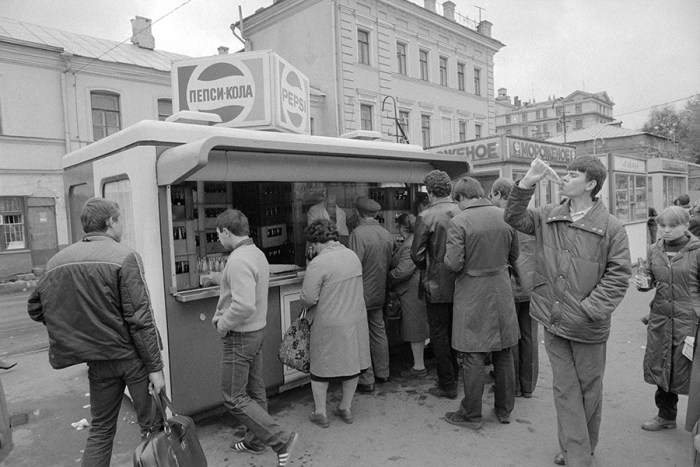
A Pepsi stand in Moscow, 1983. Photo: Getty Images

The Impenetrable Darien Gap

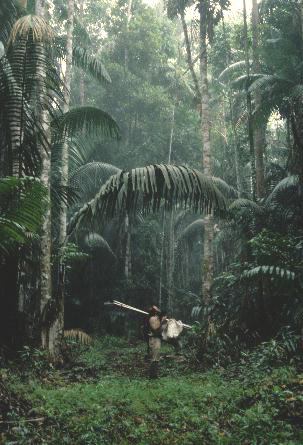
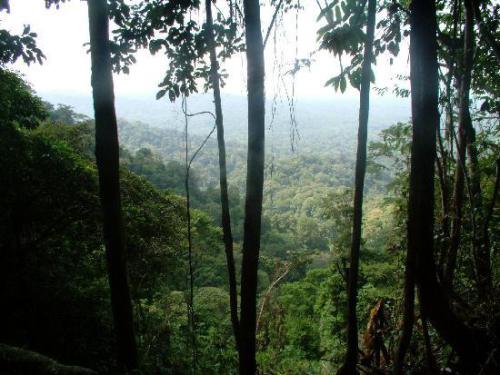
The Darién Gap is a break in the Pan-American Highway consisting of a large swath of undeveloped swampland and forest within Panama’s Darién Province in Central America and the northern portion of Colombia’s Chocó Department of South America. It measures just over 160 km (99 mi) long and about 50 km (31 mi) wide. Roadbuilding through this area is expensive, and the environmental toll is steep. Political consensus in favor of road construction has not emerged. Consequently there is no road connection through the Darién Gap connecting North/Central America with South America and it is the missing link of the Pan-American Highway.

The geography of the Darién Gap on the Colombian side is dominated primarily by the river delta of the Atrato River, which creates a flat marshland at least 80 km (50 mi) wide, half of this being swampland. The Serranía del Baudó occupy Colombia’s Pacific coast and extend into Panama. The Panamanian side, in sharp contrast, is a mountainous rainforest, with terrain reaching from 60 m (200 ft) in the valley floors to 1,845 m (6,053 ft) at the tallest peaks (Cerro Tacarcuna).

darien


The Pan-American Highway is a system of roads measuring about 48,000 km (30,000 mi) long that crosses through the entirety of North, Central, and South America, with the sole exception of the Darién Gap. On the South American side, the highway terminates at Turbo, Colombia. On the Panamanian side, the road terminus is the town of Yaviza at. This marks a straight-line separation of about 100 km (60 mi). In between is marshland and forest.

darien PanAmericanHwy

Efforts have been made for decades to remedy this missing link in the Pan-American highway. Planning began in 1971 with the help of United States funding, but this was halted in 1974 after concerns raised by environmentalists. Another effort to build the road began in 1992, but by 1994 a United Nations agency reported that the road, and the subsequent development, would cause extensive environmental damage. There is evidence that the Darién Gap has prevented the spread of diseased cattle into Central and North America, which have not seen foot-and-mouth disease since 1954, and since at least the 1970s this has been a substantial factor in preventing a road link through the Darién Gap. The Embera-Wounaan and Kuna have also expressed concern that the road would bring about the potential erosion of their cultures. The gap has been crossed by adventurers on bicycle, motorbike, all-terrain vehicle, and foot, dealing with jungle, swamp, insects, and other hazards.


This place looks like a mosquito and snake infested hot box.

darien gapxx

Darien_National_Park

darien-gap-01

End of the road, Panama side.

darien1

Entrepreneur Robert Bigelow Offers Nearly $1 Million for Evidence of the Afterlife

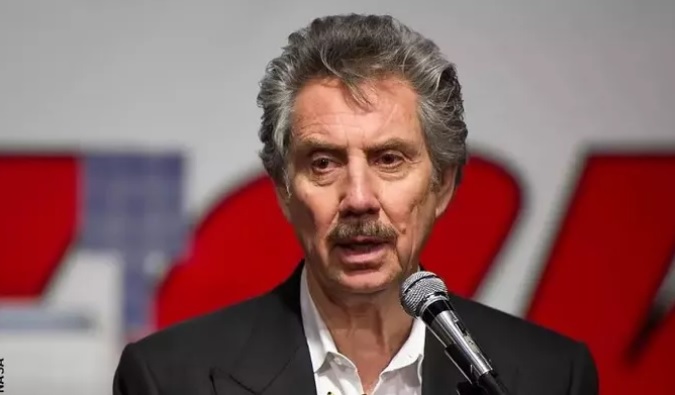
Entrepreneur Robert Bigelow has launched an intriguing competition in search of evidence for the afterlife and has put up nearly $1 million which will be awarded to the winning entries. The president of Bigelow Aerospace is well known in UFO circles for his many initiatives aimed at solving the mystery of the phenomenon as well as other matters of high strangeness, including the bizarre happenings reported at Skinwalker Ranch. Now Bigelow hopes that his considerable fortune can be used to answer one of humanity’s greatest questions: is there an afterlife?

This past June, he launched the Bigelow Institute for Consciousness Studies with an aim to “support research into both the survival of human consciousness after physical death and, based on data from such studies, the nature of the afterlife.” The organization notes that even though everyone on Earth will eventually die, there seems to be no serious research being done on what actually happens when such an event occurs. Lamenting that the “current scientific paradigm” does not treat afterlife studies seriously, the BICS argues that it is probably time to end this closed-minded approach.

As such, they have launched an essay contest “seeking hard evidence ‘beyond a reasonable doubt’ that takes us beyond religion or philosophy and provides a body of knowledge to be brought widely into the public arena.” These papers, the BICS envisions, will focus on scientific evidence and be backed up by documentation whether it be credible witnesses or photographic data. Judging the papers will be a panel that includes a number of experts including investigative journalist Leslie Kean and professor of religion Jeffrey Kripal.

While the competition is open to everyone, in order to actually submit an essay to the BICS, prospective entrants must first complete an application to the organization. Should they be approved, they will then have until August 1st, 2021 to produce a paper detailing their research into the afterlife. The winners of the competition will be announced on November 1st, 2021 with first place netting a whopping $500,000 and runners-up getting $300,000 and $150,000 respectively. Coast listeners looking to learn more about the competition can check out the BICS website and be sure to tune in to this coming Sunday’s edition of C2C as Robert Bigelow will be George Knapp’s guest in the first half of the program.

Just watch one of the ghost TV shows Robert. I counted 25 currently on the tube.

‘Grand Warlock’ of Mexico Issues Forecast for 2021

A colorful self-proclaimed clairvoyant in Mexico known as the country’s ‘Grand Warlock’ has issued his forecast for 2021. Much like his fellow prognosticators around the world, the start of January is the proverbial busy season for Antonio Vazquez, who holds an annual gathering in which he shares what he envisions for the coming year. By virtue of his striking appearance and bold predictions, the purported psychic’s yearly announcement of what is to come over the next twelve months is a popular event in Mexico, where it garners considerable media attention.

And so, as is tradition, Vazquez reportedly took to the stage last week to share a bevy of predictions for the new year. According to the Grand Warlock, the coronavirus “starts to be mastered between May and June, but it doesn’t end this year.” To that end, he ominously warned of a “second pandemic” in the form of widespread financial difficulties facing people around the world due to the slow economic recovery. For those seeking more specific predictions to test Vazquez at this time next year, he also predicted that the Summer Olympics set for Tokyo will once again be postponed and that this will be announced at a press conference in February.

As for here in America, the Grand Warlock forecast a difficult time for President Trump shortly after leaving office. “Trump is not going to remain silent, he will continue strong until February,” Vazquez said, “but he will have many problems” following that time period, possibly involving marital discord, illness, or legal issues. With regards to natural disasters, the prognosticator foresees an increase in hurricanes, floods, and small earthquakes, but no particularly catastrophic event.

Before one gets too depressed over the Olympics being postponed for another year, a look back at the Grand Warlock’s predictions for 2020 indicates that there may be no need to worry about such an event unfolding. That’s because, last January, Vazquez predicted that Donald Trump would be reelected, a “tremendous war” would erupt between the United States and Iran, and that Mexico would have “great success” at the Summer Olympics, which ultimately were not held. Additionally, the Grand Warlock had nary a word to say about a global pandemic when he issued his forecast for 2020, suggesting that perhaps his soothsaying may be more show than substance.

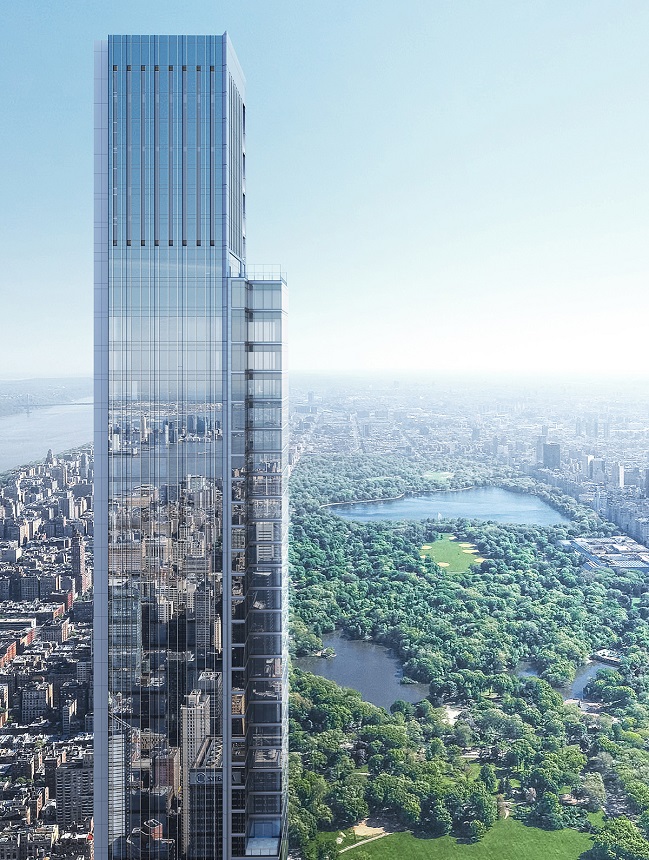
Central Park Tower Nearing Completion

Central Park Tower, also known as the Nordstrom Tower, is a residential supertall skyscraper along Billionaires’ Row on 57th Street in Midtown Manhattan, New York City. Designed by Adrian Smith + Gordon Gill Architecture, the building rises 1,550 feet (472 m) and is the second-tallest skyscraper in the United States and the Western Hemisphere, the 13th tallest building in the world, the tallest residential building in the world, and the tallest building outside Asia by roof height.

The building will have 100 stories above ground and 3 below ground. Very expensive place to live. Some penthouse condos go for 68 million dollars.


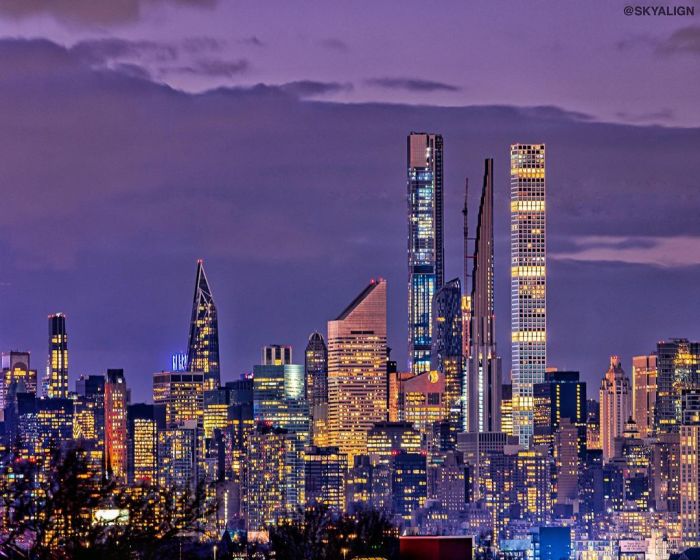
Central Park Tower tallest building on the right.


The Vertical Forest of Milan


avertical


Bosco Verticale (Vertical Forest) is a pair of residential towers in the Porta Nuova district of Milan, Italy, between Via Gaetano de Castillia and Via Federico Confalonieri near Milano Porta Garibaldi railway station. They have a height of 110 metres (360 ft) and 76 metres (249 ft) and will host more than 900 trees (approximately 550 and 350 trees in the first and second towers respectively) on 8,900 square metres (96,000 sq ft) of terraces. Within the complex is also an 11-story office building; its facade does not host plants.

The towers were designed by Boeri Studio (Stefano Boeri, Gianandrea Barreca and Giovanni La Varra). It also involved input from horticulturalists and botanists.

The building was inaugurated in October 2014.


avertical1


The project was designed as part of the rehabilitation of the historic district of Milan between Via De Castillia and Confalonieri. It consists of two residential towers of which the largest is 26 floors and 110 meters high (called Torre E) and the smaller tower is 18 floors and 76 meters high (called Torre D). It contains 400 condominium units priced from 3,000 – 12,000 Euro per square metre.

It is called Bosco Verticale because each tower houses trees between three and six meters which help mitigate smog and produce oxygen. It is also used to moderate temperatures in the building in the winter and summer. The plants also attenuate noise. The design was tested in a wind tunnel to ensure the trees would not topple from gusts of wind. Botanists and horticulturalists were consulted by the engineering team to ensure that the structure could bear the load imposed by the plants. The steel-reinforced concrete balconies are designed to be 28 cm thick, with 1.30 metre parapets.


avertical2


The construction of the towers began in late 2009 and early 2010, involving 6,000 onsite construction workers. Between mid-2010 and early 2011 construction progressed very slowly and the towers rose by only five floors while the core rose to the seventh floor. Construction progressed throughout 2011, and by the beginning of 2012 the structures were completed, and construction of the facades and installation of the plants began on 13 June 2012. The building was inaugurated in October 2014.

On April 11, 2012, one of the buildings was used as a temporary art gallery and opened to the public for an art exhibition hosted during Milan Fashion Week.

The two buildings have 730 trees (480 large, 250 small), 5,000 shrubs, and 11,000 perennials and ground cover on its facades. The original design had specified 1,280 tall plants and 920 short plants encompassing 50 species. Overall, the vegetation is the equivalent of that found in a one hectare woodlot. The innovative use of heat-pump technology is helping to slash heating and cooling costs.


avertical3


On November 19, 2014, Bosco Verticale won the International Highrise Award, prestigious international competition bestowed every two years, honouring excellence in recently constructed buildings that stand a minimum of 100 meters (328 feet) tall. The five finalists were selected from 26 nominees in 17 countries.

On the 12th of November 2015, the Council on Tall Buildings and Urban Habitat (CTBUH) Awards Jury selected Bosco Verticale, Milan, as the overall “2015 Best Tall Building Worldwide” at the 14th Annual CTBUH International Best Tall Building Awards Symposium, Ceremony & Dinner, celebrated at the Illinois Institute of Technology, Chicago.


Gardeners rappel down ropes

avertical4


avertical5


avertical6


avertical7


avertical8


avertical9


avertical10