
Year: 2021
Drone Captures Amazing Footage of Volcanic Eruption in Iceland
A daring drone photographer in Iceland captured breathtaking footage of an unfolding volcanic eruption by flying his UAV over the top of the active crater as lava burst forth high into the air. The amazing footage was reportedly filmed by Bjorn Steinbekk last Friday as the Fagradalsfjall volcano sprung to life following a series of small earthquakes in the country. Sensing the opportunity to document the event from a truly unique perspective, the visual artist fired up his drone and did just that, capturing several stunning overhead scenes of the eruption.
In one of Steinbekk’s videos, seen above, the drone cruises along a long river of lava flowing from the volcano and, amazingly, when it reaches the active crater, the UAV continues onward over the top of the eruption as it is happening. Either by way of sheer luck or skillful maneuvering, the vehicle manages to deftly avoid the molten rock as it spews forth from the site. “I really thought I would never see my drone again,” Steinbekk marveled, “but man, this was so thrilling to capture!”
Very rare space pic
The moon passed between Nasa’s Deep Space Climate Observatory and the Earth allowing this rare pic
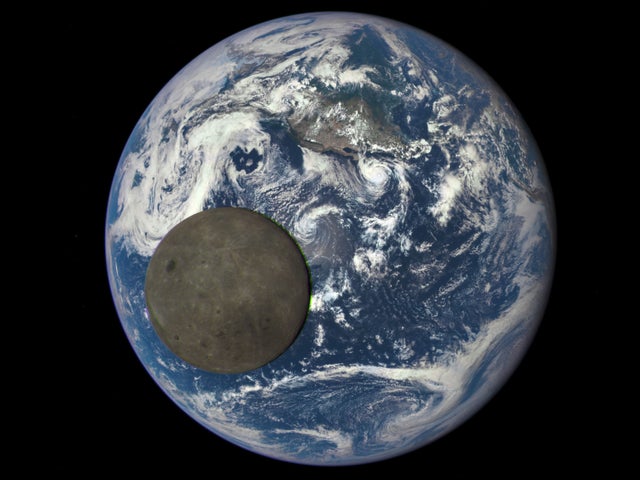
Deep Space Climate Observatory (DSCOVR; formerly known as Triana, unofficially known as GoreSat is a National Oceanic and Atmospheric Administration (NOAA) space weather, space climate, and Earth observation satellite. It was launched by SpaceX on a Falcon 9 v1.1 launch vehicle on 11 February 2015, from Cape Canaveral. This is NOAA’s first operational deep space satellite and became its primary system of warning Earth in the event of solar magnetic storms.
On 6 July 2015, DSCOVR returned its first publicly released view of the entire sunlit side of Earth from 1,475,207 km (916,651 mi) away, taken by the EPIC instrument. The moon is roughly 250,000 miles from earth. EPIC provides a daily series of Earth images, enabling the first-time study of daily variations over the entire globe. The images, available 12 to 36 hours after they are made, have been posted to a dedicated web page since September 2015.
The Moon transiting Earth, 16 July 2015. The far side of the Moon faces the camera.

World’s Most Powerful Rocket Passes Test
The core stage of NASA’s Space Launch System (SLS) rocket fired all four of its RS-25 engines for a little more than eight minutes—about the same duration needed to launch the Artemis I mission to the Moon. The successful hot fire tested the engines’ ability to direct thrust as well as handle throttling up to 109% power. Two massive propellant tanks that hold more than 733,000 gallons of liquid hydrogen and liquid oxygen fed the burning engines at the bottom of the stage. According to Stennis Center Director Richard Gilbrech, “This final test in the Green Run series represents a major milestone for this nation’s return to the Moon and eventual mission to Mars.”
Wild Sheep Sporting 78 Pounds of Wool Gets Life-Saving Shave
A wild sheep that had amassed a jaw-dropping coat of wool was rescued by an animal sanctuary who provided the creature with a life-saving shave. The wondrous ram was reportedly spotted roaming around a state park in Australia by a bewildered witness who reported the sighting to the Edgar’s Mission animal sanctuary in the town of Lancefield. Workers from the organization quickly located the hard-to-miss sheep, whom they named Baarack, and set about freeing it from the hirsute predicament.
The laborious task ultimately saw a staggering 78 pounds of wool removed from the creature’s body. The sanctuary was uncertain as to how the sheep wound up in such a state, but it would appear that the animal’s ear had once been tagged, suggesting that it had somehow escaped from a farm long ago. As one might imagine, the enormous coat of wool had made Baarack’s life in the wild rather difficult as it was found to be both malnourished and nearly blind due to all of the fur that had obscured its eyes.
Now free of the monstrous coat, Baarack looks like a completely different animal, able to see clearly and showing no signs of any ill-effects from its ordeal aside from a few nicks from the shears that were used to shave it. The intervention from the animal rescue organization undoubtedly saved the sheep’s life as it was not only highly vulnerable to predators, but faced increasingly challenges when it came to finding shelter and sustenance.


Abbott and Costello Meet the Invisible Man
Abbott and Costello Meet the Invisible Man is a 1951 American science fiction comedy film.

In the scene below Lou is faking practicing on the punching pear. The Invisible Man – a boxer – is actually doing the real punching.
 The MarkoZen Blog