NSO Group Technologies (NSO standing for Niv, Shalev and Omri, the names of the company’s founders) is an Israeli technology firm whose spyware called Pegasus enables the remote surveillance of smartphones. It was founded in 2010 by Niv Carmi, Omri Lavie, and Shalev Hulio. It employed almost 500 people as of 2017, and is based in Herzliya, near Tel Aviv, Israel.
Pegasus is spyware developed by the Israeli cyberarms firm NSO Group that can be covertly installed on mobile phones (and other devices) running most versions of iOS and Android. The 2021 Project Pegasus revelations suggest that current Pegasus software is able to exploit all recent iOS versions up to iOS 14.6. According to the Washington Post and other prominent media sources, Pegasus not only enables the keystroke monitoring of all communications from a phone (texts, emails, web searches) but it also enables phone call and location tracking, while also permitting NSO Group to hijack both the mobile phone’s microphone and camera, thus turning it into a constant surveillance device.
Pegasus was discovered in August 2018 after a failed attempt at installing it on an iPhone belonging to a human rights activist led to an investigation revealing details about the spyware, its abilities, and the security vulnerabilities it exploited. As of 2016, Pegasus was capable of reading text messages, tracking calls, collecting passwords, tracking location, accessing the target device’s microphone and camera, and harvesting information from apps. News of the spyware caused significant media coverage. It was called the “most sophisticated” smartphone attack ever, and was the first time that a malicious remote exploit using jailbreak to gain unrestricted access to an iPhone had been detected.
On August 23, 2020, according to intelligence obtained by the Israeli newspaper Haaretz, the NSO Group was reported to have sold Pegasus spyware software for hundreds of millions of US dollars to the United Arab Emirates and the other Gulf States, for surveillance of anti-regime activists, journalists and political leaders from rival nations, with Israeli government encouragement and mediation. Later, in December 2020, Al Jazeera investigation show The Tip of the Iceberg, Spy partners, showed exclusive footage about Pegasus and its penetration into the phones of media professionals and activists, used by Israel to eavesdrop on its opponents and even its allies.
The spyware can be installed on devices running certain versions of iOS, Apple’s mobile operating system, as well as some Android devices. Rather than being a specific exploit, Pegasus is a suite of exploits that uses many vulnerabilities in the system. Infection vectors include clicking links, the Photos app, the Apple Music app, and iMessage. Some of the exploits Pegasus uses are zero-click—that is, they can run without any interaction from the victim. Once installed, Pegasus has been reported to be able to run arbitrary code, extract contacts, call logs, messages, photos, web browsing history, settings, as well as gather information from apps including but not limited to communications apps iMessage, Gmail, Viber, Facebook, WhatsApp, Telegram, and Skype.
Misuse Although Pegasus is stated as intended to be used against criminals and terrorists, use by authoritarian governments to spy on critics and opponents has often been reported.
Use by India In late 2019, Facebook initiated a suit against NSO, claiming that Pegasus had been used to intercept the WhatsApp communications of a number of activists, journalists, and bureaucrats in India, leading to accusations that the Indian government was involved.
Phone numbers of Indian ministers, opposition leaders, ex-election commissioners and journalists were allegedly found on a database of NSO hacking targets by Project Pegasus in 2021.
Independent digital forensic analysis conducted on 10 Indian phones whose numbers were present in the data showed signs of either an attempted or successful Pegasus hack. The results of the forensic analysis threw up shows sequential correlations between the time and date a phone number is entered in the list and the beginning of surveillance. The gap usually ranges between a few minutes and a couple of hours.
11 phone numbers associated with a female employee of The Supreme Court of India and her immediate family, who accused the former Chief Justice of India, Ranjan Gogoi, of sexual harrasment, are also allegedly found on a database indicating possibility of their phones being snooped.
Records also indicate that phone numbers of some of the key political players in Karnataka appear to have been selected around the time when an intense power struggle was taking place between the Bharatiya Janata Party and the Janata Dal (Secular)-Congress-led state government in 2019.
It was reported that the Indian government used Pegasus to spy on Pakistan Prime Minister Imran Khan and diplomats from Iran, Afghanistan, China, Nepal and Saudi Arabia.
Use by Mexican drug cartels Reversing the intended use against criminals, Pegasus has been used to target and intimidate Mexican journalists by drug cartels and cartel-entwined government actors.
Use by Saudi Arabia Pegasus software, whose sales are licensed by the government of Israel to foreign governments, helped Saudi Arabia spy on Jamal Kashoggi, who was later killed in Turkey.
Pegasus was also used to spy on Jeff Bezos after Mohammed bin Salman, the crown-prince of Saudi Arabia, exchanged messages with him that exploited then-unknown vulnerabilities in WhatsApp.
Wheels on Meals is a 1984 Hong Kong martial arts action-comedy film written and directed by Sammo Hung, with action choreographed by Jackie Chan. The film stars Jackie Chan, Sammo Hung, Yuen Biao, Lola Forner, Benny Urquidez and José Sancho. The film was shot in Barcelona, Spain.
The film was a box office success in East Asia, including Japan where the film was released as Spartan X. The film was well-received by critics for its action and comedy, particularly the final fight between Jackie Chan and Benny Urquidez, which is considered one of the greatest fight scenes of all time. Jackie Chan with his stunt team were nominated for Best Action Choreography, for both Wheels on Meals and Project A, at the 4th Hong Kong Film Awards, winning the award for Project A.
Plot:
Thomas and David are cousins who run a fast food van in Barcelona. The food is delivered by Thomas, who rushes around the square on a skateboard. After fending off a biker gang they continue business as normal.
They pay a visit to David’s father, who is in a mental institution, and bump into Sylvia, the daughter of David’s father’s girlfriend. Thomas encourages his cousin to try to ask her out on a date, but David chickens out of this, making the excuse she would have said no anyway.
Later that night, while at the van serving food, Thomas inadvertently bumps into Sylvia, who is pretending to be a prostitute. She is actually a pickpocket, and she robs a man in a bedroom and runs away to their fast food van.
Both Thomas and David are enamored by her, but after allowing her to stay in their apartment that night, they wake to find Sylvia and their money gone. The next day, they bump into Moby, a bumbling private investigator who is also tracking Sylvia. They later discover that Sylvia is the heir to a sizable inheritance that a criminal gang is trying to steal from her. When she is kidnapped, Thomas, David and Moby team up to save her, infiltrating the villains’ castle and defeating them in a martial arts battle. The final scene of the film shows David, Thomas and Sylvia reunited. Sylvia asks for a summer job, and Moby asks David and Thomas if they wish to work as private detectives with him, which they refuse.
The film was distributed by Golden Harvest, a distribution, production and exhibition company based in Hong Kong.
Now for that very odd title:
The film’s title was supposed to be Meals on Wheels. Superstitious Golden Harvest executives however demanded the title change because their two previous films with titles that began with the letter ‘M’ – Megaforce and Menage A Trois – were both box office flops.
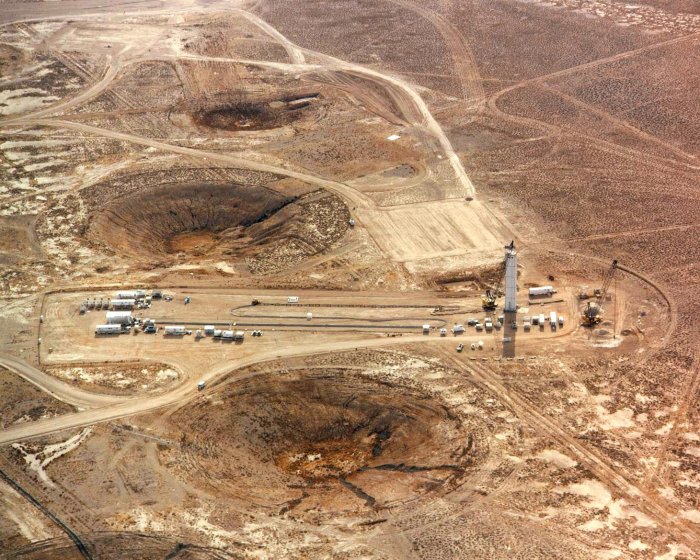
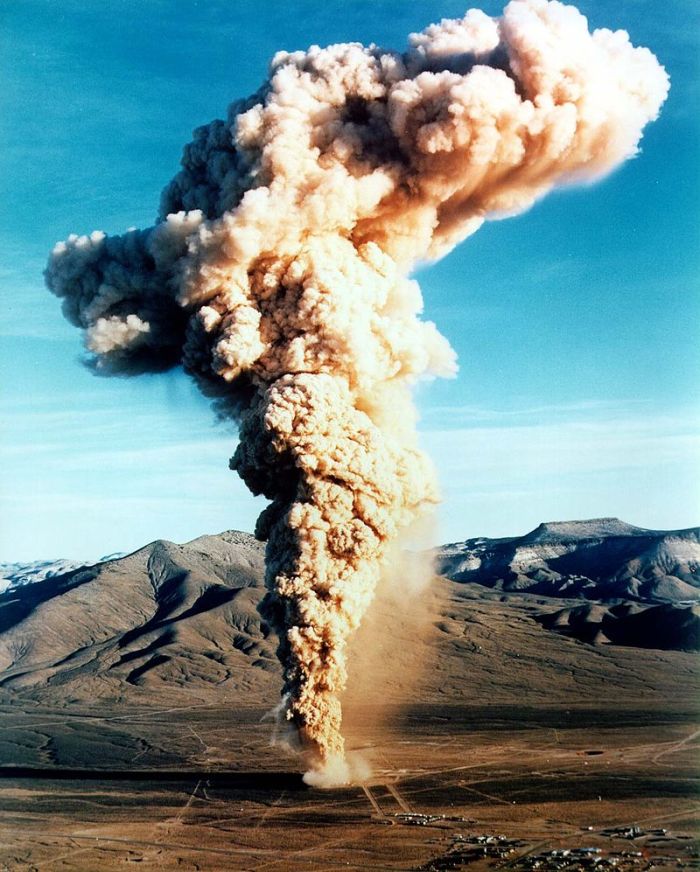
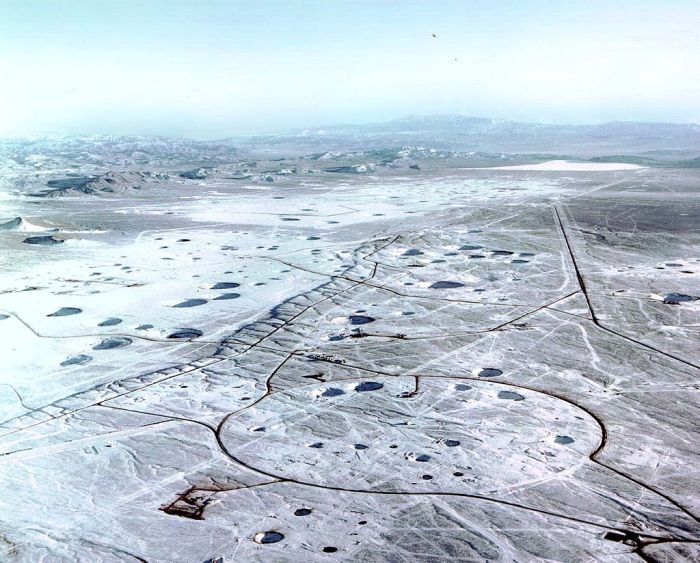
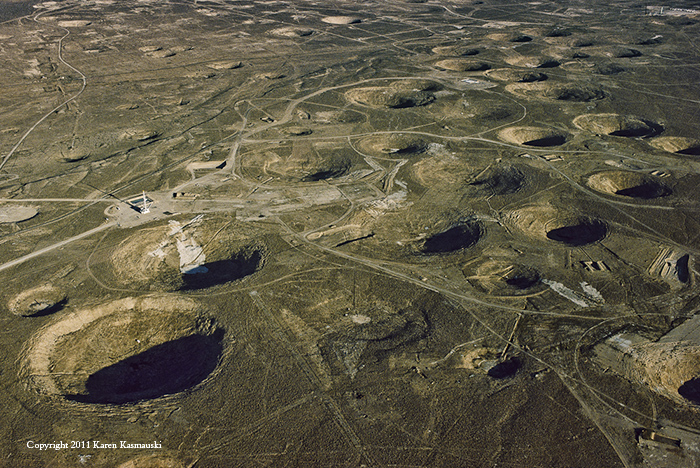
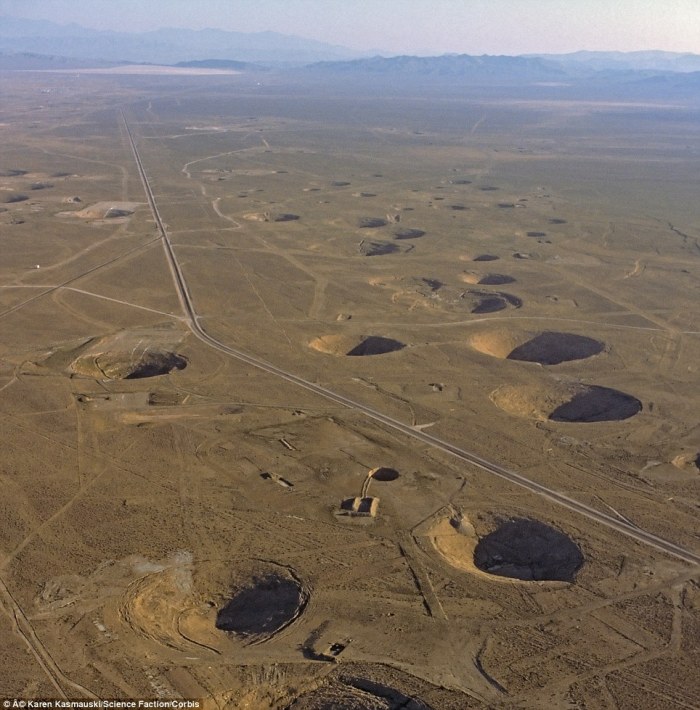
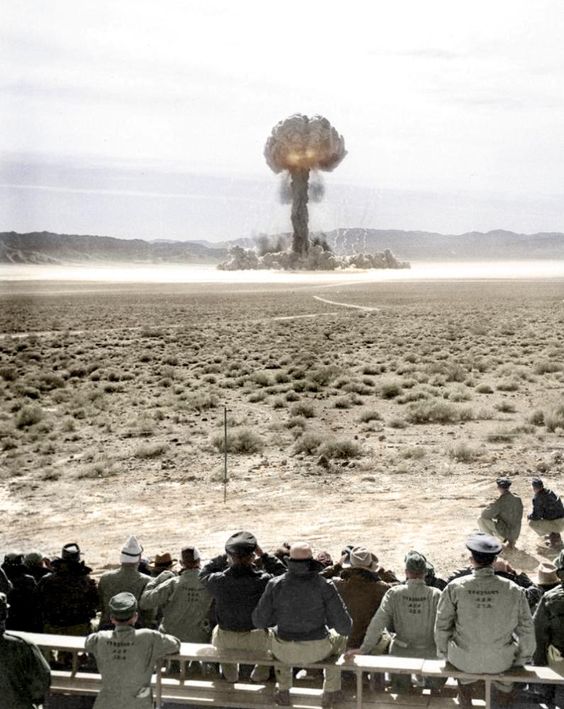
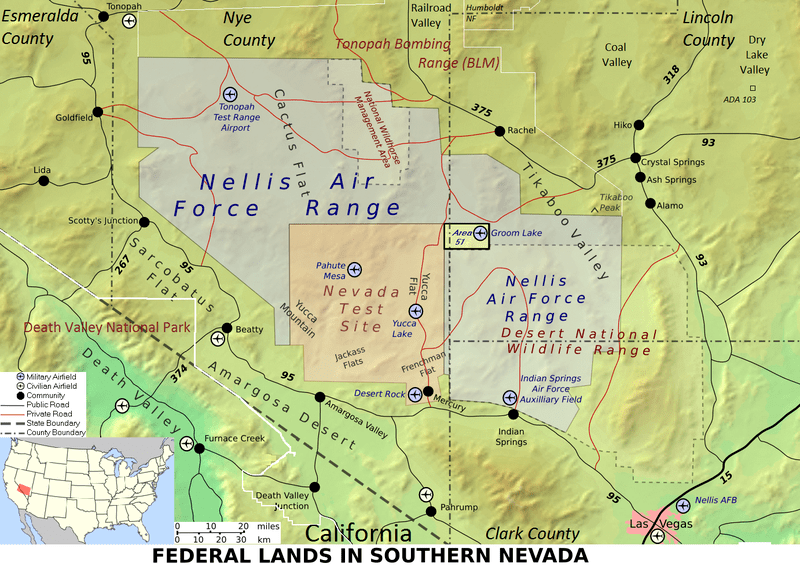
The Nevada National Security Site (NNSS), previously the Nevada Test Site (NTS), is a United States Department of Energy reservation located in southeastern Nye County, Nevada, about 65 miles (105 km) northwest of the city of Las Vegas. Formerly known as the Nevada Proving Grounds, the site was established on 11 January 1951 for the testing of nuclear devices. During the 1950s, the mushroom clouds from the 100 atmospheric tests could be seen for almost 100 mi (160 km). The city of Las Vegas experienced noticeable seismic effects, and the distant mushroom clouds, which could be seen from the downtown hotels, became tourist attractions. The vast majority—828 of the 928 total nuclear tests—were underground.
Indiana Jones nuketown scene. Indiana is one tough hombre.
I grew up in a rural area where the vocabulary of most people was about 2-300 real words. But those same people had at least 50-100 swear words under their belt ready to be spit out in a milliseconds notice. And what was better, where I grew up was a tri-lingual community, three languages, English, French and Flemish (Belgian Dutch). So we had the chance to be worldly swearers. We could be completely fluent in cuss words from three languages! It was fantastic. If you stubbed your toe you could swear for 10 minutes straight using Anglo-Franco-Flemingo cusses.
Ned shows the way:
But he used Jesus’ name in vain. Some time in Purgatory Ned.
A few examples of alternative cussing:
Fudge Nuggets that woman has a nice Fish Pastel!
If that Shuzzbutt doesn’t shut his mouth, I’m going to make a mercrob out of his Shikaka!
Why doesn’t this NFL team trade that saffron Hobknocker!
Oh, snap, Son of a motherless goat!
How in the snookerdoodle am I going to get out of this Mothersmucker?
Son of a motherless goat! How the fudge berries did I fall for those cornnuts!
That is the ugliest fart knocker I have ever come across.
Yuck Fou!
Take those kittywhiskers and shove them up your Shnookerdookies!
I’m going to rotate and tilt your jaw, then unscrew your Jehoshaphat!
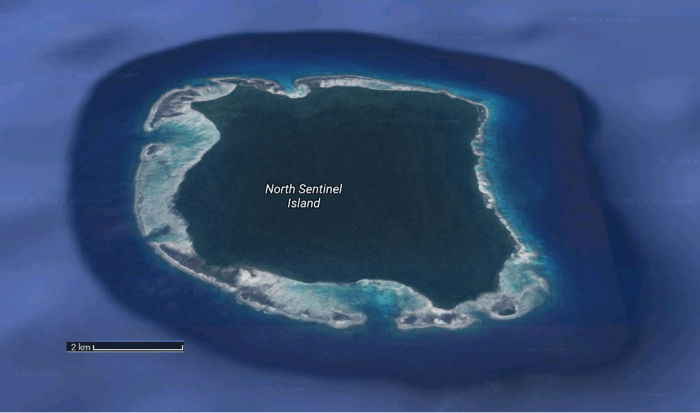
American ‘killed in India by endangered Andamans tribe’
An American man has been killed by an endangered tribe in India’s Andaman and Nicobar islands.
Fishermen who took the man to North Sentinel island say tribespeople shot him with arrows and left his body on the beach.
He has been identified as John Allen Chau, a 27 year old from Alabama.
Contact with the endangered Andaman tribes living in isolation from the world is illegal because of the risks to them from outside disease.
Estimates say the Sentinelese, who are totally cut off from civilisation, number only between 50 and 150.
Seven fishermen have been arrested for illegally ferrying the American to the island, police say.
Local media have reported that Chau may have wanted to meet the tribe to preach Christianity to them.
“Police said Chau had previously visited North Sentinel island about four or five times with the help of local fishermen,” journalist Subir Bhaumik, who has been covering the islands for years, told BBC Hindi.
“The number of people belonging to the Sentinelese tribe is so low, they don’t even understand how to use money. It’s in fact illegal to have any sort of contact with them.”
In 2017, the Indian government also said taking photographs or making videos of the aboriginal Andaman tribes would be punishable with imprisonment of up to three years.
But on social media the young man presented himself as a keen traveller and adventurer.
The AFP news agency quoted a source as saying that Chau had tried and failed to reach the island on 14 November. But then he tried again two days later.
“He was attacked by arrows but he continued walking.
“The fishermen saw the tribals tying a rope around his neck and dragging his body. They were scared and fled,” the report added.
Chau’s body was spotted on 20 November. According to the Hindustan Times, his remains have yet to be recovered.
“It’s a difficult case for the police,” says Mr Bhaumik. “You can’t even arrest the Sentinelese.”
BBC
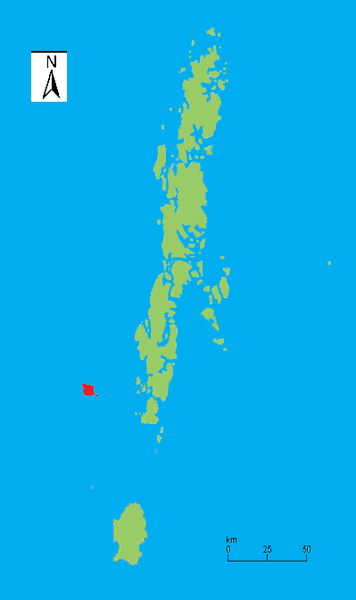
The Sentinelese (also Sentineli, Senteneli, Sentenelese, North Sentinel Islanders) are one of the Andamanese indigenous peoples and one of the most uncontacted peoples of the Andaman Islands, located in India in the Bay of Bengal. They inhabit North Sentinel Island which lies westward off the southern tip of the Great Andaman archipelago. They are noted for vigorously resisting attempts at contact by outsiders. The Sentinelese maintain an essentially hunter-gatherer society subsisting through hunting, fishing, and collecting wild plants; there is no evidence of either agricultural practices or methods of producing fire. Their language remains unclassified.
The Sentinelese (also called the Sentineli or North Sentinel Islanders) are the indigenous people of North Sentinel Island in the Andaman Islands of India. One of the Andamanese peoples, they resist contact with the outside world, and are among the last people to remain virtually untouched and uncontacted by modern civilization. The Sentinelese maintain an essentially hunter-gatherer society subsisting through hunting, fishing, and collecting wild plants. There is no evidence of either agricultural practices or methods of producing fire. The Sentinelese language remains unclassified and is not mutually intelligible with the Jarawa language of their nearest neighbors.
The precise population of the Sentinelese is not known. Estimates range from fewer than 40, through a median of around 250, and up to a maximum of 500. In 2001, Census of India officials recorded 39 individuals (21 males and 18 females); however, out of necessity this survey was conducted from a distance and almost certainly does not represent an accurate figure for the population who range over the 59.67 km2 (14,700 acres) island. The 2011 Census of India recorded only 15 individuals (12 males and three females). Any medium- or long-term effect on the Sentinelese population arising from the 2004 Indian Ocean earthquake and resulting tsunami is not known, other than the confirmation obtained that they had survived the immediate aftermath. On previous visits, groups of some 20–40 individuals were encountered regularly. Habitations of 40–60 individuals were found on two occasions. As some individuals are thoughtto be hiding, a more precise approximation of group size cannot be determined. This would suggest that some two to six groups occupy the island. The rule of thumb population density of 1.5 km2 (370 acres)/individuals in comparable hunter–gatherer societies indicates that one such group could live off the land alone. A significant amount of food is derived from the sea. It seems that, at any one time, the groups that were encountered could only have come from a rather small part of the island, and that about half of the couples had dependent children or included pregnant women. There appeared to be slightly more males than females.
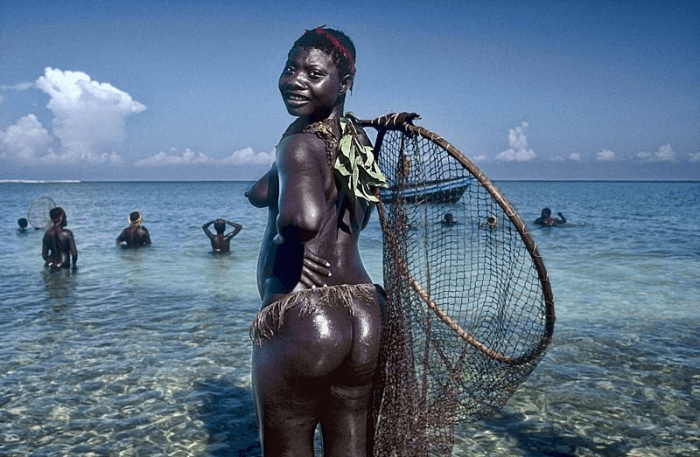
The Sentinelese and other indigenous Andamanese peoples are frequently described as negritos, a term which has been applied to various widely separated peoples in Southeast Asia, such as the Semang of the Malay Peninsula, the Aeta of the Philippines archipelago, as well as to other peoples in Australia including former populations of Tasmania.[citation needed] The defining characteristics of these “negrito” peoples (who are not a monophyletic group) include a comparatively short stature, dark skin, and afro-textured hair. Although no close contacts have been established, author Heinrich Harrer described one man as being 1.6 metres (5 ft 3 in) tall and apparently left handed.
Negrito people of the Andaman Islands
Most of what is known about Sentinelese material culture is based on observations during contact attempts in the late 20th century. The Sentinelese maintain an essentially hunter-gatherer society, obtaining their subsistence through hunting, fishing, and collecting wild plants; there is no evidence of any agricultural practices. Their dwellings are either shelter-type huts with no side walls and a floor sometimes laid out with palms and leaves, which provide enough space for a family of three or four and their belongings, or larger communal dwellings which may be some 12 square metres (130 sq ft) and are more elaborately constructed, with raised floors and partitioned family quarters. Advanced metalwork is unknown, as raw materials on the island are extremely rare. It has been observed, however, that they have made adroit use of metal objects which have washed up or been left behind on their shores, having some ability at cold smithing and sharpening iron and incorporating it into weapons and other items. For example, in the late 1980s two international container ships ran aground on the island’s external coral reefs; the Sentinelese retrieved several items of iron from the vessels.
Their weaponry consists of javelins and a type of flatbow. At least three varieties of arrows, apparently for fishing and hunting, and untipped ones for shooting warning shots, have been documented. Fishing arrows have a number of forward-pointing prongs; hunting arrows have ovoid arrowheads, the latter two as well as their associated barbs below the tip made from iron. The arrows are over 1 m (3 ft) long. The harpoon- or javelin-type arrows are nearly half as long again, about the same length as the bows (over 3 m (10 ft)), and can also be thrown or used for stabbing, but the latter probably only rarely. For catching large fish, a harpoon is used which is similar in design to the fishing arrows, but nearly 2.5 m (8 ft) long. Knives are also known, but it is unclear to what extent the Sentinelese fashion them themselves. Known tools include adzes, pounding and smithing stones, and various finely or coarsely woven baskets for small-grained or larger goods, as well as bamboo and wooden containers. Fires are maintained as embers inside dwellings, possibly assisted by resin torches. There exist fishing nets and basic outrigger canoes used for fishing and collecting shellfish from the lagoon but not for open-sea excursions. Food consists primarily of plants gathered in the forest, coconuts, which are frequently found on the beaches as flotsam, pigs, and, presumably, other wildlife (which apart from sea turtles is limited to some smaller birds and invertebrates). Wild honey is known to be collected and the Sentinelese use a kind of rake to pull down branches to gather fruit or nuts, such as sapodilla and pandanus.
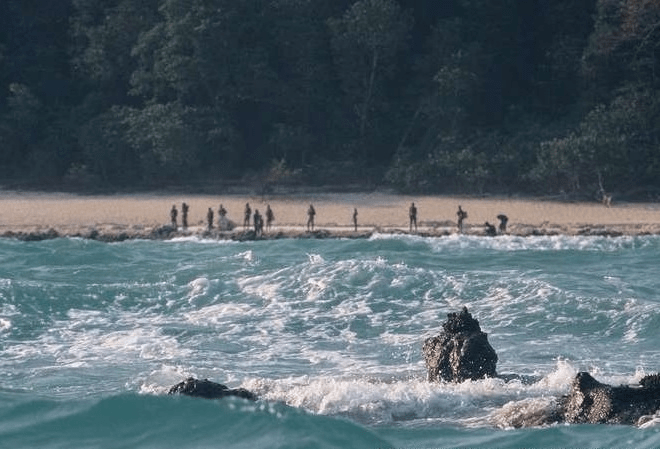
Rare photo Sentinelese on the beach
Incidents of contact
In January 1880, an armed British expedition to the island led by 20-year-old Maurice Vidal Portman, the local colonial administrator, arrived to conduct a survey of the island, and to take a prisoner, in accordance with British policy regarding unwelcoming tribes at the time, which was to kidnap a member of the tribe, treat them well and give them gifts, and release them back to the tribe, hoping to demonstrate friendliness. Portman’s expedition of the island is believed to be the first by outsiders. While the Sentinelese tended to disappear into the jungle whenever outsiders were spotted approaching, Portman’s expedition found an elderly couple and four children after several days. They were taken prisoner and brought to Port Blair. The elderly couple became ill and died, probably from contracting diseases to which they did not have immunity. The four children were returned to the island, given gifts, and released. The children then disappeared into the jungle. After this incident, the British did not try to contact the Sentinelese again and instead focused on other tribes. In 1967, the Indian government began a series of “Contact Expeditions” to the island. The programme was managed by the Director of Tribal Welfare and anthropologist T. N. Pandit. The first expedition, headed by Pandit, included armed police and naval officers. The Sentinelese retreated into the jungle, and the expedition failed to make contact with any of them. During these expeditions, an Indian Navy vessel would anchor outside the coral reefs and send small boats to approach the beaches, and while keeping a distance, the crew would drop various gifts into the water to wash up on shore. If the Sentinelese fled for the jungle, the parties might land on shore and drop off the gifts before leaving. On 29 March 1970, a research party of Indian anthropologists, which included Pandit, found themselves cornered on the reef flats between North Sentinel and Constance Island. An eyewitness recorded the following from his vantage point on a boat lying off the beach: Quite a few discarded their weapons and gestured to us to throw the fish. The women came out of the shade to watch our antics… A few men came and picked up the fish. They appeared to be gratified, but there did not seem to be much softening to their hostile attitude… They all began shouting some incomprehensible words. We shouted back and gestured to indicate that we wanted to be friends. The tension did not ease. At this moment, a strange thing happened — a woman paired off with a warrior and sat on the sand in a passionate embrace. This act was being repeated by other women, each claiming a warrior for herself, a sort of community mating, as it were. Thus did the militant group diminish. This continued for quite some time and when the tempo of this frenzied dance of desire abated, the couples retired into the shade of the jungle. However, some warriors were still on guard. We got close to the shore and threw some more fish which were immediately retrieved by a few youngsters. It was well past noon and we headed back to the ship…
In the spring of 1974, a National Geographic film crew came to the island, in what was one of the most unsuccessful expeditions made on the island. North Sentinel was visited by a team of anthropologists filming a documentary, Man in Search of Man. The team was accompanied by armed police officers and a National Geographic photographer. When the motorized boat broke through the barrier reefs, locals emerged from the jungle. The Sentinelese responded with a curtain of arrows. The boat landed at a point on the coast out of range of the arrows and the police (dressed in jackets with padded armour) landed and left gifts in the sand: a miniature plastic car, some coconuts, a live pig tied, a doll, and aluminium cookware. The policemen returned to the boat and waited to see the locals’ reaction to the gifts. The reaction was to launch another round of arrows, one of which struck the documentary’s director in the left thigh. The man who wounded the director withdrew and laughed proudly, sitting in the shade while others speared, then buried, the pig and the doll. Afterwards, everyone left, taking with them only the coconuts and aluminium cookware. In the early 1990s, the Sentinelese began allowing the boats to come closer to the shore, and sometimes greeted them unarmed. However, after a few minutes, the Sentinelese would warn them off by making menacing gestures and firing arrows without arrowheads. In 1996, the Indian government ended the “Contact Expeditions” following a series of hostile encounters resulting in several deaths in a similar programme practised with the Jarawa people of South and Middle Andaman Islands and because of the danger of introducing diseases. The Sentinelese appear to have emerged relatively unscathed from the 2004 Indian Ocean tsunami, apparently managing to reach high ground. Three days following the tsunami, an Indian naval helicopter was sent to check on them and drop food on the beach. It was warned away by a Sentinelese warrior who emerged from the jungle and brandished a bow and arrow. In 2006, Sentinelese archers killed two fishermen who were fishing illegally for mud crabs within range of the island. Their boat’s improvised anchor failed to prevent it from being carried away by currents while they were asleep. The boat drifted into the shallows of the island, where they were killed. An Indian Coast Guard helicopter that was sent to retrieve the bodies was driven off by Sentinelese warriors, who fired a volley of arrows. There were two documented occasions when Onge individuals were taken to North Sentinel Island in order to attempt communication resulting in brief and hostile exchanges, during which they were unable to recognise any of the language spoken by the inhabitants.Their island is legally a part of, and administered by, the Indian Union Territory of Andaman and Nicobar Islands. In practice, however, the Sentinelese exercise complete autonomy over their affairs and the involvement of the Indian authorities is restricted to occasional monitoring, even more infrequent and brief visits, and generally discouraging any access or approaches to the island. The possibility of future contact, whether violent or non-violent (armed or unarmed) has been discussed by various organisations and nations.
I always liked the way two other singers join in and belt it out during this song.
Clyde Jackson Browne (born October 9, 1948) is an American singer-songwriter and musician who has sold over 17 million albums in the United States alone.
Coming to prominence in the 1970s, Browne has written and recorded several notable songs throughout his career including “These Days”, “The Pretender”, “Running On Empty”, “Lawyers in Love”, “Doctor My Eyes”, “Take It Easy”, “For a Rocker”, and “Somebody’s Baby”. In 2004, he was both inducted into the Rock and Roll Hall of Fame in Cleveland, Ohio, and bestowed an Honorary Doctorate of Music by Occidental College in Los Angeles, California.
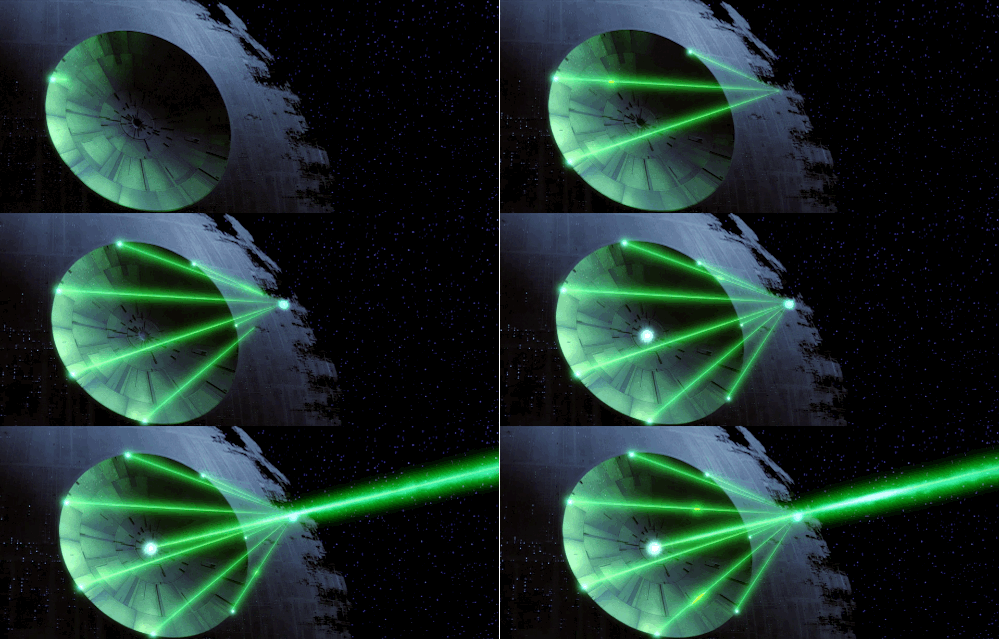
A new image from NASA’s Cassini probe is raising eyebrows among sci fi fans for its eerie resemblance to the infamous Death Star from the Star Wars films.
The unsettling celestial body, dubbed ‘Tethys,’ is one of Saturn’s icy moons and measures about 660 miles across.
With its enormous crater positioned in just the right spot when photographed by the spacecraft, the moon looks remarkably similar to the monstrous weapon at the center of the epic space opera.
While it is almost certainly not a fabricated space ship designed to destroy planets and wreak havoc across the universe, who knows what creatures could lurk in the deep deep depths of the moon?





















 The MarkoZen Blog