
Alley Fight in Japan
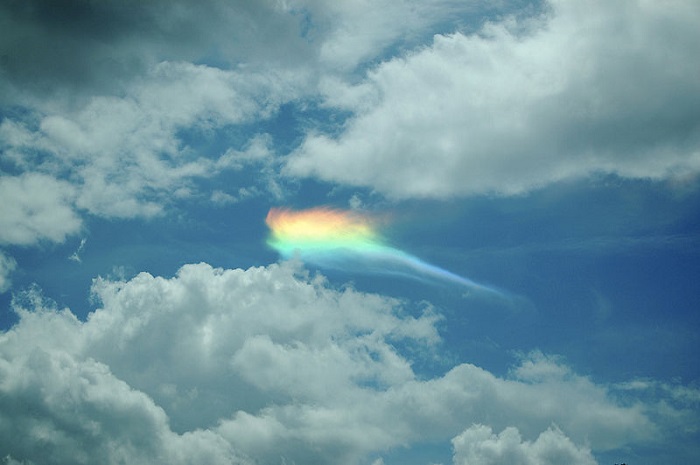
A circumhorizontal arc is an optical phenomenon that belongs to the family of ice halos formed by the refraction of sunlight or moonlight in plate-shaped ice crystals suspended in the atmosphere, typically in cirrus or cirrostratus clouds. In its full form, the arc has the appearance of a large, brightly spectrum-coloured band (red being the topmost colour) running parallel to the horizon, located far below the Sun or Moon. The distance between the arc and the Sun or Moon is twice as far as the common 22-degree halo. Often, when the halo-forming cloud is small or patchy, only fragments of the arc are seen. As with all halos, it can be caused by the Sun as well as (but much more rarely) the Moon.
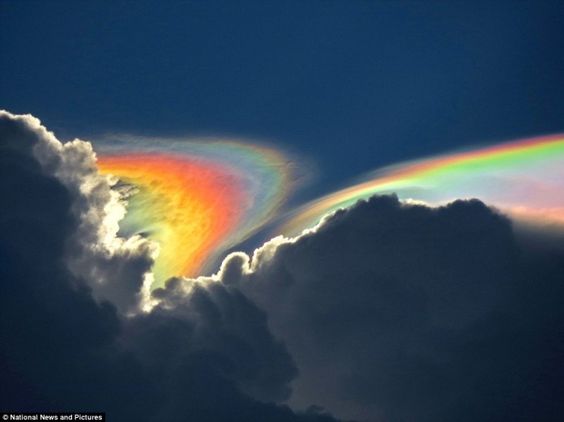
Other currently accepted names for the circumhorizontal arc are circumhorizon arc or lower symmetric 46° plate arc. The misleading term “firebows” is sometimes used to describe this phenomenon, although it is neither a rainbow, nor related in any way to fire. The term, apparently coined in 2006, may originate in the occasional appearance of the arc as “flames” in the sky, when it occurs in fragmentary cirrus clouds.
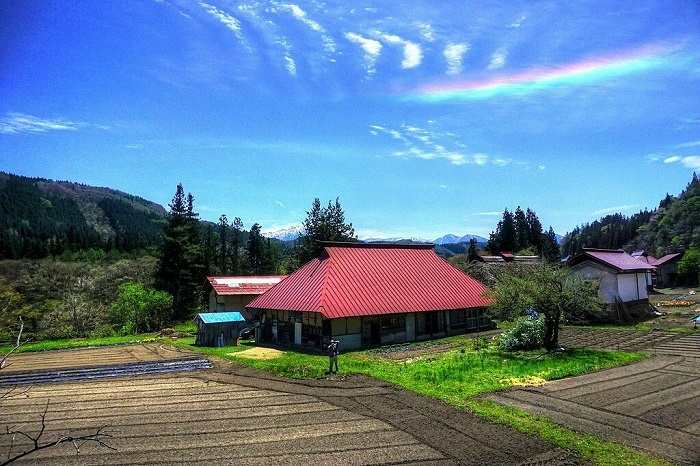
The halo is formed by sunlight entering horizontally-oriented, flat, hexagonal ice crystals through a vertical side face and leaving through the near horizontal bottom face (plate thickness does not affect the formation of the halo). In principle, Parry oriented column crystals may also produce the arc, although this is rare. The 90° inclination between the ray entrance and exit faces produce the well-separated spectral colours. The arc has a considerable angular extent and thus, rarely is complete. When only fragments of a cirrus cloud are in the appropriate sky and sun position, they may appear to shine with spectral colours.
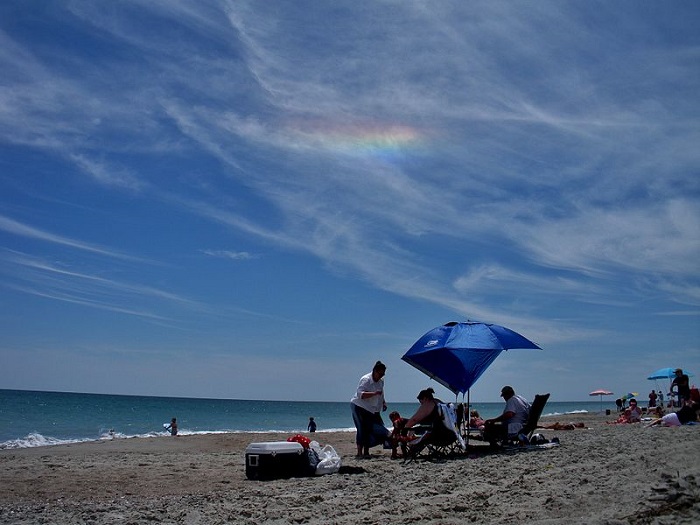
How often a circumhorizontal arc is seen, depends on the location and the latitude of the observer. In the United States it is a relatively common halo, seen several times each summer in any one place. In contrast, it is a rare phenomenon in northern Europe for several reasons. Apart from the presence of ice-containing clouds in the right position in the sky, the halo requires that the light source (Sun or Moon) be very high in the sky, at an elevation of 58° or greater. This means that the solar variety of the halo is impossible to see at locations north of 55°N or south of 55°S. A lunar circumhorizon arc might be visible at other latitudes, but is much rarer since it requires a nearly full Moon to produce enough light. At other latitudes the solar circumhorizontal arc is visible, for a greater or lesser time, around the summer solstice. Slots of visibility for different latitudes and locations may be looked up here. For example, in London the sun is only high enough for 140 hours between mid-May and late July, whereas Los Angeles has the sun higher than 58 degrees for 670 hours between late March and late September.


Upsurge in violence aboard commercial airline flights.




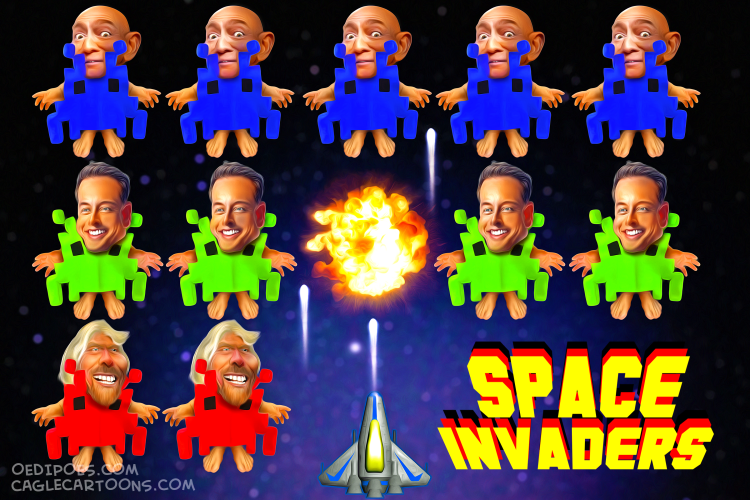

GOAT stands for Greatest of All Time.
Kim Price / AP
Simone Biles during the women’s qualification for the artistic gymnastics final at the 2020 Summer Olympics at Ariake Gymnastics Centre in Tokyo on July 25, 2021.















A Dynastic Totalitarian Dictatorship.
The North Korean cult of personality surrounding its ruling family, the Kim family, has existed in North Korea for decades and can be found in many examples of North Korean culture. Although not officially recognized by the North Korean government, many defectors and even Western visitors claim there are often stiff penalties for those who criticize or do not show “proper” respect for the regime. The personality cult began soon after Kim Il-sung took power in 1948, and was greatly expanded after his death in 1994.
While other countries have had cults of personality to various degrees (such as Joseph Stalin’s in the Soviet Union), the pervasiveness and extreme nature of North Korea’s personality cult surpasses that of Stalin or Mao Zedong. The cult is also marked by the intensity of the people’s feelings for and devotion to their leaders, and the key role played by a Confucianized ideology of familism both in maintaining the cult and thereby in sustaining the regime itself.


Stadium with participants holding large cards.
The cult of personality surrounding the Kim family requires total loyalty and subjugation to the Kim family and establishes the country as a one-man dictatorship through successive generations. The 1972 constitution of the DPRK incorporates the ideas of Kim Il-sung as the only guiding principle of the state and his activities as the only cultural heritage of the people. According to New Focus International, the cult of personality, particularly surrounding Kim Il-sung, has been crucial for legitimizing the family’s hereditary succession, and Yong-soo Park noted in the Australian Journal of International Affairs that the “prestige of the Suryong [supreme leader] has been given the highest priority over everything else in North Korea”.
North Korean authorities have co-opted portions of Christianity and Buddhism, and adapted them to their own uses, while greatly restricting all religions in general as they are seen as a threat to the regime. An example of this can be seen in the description of Kim Il-sung as a god, and Kim Jong-il as the son of a god or “Sun of the Nation”, evoking the father-son imagery of Christianity. According to author Victor Cha, during the first part of Kim Il-sung’s rule, the state destroyed over 2,000 Buddhist temples and Christian churches which might detract from fidelity to Kim. There is even widespread belief that Kim Il-sung “created the world” and that Kim Jong-il controlled the weather. Korean society, traditionally Confucian, places a strong emphasis on paternal hierarchy and loyalty. The Kims have taken these deeply held traditions and removed their spiritual component, replacing them with loyalty to the state and the ruling family in order to control the population. Despite the suppression of traditional religions, however, some have described Juche, sociologically, as the religion of the entire population of North Korea.
According to a 2013 report by New Focus International, the two major North Korean news publications (Rodong Sinmun and the Korean Central News Agency) publish around 300 articles per month relating to the “cult of Kim”. The report goes further and suggests that with the death of Kim Jong-il, the average North Korean citizen is growing weary of the vast amount of propaganda surrounding the Kims. DailyNK likewise published in 2015 that the younger generation is more interested in the outside world and that the government is finding it difficult to secure the loyalty of the “jangmadang” (marketplace) generation and promoting the idolization of Kim Jong-un.
The DPRK government claims there is no cult of personality, but rather genuine hero worship.

Mansudae Grand Monument

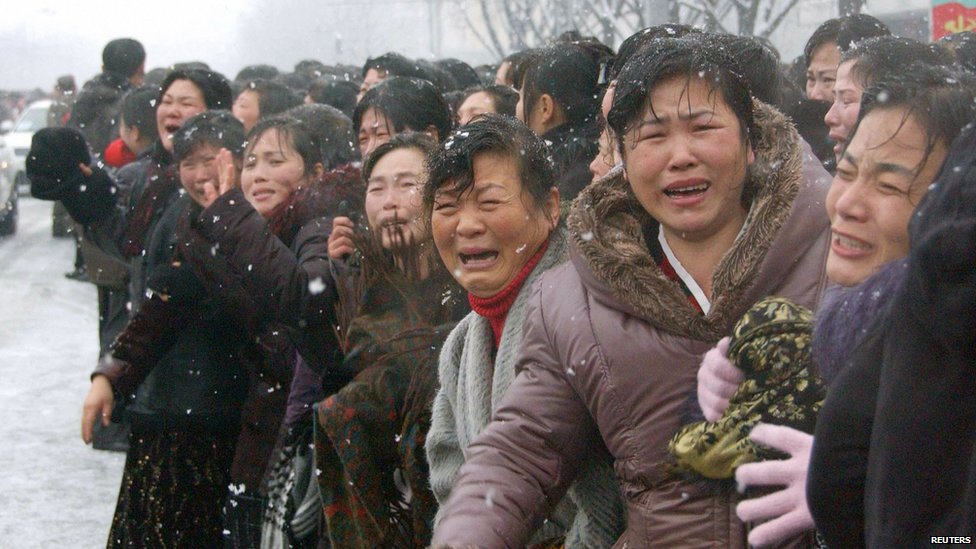
After his death on December 17, 2011, the Korean Central News Agency (KCNA) said that layers of ice ruptured with an unprecedentedly loud crack at Chon Lake on Mount Paektu and a snowstorm with strong winds hit the area. A political paper by his son, Kim Jong-un, sought to solidify his father as the “Eternal General Secretary of our Party.” Many had been seen weeping during the 100-day mourning period, which is typical of Korean Confucian society, and an analyst at South Korea’s Korea Institute for National Unification determined that much of the public grief evidenced during the mourning period was a genuine expression of sorrow. Yet, there has been some doubt as the genuine nature and depth of the displays of grief.
Kim Jong-un, the grandson of North Korea’s founder, was largely absent from the public and government service until the mid-2000s. In 2010 he began being referred to as the “Young General” and by late 2011 as “Respected General”. Like his father, he lacks any formal military training or service. With the death of his father, state media began to refer to him as the “Great Successor.” Although he is still a new ruler, the development of his own personality cult is well underway, with large numbers of posters, signs, and other propaganda being placed all over the country. Some commentators have noted that his striking likeness in appearance to Kim Il-sung has helped solidify him as the undisputed ruler in the minds of the people.
Kim Jong-un marks the third generation of Kim family dynastic leadership. According to Daily NK, people who criticized the succession were sent to re-education camps or otherwise punished and, after the mourning period of Kim Jong-il, government authorities began to increase their efforts on building the idolization of Kim Jong-un.
After Kim Jong-il’s death the president of the Presidium announced that “Respected Comrade Kim Jong-un is our party, military and country’s supreme leader who inherits great comrade Kim Jong-il’s ideology, leadership, character, virtues, grit and courage.”
Shortly after the new leader came to power, a 560 metres (1,840 ft)-long propaganda sign was erected in his honor near a lake in Ryanggang Province. The sign, supposedly visible from space, reads “Long Live General Kim Jong-un, the Shining Sun!”
In 2013, the Workers’ Party of Korea amended the Ten Principles for the Establishment of a Monolithic Ideological System, which in practice serves as the primary legal authority and framework of the country, to demand “absolute obedience” to Kim Jong-un.
Kim Jong-un’s uncle, Jang Sung-taek, was executed on December 12, 2013. His death was attributed, in part, to undermining the Kim family personality cult. His death has also been seen as a move by Kim Jong-un to consolidate his own cult.
In 2015, at the end of the formal three-year mourning period for the death of Kim Jong-il, Kim Jong-un ordered the construction of new monuments to be built in every county of North Korea. Extensive renovations to the Kumsusan Memorial Palace have also been ordered. According to The Daily Telegraph, analysts “say the order to erect more statues to the Kim family will be a heavy financial burden on an economy that is already struggling due to years of chronic mismanagement and international sanctions”.


Familism is a type of collectivism in which the one is expected to prioritize the needs of the greater society or family over the needs of the individual. This plays out on a large scale in North Korea, where the Great Leader Kim Il-Sung is Father and the Communist Party is Mother. Thus, not only are the people expected to cherish their birth parents and treat them with all the respect demanded of traditional Confucian filial piety, but they must cherish and adore the ruling Kim family and the Mother Party even more so.
Familism in North Korea stems from a combination of the traditional East Asian Confucian value of filial piety (upmost respect for parents and grandparents as well as elder uncles and aunts), the communist system of collectivism, and the Kim cult of personality. As a traditional East Asian and Confucian value, the importance of family has come to resonate through all aspects of North Korean life, from politics to the economy to education and even to interpersonal relationships between friends and enemies.
When the Soviet Union first entered North Korea in 1945 to start its occupation, it had to start almost from scratch in establishing a communist base in the capital region of Pyongyang. In fact, the Soviets’ ideologies of communism and socialism were likely as foreign to the Koreans of Pyongyang as the Soviets themselves. However, by emphasizing family and a father-child relationship between the Soviet Union and Korea, and later between Kim Il-Sung and the North Korean people, Kim not only managed to apply Western Marxism to an Asian state, but also to secure his own personality cult, thereby constructing a sense of unquestioning loyalty toward him amongst the North Korean people when North Korea was at its most vulnerable to unwelcome western influences.
I’m sure Kim-Jong Un is waiting for his statue.






 The MarkoZen Blog