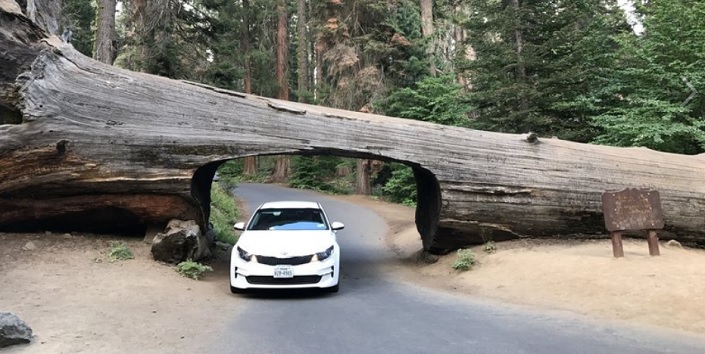
Driver, 94, pleads guilty in death of neighbour

A 94-year-old Winnipeg man has pleaded guilty to killing his elderly neighbour by accidentally driving his car over him.

Edward Hudek admitted earlier this week to a Highway Traffic Act charge of backing a vehicle without due care. He was given a $1,000 fine and two-year driving prohibition.

Frederick Albert Tippen, 86, died in April 2010 after being struck by Hudek’s rented Suzuki SX4 in the parking lot of a St. Vital seniors residence.

Hudek, who has no prior criminal or driving record, told police he heard “knocking at the side of his car” as he reversed out of a stall. He then got out, saw nothing but went inside the Dakota House assisted living facility and told a staff member he might have “bumped into somebody.”

Police and paramedics arrived to find Tippen trapped underneath the vehicle, which had to be lifted to free him. The unconscious man was rushed to hospital but pronounced dead.

“This is a tragic, isolated incident in his life,” defence lawyer Martin Glazer told court.

Hudek surrendered his licence following the tragedy and has not driven since. He also wrote a letter of apology to Tippen’s family.

Glazer said his client was unfamiliar with the rental car and may not have seen Tippen in his blind spot while backing out.

The case has raised questions about how society handles a growing number of aging motorists. The ranks of seniors behind the wheel are expanding as baby boomers age, according to Manitoba Public Insurance.

In 1994, there were more than 80,000 Manitobans 65 and older with a valid driver’s licence, MPI said. In 2010, about 103,600 — 14 per cent — of the nearly 740,000 licensed drivers provincewide were 65 or older. It’s estimated 21 per cent of drivers in Manitoba will be over 65 by 2025.

Therefore driver testing for people who reach the age of 80 should be mandatory every 18 months.  If these people can’t pass the test they can start taking cabs if they live in the city.  If they live in rural areas they can move into an old folks complex.  Friends and support staff will be there to help with the shopping, errands and appointments.

And it is not just the other drivers on the road that can be traumatized by bad senior citizen drivers, passengers are often affected as well.

Shopping can be provided by friends or companies that provide such services.  Making it less hazardous in the parking lots.

Property damage, injuries and tying up the police could all be reduced if people in their later golden years had to take the mandatory drivers test.

Ray Harryhausen: The Film-Maker Who Made The Impossible Possible

Raymond Frederick Harryhausen (June 29, 1920 – May 7, 2013) was an American artist, designer, visual effects creator, writer and producer who created a form of stop motion model animation known as “Dynamation”.

His works include the animation for Mighty Joe Young (1949), with his mentor Willis H. O’Brien, for which he won the Academy Award for Best Visual Effects; his first color film, The 7th Voyage of Sinbad (1958); and Jason and the Argonauts (1963), which featured a sword fight with seven skeleton warriors. His last film was Clash of the Titans (1981), after which he retired.

Dangerous Minds

If it wasn’t a monster movie, then it wasn’t worth watching. That was my narrow view of films when I was a child. There was the usual list of werewolves, and vampires, and stitched-together cadavers from Frankenstein’s lab, but there was nothing quite as thrilling as seeing Ray Harryhausen’s name on a film.

Harryhausen’s name meant memorable special effects that made any film extraordinary. Before VHS or DVD recorders, we memorized those key scenes to replay in our heads, and discuss at our leisure. The ghoulish, resurrected skeletons that fought Jason and the Argonauts; the Rhedosaurus that tore up New York in The Beast from 20,000 Fathoms; the Terradactyl  that terrorized Raquel Welch in One Million Years B.C.; the sinewed goddess Khali that fought Sinbad; these were memories that made many a childhood special – mine included.

It was seeing the original version of King Kong that started Harryhausen off on his career. His ability to duplicate some of Willis O’Brien’s groundbreaking effects led the young Harryhausen to meet and then work with his idol on Mighty Joe Young, in 1949. Their collaboration won an Oscar, and set Harryhausen off on his career. This is Ray Harryhausen interviewed in 1974, discussing his designs and the techniques used on some of his greatest films.

Hotel of Doom

BBC

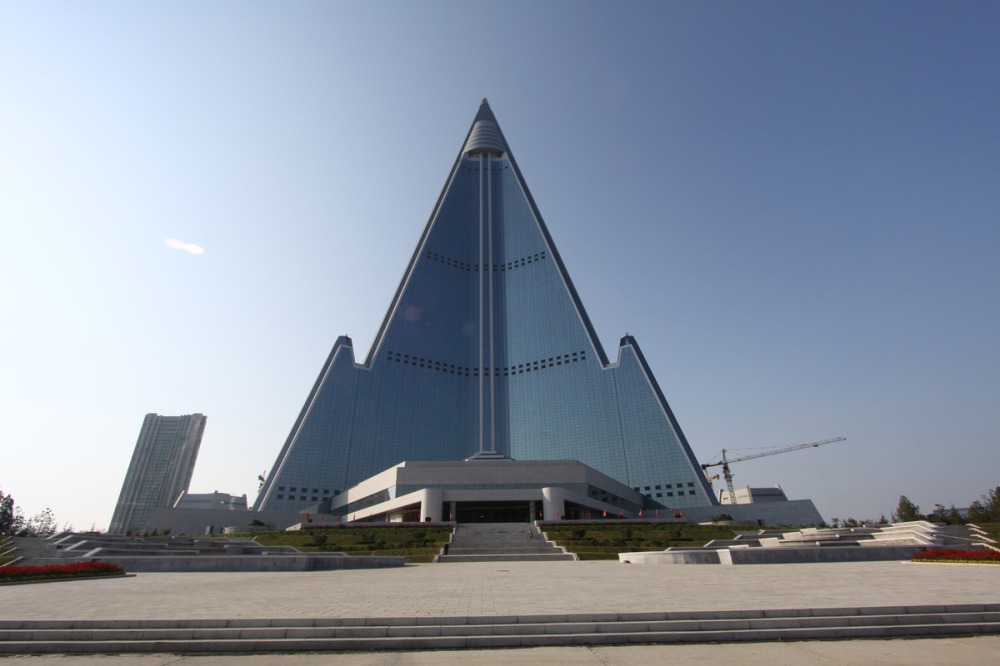
Pictures have emerged showing the inside of a 105-storey pyramid-shaped hotel that has been under construction in Pyongyang for 25 years.

North Korea began building the Ryugyong hotel in 1987, but construction was halted for 16 years when funds ran out.

Although work restarted in 2008, the hotel has become, for many, a symbol of North Korea’s thwarted ambitions.

The tour company that took the pictures say the hotel is now due to open in two or three years time.

Few people have been allowed inside the notorious hotel, which has been variously dubbed the “The Hotel of Doom” or “The Phantom Hotel”.

When conceived, the Ryugyong was intended to communicate to the world an impression of North Korea’s burgeoning wealth.

But other economic priorities meant that the hotel had to be put to one side, and it remained untouched until a city-wide “beautification scheme” was introduced five years ago.

At that time, external construction was forecast to take until the end of 2010, with work on the inside being completed in 2012 at the earliest.

But the photo of the interior taken by Koryo Tours, a Beijing-based company that specialises in travel to North Korea, shows a vast concrete lobby with barriers around the edge of each floor.

The bare interior has no sign of cabling, wiring or pipes, let alone furnishings

RYUGYONG HOTEL 330m (1,083ft) high, 105 floors. Construction started 1987, halted from 1993-2008.

China rocket debris ‘disintegrates over Indian Ocean’ – Chinese media

The rocket was launched to carry a Chinese space station section into orbit

Debris from a Chinese rocket that had been hurtling back towards Earth has disintegrated over the Indian Ocean, China says.

The bulk of the rocket was destroyed during the re-entry, but parts landed at a location 72.47° East and 2.65° North, Chinese state-run media reported.

The point lies west of the Maldives.

US and European tracking sites had been monitoring the uncontrolled fall of the Long March-5b vehicle.

Chinese state media said parts of the rocket re-entered the atmosphere at 10:24 Beijing time (02:24 GMT) on Sunday.

US Space Command said in a statement that it could “confirm the Chinese Long March-5b re-entered over the Arabian Peninsula”. It was “unknown if the debris impacted land or water,” the agency said.

Ahead of the rocket’s re-entry there were fears that debris could come down in an inhabited area. US Defence Secretary Lloyd Austin said China had been negligent in letting the rocket fall out of orbit.

However, space experts had predicted that the chances of anyone actually being hit by a piece of space junk were very small, not least because so much of the Earth’s surface is covered by ocean, and huge land areas are uninhabited.

The main segment from the Long March-5b vehicle was used to launch the first module of China’s new space station last month.

At 18 tonnes it is one of the largest items in decades to have an undirected dive into the atmosphere.

The US said last week it was watching the path of the object – but had no plans to shoot it down.

Various space debris modelling experts had pointed to late Saturday or early Sunday (GMT) as the likely moment of re-entry.

The experts predicted that most of the vehicle would burn up during its final plunge through the atmosphere, although there was always the possibility that metals with high melting points, and other resistant materials, could survive to the Earth’s surface.

When a similar core stage returned to Earth a year ago, piping assumed to be from the rocket was identified on the ground in Ivory Coast, Africa.

China has bridled at the suggestion that it has been negligent in allowing the uncontrolled return of so large an object.

Commentary in the country’s media had described Western reports about the potential hazards involved as “hype” and predicted the debris would fall somewhere in international waters.

The Golden Bridge, Vietnam.

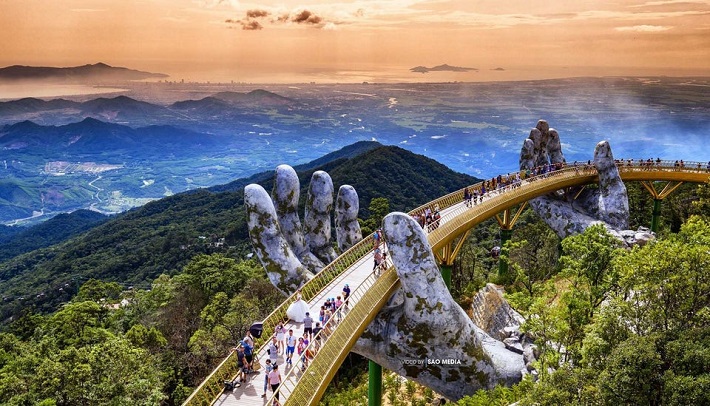
The Golden Bridge (Vietnamese: Cầu Vàng) is a 150-metre-long (490 ft) pedestrian bridge in the Bà Nà Hills resort, near Da Nang, Vietnam. It is designed to connect the cable car station with the gardens (avoiding a steep incline) and to provide a scenic overlook and tourist attraction. The bridge loops nearly back around to itself, and has two giant hands, constructed of fibreglass and wire mesh, designed to appear like stone hands that support the structure.

The client for the project was the Sun Group. The bridge was designed by TA Landscape Architecture (under Ho Chi Minh City University of Architecture) based in Ho Chi Minh City. The company’s founder, Vu Viet Anh, was the project’s principal designer, with Tran Quang Hung as the bridge designer and Nguyen Quang Huu Tuan as the bridge’s design manager. Construction began in July 2017 and was completed in April 2018. The bridge opened in June 2018.