
Source: Yale School of Forestry and Environmental Studies
Source: Yale School of Forestry and Environmental Studies
David Morris encounters rare optical illusion known as superior mirage while out on coastal stroll

David Morris, who captured the extraordinary sight on camera, declared himself “stunned” when he noticed a giant tanker floating above the water as he looked out to sea from a hamlet near Falmouth in Cornwall.
The effect is an example of an optical illusion known as a superior mirage. Such illusions are reasonably common in the Arctic but can also happen in UK winters when the atmospheric conditions are right, though they are very rare.
The illusion is caused by a meteorological phenomenon called a temperature inversion. Normally, the air temperature drops with increasing altitude, making mountaintops colder than the foothills. But in a temperature inversion, warm air sits on top of a band of colder air, playing havoc with our visual perception. The inversion in Cornwall was caused by chilly air lying over the relatively cold sea with warmer air above.

The guardian
Elon Musk’s SpaceX has successfully landed one of its Starship prototypes at the end of a high-altitude test flight.
It is the first time the space exploration company has pulled this off, after the ship’s predecessors crashed into the ground.
But that wasn’t the end of the story. A fire then developed around SN10’s base and eight minutes later it exploded on the landing pad in Boca Chica, Texas.










I couldn’t sleep at all last night
Got to thinkin’ of you
Baby things weren’t right
Well I was tossin’ and turnin’
Turnin’ and tossin’
a-tossin’ and turnin’ all night
I kicked the blankets on the floor
Turned my pillow upside down
I never never did before
’cause I was tossin’ and turnin’
Turnin’ and tossin’
a-tossin’ and turnin’ all night
Jumped out of bed
Turned on the light
I pulled down the shade
Went to the kitchen for a bite
Rolled up the shade
Turned off the light
I jumped back into bed
It was the middle of the night
The clock downstairs was strikin’ four
Couldn’t get you off my mind
I heard the milkman at the door
’cause I was tossin’ and turnin’
Turnin’ and tossin’
a-tossin’ and turnin’ all night
Jumped out of bed
Turned on the light
I pulled down the shade
Went to the kitchen for a bite
Rolled up the shade
Turned off the light
I jumped back into bed
It was the middle of the night
The clock downstairs was strikin’ four
Couldn’t get you off my mind
I heard the milkman at the door
’cause I was tossin’ and turnin’
Turnin’ and tossin’
a-tossin’ and turnin’ all, yay, yay, yay
I was a-tossin’ and turnin’
Joan of Arc, nicknamed “The Maid of Orléans” is considered a heroine of France for her role during the Lancastrian phase of the Hundred Years’ War, and was canonized as a Roman Catholic saint. Joan of Arc was born to Jacques d’Arc and Isabelle, a peasant family, at Domrémy in north-east France. Joan said she received visions of the Archangel Michael, Saint Margaret, and Saint Catherine instructing her to support Charles VII and recover France from English domination late in the Hundred Years’ War. The uncrowned King Charles VII sent Joan to the siege of Orléans as part of a relief mission. She gained prominence after the siege was lifted only nine days later. Several additional swift victories led to Charles VII’s coronation at Reims. This long-awaited event boosted French morale and paved the way for the final French victory.
On 23 May 1430, she was captured at Compiègne by the Burgundian faction which was allied with the English. She was later handed over to the English, and then put on trial by the pro-English Bishop of Beauvais Pierre Cauchon on a variety of charges. After Cauchon declared her guilty she was burned at the stake on 30 May 1431, dying at about nineteen years of age.
If joan of arc
Had a heart
Would she give it as a gift
To such as me
Who longs to see
How an angel ought to be
Her dream’s to give
Her heart away
Like an orphan on a wave
She cared so much
She offered up
Her body to the grave

In San Francisco in 1890, Louis Glass and William S. Arnold invented the nickel-in-the-slot phonograph, the first of which was an Edison Class M Electric Phonograph retrofitted with a device patented under the name of Coin Actuated Attachment for Phonograph. The music was heard via one of four listening tubes.
Early designs, upon receiving a coin, unlocked the mechanism, allowing the listener to turn a crank that simultaneously wound the spring motor and placed the reproducer’s stylus in the starting groove. Frequently, exhibitors would equip many of these machines with listening tubes (acoustic headphones) and array them in “phonograph parlors”, allowing the patron to select between multiple records, each played on its own machine. Some machines even contained carousels and other mechanisms for playing multiple records. Most machines were capable of holding only one musical selection, the automation coming from the ability to play that one selection at will. In 1918 Hobart C. Niblack patented an apparatus that automatically changed records, leading to one of the first selective jukeboxes being introduced in 1927 by the Automated Musical Instrument Company, later known as AMI.
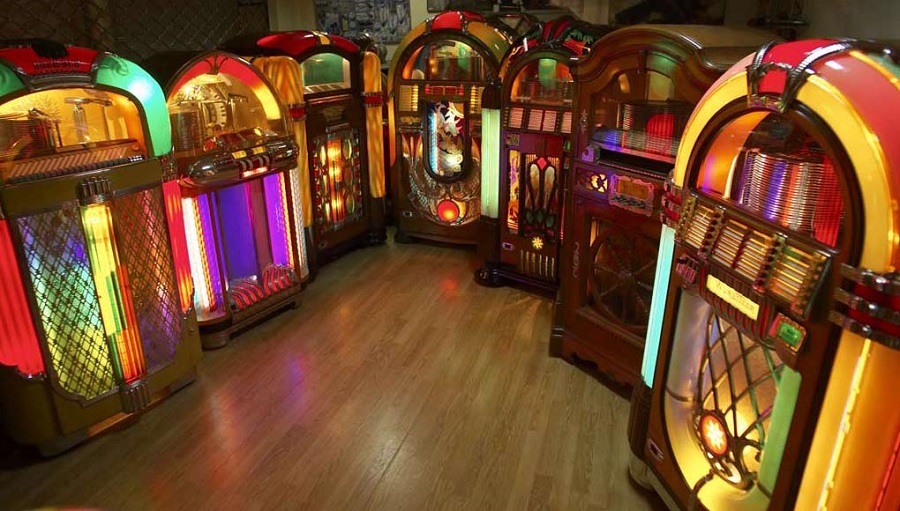
The term jukebox came into use in the United States beginning in 1940, apparently derived from the familiar usage “juke joint”, derived from the Gullah word “juke” or “joog” meaning disorderly, rowdy, or wicked. As it applies to the ‘use of a jukebox’, the terms juking (v.) and juker (n.) are the correct expressions.
Song-popularity counters told the owner of the machine the number of times each record was played (A and B side were generally not distinguished), with the result that popular records remained, while lesser-played songs could be replaced.
Wallboxes were an important, and profitable, part of any jukebox installation. Serving as a remote control, they enabled patrons to select tunes from their table or booth. One example is the Seeburg 3W1, introduced in 1949 as companion to the 100-selection Model M100A jukebox. Stereo sound became popular in the early 1960s, and wallboxes of the era were designed with built-in speakers to provide patrons a sample of this latest technology.


Jukeboxes were most popular from the 1940s through the mid-1960s, particularly during the 1950s. By the middle of the 1940s, three-quarters of the records produced in America went into jukeboxes. While often associated with early rock and roll music, their popularity extends back much earlier, including classical music, opera and the swing music era. In 1977, The Kinks recorded a song called “Jukebox Music” for their album Sleepwalker.
Many manufacturers produced jukeboxes, including 1890s Wurlitzer, 1920s Seeburg, 1930s “Rock-Ola” whose name is actually based on that of the company founder, David Cullen Rockola, Sound Leisure and Crosley.
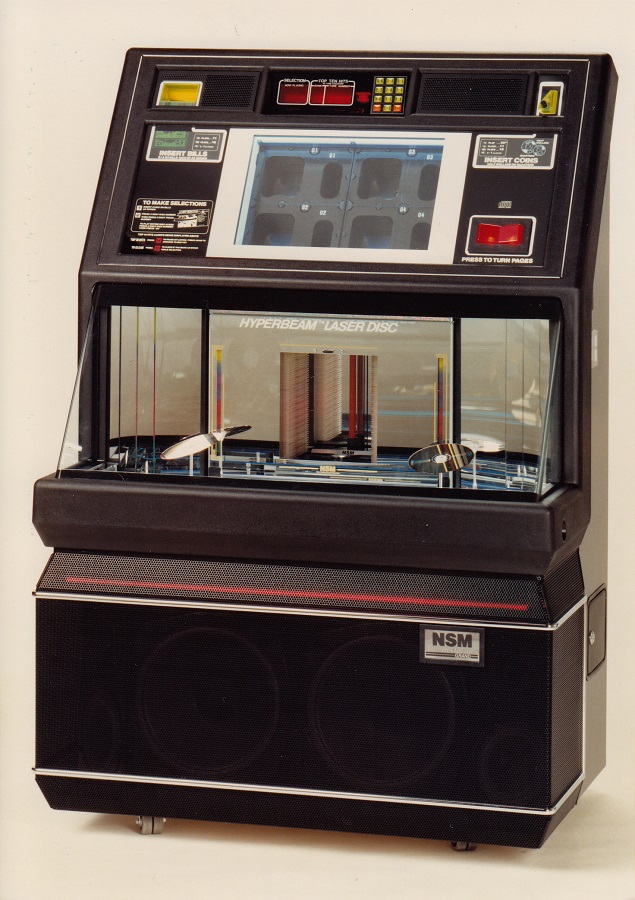
Two companies still remain today in the manufacture of classically styled jukeboxes. Rockola based in California and Sound Leisure based in Leeds in the UK. Both companies manufacture jukeboxes based on a CD playing mechanism however in April 2016 Sound Leisure showed a prototype of the “Vinyl Rocket” at the UK Classic Car Show. It stated that it would start production of the 140 7″ vinyl selector (70records) in summer of the same year.


 The MarkoZen Blog