Month: March 2021
World’s Most Powerful Rocket Passes Test
The core stage of NASA’s Space Launch System (SLS) rocket fired all four of its RS-25 engines for a little more than eight minutes—about the same duration needed to launch the Artemis I mission to the Moon. The successful hot fire tested the engines’ ability to direct thrust as well as handle throttling up to 109% power. Two massive propellant tanks that hold more than 733,000 gallons of liquid hydrogen and liquid oxygen fed the burning engines at the bottom of the stage. According to Stennis Center Director Richard Gilbrech, “This final test in the Green Run series represents a major milestone for this nation’s return to the Moon and eventual mission to Mars.”
Wild Sheep Sporting 78 Pounds of Wool Gets Life-Saving Shave
A wild sheep that had amassed a jaw-dropping coat of wool was rescued by an animal sanctuary who provided the creature with a life-saving shave. The wondrous ram was reportedly spotted roaming around a state park in Australia by a bewildered witness who reported the sighting to the Edgar’s Mission animal sanctuary in the town of Lancefield. Workers from the organization quickly located the hard-to-miss sheep, whom they named Baarack, and set about freeing it from the hirsute predicament.
The laborious task ultimately saw a staggering 78 pounds of wool removed from the creature’s body. The sanctuary was uncertain as to how the sheep wound up in such a state, but it would appear that the animal’s ear had once been tagged, suggesting that it had somehow escaped from a farm long ago. As one might imagine, the enormous coat of wool had made Baarack’s life in the wild rather difficult as it was found to be both malnourished and nearly blind due to all of the fur that had obscured its eyes.
Now free of the monstrous coat, Baarack looks like a completely different animal, able to see clearly and showing no signs of any ill-effects from its ordeal aside from a few nicks from the shears that were used to shave it. The intervention from the animal rescue organization undoubtedly saved the sheep’s life as it was not only highly vulnerable to predators, but faced increasingly challenges when it came to finding shelter and sustenance.

Abbott and Costello Meet the Invisible Man
Abbott and Costello Meet the Invisible Man is a 1951 American science fiction comedy film.

In the scene below Lou is faking practicing on the punching pear. The Invisible Man – a boxer – is actually doing the real punching.
Dazzle Camouflage: Hiding in Plain Sight
Unlike a submarine that can lurk beneath the waves, or an artillery tank that can camouflage itself among trees and the surrounding terrain, there is no hiding for a smoke-belching ship in the open waters of an ocean. So how does one go about camouflaging a ship during wartime?
That was the question that troubled Britain during World War 1. Germany’s U-boats were creating havoc in the Atlantic sinking merchant ships in alarming numbers. Ideas that were proposed included covering them with mirrors, disguising them as giant whales, draping them in canvas to make them look like clouds, or making them appear like islands. But Norman Wilkinson, a Royal Navy volunteer reserve lieutenant came up with an ingenious solution—instead of trying to hide ships, make them conspicuous; paint them with odd shapes and violent contrasts of colors so as to “dazzle” the enemy.
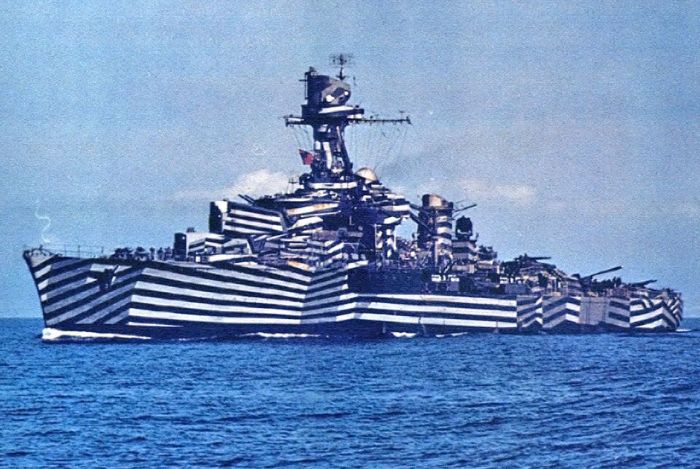
Dazzle camouflage on a World War 2-era ship.
“Since it was impossible to paint a ship so that she could not be seen by a submarine, the extreme opposite was the answer – in other words, to paint her, not for low visibility, but in such a way as to break up her form and thus confuse a submarine officer as the course on which she was heading,” Wilkinson, who was a painter, graphic designer and newspaper illustrator before the war, later told about his invention.
Dazzle camouflage, as Wilkinson’s concept came to be called, comprised of a variety of geometric shapes and curves—stripes, swirls and irregular abstract—in contrasting colors such as black and white, green and mauve, orange and blue. These shapes and colors can befuddle the captain of a U-boat peering through a periscope making it hard for him to determine the ship’s actual shape, size and direction. Bold shapes at the bow and stern can make it difficult to tell apart one from the other. Patterns disrupting the form of the ship made it hard to tell which was the front or the back, and even whether it was one vessel or two. The illusion is furthered by angled lines that make the smokestacks seem to be leaning in another direction. The curves on the hull could be mistaken for the shape of the ‘bow wave’ – created by water at the front of a fast-moving ship.

These two images demonstrate how dazzle camouflage can throw off a submarine commander’s senses. The camouflaged ship (Left) appears to be heading straight towards the observer, whereas in reality (Right) it is going off to the right.
For a U-boat gunner, looking to hit a moving target hundreds of meters away, the ship’s speed, distance and direction is essential knowledge. Accurately predicting the ships’ path is of utmost importance for a successful hit, as explained by Roy Behrens, a professor at the University of Northern Iowa: “If you’re a submarine aiming at a ship, you have to calculate how fast a ship is going, where is it going, and aim the torpedo so that they both get to the same spot at the same time.”
The gunner had typically less than 30 seconds to sight the target ship through the periscope, or risk the periscope from seen and giving away the submarine’s location. A typical U-boat also carried very limited number of very expensive slow-moving torpedoes, so getting the calculations right was important. Wilkinson’s idea was to “dazzle” the gunner so that he would either be unable to take the shot with any confidence or spoil it if he did.

Original WW1 ship models painted to test dazzle camouflage schemes. Photo: Imperial War Museum
Wilkinson developed hundreds of camouflage schemes. To determine the effectiveness of each, the Royal Academy of Arts created scale model of ships and painted them with the test patterns. They were then placed on a rotating turntable and viewed through a periscope, using screens, lights and backgrounds to see how the dazzle paint schemes would look at various times of day and night. Wilkinson even impressed King George V using one of these models. Looking through a telescope, the King announced that the ship was moving “South by west,” only to be surprised to discover that it was moving east-by-southeast.
“I have been a professional sailor for many years,” the King reportedly said, “and I would not have believed I could have been so deceived in my estimate.”

Artists of the Royal Academy of Arts applying paint on model warships. Photo: National Archives and Records Administration
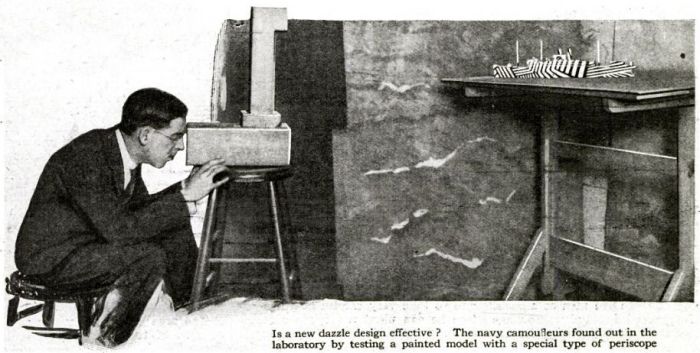
An artist testing a model vessel covered with dazzle camouflage.
In less than a year after the the Royal Navy started dazzling ships, some 2,300 British ships were painted with the camouflage, and by the end of the war, that number would swell to more than 4,000. The Americans also adopted dazzle patterns for camouflage, painting some 1,200 merchant vessels with Wilkinson’s design.
Statistically, it is hard to say whether dazzle camouflage worked. In the first quarter of 1918, for example, 72 percent of dazzled ships that were attacked were sunk or damaged versus 62 percent of non-dazzled, implying that dazzle did not minimize torpedo damage. But in the second quarter, 60 percent of attacks on dazzled ships ended in sinking or damage, compared to 68 percent of non-dazzled.
Dazzle camouflage was used again during World War II, by the US on their ships, and as an experiment, on a small number of aircrafts. But camouflage on aircraft was found to be less effective. Today, with electronic surveillance technology, dazzling a ship no longer offers any protection, but camouflage in general remains a vital part of land warfare.
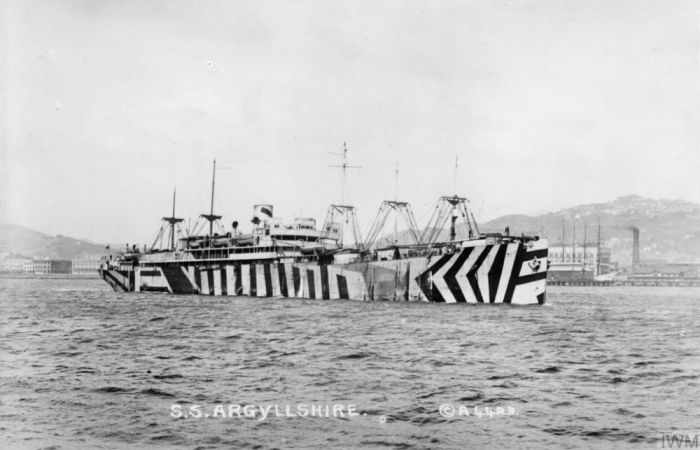
A merchant ship sporting dazzle camouflage, in Wellington, New Zealand. Photo: Imperial War Museum

Vintage Postcard of the U.S.S. Leviathan Painted With A World War I “Dazzle” Camouflage

USS West Mahomet in port, circa November 1918. Photo: Naval History & Heritage Command
Space Hotel Aims to Open in 2027
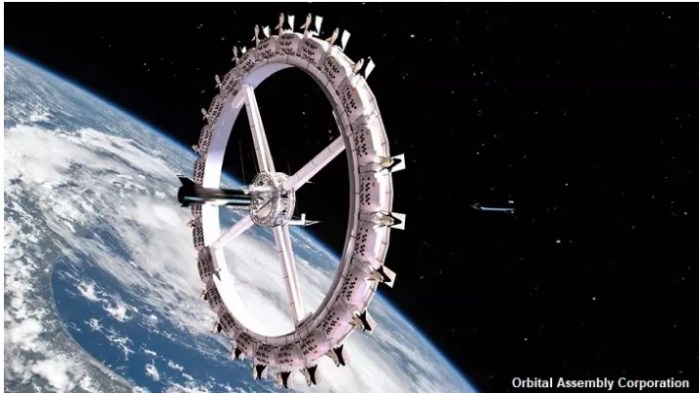
A proverbial interstellar construction company has announced plans to build a lavish space hotel and they hope to welcome their first guests to the fantastic facility in just six years. During a recent online event, the Orbital Assembly Corporation (OAC) reportedly provided a glimpse of what their ‘Voyager Station’ will look like once it has been completed and shared details as to how they intend to pull off such an audacious project. Designed to accommodate approximately 400 people spread out throughout 24 “habitation modules,” the ring-shaped space station will measure around 650 feet in diameter and reside in low Earth orbit, where it will rotate in a manner that will generate gravity similar to that found on the moon.
Much like luxurious cruise ships here on Earth, the hotel will be equipped with a vast array of amenities including all manner of restaurants and recreational activities, specifically a bevy of attractions designed to take advantage of the facility’s out-of-this-world setting. In addition to space tourists, the company hopes to sell spots on the station to various governments and any other large organizations that may wish to study or make use of its unique artificial gravity. OAC says that they hope to begin construction on the space hotel sometime around 2025, when a specially designed craft known as the Structure Truss Assembly Robot will be dispatched into space and begin building the framework of the facility.
Assuming that there are no complications in the complex construction process, which may border on wishful thinking at this stage of the station’s development, they anticipate spending two years completing the project and ultimately opening for business in 2027. With that in mind, those hoping to visit the space hotel sometime in the future will likely want to start saving now as the estimated cost for just a three-and-a-half-day visit is a whopping $5 million. Alas, with that kind of price tag, most of us will likely be stuck in the unenviable position of looking at someone’s else vacation pictures from the historic station rather than experience it for ourselves.











Get Ready
I never met a girl who makes me feel the way that you do. (You're alright)
Whenever I'm asked who makes my dreams real, I say that you do. (You're outta sight)

So, fee-fi-fo-fum
Look out baby, 'cause here I come.

And I'm bringing you a love that's true.
So get ready, so get ready.
I'm gonna try to make you love me too.
So get ready, so get ready 'cause here I come.

(Get ready 'cause here I come) I'm on my way.
(Get ready 'cause here I come)

If you wanna play hide and seek with love, let me remind you (It's alright)
But the lovin' you're gonna miss and the time it takes to find you (It's outta sight)

So, fiddley-dee, fiddley-dum
Look out baby, 'cause here I come.

And I'm bringing you a love that's true.
So get ready, so get ready.
I'm gonna try to make you love me too.
So get ready, so get ready 'cause here I come.

(Get ready 'cause here I come) I'm on my way.
(Get ready 'cause here I come)
(Get ready)

[Instrumental]

If all my friends should want you too, I'll understand it. (Be alright)
I hope I get to you before they do, the way I planned it. (Be outta sight)

So tiddley-dee, tiddley-dum
Look out baby, 'cause here I come.

And I'm bringing you a love that's true.
So get ready, so get ready.
I'm gonna try to make you love me too.
So get ready, so get ready 'cause here I come.

(Get ready 'cause here I come) I'm on my way.
(Get ready 'cause here I come)
(Get ready 'cause here I come-a)
(Get ready)
 The MarkoZen Blog