If it wasn’t for Lucille Ball, there wouldn’t be any Trekkies

The ultimate decision to put the original Star Trek series on the air back in 1966 fell into the hands of Lucille Ball. She was a studio executive (Desilu) who wielded power over decisions like which shows will move forward and which shouldn’t. She took the Star Trek plunge, the rest is mega science fiction franchise history.

Lucille Désirée Ball (August 6, 1911 – April 26, 1989) was an American actress, comedienne, model, film studio executive, and TV producer. She was the star of the sitcoms I Love LucyThe Lucy–Desi Comedy HourThe Lucy ShowHere’s Lucy, and Life with Lucy.

How Star Trek was launched:

In April 1964, Gene Roddenberry presented the Star Trek draft to Desilu Productions, a leading independent television production company. He met with Herb Solow, Desilu’s Director of Production. Solow saw promise in the idea and signed a three-year program-development contract with Roddenberry.

The idea was extensively revised and fleshed out during this time – ‘The Cage’ pilot filmed in late 1964 differs in many respects from the March 1964 treatment. Solow, for example, added the Star Date concept.

Desilu Productions had a first-look deal with CBS. Oscar Katz, Desilu’s Vice President of Production, went with Roddenberry to pitch the series to the network. They refused to purchase the show, as they already had a similar show in development, the 1965 Irwin Allen series Lost in Space.

In May 1964, Solow, who previously worked at NBC, met with Grant Tinker, then head of the network’s West Coast programming department. Tinker commissioned the first pilot – which became ‘The Cage’. NBC turned down the resulting pilot, stating that it was ‘too cerebral.’ However, the NBC executives were still impressed with the concept, and they understood that its perceived faults had been partly because of the script that they had selected themselves.

NBC made the unusual decision to pay for a second pilot, using the script called “Where No Man Has Gone Before”. Only the character of Spock, played by Leonard Nimoy, was retained from the first pilot, and only two cast members, Majel Barrett and Nimoy, were carried forward into the series. This second pilot proved to be satisfactory to NBC, and the network selected Star Trek to be in its upcoming television schedule for the fall of 1966.

The second pilot introduced most of the other main characters: Captain Kirk (William Shatner), chief engineer Lt. Commander Scott (James Doohan) and Lt. Sulu (George Takei), who served as a physicist on the ship in the second pilot but subsequently became a helmsman throughout the rest of the series. Paul Fix played Dr. Mark Piper in the second pilot; ship’s doctor Leonard McCoy (DeForest Kelley) joined the cast when filming began for the first season, and he remained for the rest of the series, achieving billing as the third star of the series. Also joining the ship’s permanent crew during the first season were the communications officer, Lt. Nyota Uhura (Nichelle Nichols), the first African-American woman to hold such an important role in an American television series; the captain’s yeoman, Janice Rand (Grace Lee Whitney), who departed midway through the first season; and Christine Chapel (Majel Barrett), head nurse and assistant to McCoy. Walter Koenig joined the cast as Ensign Pavel Chekov in the series’ second season.

In February 1966, Star Trek was nearly killed by Desilu Productions, before airing the first episode. Desilu had gone from making just one half-hour show (The Lucy Show), to deficit financing a portion of two expensive hour-long shows, Mission: Impossible and Star Trek. Solow was able to convince LUCILLE BALL that both shows should continue.


ballx3


Imagine the world without Trekkies.

trekx


trekkies


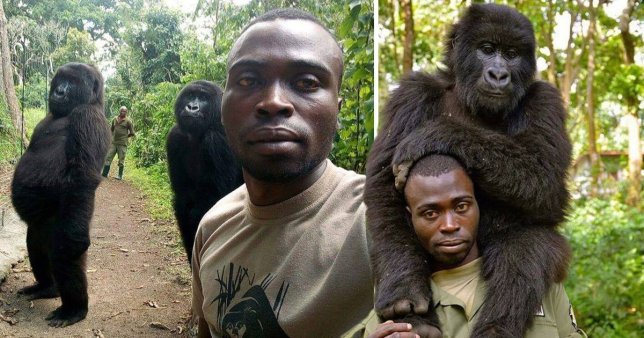
Gorillas pose for selfie with DR Congo anti-poaching unit

Two gorillas have been photographed posing for a relaxed selfie with the rangers who rescued them as babies.

The image was taken at a gorilla orphanage in Virunga National Park, DR Congo, where the animals were raised after poachers killed their parents.

The park’s deputy director told BBC Newsday that they had learned to imitate their carers, who have looked after them since they were found.

The gorillas, he added, think of the rangers as their parents.

Innocent Mburanumwe, deputy director of Virunga, told the BBC the gorillas’ mothers were both killed in July 2007.

The gorillas were just two and four months old at the time.

Shortly afterwards, they were found and taken to Senkwekwe Sanctuary in Virunga, where they have lived ever since.

Because they’ve grown up with the rangers who rescued them, Mr Mburanumwe added, “they are imitating the humans” – and standing on two legs is their way of “learning to be human beings”.

But it “doesn’t happen normally”, he said.

“I was very surprised to see it… so it’s very funny. It’s very curious to see how a gorilla can imitate a human and stand up.”

Five rangers were killed in Virunga National Park last year in an ambush by suspected rebels, and more than 130 park rangers have been killed in Virunga since 1996.

Eastern DR Congo is mired in conflict between the government and various armed groups.

Some of these armed groups are based in the park, where they often poach animals.

BBC

Why the Ark of the Covenant is one of history’s enduring mysteries

Archaeologists are skeptical that this ancient artifact can be found.

FOR CENTURIES, PEOPLE have tried in vain to locate and recover the Bible’s most sacred objects. Among the most sought-after of these religious antiquities is the famed Ark of the Covenant.

This legendary artifact is the ornate, gilded case said to have been built some 3,000 years ago by the Israelites to house the stone tablets on which the Ten Commandments were written. Biblical accounts describe the Ark as large, about the size of a 19th-century seaman’s chest, made of gold-plated wood, and topped with two large, golden angels. It was carried using poles inserted through rings on its sides.

The Ark has been linked to several of the Old Testament’s miracles. It is said to have cleared impediments and poisonous animals from the path of the Israelites during the Exodus. When the Israelites crossed the Jordan River into the Promised Land, the Bible says that the river stopped flowing the moment the Ark-bearers set foot in it.

And many believe that when the Israelites besieged Jericho, they carried the Ark around the city for a week, blowing trumpets until, on the seventh day, the walls fell down, allowing easy conquest. (This is what archaeology is telling us about the real Jesus.)

But in 597 and 586 B.C., the Babylonian Empire conquered the Israelites, and the Ark, at the time supposedly stored in the Temple in Jerusalem, vanished from history. Whether it was destroyed, captured, or hidden–nobody knows.

One of the most famous claims about the Ark’s whereabouts is that before the Babylonians sacked Jerusalem, it had found its way to Ethiopia, where it still resides in the town of Aksum, in the St. Mary of Zion cathedral. Church authorities, however, say only one man, the guardian of the Ark, is allowed to see it, and they have never permitted it to be studied for authenticity.

Another claim is that the Ark was hidden in a warren of passages beneath the First Temple in Jerusalem before the Babylonians destroyed it in 586 B.C. But that theory can’t be tested either, because the site is home to the Dome of the Rock shrine, sacred in Islam. Digging beneath it simply isn’t an option.

Other more dubious claims exist, too. But perhaps the most famous quest for the Ark was on the big screen. In the 1981 movie Raiders of the Lost Ark, adventure hero Indiana Jones must find the Ark before the Nazis, who intend to use its power for world domination.

Searches for such biblical relics are compelling, says archaeologist and National Geographic Society fellow Fred Hiebert, but ultimately doomed to failure. Even if there is an ancient, Ark-like object in Ethiopia, he asks, how do you determine it’s the one from the Bible?

“We are talking about things [at] the crossroads between myth and reality,” he said. “I think it’s great to have stories like [that of] the Ark of the Covenant. But I do not believe, as a field archaeologist, that we can use the scientific method to prove or disprove [them].”

nationalgeographic.com

Heavy Duty Sinkholes

A ver big sinkhole appeared in Naples today:


In the last few years, news of unexpected sinkholes swallowing cars, houses and people have made headlines with disturbingly high frequency. These reports are mainly coming from Florida, the U.S., where almost the entire state is karst terrain (made of limestone), which means it has the potential for sinkholes. Mexico, Belize and parts of Italy and China are also karst area, but the phenomenon of sinkholes suddenly appearing in apparently stable grounds is mostly American. Experts estimate thousands of sinkholes form every year in Florida alone.

Sinkholes form when water flowing underground has dissolved rock, mostly limestone and sometimes clay, below the surface, leading to the formation of underground voids. When the surface layer can no longer take the weight of whatever that’s above, it collapses into the void forming sinkholes. These sinkholes can be dramatic, because the surface land usually stays intact until there is not enough support. Then, a sudden collapse of the land surface can occur.


asink

A giant sinkhole caused by the rains of Tropical Storm Agatha is seen in Guatemala City on May 31, 2010. More than 94,000 people were evacuated as the storm buried homes under mud, swept away a highway bridge near Guatemala City and opened up sinkholes in the capital. (Casa Presidencial / Handout / Reuters)


asink1

An aerial view of the damaged Gran Marical de Ayacucho highway in the state of Miranda outside Caracas December 1, 2010. Thousands of Venezuelans fled their homes after landslides and swollen rivers killed at least 21 people and threatened to cause more damage. (Photo by Miranda Government/Reuters)


asink2

A construction vehicle lies where it was swallowed by a sinkhole on Saint-Catherine Street in downtown Montreal, August 5, 2013. (Photo by Christinne Muschi/Reuters)


asink3

Pamela Knox waits for rescue after a massive sinkhole opened up underneath her car in Toledo, Ohio in this July 3, 2013 handout photo provided by Toledo Fire and Rescue. Toledo firefighters later rescued Knox without major injuries. Fire officials told a local TV station that a water main break caused the large hole. Picture taken July 3, 2013. (Photo by Lt. Matthew Hertzfeld/Toledo Fire and Rescue/Handout via Reuters)


asink4

A stranded car is hoisted from a collapsed road surface in Guangzhou, Guangdong province, September 7, 2008. The road collapsed on Sunday afternoon and trapped the car in a hole, which measured 5 meters (16.4 feet) in depth and 15 meters (49.2 feet) in diameter, local media reported. Further investigation is underway. Picture taken September 7, 2008. (Photo by Reuters/China Daily)


asink5

An aerial view shows the debris of a residential building and a destroyed road in the village of Nachterstedt, July 18, 2009. Three residents were missing in the eastern German village of Nachterstedt after their lakeside home and another building suddenly collapsed early Saturday into the water. A 350-metre stretch of shoreline gave way next to an old open-cast coalmine converted to a lake, about 170 kilometres south-west of Berlin. (Photo by Reuters/Gemeindeverwaltung Nachterstedt)


asink6

Rescue workers remove a bus with a crane from a Lisbon street hole November 25, 2003. The bus was parked on a Lisbon street when the ground began to open up and gobble it. No casualties were reported. (Photo by Jose Manuel/Reuters)


asink7

A truck is seen in a hole after part of the structure of a bridge collapsed into a river in Changchun, Jilin province May 29, 2011. Two truck passengers were injured, while the cause of the accident is still under investigation, local media reported. (Photo by Reuters/China Daily)


asink8

Cars lie in a sinkhole, caused when a road collapsed into an underground cave system, in the southern Italian town of Gallipoli March 30, 2007. There were no injuries in the overnight incident, according to local police. (Photo by Fabio Serino/Reuters)


asink9

A giant sinkhole that swallowed several homes is seen in Guatemala City February 23, 2007. At least three people have been confirmed missing, officials said. (Photo by Reuters/Stringer)


asink10

A large sinkhole opened on East Monument Street in Baltimore in summer 2012. The sinkhole appeared above a 120-year-old drainage culvert after heavy rains, causing evacuations and closing the road. (Algerina Perna/Baltimore Sun Photo)

Canada’s National Animal and National Sport Come Together

The beaver was given official status as an emblem of Canada when “An Act to provide for the recognition of the Beaver (Castor canadensis) as a symbol of the sovereignty of Canada” received royal assent on March 24, 1975.

Actually lacrosse and hockey are the official sports of Canada. But the sport of curling is so widespread and can be played by people of any age, Markozen is declaring it a national sport.

The Cone of Silence

The Cone of Silence is one of many recurring joke devices from Get Smart, a 1960s American comedy television series about an inept spy. The essence of the joke is that the apparatus, designed for secret conversations, makes it impossible for those inside the device – and easy for those outside the device – to hear the conversation.

The portable Cone of Silence.

Atomic Bomb Tourism

Between 1951 and 1992, there were a total of 928 announced nuclear tests at Nevada Test Site. Of those, 828 were underground.  (Sixty-two of the underground tests included multiple, simultaneous nuclear detonations, adding 93 detonations and bringing the total number of NTS nuclear detonations to 1,021, of which 921 were underground.)  The site is covered with subsidence craters from the testing. The Nevada Test Site was the primary testing location of American nuclear devices; 126 tests were conducted elsewhere (many at the Pacific Proving Grounds in the Marshall Islands).

During the 1950s, the mushroom clouds from these tests could be seen for almost 100 mi (160 km) in either direction, including the city of Las Vegas, where the tests became tourist attractions. Americans headed for Las Vegas to witness the distant mushroom clouds that could be seen from the downtown hotels.