The Impenetrable Darien Gap

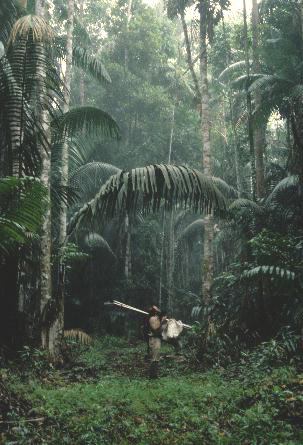
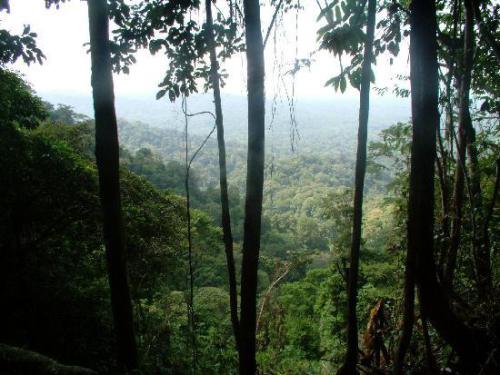
The Darién Gap is a break in the Pan-American Highway consisting of a large swath of undeveloped swampland and forest within Panama’s Darién Province in Central America and the northern portion of Colombia’s Chocó Department of South America. It measures just over 160 km (99 mi) long and about 50 km (31 mi) wide. Roadbuilding through this area is expensive, and the environmental toll is steep. Political consensus in favor of road construction has not emerged. Consequently there is no road connection through the Darién Gap connecting North/Central America with South America and it is the missing link of the Pan-American Highway.

The geography of the Darién Gap on the Colombian side is dominated primarily by the river delta of the Atrato River, which creates a flat marshland at least 80 km (50 mi) wide, half of this being swampland. The Serranía del Baudó occupy Colombia’s Pacific coast and extend into Panama. The Panamanian side, in sharp contrast, is a mountainous rainforest, with terrain reaching from 60 m (200 ft) in the valley floors to 1,845 m (6,053 ft) at the tallest peaks (Cerro Tacarcuna).

darien


The Pan-American Highway is a system of roads measuring about 48,000 km (30,000 mi) long that crosses through the entirety of North, Central, and South America, with the sole exception of the Darién Gap. On the South American side, the highway terminates at Turbo, Colombia. On the Panamanian side, the road terminus is the town of Yaviza at. This marks a straight-line separation of about 100 km (60 mi). In between is marshland and forest.

darien PanAmericanHwy

Efforts have been made for decades to remedy this missing link in the Pan-American highway. Planning began in 1971 with the help of United States funding, but this was halted in 1974 after concerns raised by environmentalists. Another effort to build the road began in 1992, but by 1994 a United Nations agency reported that the road, and the subsequent development, would cause extensive environmental damage. There is evidence that the Darién Gap has prevented the spread of diseased cattle into Central and North America, which have not seen foot-and-mouth disease since 1954, and since at least the 1970s this has been a substantial factor in preventing a road link through the Darién Gap. The Embera-Wounaan and Kuna have also expressed concern that the road would bring about the potential erosion of their cultures. The gap has been crossed by adventurers on bicycle, motorbike, all-terrain vehicle, and foot, dealing with jungle, swamp, insects, and other hazards.


This place looks like a mosquito and snake infested hot box.

darien gapxx

Darien_National_Park

darien-gap-01

End of the road, Panama side.

darien1

Entrepreneur Robert Bigelow Offers Nearly $1 Million for Evidence of the Afterlife

Entrepreneur Robert Bigelow has launched an intriguing competition in search of evidence for the afterlife and has put up nearly $1 million which will be awarded to the winning entries. The president of Bigelow Aerospace is well known in UFO circles for his many initiatives aimed at solving the mystery of the phenomenon as well as other matters of high strangeness, including the bizarre happenings reported at Skinwalker Ranch. Now Bigelow hopes that his considerable fortune can be used to answer one of humanity’s greatest questions: is there an afterlife?

This past June, he launched the Bigelow Institute for Consciousness Studies with an aim to “support research into both the survival of human consciousness after physical death and, based on data from such studies, the nature of the afterlife.” The organization notes that even though everyone on Earth will eventually die, there seems to be no serious research being done on what actually happens when such an event occurs. Lamenting that the “current scientific paradigm” does not treat afterlife studies seriously, the BICS argues that it is probably time to end this closed-minded approach.

As such, they have launched an essay contest “seeking hard evidence ‘beyond a reasonable doubt’ that takes us beyond religion or philosophy and provides a body of knowledge to be brought widely into the public arena.” These papers, the BICS envisions, will focus on scientific evidence and be backed up by documentation whether it be credible witnesses or photographic data. Judging the papers will be a panel that includes a number of experts including investigative journalist Leslie Kean and professor of religion Jeffrey Kripal.

While the competition is open to everyone, in order to actually submit an essay to the BICS, prospective entrants must first complete an application to the organization. Should they be approved, they will then have until August 1st, 2021 to produce a paper detailing their research into the afterlife. The winners of the competition will be announced on November 1st, 2021 with first place netting a whopping $500,000 and runners-up getting $300,000 and $150,000 respectively. Coast listeners looking to learn more about the competition can check out the BICS website and be sure to tune in to this coming Sunday’s edition of C2C as Robert Bigelow will be George Knapp’s guest in the first half of the program.

Just watch one of the ghost TV shows Robert. I counted 25 currently on the tube.

‘Grand Warlock’ of Mexico Issues Forecast for 2021

A colorful self-proclaimed clairvoyant in Mexico known as the country’s ‘Grand Warlock’ has issued his forecast for 2021. Much like his fellow prognosticators around the world, the start of January is the proverbial busy season for Antonio Vazquez, who holds an annual gathering in which he shares what he envisions for the coming year. By virtue of his striking appearance and bold predictions, the purported psychic’s yearly announcement of what is to come over the next twelve months is a popular event in Mexico, where it garners considerable media attention.

And so, as is tradition, Vazquez reportedly took to the stage last week to share a bevy of predictions for the new year. According to the Grand Warlock, the coronavirus “starts to be mastered between May and June, but it doesn’t end this year.” To that end, he ominously warned of a “second pandemic” in the form of widespread financial difficulties facing people around the world due to the slow economic recovery. For those seeking more specific predictions to test Vazquez at this time next year, he also predicted that the Summer Olympics set for Tokyo will once again be postponed and that this will be announced at a press conference in February.

As for here in America, the Grand Warlock forecast a difficult time for President Trump shortly after leaving office. “Trump is not going to remain silent, he will continue strong until February,” Vazquez said, “but he will have many problems” following that time period, possibly involving marital discord, illness, or legal issues. With regards to natural disasters, the prognosticator foresees an increase in hurricanes, floods, and small earthquakes, but no particularly catastrophic event.

Before one gets too depressed over the Olympics being postponed for another year, a look back at the Grand Warlock’s predictions for 2020 indicates that there may be no need to worry about such an event unfolding. That’s because, last January, Vazquez predicted that Donald Trump would be reelected, a “tremendous war” would erupt between the United States and Iran, and that Mexico would have “great success” at the Summer Olympics, which ultimately were not held. Additionally, the Grand Warlock had nary a word to say about a global pandemic when he issued his forecast for 2020, suggesting that perhaps his soothsaying may be more show than substance.

Central Park Tower Nearing Completion

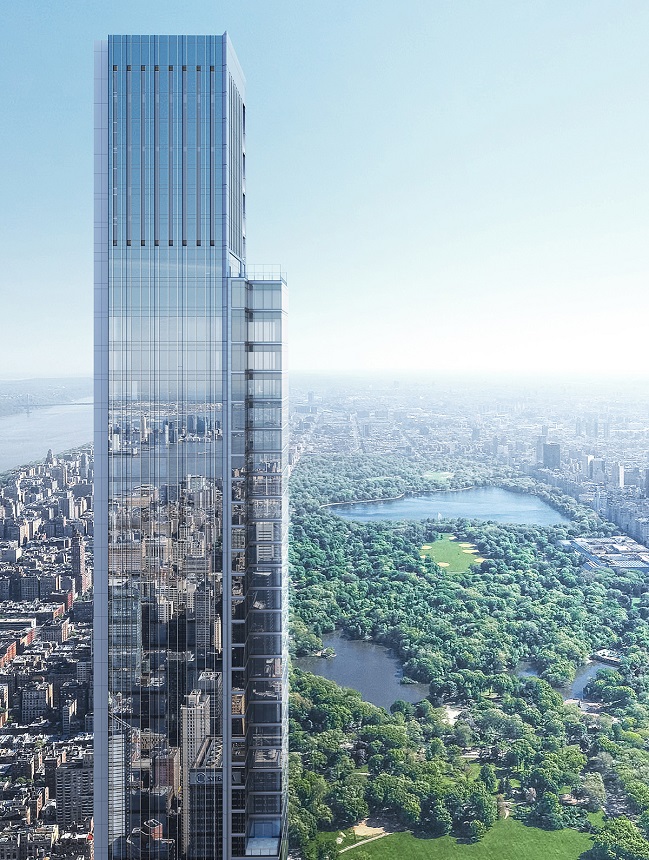
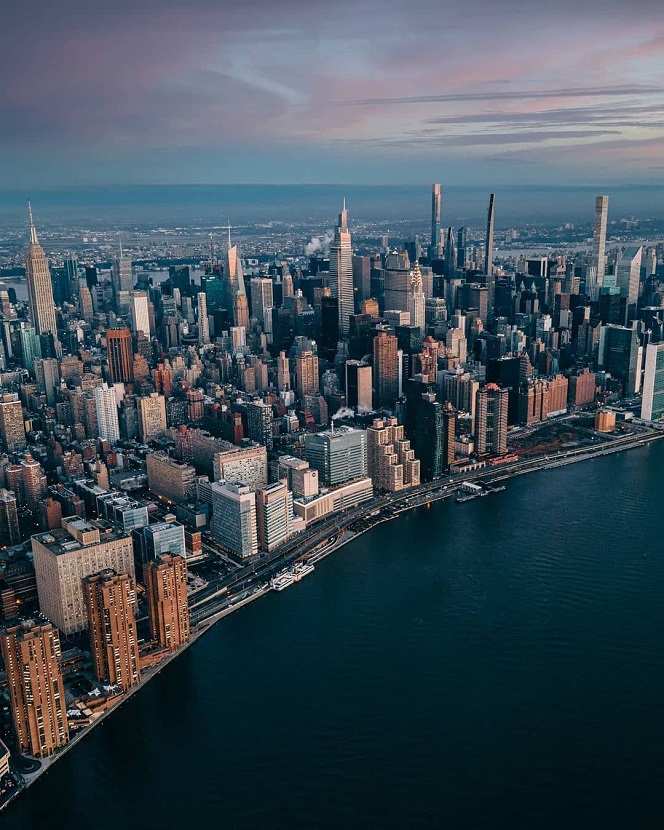
Central Park Tower, also known as the Nordstrom Tower, is a residential supertall skyscraper along Billionaires’ Row on 57th Street in Midtown Manhattan, New York City. Designed by Adrian Smith + Gordon Gill Architecture, the building rises 1,550 feet (472 m) and is the second-tallest skyscraper in the United States and the Western Hemisphere, the 13th tallest building in the world, the tallest residential building in the world, and the tallest building outside Asia by roof height.

The building will have 100 stories above ground and 3 below ground. Very expensive place to live. Some penthouse condos go for 68 million dollars.


Central Park Tower tallest building on the right.


The Vertical Forest of Milan


avertical


Bosco Verticale (Vertical Forest) is a pair of residential towers in the Porta Nuova district of Milan, Italy, between Via Gaetano de Castillia and Via Federico Confalonieri near Milano Porta Garibaldi railway station. They have a height of 110 metres (360 ft) and 76 metres (249 ft) and will host more than 900 trees (approximately 550 and 350 trees in the first and second towers respectively) on 8,900 square metres (96,000 sq ft) of terraces. Within the complex is also an 11-story office building; its facade does not host plants.

The towers were designed by Boeri Studio (Stefano Boeri, Gianandrea Barreca and Giovanni La Varra). It also involved input from horticulturalists and botanists.

The building was inaugurated in October 2014.


avertical1


The project was designed as part of the rehabilitation of the historic district of Milan between Via De Castillia and Confalonieri. It consists of two residential towers of which the largest is 26 floors and 110 meters high (called Torre E) and the smaller tower is 18 floors and 76 meters high (called Torre D). It contains 400 condominium units priced from 3,000 – 12,000 Euro per square metre.

It is called Bosco Verticale because each tower houses trees between three and six meters which help mitigate smog and produce oxygen. It is also used to moderate temperatures in the building in the winter and summer. The plants also attenuate noise. The design was tested in a wind tunnel to ensure the trees would not topple from gusts of wind. Botanists and horticulturalists were consulted by the engineering team to ensure that the structure could bear the load imposed by the plants. The steel-reinforced concrete balconies are designed to be 28 cm thick, with 1.30 metre parapets.


avertical2


The construction of the towers began in late 2009 and early 2010, involving 6,000 onsite construction workers. Between mid-2010 and early 2011 construction progressed very slowly and the towers rose by only five floors while the core rose to the seventh floor. Construction progressed throughout 2011, and by the beginning of 2012 the structures were completed, and construction of the facades and installation of the plants began on 13 June 2012. The building was inaugurated in October 2014.

On April 11, 2012, one of the buildings was used as a temporary art gallery and opened to the public for an art exhibition hosted during Milan Fashion Week.

The two buildings have 730 trees (480 large, 250 small), 5,000 shrubs, and 11,000 perennials and ground cover on its facades. The original design had specified 1,280 tall plants and 920 short plants encompassing 50 species. Overall, the vegetation is the equivalent of that found in a one hectare woodlot. The innovative use of heat-pump technology is helping to slash heating and cooling costs.


avertical3


On November 19, 2014, Bosco Verticale won the International Highrise Award, prestigious international competition bestowed every two years, honouring excellence in recently constructed buildings that stand a minimum of 100 meters (328 feet) tall. The five finalists were selected from 26 nominees in 17 countries.

On the 12th of November 2015, the Council on Tall Buildings and Urban Habitat (CTBUH) Awards Jury selected Bosco Verticale, Milan, as the overall “2015 Best Tall Building Worldwide” at the 14th Annual CTBUH International Best Tall Building Awards Symposium, Ceremony & Dinner, celebrated at the Illinois Institute of Technology, Chicago.


Gardeners rappel down ropes

avertical4


avertical5


avertical6


avertical7


avertical8


avertical9


avertical10


Bob Hope Had The Moves

Bob Hope was an entertainer from the 1950’s, 60’s, 70’s and 1980’s. Most people think of Bob Hope hosting celebrity roasts, golfing and telling lame jokes. But old Bob could really dance.

The Seven Little Foys is a Technicolor in VistaVision 1955 comedy film directed by Melville Shavelson starring Bob Hope as Eddie Foy. One highlight of the film is an energetic tabletop dance showdown sequence with Bob Hope as Eddie Foy and James Cagney as George M. Cohan (reprising his role from Yankee Doodle Dandy). The story of Eddie Foy Sr. and the Seven Little Foys inspired a TV version in 1964 and a stage musical version, which premiered in 2007.

Iguana escapes fire by jumping on Corby fireman’s helmet

An iguana escaped from a house fire by jumping on to a firefighter’s helmet.

The athletic reptile’s survival instinct kicked in when fire broke out at its owner’s home in Whitworth Avenue, Corby, on Wednesday night.

As crews battled the flames, the iguana leapt to the safety of a firefighter’s head, Northamptonshire Fire and Rescue Service said.

A spokeswoman said the crew member did not realise it was there, and the pet was carried away unscathed.

It was “a very unique incident – one that we have never dealt with before”, she said.

“The fireman… didn’t realise the iguana had climbed on top of him at first as he initially thought it was a colleague touching his helmet.

“What a surprise he then had to find this iguana chilling on his head, eager to escape the burning building.”

Iguana fact file

  • Iguanas are native to Central and South America and are tropical, arboreal lizards
  • They can grow up to six feet (1.8m) in length and are herbivorous, feeding on jungle leaves, fruits and flowers in the wild
  • Young iguanas need daily feeding whilst large adult iguanas may only feed two to three times a week on a diet consisting of, among other things, dark green leafy vegetables, carrots, tomatoes, melon and bananas
  • A mature iguana can weigh as much as 15lbs (6.8kg) and the reptiles can be difficult to handle as they have razor-sharp teeth, claws and a lashing tail