
Year: 2020
Barack and Michelle Obama react to a child in a pope costume and mini popemobile during Halloween

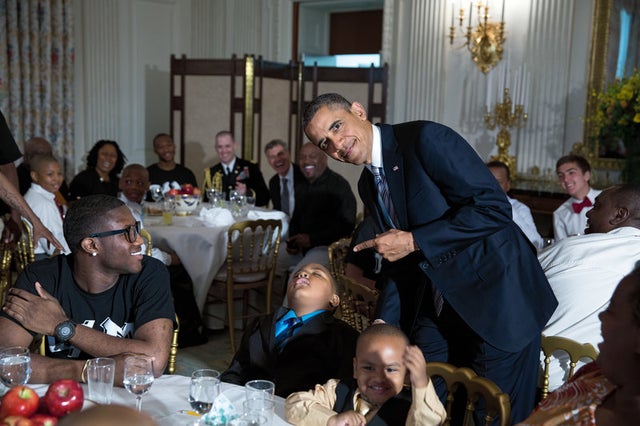
This kid fell asleep during an event at the Obama White House.
The Heavyweight Cattle Breed of The World

The Chianina is an Italian breed of cattle, formerly principally a draught breed, now raised mainly for beef. It is the largest and one of the oldest cattle breeds in the world. The famous bistecca alla fiorentina (‘beefsteak Florentine style’) is produced from its meat.
One of the oldest breeds of cattle, the Chianina originates in the area of the Valdichiana, from which it takes its name, and the middle Tiber valley. Chianina cattle have been raised in the Italian regions of Tuscany, Umbria and Lazio for at least 2200 years.

The Chianina is both the tallest and the heaviest breed of cattle. Mature bulls stand up to 1.8 m (5 ft 11 in), and castrated oxen may reach 2 m (6 ft 7 in). It is not unusual for bulls to exceed 1,600 kg (3,500 lb) in weight. Males standing over 1.51 m (4 ft 11 in) at 12 months are considered top-grade. A Chianina bull named Donetto holds the world record for the heaviest bull, reported by one source as 1,740 kg (3,840 lb) when exhibited at the Arezzo show in 1955, but as 1,780 kg (3,920 lb) and 1.85 m (6 ft 1 in) tall at the age of 8 by others including the Tenuta La Fratta, near Sinalunga in the province of Siena, where he was bred. Cows usually weigh 800–900 kg (1,800–2,000 lb), but commonly exceed 1,000 kg (2,200 lb); those standing over 1.65 m (5 ft 5 in) are judged top-grade. Calves routinely weigh over 50 kg (110 lb) at birth. The coat of the Chianina is white; very slight grey shading round the eyes and on the foreparts is tolerated. The skin, muzzle, switch, hooves and the tips of the horns are black.
At the end of 2010 there were 47,236 head registered in Italy, of which more than 90% were in Tuscany, Umbria and Lazio; it is, after the Marchigiana, the second indigenous beef breed of Italy.

Don’t want one these beasts to get agitated when you are nearby.
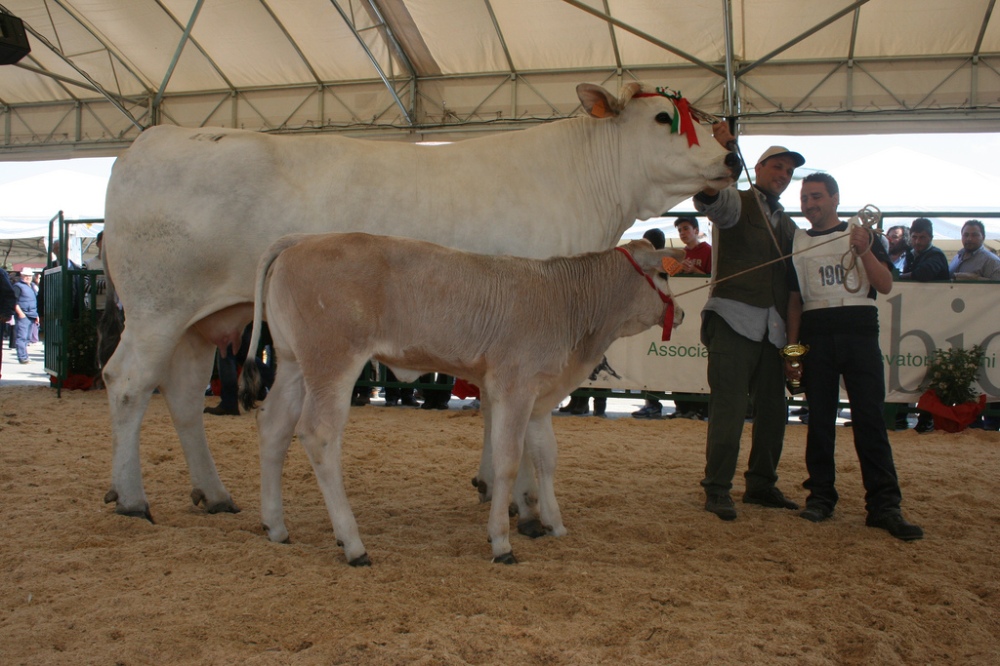

Their history as draft animals means that Chianinas were bred for docile temperaments, as they had to work closely with people. That good disposition is important in a cow as large as the Chianina.

Variations of English


Australian English — American English
Ad or advertisement (ad break), TV — Commercial (commercial break)
Autumn — fall
Bag — sack
Barrack (for your team) — root (this one does give Australians a laugh. A warning for visiting Americans.)
Bathroom – restroom
Bedside cabinet, cupboard or table — nightstand
Beetle — bug
Biffo (aggro, fisticuffs, punch-up, argy-bargy, etc) – a bit of a fight
Biro (a brand) — ballpoint
Blackboard — chalkboard or blackboard
Blackboard duster — chalkboard or blackboard eraser
Bloke (or fella [fellow]) — guy
Bogan – trailer trash (closest translation; but bogan can also be used self-depractingly; usually less of an insult than ‘trailer trash’).
Booking — reservation
Bum (backside or bottom) — butt
Bushfire — forest fire, wildfire
Bushwalk/bushwalking — hike/hiking (NZ — tramping)
Bucket — pail
Caretaker — janitor
Carrybag — tote
CBD (Central Business District) — downtown. Australians will also say they are ‘going into town’ — meaning going into the centre of the town (the CBD).
Chemist shop — drug store
Chook shed or yard — chicken coop
Clever — neat (‘neat’ in Australia is only used to mean ‘tidy/well organised’)
Conference — congress
Curtains — drapes
Cyclone — hurricane
Dad — pop (‘pop’ in Australia means grandfather, but more commonly referred to as ‘grandad’)
Deb (debutante) ball (formal coming-of-age dance for girls [and boys] of a certain age; run by community organisations, such as a Masonic Lodge or Rotary — not specifically related to schools — with proceeds going to charity) — school prom (closest equivalent)
Diary or journal (for recording appointment times and/or the day’s details) — date book or (daily) planner
Dinner suit or ‘black tie’ or tails (coat with ‘tails’) — tux (tuxedo)
Dobber (to ‘dob in’) – snitch (school age term, meaning to tell on someone’s misbehaviour)
Doona — duvet
Door frame — door jam
Drawing pins — thumb tacks
Dummy — pacifier
Film (film star, film producer etc) — movie (movie star, movie producer etc)
Finish — quit
Flat or unit — apartment
Footpath, pavement — sidewalk
Footy — football (In Australia, what sort of football it is depends on where you are. In Tasmania, Victoria, southern NSW, SA, WA, & the NT it’ll probably be Aussie Rules [AFL]; in Qld and central & northern NSW it’ll be rugby (‘union’ or ‘league’), however soccer is also referred to as footy, and it’s increasingly played in primary schools, as well as professionally. Rugby has also sneaked into Victoria, but it only has a toe-hold.)
Fortnightly – biweekly
Freight (or postage) — shipping (in Australia, ‘shipping’ is only used when an actual ship is involved; postage is via the postal system, freight is via other carriers)
Friends or mates (usually a bloke’s friends) — buddies
Fringe — bangs
Gaol (usually also “jail” in Australia now) – jail
Greeting card — note card
Grid iron — American football
Ground floor (floor level with the ground) — first floor
Guillotine — paper cutter
Guinea pigs — hamsters
Handbag (bag large enough to carry a woman’s purse, hairbrush, phone, car keys etc while shopping) – pocketbook (less common term in some parts of USA)
Holiday — vacation
Hang around together — hang out together
Jokes — gags
Jug – pitcher
Lawyer/solicitor — attorney
Lift — elevator
Lucerne – alfalfa
Medicine — drugs (in Australia, when the general public talk about ‘drugs’ they’re referring to illegal drugs — only members of the medical profession refer to medicine as ‘drugs’)
Mozzy — mosquito
Newsagency — newsstand (In Australia, the person running the newsagency — the owner and/or manager — is called a newsagent. An Australian newsagency business primarily sells newspapers & magazines; and usually basic stationery, greeting cards, and often lottery tickets.)
Noticeboard — bulletin board
Pay tv — cable tv
Pegs — clothes pins
Pissed (considered slang) – drunk
Portaloo — portajohn (brands, but used as nouns)
Primary school — elementary school
Prime mover (semi-trailer) – tractor
Postcode — zipcode
Powerpoint — wall plug
Purse (women, only; just large enough to contain banknotes, coins and credit cards) – pocket book
Queue — line
Real estate agent — realtor
Reception (motel/hotel) — lobby
Resign — quit
Ride-on mower – ride-on tractor
Roadtrain — ‘trailer truck’ or ‘big rig’ etc
Rubber (for pencils) — eraser
Rubbish bin (& rubbish tip) — trash can or garbage can (& garbage dump)
Sacked — fired
Sandpit — sandbox
Semi-trailer (truck) – semi-trailer but also tractor-trailer
Sent — shipped
Shop — store
Shopping centre — shopping mall
Shopping trolley — shopping cart
Skip — dumpster
Star jumps – jumping jacks
Sunbake — sunbathe (U.S. & U.K.) (The difference is very appropriate if you think about it. Australia has the highest incidence of skincancer in the world — so ‘bake’ instead of ‘bathe’ is very appropriate.)
Survey — poll
Tap – spigot
Teatowel – dish towel
The pictures (as in let’s go to the pictures) — the movies
Tick (the box) — check (the box)
Toilet (also sometimes bathroom) – restroom
Track (eg Kokoda track is the Australian term) — trail (eg trail riding is a U.S. term)
Trolley (as in shopping trolley) — cart
Turf (turf farm) — sod (sod farm)
Send (sent) — ship (shipped)
Spa — jacuzzi
Tap — faucet
Torch — flashlight
Verandah (groundfloor; if it’s raised up, it’s a balcony) — porch
Wallet (usually DL sized, to fit banknotes & credit cards) – billfold (rare term in Aus)
Wardrobe — closet
Weatherboard (timber clad housing) — clap board
Whinge — complain
Whiteboard — dry erase board
For emergency services in Australia, you dial 000 (triple zero), whereas it is 911 in the U.S.
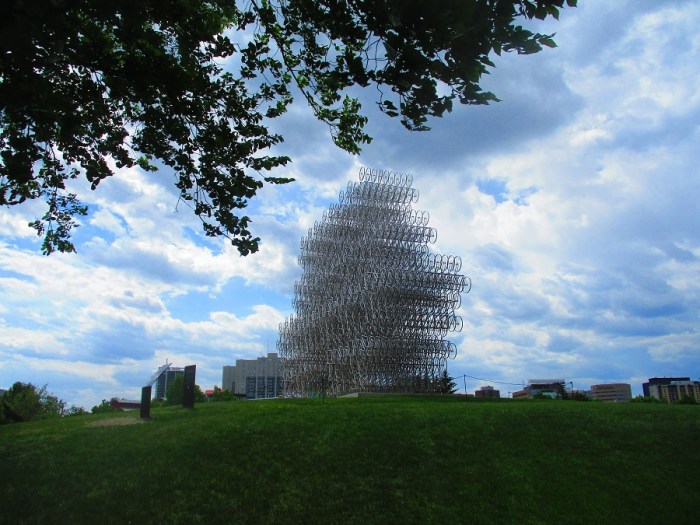
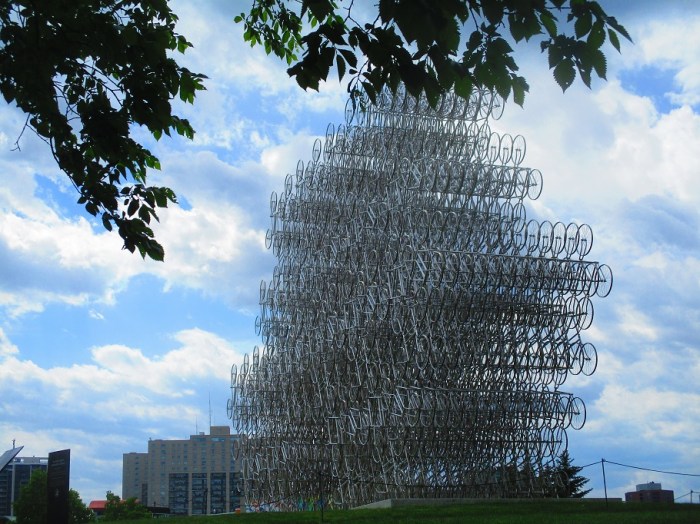
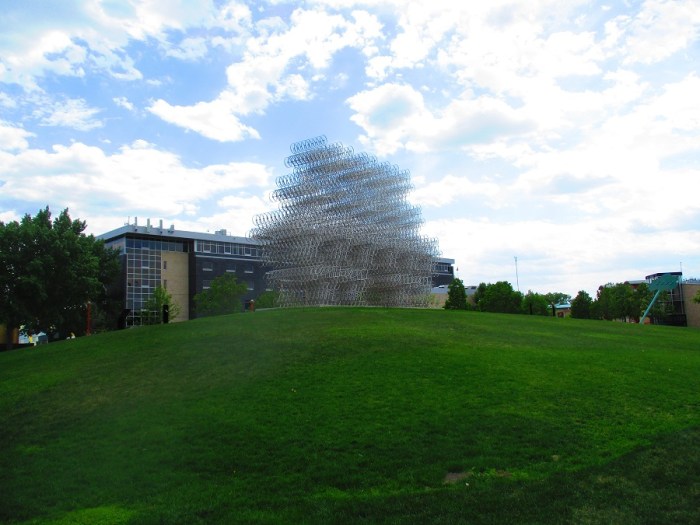
Intriguing Bicycle Art
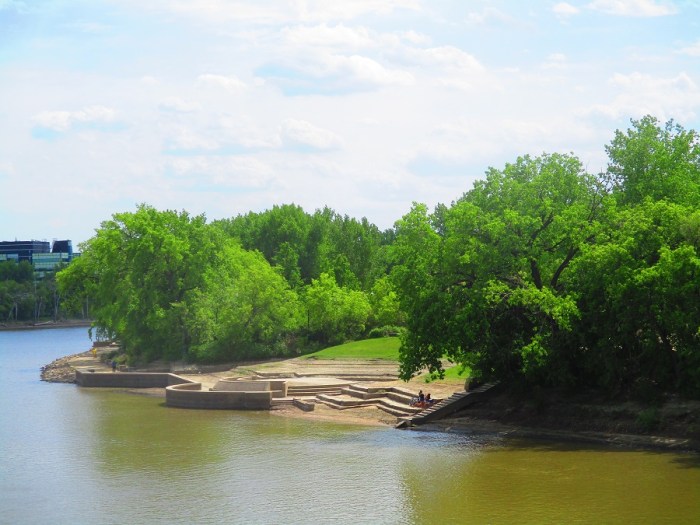
A very interesting piece of art at the Forks in Winnipeg. The piece is made up of bicycles. The Forks is a recreation and commercial area in the center of the city. It is located at the confluence of the Assiniboine River and Red River.




Top Twitter Accounts
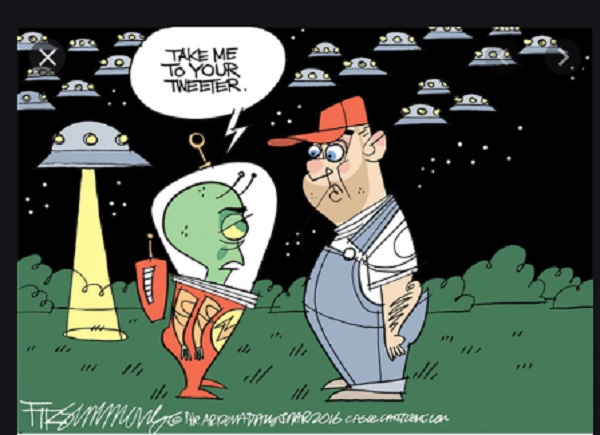
Top 50 accounts
The following table lists the top 50 most followed accounts on Twitter, with each total rounded to the nearest million followers, as well as the profession or activity of each user, and their country of origin.[1] Account totals and monthly changes in ranking were last updated on June 1, 2020.
| Rank | Change (monthly) |
Account name | Owner | Followers (millions) |
Activity | Country |
|---|---|---|---|---|---|---|
| 1 |  |
@BarackObama | Barack Obama | 119 | Former U.S. president | United States |
| 2 | |
@justinbieber | Justin Bieber | 112 | Musician | Canada |
| 3 | |
@katyperry | Katy Perry | 109 | Musician | United States |
| 4 | |
@rihanna | Rihanna | 97 | Musician and businesswoman | Barbados |
| 5 | |
@taylorswift13 | Taylor Swift | 86 | Musician | United States |
| 6 | |
@Cristiano | Cristiano Ronaldo | 85 | Footballer | Portugal |
| 7 | |
@ladygaga | Lady Gaga | 82 | Musician and actress | United States |
| 8 |  |
@realDonaldTrump | Donald Trump | 81 | Current U.S. president | United States |
| 9 |  |
@TheEllenShow | Ellen DeGeneres | 80 | Comedian and television hostess | United States |
| 10 | |
@ArianaGrande | Ariana Grande | 74 | Musician and actress | United States |
| 11 | |
@YouTube | YouTube | 72 | Online video platform | United States |
| 12 | |
@KimKardashian | Kim Kardashian | 65 | Television personality and businesswoman | United States |
| 13 | |
@jtimberlake | Justin Timberlake | 65 | Musician and actor | United States |
| 14 | |
@selenagomez | Selena Gomez | 61 | Musician and actress | United States |
| 15 | |
58 | Social media platform | United States | ||
| 16 | |
@narendramodi | Narendra Modi | 58 | Current Prime Minister of India | India |
| 17 | |
@cnnbrk | CNN Breaking News | 58 | News channel | United States |
| 18 | |
@britneyspears | Britney Spears | 56 | Musician | United States |
| 19 | ✖32 |
@ddlovato | Team Demi | 56 | Musician | United States |
| 20 | |
@shakira | Shakira | 52 | Musician | Colombia |
| 21 | |
@jimmyfallon | Jimmy Fallon | 52 | Comedian | United States |
| 22 | |
@BillGates | Bill Gates | 51 | Businessman and philanthropist | United States |
| 23 | |
@CNN | CNN | 48 | News channel | United States |
| 24 | |
@neymarjr | Neymar | 47 | Footballer | Brazil |
| 25 | |
@nytimes | The New York Times | 47 | Newspaper | United States |
| 26 | |
@KingJames | LeBron James | 46 | Basketball player | United States |
| 27 | |
@JLo | Jennifer Lopez | 45 | Musician and actress | United States |
| 28 | |
@MileyCyrus | Miley Cyrus | 45 | Musician and actress | United States |
| 29 | |
@BBCBreaking | BBC Breaking News | 44 | News channel | United Kingdom |
| 30 | |
@BrunoMars | Bruno Mars | 43 | Musician | United States |
| 31 | |
@Oprah | Oprah Winfrey | 43 | Television personality and businesswoman | United States |
World’s Largest Ship Graveyard
The city of Nouadhibou is the second largest city in Mauritania and serves as the country’s commercial center. The port of Nouadhibou is the final resting place of over 300 ships which were abandoned by their owners. These ships rusting in the shallow waters has given the port of Nouadhibou the notorious name of being the world’s largest ship graveyard. Unlike the en masse arrival of ships at Mallows Bay, here the number of craft has built up over time, as corrupt officials accepted bribes from boat owners to allow them to dump their vessels in the area.

The phenomenon started in the 80’s after the nationalization of the Mauritanian fishing industry, numerous uneconomical ships were simply abandoned there. Discarding a ship is quite expensive for a company, so during the decades, lots of unwanted ships ended up in the Harbour of Nouadibou.
A few years ago, the situation was so out of control, that even Mauritanians started to worry. Nowadays there’s a project from the European Union to refloat all these junk ships and take them away, or destroy the remaining wrecks.


The Destruction of Aleppo
The Battle of Aleppo was a major military confrontation in Aleppo, the largest city in Syria, between the Syrian opposition (including the Free Syrian Army (FSA) and other largely-Sunni groups, such as the Levant Front and the al-Qaeda-affiliated al-Nusra Front) against the Syrian government, supported by Hezbollah, Shia militias and Russia, and against the Kurdish-led People’s Protection Units (YPG). The battle began on 19 July 2012 and was part of the ongoing Syrian Civil War. A stalemate that had been in place for four years finally ended in July 2016, when Syrian government troops closed the rebels’ last supply line into Aleppo with the support of Russian airstrikes. In response, rebel forces launched unsuccessful counteroffensives in September and October that failed to break the siege; in November, government forces embarked on a decisive campaign that resulted in the recapture of all of Aleppo by December 2016. The Syrian government victory was widely seen as a potential turning point in Syria’s civil war.
The large-scale devastation of the battle and its importance led combatants to name it the “mother of battles” or “Syria’s Stalingrad”. The battle was marked by widespread violence against civilians, alleged repeated targeting of hospitals and schools (mostly by pro-government Air Forces and to a lesser extent by the rebels), and indiscriminate aerial strikes and shelling against civilian areas. It was also marked by the inability of the international community to resolve the conflict peacefully. The UN special envoy to Syria proposed to end the battle by giving East Aleppo autonomy, but the idea was rejected by the Syrian government. Hundreds of thousands of residents were displaced by the fighting and efforts to provide aid to civilians or facilitate evacuation were routinely disrupted by continued combat and mistrust between the opposing sides.
Before and after photos


In late September 2016, Russia and Syria began performing nightly air raids on rebel-held parts of the city. Russian and Syrian forces were also accused of conducting “double tap” airstrikes which purposefully targeted rescue workers and first responders at hospitals and other civilian structures that they had already bombed, however this is disputed by government and Russian sources. To prevent civilian casualties, Syrian and Russian forces opened up humanitarian corridors to allow the civilian population of Aleppo to evacuate, away from the fighting. During evacuation, several East Aleppo residents reported that evacuating civilians were shelled by rebels. During the 2016 Syrian government offensive, the Office of the United Nations High Commissioner for Human Rights warned that “crimes of historic proportions” were being committed in Aleppo.


The battle caused catastrophic destruction to the Old City of Aleppo, a UNESCO World Heritage site. With over four years of fighting, it represents one of the longest sieges in modern warfare and one of the bloodiest battles of the Syrian Civil War, which left an estimated 31,000 people dead, almost a tenth of the overall war casualties.


 The MarkoZen Blog