The Gloster Meteor

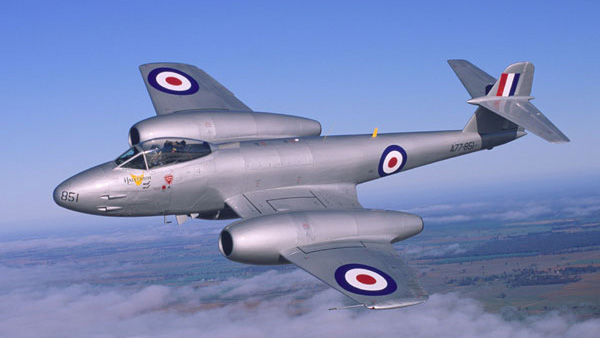
The Gloster Meteor was the first British jet fighter and the Allies’ only operational jet aircraft during the Second World War. The Meteor’s development was heavily reliant on its ground-breaking turbojet engines, pioneered by Sir Frank Whittle and his company, Power Jets Ltd. Development of the aircraft began in 1940, although work on the engines had been under way since 1936. The Meteor first flew in 1943 and commenced operations on 27 July 1944 with No. 616 Squadron RAF. Nicknamed the “Meatbox”, the Meteor was not a sophisticated aircraft in its aerodynamics, but proved to be a successful combat fighter.
 

meteor-7a


Several major variants of the Meteor incorporated technological advances during the 1940s and 1950s. Thousands of Meteors were built to fly with the RAF and other air forces and remained in use for several decades. The Meteor saw limited action in the Second World War. Meteors of the Royal Australian Air Force (RAAF) fought in the Korean War. Several other operators such as Argentina, Egypt and Israel flew Meteors in later regional conflicts. Specialised variants of the Meteor were developed for use in photographic aerial reconnaissance and as night fighters.


meteor1


No. 616 Squadron RAF was the first to receive operational Meteors: a total of 14 aircraft were initially delivered. The squadron was based at RAF Culmhead, Somerset and had been previously equipped with the Spitfire VII. The conversion to the Meteor was initially a matter of great secrecy. Following a conversion course at Farnborough attended by the squadron’s six leading pilots, the first aircraft was delivered to Culmhead on 12 July 1944. The squadron and its seven Meteors moved on 21 July 1944 to RAF Manston on the east Kent coast and, within a week, 32 pilots had been converted to the type.

The Meteor was initially used to counter the V-1 flying bomb threat. 616 Squadron Meteors saw action for the first time on 27 July 1944, when three aircraft were active over Kent. These were the first operational jet combat missions for the Meteor and for the Royal Air Force. After some problems, especially with jamming guns, the first two V1 “kills” were made on 4 August. By war’s end, Meteors had accounted for 14 flying bombs. After the end of the V-1 threat, and the introduction of the ballistic V-2 rocket, the RAF was forbidden to fly the Meteor on combat missions over German-held territory for fear of an aircraft being shot down and salvaged by the Germans.

meteor-3

No. 616 Squadron briefly moved to RAF Debden to allow USAAF bomber crews to gain experience and create tactics in facing jet-engined foes before moving to Colerne, Wiltshire. For a week from 10 October 1944 a series of exercises were carried out in which a flight of Meteors made mock attacks on a formation of 100 B-24s and B-17s escorted by 40 Mustangs and Thunderbolts. These suggested that, if the jet fighter attacked the formation from above, it could take advantage of its superior speed in the dive to attack the bombers and then escape by diving through the formation before the escorts could react. The best tactic to counter this was to place a fighter screen 5,000 ft above the bombers and attempt to intercept the jets early in the dive. The exercise was also useful from No. 616 Squadron’s perspective, gaining valuable practical experience in Meteor operations.

In March, the entire squadron was moved to Gilze-Rijen and then in April, to Nijmegen. The Meteors flew armed reconnaissance and ground attack operations without encountering any German jet fighters. By late April, the squadron was based at Faßberg, Germany and suffered its first losses when two aircraft collided in poor visibility. The war ended with the Meteors having destroyed 46 German aircraft through ground attack. Friendly fire through misidentification as Messerschmitt Me 262s by Allied anti-aircraft gunners was more of a threat than the already-diminished forces of the Luftwaffe; to counter this, continental-based Meteors were given an all-white finish as a recognition aid.


meteor12


Operators:

Australia: 113 aircraft

Argentina: 100 aircraft

Egypt: 30 aircraft

meteor2

Syria: 25 aircraft

France: 55 aircraft

Israel: 35 aircraft

meteors_alley_c

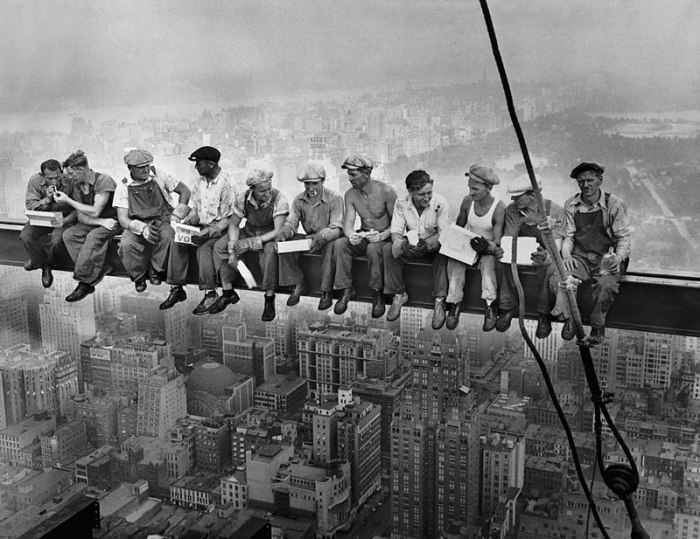
Chicago workers remake the iconic ‟lunch atop the skyscraper” photo from 1932

Lunch atop a Skyscraper (New York Construction Workers Lunching on a Crossbeam) is a photograph taken atop the steelwork of 30 Rockefeller Plaza, during the construction of the Rockefeller Center, in Manhattan, New York City, United States.

The photograph depicts 11 men eating lunch, seated on a girder with their feet dangling 840 feet (260 meters) above the New York City streets. The photograph was taken on September 20, 1932, on the 69th floor of the RCA Building during the last months of construction. According to archivists, the photograph was in fact prearranged. Although the photograph shows real ironworkers, it is believed that the moment was staged by Rockefeller Center to promote its new skyscraper. Other photographs taken on the same day show some of the workers throwing a football and pretending to sleep on the girder. The photo appeared in the Sunday photo supplement of the New York Herald Tribune on October 2, 1932.


Opera House Concert Serenades Thousands of Potted Plants

On Monday, the El Liceu opera house in Barcelona hosted a special concert for 2,292 house plants. The event, organized by Spanish conceptual artist Eugenio Ampudia, took place just as Spain lifted its three-month state of emergency. Reaffirming the value of art and music, the theatre kicked off its re-opening with this performance as a kind of roadmap for returning to normalcy.

Ampudia said the inspiration for the idea came from his getting back in touch with nature during the quietude of the pandemic. The plants will be donated to local health care workers as a token of appreciation for their hard work.

Kung Flu

Donald Trump may not be qualified or competent enough to be President of the United States, but one thing he is very competent at, is name calling.  From “Sleepycreepy” Joe Biden, “Crooked Hillary” Clinton, “Mini Mike” Michael Bloomberg, “Slimeball” James Comey, ‘Al Frankenstein” Al Franken, “Basically braindead Bernie” Bernie Sanders and many many more.

Such bizarre presidential behaviour. But the strange thing is Trump’s base and supporters like the name calling. They like the way he ‘tells it like it is’. Where has social decorum gone?

But now Trump has come up with a nickname for covid-19. Kung Flu!

White House press secretary Kayleigh McEnany on Monday defended President Donald Trump’s use of the term “Kung Flu” in referring to COVID-19 at a rally in Tulsa, Oklahoma.

McEnany said Trump’s rhetoric Saturday was an indictment of China rather than Asian Americans. Experts, however, said that besides being offensive to both groups, the excuse doesn’t hold up because Asians and Asian Americans are often viewed as a monolith because of implicit bias, the history of the racial group in the U.S. and the current political climate.

Asian American advocacy groups responded to Trump’s use of the racist phrase, which he used after joking that the coronavirus “has more names than any disease in history.”

“I can name ‘kung flu,'” Trump told the crowd. “I can name 19 different versions of names.”

“It’s not a discussion about Asian Americans, who the president values and prizes as citizens of this great country,” McEnany said. “It is an indictment of China for letting the virus get here.”

But Andy Kang, executive director of the civil rights nonprofit Asian Americans Advancing Justice-Chicago, told NBC News that given the political and racial environment of the U.S., Trump’s words could have harmful consequences.

“We’re currently in the middle of a global pandemic that has caused a tremendous amount of suffering, both in economic terms and, more importantly, lives lost. On top of that, it’s a presidential election year,” he said. “With such an emotionally charged political atmosphere, it’s irresponsible and reckless for our political leaders and candidates for our nation’s highest office to engage in rhetoric that incites xenophobic scapegoating and violence.”

Stunning Views of the Solar Eclipse

On Sunday, across a pathway that included parts of Africa and Asia, viewers were treated to a stunning “ring of fire” solar eclipse. In this “annular” eclipse which coincided with the Summer Solstice, the Moon passed between the Earth and the sun, revealing a thin outer ring of the fiery solar disc. Skywatchers were not bathed in total darkness, but astronomers have said it was like switching from a 500W bulb to a 30W one.

In the above combination photo, the eclipse is seen in various locations in India: (top L to R) Kurukshetra, Allahabad, Bangalore and (bottom L to R) Kolkata, New Delhi, Bangalore.


Literal Heavy Metal: Brass Band plays Motorhead, Maiden, Sabbath and AC/DC

metal

.

Over the weekend, my Facebook feed—and a fair few others’ as well—blew up with a years-old video of a Dutch brass band called Heavy Hoempa busking Motörhead’s “Ace of Spades” at the prog/metal festival ProgPower in 2013. Despite its age, the video went viral seemingly out of nowhere, racking up 50,000 shares in just a few days. If you weren’t one of its three million viewers, check it out now, it’s quite wonderful.

Super Secure Secret Shield Entrance

Maxwell Smart entering the headquarters of CONTROL.

Get Smart is an American comedy television series parodying the secret agent genre that became widely popular in the first half of the 1960s with the release of James Bond films. The program was created by Mel Brooks and Buck Henry and had its television premiere on NBC on September 18, 1965. The show stars Don Adams (who also worked as a director on the series) as agent Maxwell Smart (Agent 86), Barbara Feldon as Agent 99, and Edward Platt as Thaddeus the Chief. Henry said that they created the show at the request of Daniel Melnick to capitalize on James Bond and Inspector Clouseau, “the two biggest things in the entertainment world today”. Brooks described it as “an insane combination of James Bond and Mel Brooks comedy.”