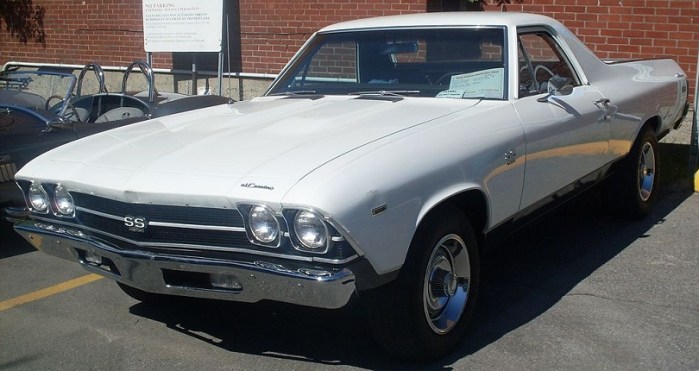
The Chevrolet El Camino is a pickup / coupé utility vehicle that was produced by Chevrolet between 1959–60 and 1964–1987. Unlike a standard pickup truck, the El Camino was adapted from the standard two-door Chevrolet station wagon platform and integrated the cab and cargo bed into the body.
Introduced in the 1959 model year in response to the success of the Ford Ranchero pickup, its first run lasted only two years. Production resumed for the 1964–1977 model years based on the Chevelle platform, and continued for the 1978–1987 model years based on the GM G-body platform.
Although based on corresponding General Motors car lines, the vehicle is classified in the United States as a pickup.
1959 El Camino
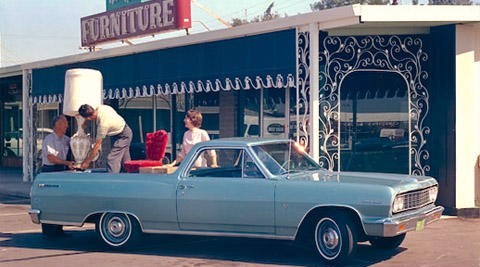
1964 El Camino
1973 El Camino
1979 El Camino
The Ford Ranchero is a Pickup /coupe utility that was produced by Ford between 1957 and 1979. Unlike a standard pickup truck, the Ranchero was adapted from a two-door station wagon platform that integrated the cab and cargo bed into the body. A total of 508,355 units were produced during the model’s production run. Over its lifespan it was variously derived from full-sized, compact, and intermediate automobiles sold by Ford for the North American market.
During the 1970s, the Ranchero name was used in the South African market for a rebadged Australian Ford Falcon utility. Shipped from Australia in complete knock down (CKD) form, these vehicles were assembled in South Africa at Ford’s plant in Port Elizabeth. In Argentina, a utility version of the locally produced Ford Falcon was also called Ranchero.
The original Ranchero sold well enough to spawn a competitor from General Motors in 1959, the Chevrolet El Camino.
1967 Ford Ranchero
1958 Ranchero
1970 Ranchero
1979 Ranchero
An El Camino on fire in downtown Winnipeg in 2016.
ABC’s Wide World of Sports was an American sports anthology television program that aired on the American Broadcasting Company (ABC) from April 29, 1961 to January 3, 1998, primarily on Saturday afternoons. Hosted by Jim McKay, with a succession of co-hosts beginning in 1987, the title continued to be used for general sports programs on the network until 2006. In 2007, Wide World of Sports was named by Time on its list of the 100 best television programs of all-time.
The aircraft in the photograph was XG332. It was built in 1959, one of 20 pre-production Lightnings. Alan Sinfield took a photograph of XG332 in 1960 at Farnborough:
However, the very last photograph taken of XG332, in 1962, is deservedly the most famous one. How does someone manage to take a photograph like this? Planning, quick wits and a healthy dose of luck.
Jim Meads is the man who took the picture. He was a professional photographer who lived near the airfield, next door to de Havilland test pilot Bob Sowray.
So, the story goes: Bob Sowray mentioned to Jim Meads that he was going to fly the Lightning that day. When Meads took his kids for a walk, he took his camera along, hoping to get a shot of the plane.
His plan was to take a photograph of the children with the airfield in the background as the Lightning came in to land. They found a good view of the final approach path and waited for the Lightning to return.
As it happened, Bob Sowray didn’t fly the Lightning that day. The pilot was George Aird, another test pilot working for De Havilland.
Whilst carrying out a demonstration flight, there was a fire in the aircraft’s reheat zone. Unburnt fuel in the rear fuselage had been ignited by a small crack in the jet pipe and had weakened the tailplane actuator anchorage. This weakened the tailplane control system which failed with the aircraft at 100 feet on final approach.
The aircraft pitched up violently just as Aird was coming up to land. Aird lost control of the aircraft and ejected.
Luckily, because the nose pitched up he had just enough time to eject.
The tractor in the photograph was a Fordson Super Major. If you look closely at the grill, you’ll see it reads D H Goblin, as in the de Havilland Goblin jet engine.
The tractor driver was 15-year-old Mick Sutterby, who spent that summer working on the airfield. He wasn’t posing for the camera. In fact, he was telling the photographer, Jim Mead, to move on, because he shouldn’t be there.
Mead saw the plane coming in and the nose pitch up. Then Aird ejected and Mead says he had just enough time to line up the shot as the Lightning came down nose first.
Meanwhile, George Aird landed on a greenhouse and fell through the roof, breaking both legs as he landed unconscious on the ground. The water from the sprinkler system for the tomatoes woke him. He’s reported to have said that his first thought was that he must be in heaven.
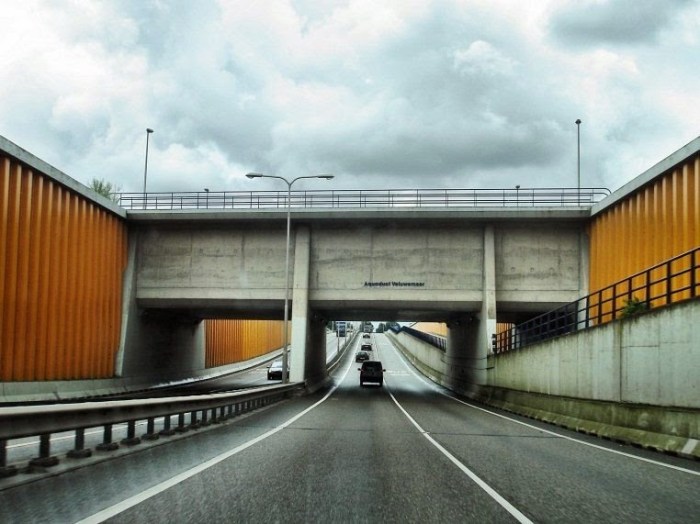
The Aqueduct Veluwemeer is a navigable aqueduct over the N302 road near Harderwijk, in eastern Netherlands. It is located under a small part of the lake Veluwemeer and at the same time connects the mainland Netherlands to Flevoland, which happens to be the largest artificial island in the world. The aqueduct, which was opened to traffic in 2002, is 25 meters long and 19 meters wide and has a water depth of 3 meters that allow small boats to pass through. Underneath, around 28 000 vehicles passes every day. Footpaths are built on either side of the aqueduct for public that wants to enjoy the view.
What it is: Hand headrest that lets you nap at your desk Invented: 2015 Average Price: $40*
This weird invention is slightly creepy-looking, but it does appear to be popular. The hand-shaped head holder attaches to your desk, and you can adjust the shape of the hand to conform to your head, allowing you to take a nap at the office, if you want. It’s sort of like a third, urethane hand.
You can also use it to rest your chin while you stay awake and get work done. The hand-shaped head holder is supposed to improve your posture. The invention has been around since 2015, and it costs the U.S. equivalent of around $40 in total.
What it is: An exercise tool that you put in your mouth to tighten facial muscles Invented: Average Price: $37*
This looks like a torture device from a horror movie, but it’s not. The little pink figure goes between your lips in order to strengthen your facial muscles around your jaw and mouth. This prevents skin sagging and aging. You only have to use it three minutes a day to see results over time.
The mouth exercise training figure is made by Taruman, and it costs about $37. There are two versions: strong and normal, both of which are made of elastomer. The figure’s dimensions are 2.1” by 1.3” by 1.3” for reference. You can vary the strength based on how out of shape your face is.
Remote controlled floor mop
What it is: A floor mop operated by a video game controller Invented: 2015 Average Price: $87.53*
The Japanese company Kyosho makes this, and it advertises this remote-control mop as a way to “mop without mopping.” The remote-control mop is somewhat of a Roomba, but, instead of a vacuum, it is a small floor mop. The remote-control in question is a video game console.
Basically, you can clean stuff without getting off the couch. Kyosho cautions against using the remote control mop for large cleaning projects, admitting that it is really only good for cleaning “small areas, spills, or small messes.” The remote-control mop is available on Amazon for $87.53 (although it’s rating is 2.5/5 stars).
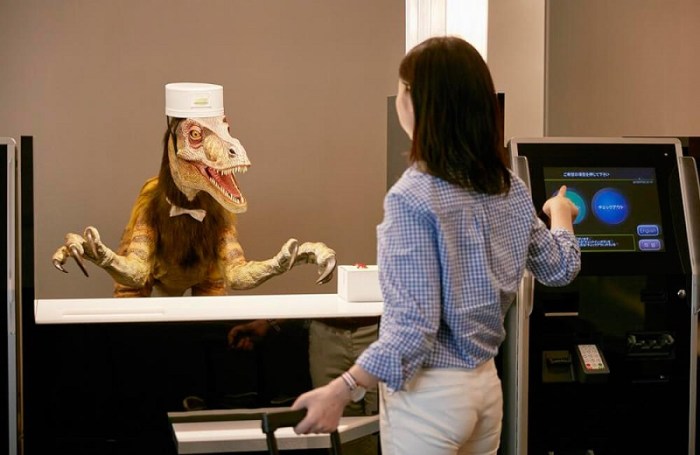
What it is: Several benevolent, loud robotic dinosaurs that check-in people at a hotel Invented: 2015 (certified by Guinness World Records in 2016) Average Price: $0* (not for sale, they are working at a hotel)
Jurassic Park fans will like this one. At the Henn-na Hotel, located in suburban Tokyo’s Urayasu, there are two very interesting new staff members. The front desk is manned by robotic dinosaurs. The dinosaurs have sensors, and, when they sense you approaching, they scream, “WELCOME” at you.
The check-in dinosaurs have little bellboy hats and appear to be benevolent. Henn-na means “weird,” and the chain prides itself on its quirky experience. Particularly, Henn-na is pleased that it is the first hotel chain staffed by robots. The robotic dinosaurs are all Tyrannosaurus Rex models, though they are far from life-size.
Scream jar
What it is: Soundproof jar you can scream into to let off stress Invented: 2016 Average Price: $81.72*
Everyone gets stressed out, but not everyone is able to just yell at someone when they’re stressed. The Banraishop Scream Jar Voice Silencer is primed for stress relief. You put the jar up to your mouth and scream into it. It is soundproof, so there is just a tiny whisper that comes out.
The Voice Silencer also is good for practicing karaoke or singing, but, judging from the reviews, people are mostly using it to rage-scream into. Or they’re giving it to their kids to yell into so that they’re not as annoying. It costs approximately $82 and is available on Amazon.
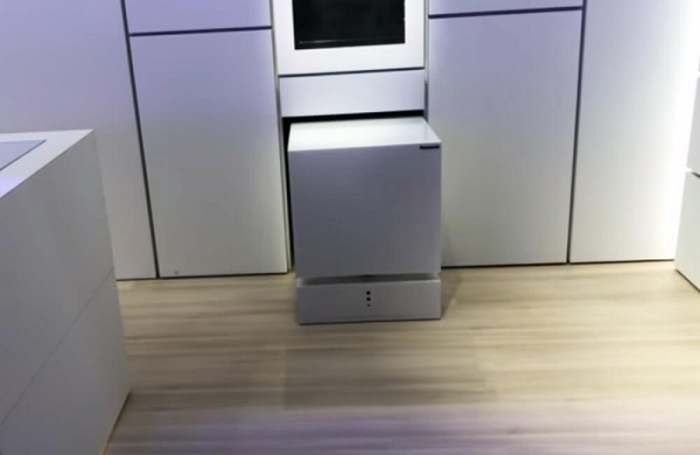
Walking fridge
What it is: A fridge that comes when called Invented: 2017 Average Price: $5,000*
Designed by Panasonic, the Japanese Walking Fridge is something that fans of Requiem for a Dream or Black Mirror will like. The Walking Fridge comes to you when you call it. The Panasonic Moving Fridge, as it is called, comes with a LIDAR built-in. The fridge will be able to use the light detection/depth sensors to come to you without running into things.
When you call the 600-pound mini-fridge, it will waddle over to you. Panasonic created the fridge for elderly people or those with mobility problems, but anyone can use it. Caution: your pets will probably be freaked out by it.
Noodle-cooling fan chopsticks
What it is: A fan attached to chopsticks to blow on your noodles to cool them Invented: 2018 Average Price: $99*
Everyone in Japan uses chopsticks, and this invention is basically chopsticks with a fan attached. The USB-powered fan latches onto the base of the chopsticks, blowing on your noodles and cooling them while you eat. The fan comes with the sound effects of bubble wrap, and some limited-edition Otaku versions have the voices of anime characters.
The noodle cooler is made by YO! Sushi. The fan first launched in 2018, and it has since become pretty popular, as, though it is technically Chindogu (Japanese for “useless invention”), it appears to work. YO! Sushi has also invented a Napkin Hat, Wasabi Stick, and Noodle Splash Guard.
Nose straightener
What it is: A clip to contour/straighten your nose Invented: 2012 Average Price: $43*
Want a straighter nose but don’t want to shell out for surgery? Japanese inventors have you covered. The company has invented the Hana Tsun Nose Straightener. The silicon clip works to straighten the bones of your nose over time and make it more contoured. All you have to do is wear it twenty minutes per day.
According to Japan Trend Shop, the nose straightener is made in Japan and the instructions are all in Japanese. However, it’s pretty self-explanatory. It’s unclear how long it will take to see results, but it has sold out rather quickly, so it must work, right?
Cubic sound catching pillow
What it is: A pillow that lets you lay on your side and still hear out of both ears Invented: 2013 Average Price: Currently unlisted (out of stock everywhere)
Made by FUJIPACKS, the cubic sound catching pillow helps you be comfortable while watching TV. The cube-shaped pillow has cube-shaped holes in it, so, when you rest your head on its side while watching TV, your ear isn’t blocked off and you can still hear what’s going on.
FUJIPACKS All-Sound Catch Cubic Pillow comes in two colors (Dark Navy and Red), and reviewers have compared the filling of the pillow to “soft, fine sand.” The Cubic Pillow isn’t FUJIPACKS’ first Chigodu rodeo, as it has also invented a mushroom light ($44) and a stainless-steel four-way cylindrical nail file ($102).
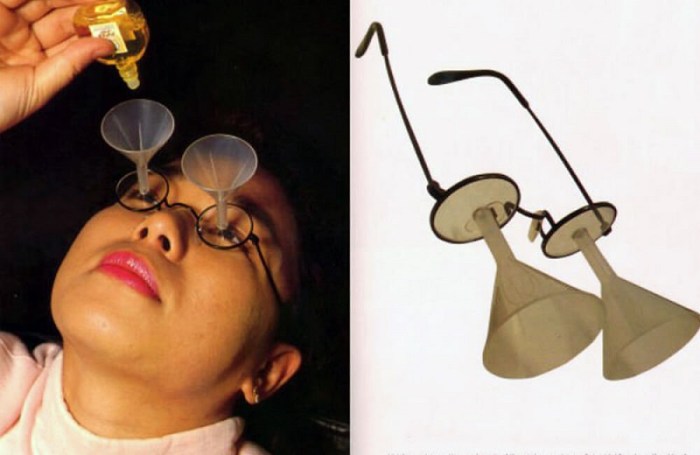
What it is: Funnel glasses that help you put eyedrops in Invented: 1991 Average Price: $15-$20*
A lot of people can’t put medication in their eyes. Whether that has something to do with a fear of something going in their eyes or they just don’t like it, it’s a big problem. Japanese eyedrop glasses are there to fix the problem. The eyedrop glasses contain a funnel balanced on each of the lenses.
You put the medication into the funnel, keep your eye open, and it goes right into your eye without a problem. The glasses are made by Topcon, located in Tokyo, Japan. According to the U.S. Patent Office, these eyedrop glasses were first patented in 1991.
Mount Shasta is a potentially active volcano at the southern end of the Cascade Range in Siskiyou County, California. At an elevation of 14,179 feet (4321.8 m), it is the second-highest peak in the Cascades and the fifth-highest in the state. Mount Shasta has an estimated volume of 85 cubic miles (350 km3), which makes it the most voluminous stratovolcano in the Cascade Volcanic Arc. The mountain and surrounding area are part of the Shasta–Trinity National Forest.
Mount Shasta is connected to its satellite cone of Shastina, and together they dominate the landscape. Shasta rises abruptly to tower nearly 10,000 feet (3,000 m) above its surroundings. On a clear winter day, the mountain can be seen from the floor of the Central Valley 140 miles (230 km) to the south. The mountain has attracted the attention of poets, authors, and presidents.
The mountain consists of four overlapping dormant volcanic cones that have built a complex shape, including the main summit and the prominent satellite cone of 12,330 ft (3,760 m) Shastina, which has a visibly conical form. If Shastina were a separate mountain, it would rank as the fourth-highest peak of the Cascade Range (after Mount Rainier, Rainier’s Liberty Cap, and Mount Shasta itself).
California’s Mount Shasta has been the subject of an unusually large number of myths and legends. In particular, it is often said to hide a secret city beneath its peaks. In some stories, the city is no longer inhabited, while in others, it is inhabited by a technologically advanced society of human beings or mythical creatures.
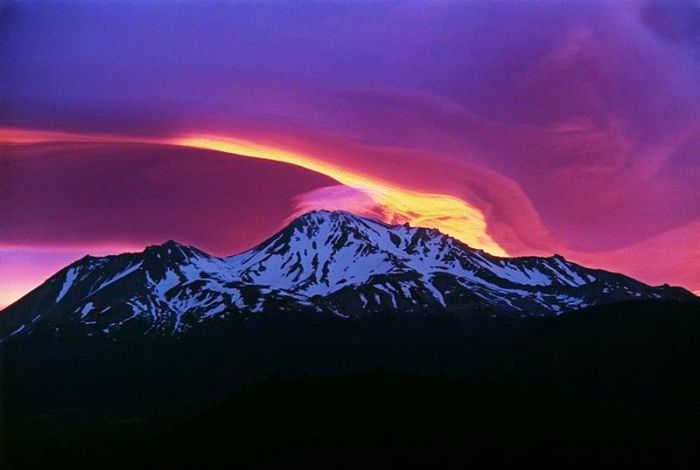
Mount Shasta can generate lenticular clouds, which may contribute to its supernatural reputation.
According to local indigenous tribes, namely the Klamath people, Mount Shasta is inhabited by the spirit chief Skell, who descended from heaven to the mountain’s summit. Skell fought with Spirit of the Below-World, Llao, who resided at Mount Mazama, by throwing hot rocks and lava, probably representing the volcanic eruptions at both mountains. Writer Joaquin Miller recorded various related legends in the 1870s.
Mount Shasta has also been a focus for non-Native American legends, centered on a hidden city (called Telos) of advanced beings from the lost continent of Lemuria. The legend grew from an offhand mention of Lemuria in the 1880s. In 1899, Frederick Spencer Oliver published A Dweller on Two Planets, which claimed that survivors from a sunken continent called Lemuria were living in or on Mount Shasta. Oliver’s Lemurians lived in a complex of tunnels beneath the mountain and occasionally were seen walking the surface dressed in white robes. In 1931, Harvey Spencer Lewis, using the pseudonym Wisar Spenle Cerve, wrote a book (published by the Rosicrucians) about the hidden Lemurians of Mount Shasta that a bibliography on Mount Shasta described as “responsible for the legend’s widespread popularity.” This belief has been incorporated into numerous occult religions, including “I AM” Activity, The Summit Lighthouse, Church Universal and Triumphant, and Kryon.
According to Guy Ballard, while hiking on Mount Shasta, he encountered a man who introduced himself as Count of St. Germain, who is said to have started Ballard on the path to discovering the teachings that would become the “I AM” Activity religious movement.
According to a legend, J. C. Brown was a British prospector who discovered a lost underground city beneath Mt. Shasta in 1904. Brown had been hired by the Lord Cowdray Mining Company of England to prospect for gold, and discovered a cave which sloped downward for 11 miles. In the cave, he found an underground village filled with gold, shields, and mummies, some being up to 10 feet tall.
Thirty years later, he told his story to John C. Root, who proceeded to gather an exploration team in Stockton, California. About 80 people joined the team, but on the day the team was to set out, Brown did not show up. Brown was not heard from again.
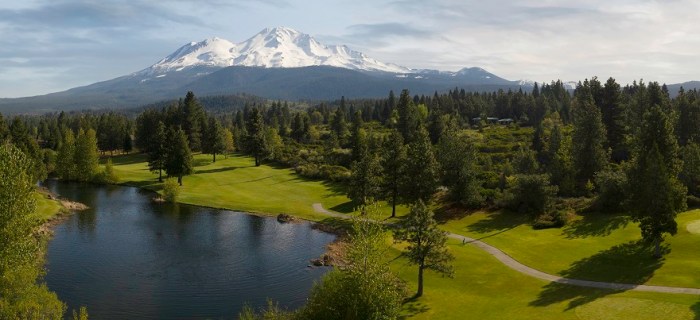
The 429 yard par 4 sninth hole at Mount Shasta Resort.
Mount Shasta is believed to be a home base for the Lizard People, too, reptilian humanoids that also reside underground. The mountain is a hotbed of UFO sightings, one of the most recent of which occurred in February 2020. (It was a saucer-shaped lenticular cloud.) In fact, the mountain is associated with so many otherworldly, paranormal, and mythical beings—in addition to long-established Native American traditions—that it’s almost like a who’s who of metaphysics. It has attracted a legion of followers over the years, including “Poet of the Sierras” Joaquin Miller and naturalist John Muir, as well as fringe religious organizations such as the Ascended Masters, who believe that they’re enlightened beings existing in higher dimensions. What is it about this mountain in particular that inspires so much belief?
Pluto’s Cave is a volcanic lava tube on the outskirts of Mount Shasta.
“There’s a lot about Mount Shasta, and volcanoes in general, that are difficult to explain,” says Andrew Calvert, scientist-in-charge at the California Volcano Observatory, “and when you’re having difficulty explaining something, you try and understand it.” Calvert has studied Shasta’s eruptive history since 2001. “It’s such a complicated and rich history,” he says, “and Shasta itself is also very visually powerful. These qualities build on each other to make it a profound place for a lot of people—geologists, spirituality seekers … even San Francisco tech folks, and hunters and gatherers from 10,000 years ago. It’s one that can have a really strong effect on your psyche.”
Taylor Tupper, a Modoc Indian of the Klamath Tribes, raised in the Klamath Basin just north of Shasta. Tupper says she leaves people to their own beliefs about Shasta as well: spiritual, metaphysical, or simply on another plane. “People always ask me about UFOs and such, and I say I’m not going to go poking around in others’ business. Every place you go is sacred or special to someone or something, or was at some point. Treat it all with respect and your spirit will be in tune with nature and the creator, and you won’t be going against spiritual law. If you are going against it, nature will let you know.”
Five giants: three Airbus A380’s, a Boeing 747 and 777.
Qantas A380
747 coming in extremely low at St. Martens.
The infamous “Gimli Glider”. Air Canada 767 made an emergency landing at an abandoned airstrip in Gimli, Manitoba. The plane ran out of fuel when a technician made a mistake converting gallons into litres.
Up and away at LAX
Berlin Airshow. The American section with the giant C-5 Galaxy dwarfing everything else.
The Russian Anotov AN-225 Mriya. Biggest plane in the world.
Crosswinds
More Crosswinds
747 into the sunset
Car-go
Thunderbirds over Nevada
F-100 Super Sabre alongside FedEx MD-111 Mojave, California.
In Death Valley National Park, north of Barstow, California, is Rainbow Canyon. It’s not especially remarkable, just one canyon in an area full of them, all but indistinguishable from its neighbors in an area populated mainly by snakes. But stand on one of the canyon tops for long enough and a fighter jet will suddenly roar into the valley below you, flying fast and very, very low. It will be visible for only a few seconds before it turns hard and disappears behind the next hill. But during those few moments, anyone with a camera has a brief chance to take a spectacular picture. Rainbow Canyon (or Star Wars Canyon, as some call it) is part of the R-2508 restricted airspace complex, host to a busy, low-level training route for combat aircraft.
Military pilots train to fly low and fast, hiding behind hills to fool radar and going fast enough that they can’t be shot at. Since flying is a perishable skill, every fighter or attack pilot periodically has to practice such low-level flights. Rainbow Canyon is in the desert of eastern California, where the population is sparse and the airspace wide open. It’s also surrounded by military bases, bombing ranges, maneuvering grounds and radars—an ideal spot for military pilots to hone their skills. Among the nearby facilities are Edwards AFB, Naval Air Station China Lake, and Plant 42 (where Lockheed and Northrop build advanced aircraft).


























 The MarkoZen Blog