Is someone really flying around LAX in a jet pack? Trying to solve an aviation mystery

David Mayman flies up the Goodwood Hill displaying his JB11 JetPack .
David Mayman, founder of Chatsworth-based JetPack Aviation, suits up in his company’s JB11 JetPack in 2018 in England. (Michael Cole / Corbis via Getty Images)

It was an otherwise quiet Sunday night at the Los Angeles International Airport control tower when an American Airlines pilot radioed in with an unbelievable report.

“Tower, American 1997. We just passed a guy in a jet pack,” the pilot said.

Minutes later came another report, this time from a pilot approaching LAX in a Jet Blue airliner: “We just saw the guy pass us by in the jet pack.”

So began one of the most intriguing aviation mysteries Los Angeles has confronted in years.

Those sightings occurred Aug. 30. The case took another twist Wednesday when a China Airlines pilot approaching LAX reported seeing a jet pack flying at an altitude of 6,000 feet. That’s more than a mile up.

The FBI is on the case, as is a good chunk of L.A.’s aviation community, which has been buzzing about the sightings.

Though jet packs make frequent appearances in popular culture and movies — think Sean Connery’s James Bond and Disney’s “The Rocketeer” — they are actually very rare.

There are only a handful of companies around the world that make jet packs, including a winged device created by former Swiss air force pilot Yves Rossy, which requires him to be hoisted in the air by a helicopter or balloon before he can take off. There is also a type of hoverboard made by French firm Zapata and flown only by its inventor, Franky Zapata.

Locally, Chatsworth-based JetPack Aviation has created five jet packs that are worn like backpacks. But they’re not for sale, and Chief Executive David Mayman said none of his competitors’ products are sold to consumers, either.

It’s possible that Wednesday’s sighting near LAX was indeed a person flying with a jet pack. But the reported altitude makes such a flight seem “highly unlikely,” said Mike Hirschberg, executive director of the Vertical Flight Society, a nonprofit professional organization.

Mayman said his company’s jet packs are technically capable of soaring to heights of 15,000 feet. But because of fuel constraints, they can actually reach only about 1,000 or 1,500 feet off the ground safely.

“To fly up to 6,000 feet from the ground, to fly around long enough to be seen by China Airlines and then to descend again, you’d be out of fuel,” he said.

Mayman said he knows it wasn’t any of his company’s jet packs because he knows exactly where they are — plus, they are disabled when not in use, so grabbing a pack out of storage wouldn’t be possible.

Instead, he suggests a more likely scenario, an electric drone — perhaps with a mannequin attached.

Thomas Anthony, director of the USC Aviation Safety and Security Program and a former Federal Aviation Administration criminal investigator, said the strongest evidence that the LAX sightings is a person with a jet pack — as opposed to a balloon or drone — came from the American Airlines pilot, who reported seeing the object at 3,000 feet over Cudahy.

The pilot stated he saw “a guy in a jet pack” 300 yards to his left and flying at about the plane’s altitude.

“That is quite close,” Anthony said.

He said federal investigators would immediately look at the limited number of jet packs that exist in the U.S. and overseas.

“People in that community will know who has bought these packs,” he said. “If someone is doing this, they are going to have to take off and land somewhere, and there is going to be noise.”

Anthony said he doubts the culprit is using an airport to take off and that investigators should look to out-of-the-way industrial spots for clues. The FBI suggested the jet pack was flying in a section of Southeast Los Angeles County near Cudahy and Vernon that is dotted with commercial and manufacturing businesses.

The flying range of jet packs is pretty limited, Anthony added, so it’s unlikely it traveled any great distance.

After the China Airlines pilot’s report Wednesday, the LAX control tower called in a law enforcement aircraft to investigate.

The aircraft was flying about seven miles from where the pilot said he’d seen the jetpack, according to radio communications.

But when the craft arrived, no signs of the jet pack remained.

A jet pack could be operated as an ultralight — meaning it would not be registered and its operator wouldn’t need a pilot’s license if it meets fuel capacity, weight and speed requirements, according to the FAA. Ultralight aircraft are permitted to fly only during the day and are barred from flying over densely populated areas or in controlled aerospace without FAA approval.

Anthony and others say it’s imperative that the FBI investigate the sightings for safety.

“This does represent a very significant compromise of the airspace,” he said.

If a rogue pilot were flying at 6,000 feet without a transponder or radio, Anthony said, that would put him or her in the path of commercial airlines maneuvering over Los Angeles.

Airliners are designed to withstand getting hit by small objects. But a big metal object is another matter, especially if it were sucked into an engine.

“The engines aren’t designed to consume something large and metal, or something with fuel that’s going to burn or explode,” Hirschberg said. “That could be potentially catastrophic for an airplane. You could potentially have an engine explode and bring down the airliner and potentially hundreds of people could die.”

So is what has been reported near LAX really a jet pack?

Some experts say it’s possible.

In February, a pilot in Dubai reached an altitude of 5,900 feet flying a Jetman jet pack powered by four mini jet engines with carbon-fiber wings. The pack’s builders say it can reach speeds of nearly 250 mph. After a number of dip and roll maneuvers, the Dubai pilot descended to the ground using a parachute.

Hitler was ‘exorcised’ by Pope Pius XII, new book reveals

ITALIAN journalist Fabio Marchese Ragona has a new book out that reveals that Eugenio Pacelli who became Pope Pius XII – regarded by many as an anti-Semitic Nazi sympathizer – actually performed exorcisms ‘from a distance’ on Adolf Hitler.

Strange Airports

Courchevel International Airport (Courchevel, France)

Background:
Getting to the iconic ski resort of Courchevel requires navigating the formidable French Alps before making a hair-raising landing at Courchevel International Airport. The runway is about 1700 feet long, but the real surprise is the large hill toward the middle of the strip.
Why It’s Unique:
“You take off downhill and you land going uphill,” Schreckengast says. He adds that the hill, which has an 18.5 percent grade, is so steep that small planes could probably gain enough momentum rolling down it with no engines to safely glide off the edge. Landing at Courchevel is obviously no easy task, so pilots are required to obtain certification before attempting to conquer the dangerous runway.


Congonhas Airport (Sao Paulo, Brazil)

Background:
Most major cities have an airport, but rarely are they built just 5 miles from the city center, especially in metropolises like Sao Paulo. Congonhas’ close proximity to downtown can be attributed in part to the fact that it was completed in 1936, with the city experiencing rapid development in the following decades.
Why It’s Unique:
While having an airport only 5 miles from the city center may be a convenience for commuters, it places a strain on both pilots and air traffic control crews. “It becomes a challenge in terms of safety to just get the plane in there,” Schreckengast says. “Then you throw on noise restrictions and these terribly awkward arrival and departure routes that are needed to minimize your noise-print and it becomes quite challenging for pilots.” Fortunately, Sao Paulo’s many high-rise buildings are far enough away from the airport that they aren’t an immediate obstacle for pilots landing or taking off.


Don Mueang International Airport (Bangkok, Thailand)

Background:
From a distance Don Mueang International looks like any other midsize airport. However, smack-dab in the middle of the two runways is an 18-hole golf course.
Why It’s Unique:
Schreckengast, who has worked on consulting projects at this airport, says one of the major problems is that the only taxiways were located at the end of the runways. “We recommended that they build an additional taxiway in the middle, from side to side, and they said ‘absolutely not, that will take out a green and one fairway.’” The airport and the course were originally an all-military operation, but have since opened up to commercial traffic. Security threats, however, have limited the public’s access to the greens.


Madeira International Airport (Madeira, Portugal)

Background:
Madeira is a small island far off the coast of Portugal, which makes an airport that is capable of landing commercial-size aircraft vital to its development. This airport’s original runway was only about 5000 feet long, posing a huge risk to even the most experienced pilots and limiting imports and tourism.
Why It’s Unique:
Engineers extended the runway to more than 9000 feet by building a massive girder bridge atop about 200 pillars. The bridge, which itself is over 3000 feet long and 590 feet wide, is strong enough to handle the weight of 747s and similar jets. In 2004, the International Association for Bridge and Structural Engineering selected the expansion project for its Outstanding Structure Award, noting that the design and construction was both “sensitive to environmental and aesthetic considerations.”


Gibraltar Airport (Gibraltar)

Background:
Between Morocco and Spain sits the tiny British territory of Gibraltar. Construction of the airport dates back to World War II, and it continues to serve as a base for the United Kingdom’s Royal Air Force, though commercial flights land on a daily basis.
Why It’s Unique:
Winston Churchill Avenue, Gibraltar’s busiest road, cuts directly across the runway. Railroad-style crossing gates hold cars back every time a plane lands or departs. “There’s essentially a mountain on one side of the island and a town on the other,” Schreckengast says. “The runway goes from side to side on the island because it’s the only flat space there, so it’s the best they can do. It’s a fairly safe operation as far as keeping people away,” he says, “It just happens to be the best place to land, so sometimes it’s a road and sometimes it’s a runway.”


Kansai International Airport (Osaka, Japan)

Background:
Land is a scarce resource in Japan, so engineers headed roughly 3 miles offshore into Osaka Bay to build this colossal structure. Work on the manmade island started in 1987, and by 1994 jumbo jets were touching down. Travelers can get from the airport to the main island of Honshu via car, railroad or even a high-speed ferry.
Why It’s Unique:
Kansai’s artificial island is 2.5 miles long and 1.6 miles wide—so large that it’s visible from space. Earthquakes, dangerous cyclones, an unstable seabed, and sabotage attempts from protestors are just some of the variables engineers were forced to account for. As impressive as the airport is, Stewart Schreckengast, a professor of aviation technology at Purdue University and a former aviation consultant with MITRE, cautions that climate change and rising sea levels pose a very real threat to the airport’s existence. “When this was built, [engineers] probably didn’t account for global warming,” he says. “In 50 years or so, this might be underwater.”

Getting Closer to God


red-katskhi_pillar


The Katskhi pillar is a natural limestone monolith located at the village of Katskhi in western Georgian region of Imereti, near the town of Chiatura. It is approximately 40 metres (130 ft) high, and overlooks the small river valley of Katskhura, a right affluent of the Q’virila.

The rock, with visible church ruins on a top surface measuring c. 150 m2, has been venerated by locals as the Pillar of Life and a symbol of the True Cross, and has become surrounded by legends. It remained unclimbed by researchers and unsurveyed until 1944 and was more systematically studied from 1999 to 2009. These studies determined the ruins were of an early medieval hermitage dating from the 9th or 10th century. A Georgian inscription paleographically dated to the 13th century suggests that the hermitage was still extant at that time. Religious activity associated with the pillar was revived in the 1990s and the monastery building had been restored within the framework of a state-funded program by 2009.


red-katskhi-pillar-dark2


The Katskhi pillar complex currently consists of a church dedicated to Maximus the Confessor, a crypt (burial vault), three hermit cells, a wine cellar, and a curtain wall on the uneven top surface of the column. At the base of the pillar are the newly built church of Simeon Stylites and ruins of an old wall and belfry.

The church of St. Maximus the Confessor is located at the south-easternmost corner of the top surface of the Katskhi pillar. A small simple hall church design with the dimensions of 4.5 × 3.5 m., it is a modern restoration of the ruined medieval church built of stone. Beneath and south of the church is an elongated rectangular crypt with the dimensions of 2.0 × 1.0 m., which had served as a burial vault. Digs at the ruined wine cellar revealed eight large vessels known in Georgia as k’vevri. Also of note is a rectangular cellar grotto with the entrance and two skylights—on the vertical surface of the rock, some 10-metre (33 ft) below the top. At the very base of the pillar there is a cross in relief, exhibiting parallels with similar early medieval depictions found elsewhere in Georgia, particularly at Bolnisi.


red2


red-katskhi-pillar


red3


In July 1944 a group led by the mountaineer Alexander Japaridze and the writer Levan Gotua made the first documented ascent of the Katskhi pillar. Vakhtang Tsintsadze, an architecture specialist with the group, reported in his 1946 paper that the ruins found on top of the rock were remains of two churches, dating from the 5th and 6th centuries and associated with a stylite practice, a form of Christian asceticism. Since 1999, the Katskhi pillar has become the subject of more systematic research. Based on further studies and archaeological digs conducted in 2006, Giorgi Gagoshidze, an art historian with the Georgian National Museum, re-dated the structures to the 9th–10th century. He concluded that this complex was composed of a monastery church and cells for hermits. Discovery of the remnants of a wine cellar also undermined the idea of extreme ascetism flourishing on the pillar. In 2007, a small limestone plate with the asomtavruli Georgian inscriptions was found, paleographically dated to the 13th century and revealing the name of a certain “Giorgi”, responsible for the construction of three hermit cells. The inscription also makes mention of the Pillar of Life, echoing the popular tradition of veneration of the rock as a symbol of the True Cross.[1]

Religious activity started to revive in 1995, with the arrival of the monk Maxim Qavtaradze, a native of Chiatura. Between 2005 and 2009, the monastery building on the top of the pillar was restored with the support of the National Agency for Cultural Heritage Preservation of Georgia. The rock was once accessible to male visitors through an iron ladder running from its base to the top, but has recently been deemed inaccessible to the public.


The ladder


red-katskhi_pillar_ladder


red5

Rope pulley to bring up supplies


red4


red1


A church is seen on top of the Katskhi Pillar, a rock mass about 40 meters high, in the village of Katskhi, Georgia, November 27, 2015. (Photo by David Mdzinarishvili/Reuters)

The Empire State Building was Constructed Incredibly Fast

The speed with which they built the Empire State Building, 1931


empire_state_building_history


The idea for the Empire State Building is said to have been born of a competition between Walter Chrysler of the Chrysler Corporation and John Jakob Raskob of General Motors, to see who could erect the taller building. Chrysler had already begun work on the famous Chrysler Building, the gleaming 1,046-foot skyscraper in midtown Manhattan. Not to be bested, Raskob assembled a group of well-known investors, including former New York Governor Alfred E. Smith. The group chose the architecture firm Shreve, Lamb and Harmon Associates to design the building. The Art-Deco plans is said to have been based in large part on the look of a pencil.

Despite the colossal size of the project, the design, planning and construction of the Empire State Building took just 20 months from start to finish. After demolishing the Waldorf-Astoria hotel—the plot’s previous occupant—contractors Starrett Brothers and Eken used an assembly line process to erect the new skyscraper in a brisk 410 days. Using as many as 3,400 men each day, they assembled its skeleton at a record pace of four and a half stories per week—so fast that the first 30 stories were completed before certain details of the ground floor were finalized. The Empire State Building was eventually finished ahead of schedule and under budget, but it also came with a human cost: at least five workers were killed during the construction process.

The new building imbued New York City with a deep sense of pride, desperately needed in the depths of the Great Depression, when many city residents were unemployed and prospects looked bleak. The grip of the Depression on New York’s economy was still evident a year later, however, when only 25 percent of the Empire State’s offices had been rented.


empire_state_building_history_2

During certain periods of building, the frame grew an astonishing four-and-a-half stories a week.


Chrysler Building 1932

chrysler_building_midtown_manhattan_new_york_city_1932

Tribute to Eddie Van Halen

Edward Lodewijk Van Halen (January 26, 1955 – October 6, 2020) was a Dutch-American musician, songwriter, producer, and inventor. He was the main songwriter and lead guitarist of the American rock band Van Halen, which he co-founded in 1972 with his brother, drummer Alex Van Halen, bassist Mark Stone, and singer David Lee Roth. He was best known for popularizing the tapping guitar solo technique, allowing rapid arpeggios to be played with two hands on the fretboard. In 2012, he was voted number one in a Guitar World magazine reader’s poll for “The 100 Greatest Guitarists of All Time”.

Born on January 26, 1955, in Amsterdam, Netherlands, Edward Lodewijk van Halen was the son of Jan van Halen and Eugenia van Halen (née van Beers). Jan was a Dutch clarinetist, saxophonist, and pianist, and Eugenia was an Indo (Eurasian) from Rangkasbitung on the island of Java in the Dutch East Indies (now Indonesia). The family eventually resettled in Nijmegen.

In February 1962, the Van Halen family moved from the Netherlands to the United States, settling in Pasadena, California. Both Eddie and his older brother, Alex van Halen, were naturalized as U.S. citizens. The brothers learned to play the piano as children starting at the age of six. They commuted from Pasadena to San Pedro to study with an elderly piano teacher, Stasys Kalvaitis.


Members of Indigenous Indonesian Tribe Have Electric Blue Eyes Due to Rare Genetic Condition

Blue eyes are a rare sight in Indonesia, a country where the vast majority of the population has dark hair and dark eyes, but some members of an indigenous tribe have the most stunning blue eyes, because of a rare condition known as Waardenburg Syndrome.

Believed to affect about 1 in 42,000 people, Waardenburg Syndrome is characterized by some degree of hearing loss and pigmentation deficiencies, which can include bright blue eyes (or one blue eye and one black/brown eye). It is caused by mutations in any of several genes that affect the operation of neural crest cells in embryonic development. The visual effect of Waardenburg Syndrome is particularly impressive in ethnic groups where blue eyes are a rarity, as you can see in the photos of members of the Buton tribe taken by Indonesian geologist and amateur photographer Korchnoi Pasaribu.

Buton Island, which is located in Indonesia’s Sulawesi region, is home to the indigenous Buton people, some of whom suffer from the Waardenburg Syndrome and have the characteristic electric blue eyes (either one or both).

Korchnoi Pasaribu visited Buton Island last month and took some photos of its natives, focusing on their stunning electric blue eyes. He posted the photos on his Instagram, and they have since gone viral, being picked up by most major news outlets and shared massively on social media.

Cruise Ship Graveyard

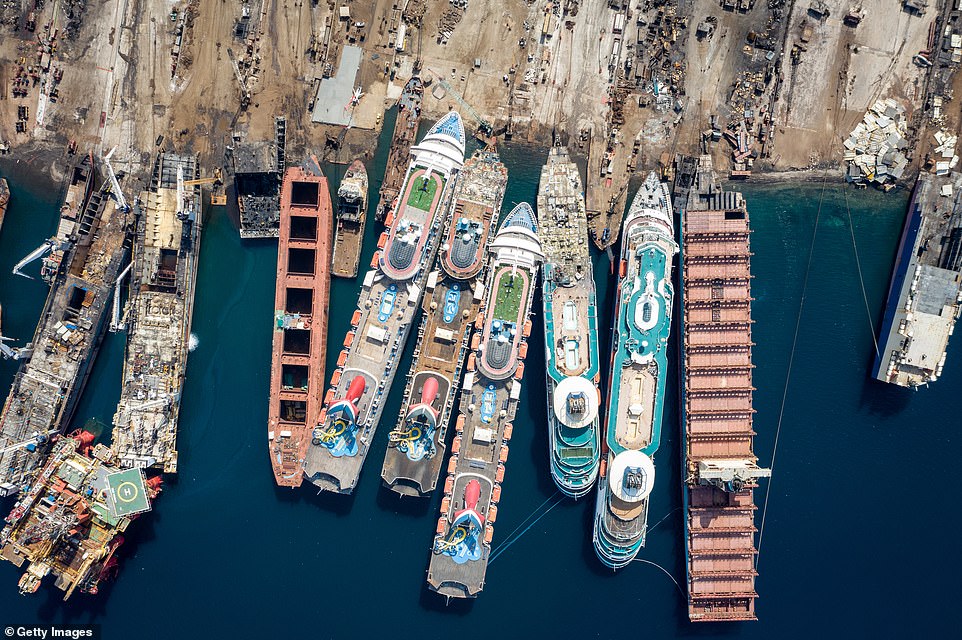
The covid cruise ship graveyard: Passenger liners are stripped for scrap at Turkish dock after the multi-billion pound industry was smashed by the coronavirus crisis
Cruise ships were home to the some of the earliest clusters of COVID-19 as it spread around the world
US authorities have issued a no-sail order on cruises and the multi-billion pound industry has been hammered
But business is booming for a ship scrapyard in Turkey which has welcomed five colossal cruise ships
One of them, the Carnival Fantasy operated by Carnival Cruise Line, had only just been refurbished last year
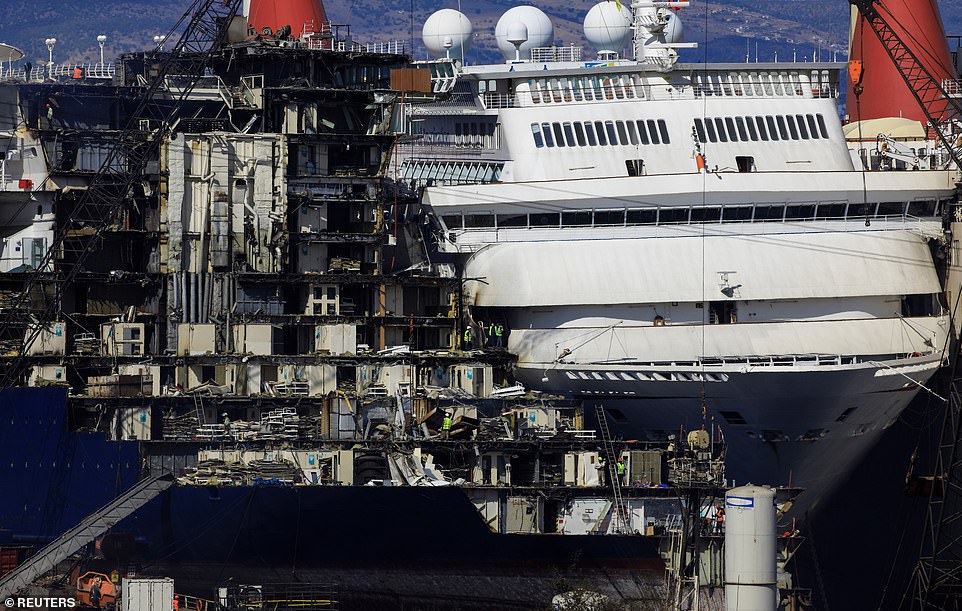
On Friday, workers were seen taking apart the vessels, some with their pools and mini golf course still visible

Cruise ships from Britain and the United States are being scrapped at a Turkish dock after the multi-billion pound industry was smashed by the coronavirus crisis.

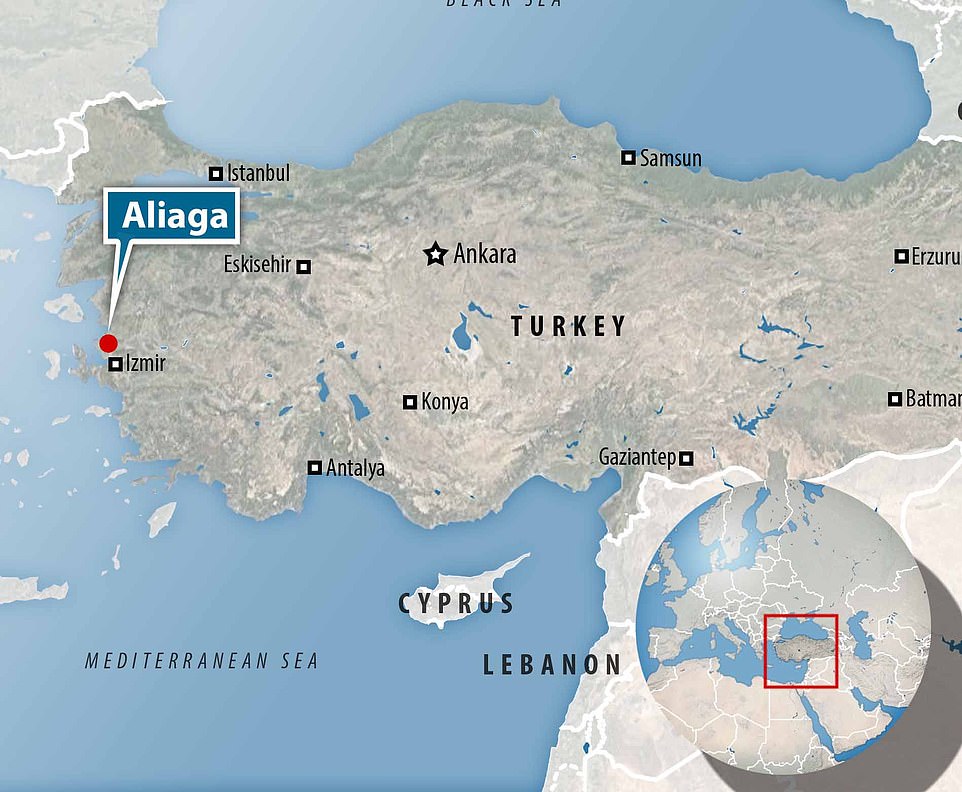
The coronavirus cruise liner graveyard at the port in Aliaga, a town 30 miles north of Izmir on Turkey’s west coast, bustled with work again on Friday as scrapyard workers stripped walls, windows and railings from five vessels.

Cruise ships were home to the some of the earliest clusters of COVID-19 as the pandemic spread globally early this year.