Weird Yet Brilliant Japanese Inventions

What it is: Hand headrest that lets you nap at your desk
Invented: 2015
Average Price: $40*

This weird invention is slightly creepy-looking, but it does appear to be popular. The hand-shaped head holder attaches to your desk, and you can adjust the shape of the hand to conform to your head, allowing you to take a nap at the office, if you want. It’s sort of like a third, urethane hand.

You can also use it to rest your chin while you stay awake and get work done. The hand-shaped head holder is supposed to improve your posture. The invention has been around since 2015, and it costs the U.S. equivalent of around $40 in total.

What it is: An exercise tool that you put in your mouth to tighten facial muscles
Invented:
Average Price: $37*

This looks like a torture device from a horror movie, but it’s not. The little pink figure goes between your lips in order to strengthen your facial muscles around your jaw and mouth. This prevents skin sagging and aging. You only have to use it three minutes a day to see results over time.

The mouth exercise training figure is made by Taruman, and it costs about $37. There are two versions: strong and normal, both of which are made of elastomer. The figure’s dimensions are 2.1” by 1.3” by 1.3” for reference. You can vary the strength based on how out of shape your face is.
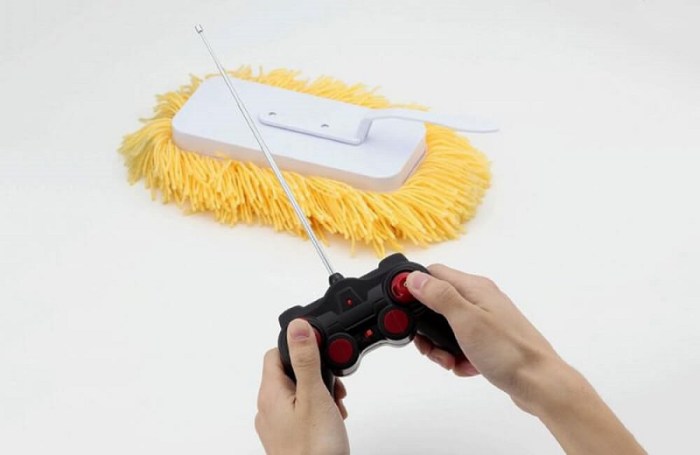
Remote controlled floor mop

What it is: A floor mop operated by a video game controller
Invented: 2015
Average Price: $87.53*

The Japanese company Kyosho makes this, and it advertises this remote-control mop as a way to “mop without mopping.” The remote-control mop is somewhat of a Roomba, but, instead of a vacuum, it is a small floor mop. The remote-control in question is a video game console.

Basically, you can clean stuff without getting off the couch. Kyosho cautions against using the remote control mop for large cleaning projects, admitting that it is really only good for cleaning “small areas, spills, or small messes.” The remote-control mop is available on Amazon for $87.53 (although it’s rating is 2.5/5 stars).
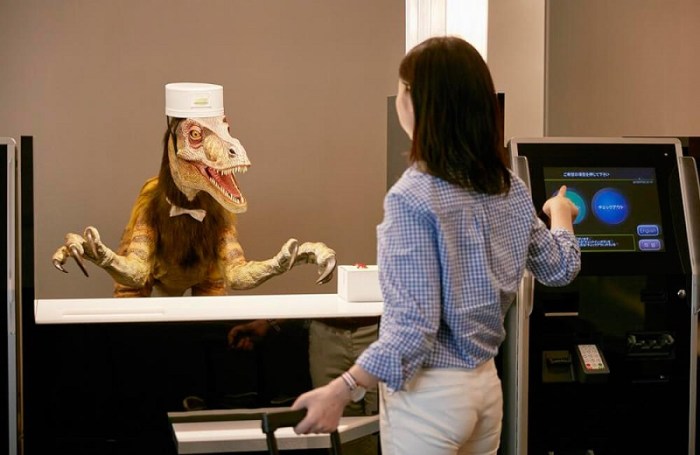
What it is: Several benevolent, loud robotic dinosaurs that check-in people at a hotel
Invented: 2015 (certified by Guinness World Records in 2016)
Average Price: $0* (not for sale, they are working at a hotel)

Jurassic Park fans will like this one. At the Henn-na Hotel, located in suburban Tokyo’s Urayasu, there are two very interesting new staff members. The front desk is manned by robotic dinosaurs. The dinosaurs have sensors, and, when they sense you approaching, they scream, “WELCOME” at you.

The check-in dinosaurs have little bellboy hats and appear to be benevolent. Henn-na means “weird,” and the chain prides itself on its quirky experience. Particularly, Henn-na is pleased that it is the first hotel chain staffed by robots. The robotic dinosaurs are all Tyrannosaurus Rex models, though they are far from life-size.

Scream jar

What it is: Soundproof jar you can scream into to let off stress
Invented: 2016
Average Price: $81.72*

Everyone gets stressed out, but not everyone is able to just yell at someone when they’re stressed. The Banraishop Scream Jar Voice Silencer is primed for stress relief. You put the jar up to your mouth and scream into it. It is soundproof, so there is just a tiny whisper that comes out.

The Voice Silencer also is good for practicing karaoke or singing, but, judging from the reviews, people are mostly using it to rage-scream into. Or they’re giving it to their kids to yell into so that they’re not as annoying. It costs approximately $82 and is available on Amazon.
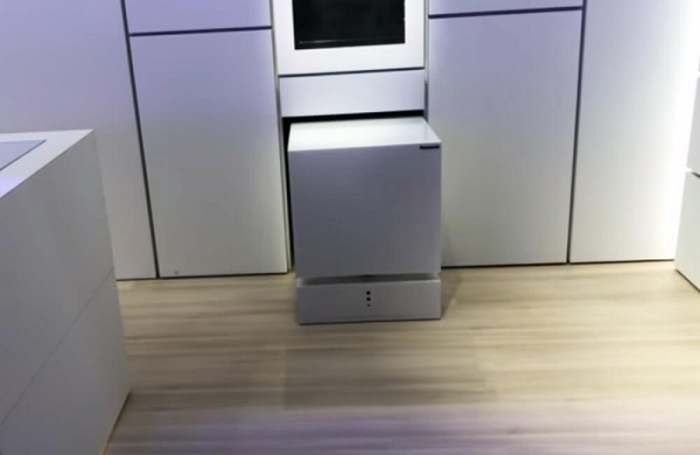
Walking fridge

What it is: A fridge that comes when called
Invented: 2017
Average Price: $5,000*

Designed by Panasonic, the Japanese Walking Fridge is something that fans of Requiem for a Dream or Black Mirror will like. The Walking Fridge comes to you when you call it. The Panasonic Moving Fridge, as it is called, comes with a LIDAR built-in. The fridge will be able to use the light detection/depth sensors to come to you without running into things.

When you call the 600-pound mini-fridge, it will waddle over to you. Panasonic created the fridge for elderly people or those with mobility problems, but anyone can use it. Caution: your pets will probably be freaked out by it.

Noodle-cooling fan chopsticks

What it is: A fan attached to chopsticks to blow on your noodles to cool them
Invented: 2018
Average Price: $99*

Everyone in Japan uses chopsticks, and this invention is basically chopsticks with a fan attached. The USB-powered fan latches onto the base of the chopsticks, blowing on your noodles and cooling them while you eat. The fan comes with the sound effects of bubble wrap, and some limited-edition Otaku versions have the voices of anime characters.

The noodle cooler is made by YO! Sushi. The fan first launched in 2018, and it has since become pretty popular, as, though it is technically Chindogu (Japanese for “useless invention”), it appears to work. YO! Sushi has also invented a Napkin Hat, Wasabi Stick, and Noodle Splash Guard.

Nose straightener

What it is: A clip to contour/straighten your nose
Invented: 2012
Average Price: $43*

Want a straighter nose but don’t want to shell out for surgery? Japanese inventors have you covered. The company has invented the Hana Tsun Nose Straightener. The silicon clip works to straighten the bones of your nose over time and make it more contoured. All you have to do is wear it twenty minutes per day.

According to Japan Trend Shop, the nose straightener is made in Japan and the instructions are all in Japanese. However, it’s pretty self-explanatory. It’s unclear how long it will take to see results, but it has sold out rather quickly, so it must work, right?

Cubic sound catching pillow

What it is: A pillow that lets you lay on your side and still hear out of both ears
Invented: 2013
Average Price: Currently unlisted (out of stock everywhere)

Made by FUJIPACKS, the cubic sound catching pillow helps you be comfortable while watching TV. The cube-shaped pillow has cube-shaped holes in it, so, when you rest your head on its side while watching TV, your ear isn’t blocked off and you can still hear what’s going on.

FUJIPACKS All-Sound Catch Cubic Pillow comes in two colors (Dark Navy and Red), and reviewers have compared the filling of the pillow to “soft, fine sand.” The Cubic Pillow isn’t FUJIPACKS’ first Chigodu rodeo, as it has also invented a mushroom light ($44) and a stainless-steel four-way cylindrical nail file ($102).
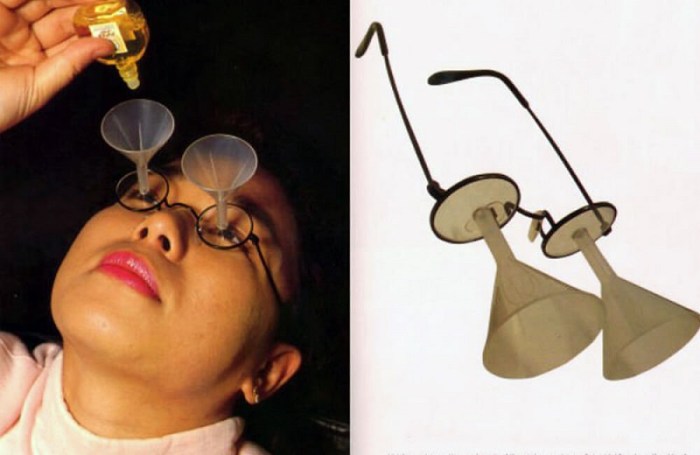
What it is: Funnel glasses that help you put eyedrops in
Invented: 1991
Average Price: $15-$20*

A lot of people can’t put medication in their eyes. Whether that has something to do with a fear of something going in their eyes or they just don’t like it, it’s a big problem. Japanese eyedrop glasses are there to fix the problem. The eyedrop glasses contain a funnel balanced on each of the lenses.

You put the medication into the funnel, keep your eye open, and it goes right into your eye without a problem. The glasses are made by Topcon, located in Tokyo, Japan. According to the U.S. Patent Office, these eyedrop glasses were first patented in 1991.

The Unbelievable Mysteries of Mount Shasta

Mount Shasta is a potentially active volcano at the southern end of the Cascade Range in Siskiyou County, California. At an elevation of 14,179 feet (4321.8 m), it is the second-highest peak in the Cascades and the fifth-highest in the state. Mount Shasta has an estimated volume of 85 cubic miles (350 km3), which makes it the most voluminous stratovolcano in the Cascade Volcanic Arc. The mountain and surrounding area are part of the Shasta–Trinity National Forest.

Mount Shasta is connected to its satellite cone of Shastina, and together they dominate the landscape. Shasta rises abruptly to tower nearly 10,000 feet (3,000 m) above its surroundings. On a clear winter day, the mountain can be seen from the floor of the Central Valley 140 miles (230 km) to the south. The mountain has attracted the attention of poets, authors, and presidents.

The mountain consists of four overlapping dormant volcanic cones that have built a complex shape, including the main summit and the prominent satellite cone of 12,330 ft (3,760 m) Shastina, which has a visibly conical form. If Shastina were a separate mountain, it would rank as the fourth-highest peak of the Cascade Range (after Mount Rainier, Rainier’s Liberty Cap, and Mount Shasta itself).

California’s Mount Shasta has been the subject of an unusually large number of myths and legends. In particular, it is often said to hide a secret city beneath its peaks. In some stories, the city is no longer inhabited, while in others, it is inhabited by a technologically advanced society of human beings or mythical creatures.

Mount Shasta can generate lenticular clouds, which may contribute to its supernatural reputation.

According to local indigenous tribes, namely the Klamath people, Mount Shasta is inhabited by the spirit chief Skell, who descended from heaven to the mountain’s summit. Skell fought with Spirit of the Below-World, Llao, who resided at Mount Mazama, by throwing hot rocks and lava, probably representing the volcanic eruptions at both mountains. Writer Joaquin Miller recorded various related legends in the 1870s.

Mount Shasta has also been a focus for non-Native American legends, centered on a hidden city (called Telos) of advanced beings from the lost continent of Lemuria. The legend grew from an offhand mention of Lemuria in the 1880s. In 1899, Frederick Spencer Oliver published A Dweller on Two Planets, which claimed that survivors from a sunken continent called Lemuria were living in or on Mount Shasta. Oliver’s Lemurians lived in a complex of tunnels beneath the mountain and occasionally were seen walking the surface dressed in white robes. In 1931, Harvey Spencer Lewis, using the pseudonym Wisar Spenle Cerve, wrote a book (published by the Rosicrucians) about the hidden Lemurians of Mount Shasta that a bibliography on Mount Shasta described as “responsible for the legend’s widespread popularity.” This belief has been incorporated into numerous occult religions, including “I AM” Activity, The Summit Lighthouse, Church Universal and Triumphant, and Kryon.

According to Guy Ballard, while hiking on Mount Shasta, he encountered a man who introduced himself as Count of St. Germain, who is said to have started Ballard on the path to discovering the teachings that would become the “I AM” Activity religious movement.

According to a legend, J. C. Brown was a British prospector who discovered a lost underground city beneath Mt. Shasta in 1904. Brown had been hired by the Lord Cowdray Mining Company of England to prospect for gold, and discovered a cave which sloped downward for 11 miles. In the cave, he found an underground village filled with gold, shields, and mummies, some being up to 10 feet tall.

Thirty years later, he told his story to John C. Root, who proceeded to gather an exploration team in Stockton, California. About 80 people joined the team, but on the day the team was to set out, Brown did not show up. Brown was not heard from again.

The 429 yard par 4 sninth hole at Mount Shasta Resort.

Mount Shasta is believed to be a home base for the Lizard People, too, reptilian humanoids that also reside underground. The mountain is a hotbed of UFO sightings, one of the most recent of which occurred in February 2020. (It was a saucer-shaped lenticular cloud.) In fact, the mountain is associated with so many otherworldly, paranormal, and mythical beings—in addition to long-established Native American traditions—that it’s almost like a who’s who of metaphysics. It has attracted a legion of followers over the years, including “Poet of the Sierras” Joaquin Miller and naturalist John Muir, as well as fringe religious organizations such as the Ascended Masters, who believe that they’re enlightened beings existing in higher dimensions. What is it about this mountain in particular that inspires so much belief?

Pluto’s Cave is a volcanic lava tube on the outskirts of Mount Shasta.

“There’s a lot about Mount Shasta, and volcanoes in general, that are difficult to explain,” says Andrew Calvert, scientist-in-charge at the California Volcano Observatory, “and when you’re having difficulty explaining something, you try and understand it.” Calvert has studied Shasta’s eruptive history since 2001. “It’s such a complicated and rich history,” he says, “and Shasta itself is also very visually powerful. These qualities build on each other to make it a profound place for a lot of people—geologists, spirituality seekers … even San Francisco tech folks, and hunters and gatherers from 10,000 years ago. It’s one that can have a really strong effect on your psyche.”
Taylor Tupper, a Modoc Indian of the Klamath Tribes, raised in the Klamath Basin just north of Shasta. Tupper says she leaves people to their own beliefs about Shasta as well: spiritual, metaphysical, or simply on another plane. “People always ask me about UFOs and such, and I say I’m not going to go poking around in others’ business. Every place you go is sacred or special to someone or something, or was at some point. Treat it all with respect and your spirit will be in tune with nature and the creator, and you won’t be going against spiritual law. If you are going against it, nature will let you know.”

Magnificent Jet Airplanes

16249849822_a4c9b459fc_b

San Francisco International


airline

Five giants: three Airbus A380’s, a Boeing 747 and 777.


airline1

Qantas A380


airline2

747 coming in extremely low at St. Martens.

airline3

The infamous “Gimli Glider”. Air Canada 767 made an emergency landing at an abandoned airstrip in Gimli, Manitoba. The plane ran out of fuel when a technician made a mistake converting gallons into litres.

airline4 lax

Up and away  at LAX

airline5 berlin

Berlin Airshow. The American section with the giant C-5 Galaxy dwarfing everything else.

airline6 Antonov An-225 Mriya

The Russian Anotov AN-225 Mriya. Biggest plane in the world.


airline7

Crosswinds


More Crosswinds


airline9 crosswinds ecuador


airline8

747 into the sunset


airline10

Car-go


airline11

Thunderbirds over Nevada


airline12

F-100 Super Sabre alongside FedEx MD-111 Mojave, California.

A Canyon That Fighter Pilots Love To Scream Through

f-16c


In Death Valley National Park, north of Barstow, California, is Rainbow Canyon. It’s not especially remarkable, just one canyon in an area full of them, all but indistinguishable from its neighbors in an area populated mainly by snakes. But stand on one of the canyon tops for long enough and a fighter jet will suddenly roar into the valley below you, flying fast and very, very low. It will be visible for only a few seconds before it turns hard and disappears behind the next hill. But during those few moments, anyone with a camera has a brief chance to take a spectacular picture. Rainbow Canyon (or Star Wars Canyon, as some call it) is part of the R-2508 restricted airspace complex, host to a busy, low-level training route for combat aircraft.

Military pilots train to fly low and fast, hiding behind hills to fool radar and going fast enough that they can’t be shot at. Since flying is a perishable skill, every fighter or attack pilot periodically has to practice such low-level flights. Rainbow Canyon is in the desert of eastern California, where the population is sparse and the airspace wide open. It’s also surrounded by military bases, bombing ranges, maneuvering grounds and radars—an ideal spot for military pilots to hone their skills. Among the nearby facilities are Edwards AFB, Naval Air Station China Lake, and Plant 42 (where Lockheed and Northrop build advanced aircraft).


f-4
f-15
Photos are taken on a high ridge above the jets
f-16d
f-15a
f-16a
Thunderbird
Marine Harrier
f-8
f-18
f-16b
F-18 Hornet with brown camo.
fa-18f-vfa-122

Shark researchers size up real ‘Megalodon’ for first time

The enormity of a prehistoric mega-shark made famous in Hollywood films has finally been revealed by researchers.

Until now, only the length of the Otodus Megalodon, as featured in the 2018 film The Meg, had been estimated from fossils of its teeth.

However a team from Swansea and Bristol universities have combined maths with nature to reveal just how big it was.

The study has been published in the journal Scientific Reports.

Researchers used mathematical methods and comparisons with living relatives to find the overall size of the megalodon, which lived from about 23 million to three million years ago.

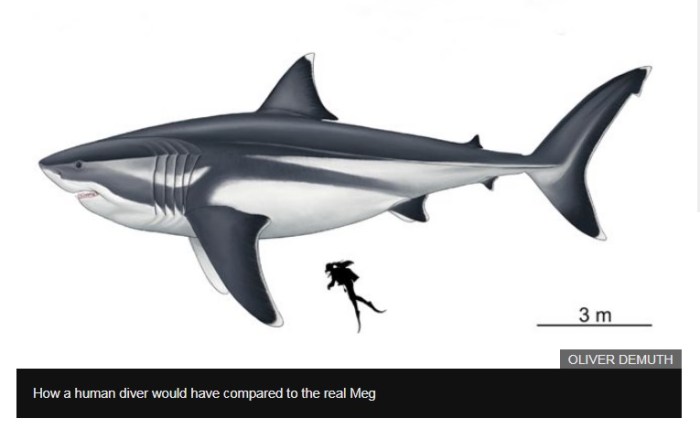
Results suggest a 16m (52ft) megalodon – almost three times as long as a great white shark – is likely to have had a head about 4.65m (15ft) long, a dorsal fin as large as an entire adult human and a tail about 3.85m (13ft) high.

Jack Cooper, who is to study a PHD in palaeobiology at Swansea University, described the research as his “dream project”.

“Megalodon was the very animal that inspired me to pursue palaeontology but studying the whole animal is difficult considering all we really have are lots of isolated teeth,” he said.

“It’s significant that we have now been able to produce estimates of proportions and dimensions of the body parts when there are no fossils to go off.

“However the dimensions in the film were actually pretty accurate.”

Previously, the shark was only compared with the great white, but the latest analysis was expanded to include five modern sharks, including the makos, salmon shark and porbeagle shark.

Mr Cooper added: “We could take the growth curves of the five modern forms and project the overall shape as they get larger and larger – right up to a body length of 16 metres.”

Moon Bases

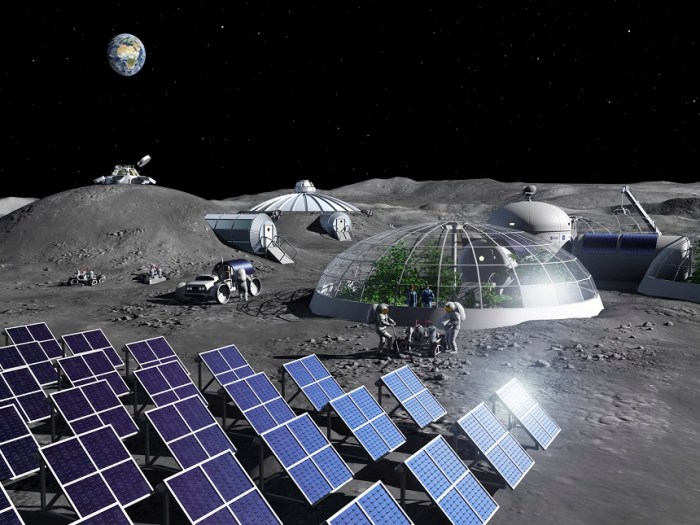
Discovery of water in the soil at the lunar poles by Chandrayaan-1 (ISRO) in 2008–09 renewed interest in the Moon, after NASA missions in the 1990s suggested the presence of lunar ice. Locating a colony at one of the lunar poles would also avoid the problem of long lunar nights—about 354 hours long, half a lunar month—and allow the colony to take advantage of the continuous sunlight there for generating solar power.

Permanent human habitation on a planetary body other than the Earth is one of science fiction’s most prevalent themes. As technology has advanced, and concerns about the future of humanity on Earth have increased, the vision of space colonization as an achievable and worthwhile goal has gained momentum. Because of its proximity to Earth, the Moon is seen by many as the best and most obvious location for the first permanent human space colony. Currently, the main problem hindering the development of such a colony is the high cost of human spaceflight.

There are also several projects that have been proposed for tourism on the Moon in the near future by private space companies.

The notion of a lunar colony originated before the Space Age. In 1638, Bishop John Wilkins wrote A Discourse Concerning a New World and Another Planet, in which he predicted a human colony on the Moon. Konstantin Tsiolkovsky (1857–1935), among others, also suggested such a step.

From the 1950s onwards, a number of more concrete concepts and designs have been suggested by scientists, engineers and others. In 1954, science fiction writer Arthur C. Clarke proposed a lunar base of inflatable modules covered in lunar dust for insulation. A spaceship assembled in low Earth orbit would launch to the Moon, and astronauts would set up the igloo-like modules and an inflatable radio mast. Subsequent steps would include the establishment of a larger, permanent dome; an algae-based air purifier; a nuclear reactor for the provision of power; and electromagnetic cannons to launch cargo and fuel to interplanetary vessels in space.

In 1959, John S. Rinehart suggested that the safest design would be a structure that could “[float] in a stationary ocean of dust”, since there were, at the time this concept was outlined, theories that there could be mile-deep dust oceans on the Moon. The proposed design consisted of a half-cylinder with half-domes at both ends, with a micrometeoroid shield placed above the base.

The United States space administration NASA has requested an increase in the 2020 budget of $1.6 billion, in order to make another crewed mission to the Moon by 2024, followed by a sustained presence on the Moon by 2028. NASA is ready to announce plans to bring together a Commercial Human Lander Awards for Artemis Missions on the Moon. This specific program, “The Artemis Program,” encompasses NASA’s overview for lunar exploration plans. This announcement will go over the first in a series of many more to come complex missions. Artemis I will start off as an un-crewed flight test to demonstrate the capabilities of NASA’s Space Launch System (SLS) rocket and Orion spacecraft. The first flight with a crew will be Artemis II, closely followed by Artemis III that will actually land crew on the moon by the end of 2024 using a new commercially-procured Human Landing System (HLS). They hope to develop a sustainable lunar exploration program starting from 2028.

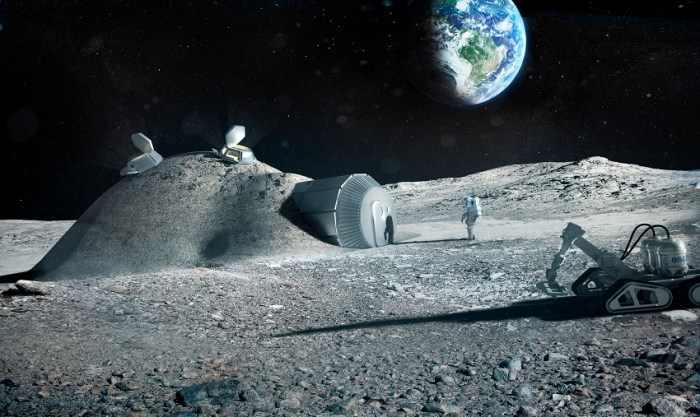
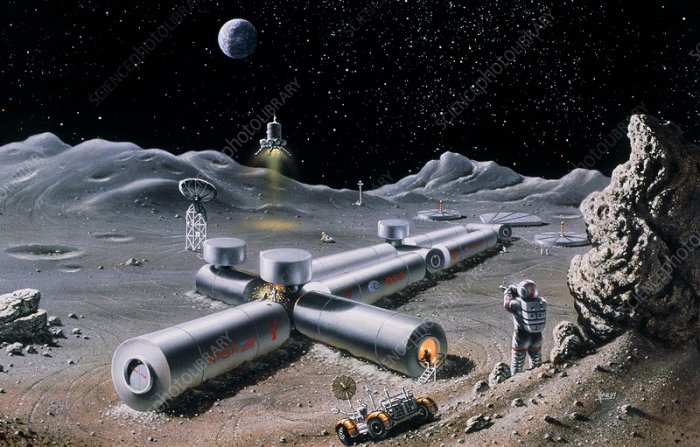
Artist’s impression of a manned lunar base. Permanently-manned bases on the Moon have been proposed to support a manned mission to the planet Mars. The low-gravity environment on the Moon could allow materials processing and construction projects that would be impractical on Earth. The objects and structures made on the Moon could be very easily launched into orbit for final construction of the Mars spaceship. The Moon has also been seen as an easy source of liquid oxygen. 

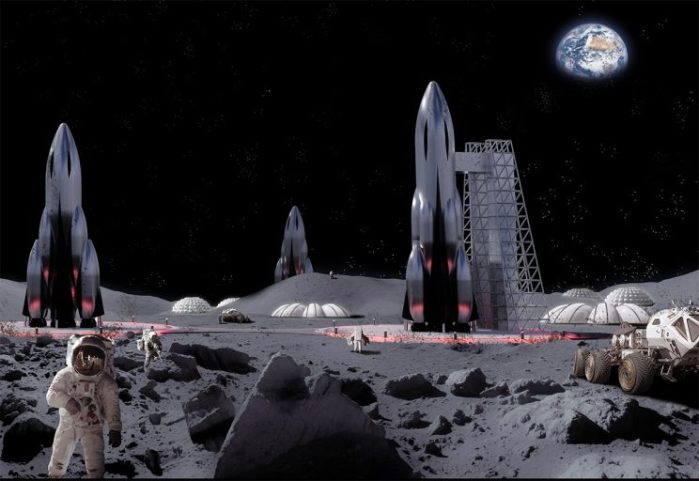
Billionaire Jeff Bezos has outlined his plans for a lunar base in the 2020s. Independently, SpaceX plans to send Starship to the Moon to establish a base.

In March 2019 NASA unveiled the Artemis program’s mission to send a crewed mission to the Moon by 2024, in response to a directive by President Trump, along with plans to establish an outpost in 2028. However, existing plans delay the proposed mission to 2028 with a base established in the 2030s.

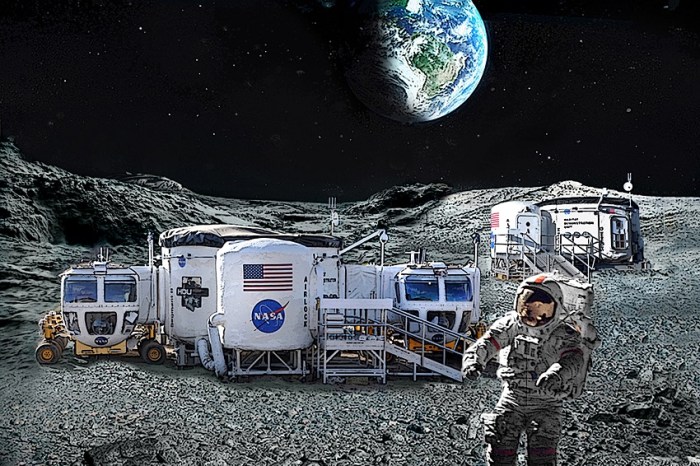
There have been numerous proposals regarding habitat modules. The designs have evolved throughout the years as humankind’s knowledge about the Moon has grown, and as the technological possibilities have changed. The proposed habitats range from the actual spacecraft landers or their used fuel tanks, to inflatable modules of various shapes. Some hazards of the lunar environment such as sharp temperature shifts, lack of atmosphere or magnetic field (which means higher levels of radiation and micrometeoroids) and long nights, were unknown early on. Proposals have shifted as these hazards were recognized and taken into consideration.

Underground colonies
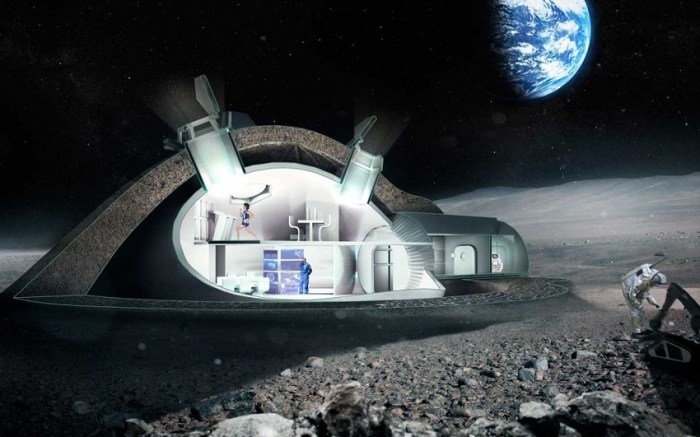
Some suggest building the lunar colony underground, which would give protection from radiation and micrometeoroids. This would also greatly reduce the risk of air leakage, as the colony would be fully sealed from the outside except for a few exits to the surface.

The construction of an underground base would probably be more complex; one of the first machines from Earth might be a remote-controlled excavating machine. Once created, some sort of hardening would be necessary to avoid collapse, possibly a spray-on concrete-like substance made from available materials. A more porous insulating material also made in-situ could then be applied. Rowley & Neudecker have suggested “melt-as-you-go” machines that would leave glassy internal surfaces. Mining methods such as the room and pillar might also be used. Inflatable self-sealing fabric habitats might then be put in place to retain air. Eventually an underground city can be constructed. Farms set up underground would need artificial sunlight. As an alternative to excavating, a lava tube could be covered and insulated, thus solving the problem of radiation exposure. An alternative solution is studied in Europe by students to excavate a habitat in the ice-filled craters of the Moon.

Race for Coronavirus Vaccine Pits Spy Against Spy

New York Times

The intelligence wars over vaccine research have intensified as China and Russia expand their efforts to steal American work at both research institutes and companies.

WASHINGTON — Chinese intelligence hackers were intent on stealing coronavirus vaccine data, so they looked for what they believed would be an easy target. Instead of simply going after pharmaceutical companies, they conducted digital reconnaissance on the University of North Carolina and other schools doing cutting-edge research.

They were not the only spies at work. Russia’s premier intelligence service, the S.V.R., targeted vaccine research networks in the United States, Canada and Britain, espionage efforts that were first detected by a British spy agency monitoring international fiber optic cables.

Iran, too, has drastically stepped up its attempts to steal information about vaccine research, and the United States has increased its own efforts to track the espionage of its adversaries and shore up its defenses.

In short, every major spy service around the globe is trying to find out what everyone else is up to.

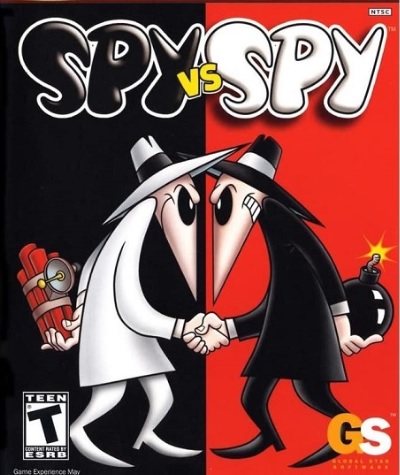
The coronavirus pandemic has prompted one of the fastest peacetime mission shifts in recent times for the world’s intelligence agencies, pitting them against one another in a new grand game of spy versus spy, according to interviews with current and former intelligence officials and others tracking the espionage efforts.

Nearly all of the United States’ adversaries intensified their attempts to steal American research while Washington, in turn, has moved to protect the universities and corporations doing the most advanced work. NATO intelligence, normally concerned with the movement of Russian tanks and terrorist cells, has expanded to scrutinize Kremlin efforts to steal vaccine research as well, according to a Western official briefed on the intelligence.

The contest is reminiscent of the space race, where the Soviet Union and America relied on their spy services to catch up when the other looked likely to achieve a milestone. But where the Cold War contest to reach the Earth’s orbit and the moon played out over decades, the timeline to help secure data on coronavirus treatments is sharply compressed as the need for a vaccine grows more urgent each day.

“It would be surprising if they were not trying to steal the most valuable biomedical research going on right now,” John C. Demers, a top Justice Department official, said of China last month during an event held by the Center for Strategic and International Studies. “Valuable from a financial point of view and invaluable from a geopolitical point of view.”

China’s push is complex. Its operatives have also surreptitiously used information from the World Health Organization to guide its vaccine hacking attempts, both in the United States and Europe, according to a current and a former official familiar with the intelligence.

It was not clear how exactly China was using its influential position in the W.H.O. to gather information about vaccine work around the globe. The organization does collect data about vaccines under development, and while much of it is eventually made public, Chinese hackers could have benefited by getting early information on what coronavirus vaccine research efforts the W.H.O. viewed as most promising, according to a former intelligence official.

American intelligence officials learned about China’s efforts in early February as the virus was gaining a foothold in the United States, according to current and former American officials. The C.I.A. and other agencies closely watch China’s moves inside international agencies, including the W.H.O.

The intelligence conclusion helped push the White House toward the tough line it adopted in May on the W.H.O., according to the former intelligence official.

Besides the University of North Carolina, Chinese hackers have also targeted other universities around the country and some may have had their networks breached, American officials said. Mr. Demers said in his speech that China had conducted “multiple intrusions” beyond what the Justice Department revealed in an indictment in July, which accused two hackers of working on behalf of China’s Ministry of State Security spy service to pursue vaccine information and research from American biotechnology companies.

The F.B.I. warned officials at U.N.C. in recent weeks about the hacking attempts, according to two people familiar with the matter. The Chinese hacking teams were trying to break into the computer networks of the school’s epidemiology department but did not infiltrate them.

A U.N.C. spokeswoman, Leslie Minton, said that the school “regularly receives threat alerts from U.S. security agencies.” She directed further questions to the federal government, but said the school had invested in “around-the-clock monitoring” to “help guard against advanced persistent threat attacks from state sponsored organizations.”

Besides hacking, China has pushed into universities in other ways. Some government officials believe it is trying to take advantage of research partnerships that American universities have forged with Chinese institutions.

Others have warned that Chinese intelligence agents in the United States and elsewhere have tried to collect information on researchers themselves. The Trump administration ordered China on July 22 to close its consulate in Houston in part because Chinese operatives had used it as an outpost to try to make inroads with medical experts in the city, according to the F.B.I.

Chinese intelligence officials are focused on universities in part because they view the institutions’ data protections as less robust than those of pharmaceutical companies. But spy work is also intensifying as researchers share more vaccine candidates and antiviral treatments for peer review, giving adversaries a better chance of gaining access to formulations and vaccine development strategies, said an American government official briefed on the intelligence.

So far, officials believe that foreign spies have taken little information from the American biotech companies they targeted: Gilead Sciences, Novavax and Moderna.

At the same time the British electronic surveillance agency G.C.H.Q. was learning about the Russian effort and American intelligence learned of the Chinese hacking, the Department of Homeland Security and F.B.I. dispatched teams to work with American biotech teams to bolster their computer networks’ defenses.

The Russian effort, announced by British, American and Canadian intelligence agencies in July, was primarily focused on gathering intelligence about research by Oxford University and its pharmaceutical corporate partner, AstraZeneca.

The Russians caught trying to get vaccine information were part of the group known as Cozy Bear, a collection of hackers affiliated with the S.V.R. Cozy Bear was one of the hacking groups that in 2016 broke into Democratic computer servers.

Homeland security officials have warned pharmaceutical companies and universities about the attacks and helped institutions review their security. For the most part, officials have observed the would-be vaccine hackers using known vulnerabilities that have yet to be patched, not the more exquisite cyberweapons that target unknown gaps in computer security.

No corporation or university has announced any data thefts resulting from the publicly identified hacking efforts. But some of the hacking attempts succeeded in at least penetrating defenses to get inside computer networks, according to one American government official. And hackers for China and Russia test weaknesses every day, according to intelligence officials.

“It is really a race against time for good guys to find the vulnerabilities and get them patched, get those patches deployed before the adversary finds them and exploits them,” said Bryan S. Ware, the assistant director of cybersecurity for the Homeland Security Department’s Cybersecurity and Infrastructure Security Agency. “The race is tighter than ever.”

While only two teams of hackers, one each from Russia and China, have been publicly identified, multiple hacking teams from nearly all the intelligence services of those two countries have been trying to steal vaccine information, according to law enforcement and intelligence officials.

Russia announced on Aug. 11 that it had approved a vaccine, a declaration that immediately aroused suspicion that its scientists were at least aided by its spy agencies’ work to steal research information from other countries.

American officials insist their own spy services’ efforts are defensive and that intelligence agencies have not been ordered to steal coronavirus research. But other current and former intelligence officials said the reality was not nearly so black and white. As American intelligence agencies try to find out what Russia, China and Iran may have stolen, they could encounter information on those countries’ research and collect it.

Officials expressed concerns that further hacking attempts could hurt vaccine development efforts. Hackers extracting data could inadvertently — or purposefully — damage research systems.

“When an adversary is doing a smash-and-grab, there is even more likely a chance of not just stealing information but somehow disrupting the victim’s operations networks,” Mr. Ware said.

While some of Russia’s and China’s spying may have been aimed at checking their own research or looking for shortcuts, some current and former officials raised the possibility that the countries sought instead to sow distrust in an eventual vaccine from Western countries.

Both Russia and China have already spread disinformation about the virus, its origins and the American response. Russian intelligence services in particular are laying the groundwork for a more aggressive effort to escalate the anti-vaccine movement in the West and could use the allegations of spying to give its narrative greater traction.

Russia has a long record of trying to amplify divisions in American society. Current and former national security officials said they expect Russia to eventually spread disinformation about any vaccine approved in the West.

“This case seems to be a throwback to the old Soviet Union,” said Fiona Hill, the former National Security Council official and Russia expert who testified in the impeachment hearings against President Trump. “Russia and the Chinese have been out there on disinformation campaigns. How better to create confusion and weaken the U.S. further than to whip up the antivax movement? But you make sure all your guys are vaccinated.”