









All over the world, from the US to Germany to the UK, some people decide to disappear from their own lives without a trace – leaving their homes, jobs and families in the middle of the night to start a second life, often without ever looking back.
In Japan, these people are sometimes referred to as “jouhatsu”. That’s the Japanese word for “evaporation”, but it also refers to people who vanish on purpose into thin air, and continue to conceal their whereabouts – potentially for years, even decades.
“I got fed up with human relationships. I took a small suitcase and disappeared,” says 42-year-old Sugimoto, who’s just going by his family name for this story. “I just kind of escaped.” He says that back in his small hometown, everybody knew him because of his family and their prominent local business, which Sugimoto was expected to carry on. But having that role foisted upon him caused him such distress that he abruptly left town forever and told no one where he was going.
From inescapable debt to loveless marriages, the motivations that push jouhatsu to “evaporate” can vary. Regardless of their reasons, they turn to companies that help them through the process. These operations are called “night moving” services, a nod to the secretive nature of becoming a jouhatsu. They help people who want to disappear discreetly remove themselves from their lives, and can provide lodging for them in secret whereabouts.
“Normally, the reason for moving is something positive, like entering university, getting a new job or a marriage. But there’s also sad moving – for example, like dropping out of university, losing a job or escaping from a stalker,” says Sho Hatori, who founded a night-moving company in the 90s when Japan’s economic bubble burst. At first, he thought financial ruin would be the only thing driving people to flee their troubled lives, but he soon found there were “social reasons”, too. “What we did was support people to start a second life,” he says.
Sociologist Hiroki Nakamori has been researching jouhatsu for more than a decade. He says the term ‘jouhatsu’ first started being used to describe people who decided to go missing back in the 60s. Divorce rates were (and still are) very low in Japan, so some people decided it was easier to just up and leave their spouses instead of going through elaborate, formal divorce proceedings.
“In Japan, it’s just easier to evaporate,” says Nakamori. Privacy is fiercely protected: missing people can freely withdraw money from ATMs without being flagged, and their family members can’t access security videos that might have captured their loved one on the run. “Police will not intervene unless there’s another reason – like a crime or an accident. All the family can do is pay a lot for a private detective. Or just wait. That’s all.”

‘I was shocked’
For the loved ones who get left behind, the abandonment – and resultant search for their jouhatsu – can be unbearable.
“I was shocked,” says a woman who’s remained anonymous, and whose 22-year-old son went missing and hasn’t contacted her since. “He failed after quitting his job twice. He must have felt miserable with his failure.” She drove to where he was living, searched the premises and then waited in her car for days to see if he showed up. He never did.
She says the police haven’t been helpful, and says they told her they could only get involved if it was a suspected suicide. But since there was no note, they won’t help.
“I understand there are stalkers – information can be misused. This is a necessary law, perhaps. But criminals, stalkers and parents who cannot search for their own children? All of them are treated the same way due to the protection. What is this?” she says. “With the current law, without money, all I can do is check if [a] dead body is my son – the only thing left for me.”
The disappeared
For the jouhatsu themselves, feelings of sadness and regret stick with many of them long after they leave their lives behind.
“I constantly have a feeling that I’ve done something wrong,” says Sugimoto, the businessman who left his wife and kids in the small town. “I haven’t seen [my children] in a year. I told them I’m on a business trip.” His only regret, he says, was leaving them.
Sugimoto is currently staying in a home tucked away in a residential district of Tokyo. The night-moving company that’s housing him is run by a woman called Saita, who’s also going by her family name only to preserve anonymity. She was a jouhatsu herself, who went missing 17 years ago. She ‘disappeared’ after being in a physically abusive relationship, and says “in a way, I’m a missing person – even now.”
“I have various types of clients,” she continues. “There are people who run away from serious domestic violence or ego and self-interest. I don’t judge. I never say, ‘Your case is not serious enough’. Everybody has individual struggles.”
For people like Sugimoto, her company helped him address those struggles of his own . But even though he managed to disappear, it doesn’t mean that traces of his old life don’t linger. “Only my first son knows the truth. He’s 13 years old,” he says. “The words I can’t forget are, ‘What Dad decided is Dad’s life, and I can’t change it’. It sounds more mature than me, doesn’t it?”
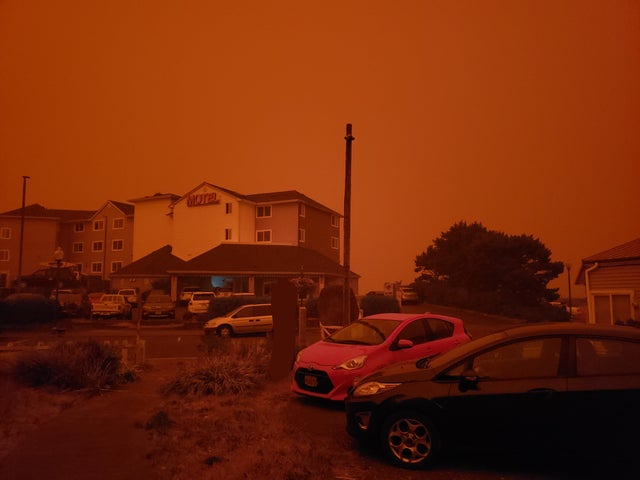
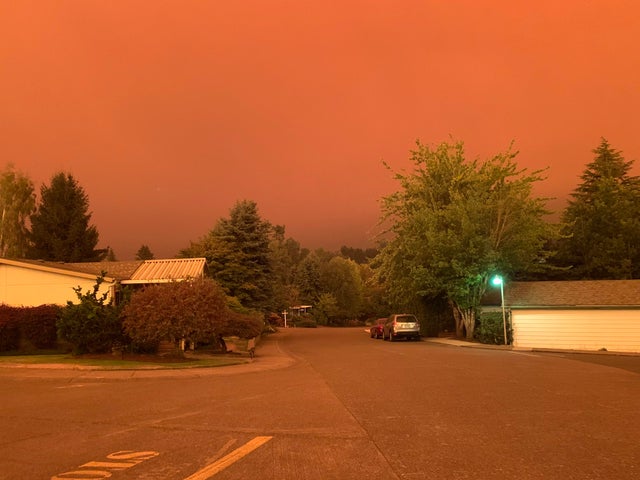
Multiple wildfires in the state of Oregon has caused skies to turn red due to the heavy smoke.



State capital building in Salem


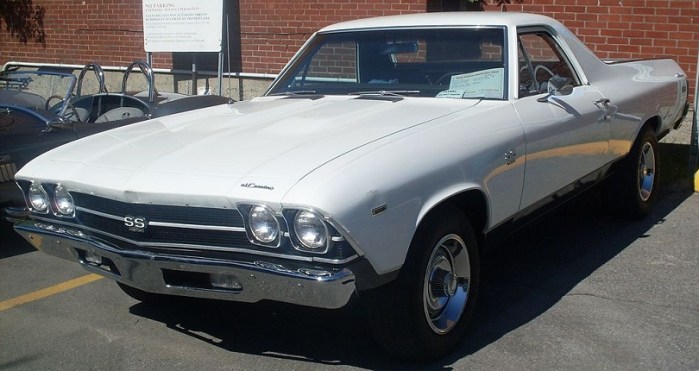
The Chevrolet El Camino is a pickup / coupé utility vehicle that was produced by Chevrolet between 1959–60 and 1964–1987. Unlike a standard pickup truck, the El Camino was adapted from the standard two-door Chevrolet station wagon platform and integrated the cab and cargo bed into the body.
Introduced in the 1959 model year in response to the success of the Ford Ranchero pickup, its first run lasted only two years. Production resumed for the 1964–1977 model years based on the Chevelle platform, and continued for the 1978–1987 model years based on the GM G-body platform.
Although based on corresponding General Motors car lines, the vehicle is classified in the United States as a pickup.
1959 El Camino

1964 El Camino
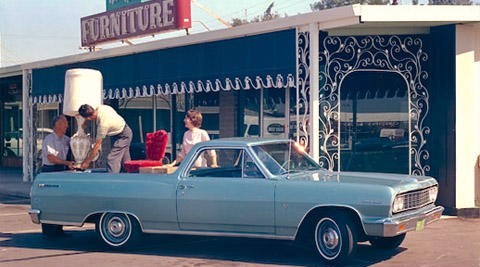
1973 El Camino

1979 El Camino

The Ford Ranchero is a Pickup /coupe utility that was produced by Ford between 1957 and 1979. Unlike a standard pickup truck, the Ranchero was adapted from a two-door station wagon platform that integrated the cab and cargo bed into the body. A total of 508,355 units were produced during the model’s production run. Over its lifespan it was variously derived from full-sized, compact, and intermediate automobiles sold by Ford for the North American market.
During the 1970s, the Ranchero name was used in the South African market for a rebadged Australian Ford Falcon utility. Shipped from Australia in complete knock down (CKD) form, these vehicles were assembled in South Africa at Ford’s plant in Port Elizabeth. In Argentina, a utility version of the locally produced Ford Falcon was also called Ranchero.
The original Ranchero sold well enough to spawn a competitor from General Motors in 1959, the Chevrolet El Camino.
1967 Ford Ranchero

1958 Ranchero

1970 Ranchero

1979 Ranchero

An El Camino on fire in downtown Winnipeg in 2016.

ABC’s Wide World of Sports was an American sports anthology television program that aired on the American Broadcasting Company (ABC) from April 29, 1961 to January 3, 1998, primarily on Saturday afternoons. Hosted by Jim McKay, with a succession of co-hosts beginning in 1987, the title continued to be used for general sports programs on the network until 2006. In 2007, Wide World of Sports was named by Time on its list of the 100 best television programs of all-time.


The aircraft in the photograph was XG332. It was built in 1959, one of 20 pre-production Lightnings. Alan Sinfield took a photograph of XG332 in 1960 at Farnborough:

However, the very last photograph taken of XG332, in 1962, is deservedly the most famous one. How does someone manage to take a photograph like this? Planning, quick wits and a healthy dose of luck.
Jim Meads is the man who took the picture. He was a professional photographer who lived near the airfield, next door to de Havilland test pilot Bob Sowray.
So, the story goes: Bob Sowray mentioned to Jim Meads that he was going to fly the Lightning that day. When Meads took his kids for a walk, he took his camera along, hoping to get a shot of the plane.
His plan was to take a photograph of the children with the airfield in the background as the Lightning came in to land. They found a good view of the final approach path and waited for the Lightning to return.
As it happened, Bob Sowray didn’t fly the Lightning that day. The pilot was George Aird, another test pilot working for De Havilland.
Whilst carrying out a demonstration flight, there was a fire in the aircraft’s reheat zone. Unburnt fuel in the rear fuselage had been ignited by a small crack in the jet pipe and had weakened the tailplane actuator anchorage. This weakened the tailplane control system which failed with the aircraft at 100 feet on final approach.
The aircraft pitched up violently just as Aird was coming up to land. Aird lost control of the aircraft and ejected.
Luckily, because the nose pitched up he had just enough time to eject.
The tractor in the photograph was a Fordson Super Major. If you look closely at the grill, you’ll see it reads D H Goblin, as in the de Havilland Goblin jet engine.
The tractor driver was 15-year-old Mick Sutterby, who spent that summer working on the airfield. He wasn’t posing for the camera. In fact, he was telling the photographer, Jim Mead, to move on, because he shouldn’t be there.
Mead saw the plane coming in and the nose pitch up. Then Aird ejected and Mead says he had just enough time to line up the shot as the Lightning came down nose first.
Meanwhile, George Aird landed on a greenhouse and fell through the roof, breaking both legs as he landed unconscious on the ground. The water from the sprinkler system for the tomatoes woke him. He’s reported to have said that his first thought was that he must be in heaven.

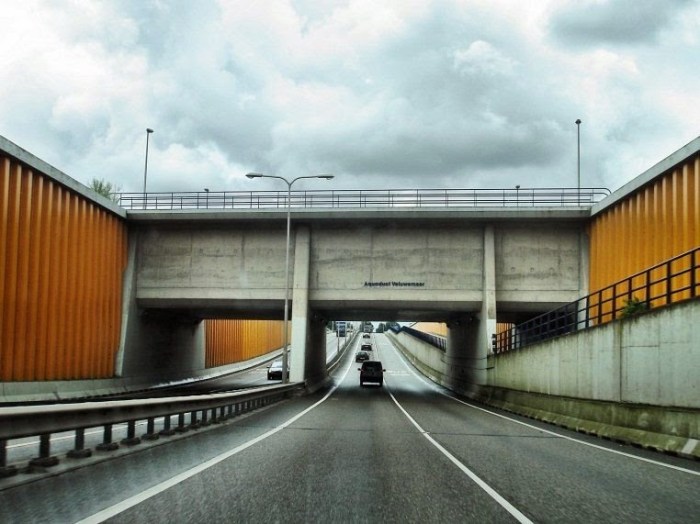
The Aqueduct Veluwemeer is a navigable aqueduct over the N302 road near Harderwijk, in eastern Netherlands. It is located under a small part of the lake Veluwemeer and at the same time connects the mainland Netherlands to Flevoland, which happens to be the largest artificial island in the world. The aqueduct, which was opened to traffic in 2002, is 25 meters long and 19 meters wide and has a water depth of 3 meters that allow small boats to pass through. Underneath, around 28 000 vehicles passes every day. Footpaths are built on either side of the aqueduct for public that wants to enjoy the view.


A company named Ghost Robotics has developed a dog-like robot, the Q-UGV to primarily conduct surveillance and security operations.
It’s actually kind of creepy.
This robot is sort of humorous.







 The MarkoZen Blog