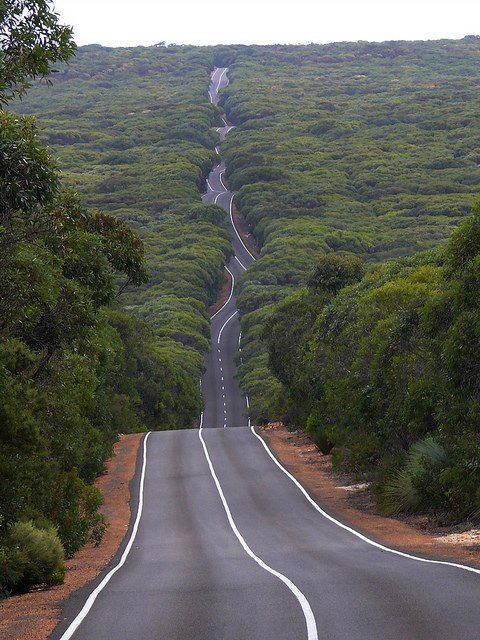
Kangaroo Island, also known as Karta (“island of the dead”), is Australia’s third-largest island, after Tasmania and Melville Island. It lies in the state of South Australia 112 km (70 mi) southwest of Adelaide. Its closest point to the mainland is Snapper Point in Backstairs Passage, which is 13.5 km (8.4 mi) from the Fleurieu Peninsula.
The island and road was affected this year by the devastating bush fires.
A jaw-dropping video from Thailand provides a chilling example of how the coronavirus has spawned chaos in unexpected ways as it shows an enormous group of monkeys accustomed to eating handouts from tourists now forced to fight over a meager scrap of food. The unsettling scene was reportedly filmed this week in the city of Lopburi. Usually a prime destination for visitors from around the world, the location has become a veritable ghost town due to the concerns over the pandemic.
Due to the downturn in tourism, the area’s resident monkey population, which numbers in the thousands, has grown increasingly hungry as was evident in the unnerving incident filmed by stunned onlooker Sasaluk Rattanachai. In her video, the deprived primates can be seen roaming the streets by the hundreds in an apparent search for sustenance. Although it’s hard to discern exactly what one of the monkeys wound up finding to eat, its meal does not last very long as the creature is soon swarmed by the other starving animals in a truly terrifying turn of events.
“They looked more like wild dogs than monkeys,” Rattanachai marveled, “they went crazy for the single piece of food. I’ve never seen them this aggressive.” One can only hope that similar showdowns do not erupt at local grocery stores across America once the initial stockpiles of toilet paper and other hoarded sundries that people have acquired over the last few days begin to dwindle in the weeks to come.
For several years, Panama City’s skyline remained largely unchanged, with only four buildings exceeding 150 m (492 feet). Beginning in the early 2000s, the city experienced a large construction boom, with new buildings rising up all over the city.
F&F Tower
Here’s The Donald Again!
The JW Marriott Panama (formerly The Bahia Grand Panama, before that Trump International Hotel & Tower Panama, and before that Trump Ocean Club) is a 70 floors, 2,710,000 sq ft (252,000 m2), mixed-use waterfront hotel and condominium tower development in Panama City, Panama, in the area of Punta Pacifica. It opened in 2011 as the first international “named branded development” of The Trump Organization. At 70 stories, it is the tallest building in Panama and the tallest building in Central America.
JetPack Aviation says it has the world’s first true jetpack that lives up to the name. Their CEO deconstructs how it stacks up against the competition.
Even if all the hoverboards, self-driving cars, and hand-held communication gizmos haven’t convinced you, there’s no more denying that we live in a mind-bending science fiction dreamland.
The jetpack is here.
The JB-9, which Van Nuys, California-based maker JetPack Aviation calls the “World’s Only True Jetpack,” it had its coming-out party in 2015 during a flight around the Statue of Liberty.
There have, of course, been many other claimants to the jetpack name. But the JB-9 is “different to anything else being flown, or [that] has been flown historically,” says David Mayman, JetPack Aviation’s CEO and test pilot.
The JB-9 is the product of ten years of collaboration between Mayman and Nelson Tyler, a process chronicled in a forthcoming documentary to be titled Own the Sky. Tyler is best known, appropriately enough, as an inventor for Hollywood, where his advanced camera tools have earned him three Oscars for technical achievement.
Tyler was also the brains behind a so-called “rocket belt” developed in the 1970s. Inspired by the Bell rocket belt that appeared in the 1965 James Bond movie Thunderball, Tyler’s version had a long career in the movies and TV.
But, just like most other almost-jetpacks, the rocket belt had serious limitations. Flight times were under 30 seconds, which is why their main application has been in Hollywood. The JB-9 has flight times of ten minutes or more.
Then there’s Yves Rossy and his Jetman Dubai team, who fly jet-powered wingsuits. But those deploy from a helicopter, while the JB-9 offers true vertical takeoff and landing. According to Mayman, he can almost land on a dime.
Finally, the Martin Jetpack is perhaps the least convincing contender for the title—it’s neither a jet, nor a pack. “They called it a jetpack because it’s a sexy marketing term,” says Mayman, in his genial Aussie burr. “But it’s actually a gasoline powered piston engine that drives ducted fans.”
It’s also the size of a large motorcycle, and impossible for a wearer to carry. “Effectively it’s a drone,” says Mayman, “and then they put a man inside it.”
The only proper jetpack previously produced, at least by Mayman’s standards, was the Bell Aerosystems and Williams International “Jet Belt” of the late 1960s. But it was extremely heavy, and barely got past the R&D phase.
The JB-9, in contrast to the Martin, runs scaled-down versions of the same kind of jet engines that drive a 747 or F-16. Unlike the old Bell-Williams device, it’s light enough to be carried by a wearer on foot, and small enough to fit into the back seat of a car. The JB-9 also runs on a range of fuels, including diesel and kerosene. Mayman says most of the JB-9’s performance advantages are thanks to recent advances in jet engine technology.
There is still that eternal question of the jetpack—how do you not burn your legs? “It’s really not hot,” insists Mayman. “I could fly in shorts.” That’s because the exhaust mixes with ambient air almost immediately.
Another advantage of the ‘pure’ jetpack is its performance in high winds and turbulence. “We have no wings, so when we fly into 30 or 40 mile per hour winds, we hardly feel it.”
All of that makes the JB-9, at the very least, the first jetpack with potential practical applications. Mayman is particularly keen to see it in the hands of emergency responders, who could travel several miles over rough terrain much more easily than in a helicopter. Mayman says he’s fielded inquiries from Hollywood (no surprise), individual collectors, and marketers who are curious about setting up a jetpack race series (cross your fingers).
There are caveats. Even if the design is ready for prime time, the JB-9 is a prototype, and production at any scale is still in the future. Mayman wouldn’t speculate on the units’ eventual price.
Mayman is also the only person who has ever flown the JB-9. His swing around the Statue of Liberty came after what he admits was a sometimes-rocky learning curve, including dozens of practice flights on a safety tether over two years. Quicker training would be essential to real-world adoption.
Legally, Mayman says JB-9s could be sold tomorrow, under the Federal Aviation Administration’s Ultralight aircraft classification. But, acknowledging that this is a particularly risky form of flight, JetPack Aviation wants to carefully select and train prospective pilots. Even Mayman hasn’t taken the machine to its altitude limits, since the planned parachute assembly isn’t complete.
For all the market demand for a true jet pack, Mayman says the JB-9 has always been mainly a passion project. He’s a dedicated pilot of planes and helicopters, but he says nothing compares with the jetpack experience.
“Ah, it’s extraordinary,” Mayman gushes. “It’s like riding a motorcycle in the sky. It’s so maneuverable, all you have to do is think—I want to go left. And really you don’t do anything, it just goes left.
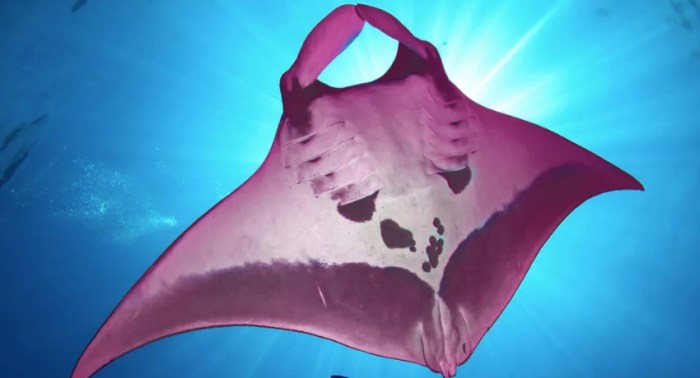
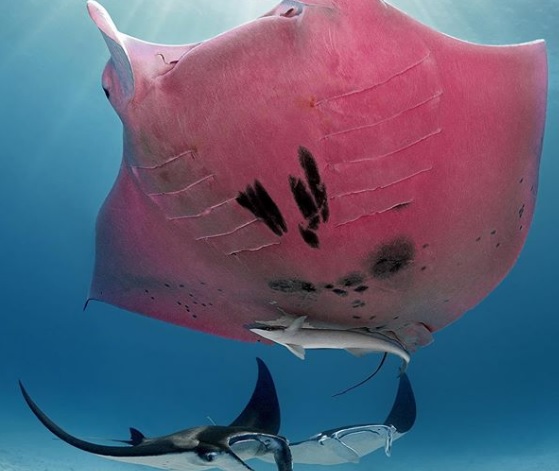
A truly wondrous natural phenomenon has been captured in photo. The world’s only known pink manta ray. In the aquatic world, even grown fish sometimes retain the magnificent colors nature bestows on them at birth. Clown fish, for example, are beautifully hued creatures that keep their rainbow colors for their entire lives, but larger fish — manta rays, for example — are a dull, rather uninspiring shade of grey, or even a dull brownish green.
Vivid colors like aquamarine and bright pink aren’t found on large sea critters; it’s as though nature gave them size, and decided that was enough of an advantage, since they can pretty much take on any adversary they encounter under the sea. But all of that changes now with the discovery of this pretty in pink manta ray.
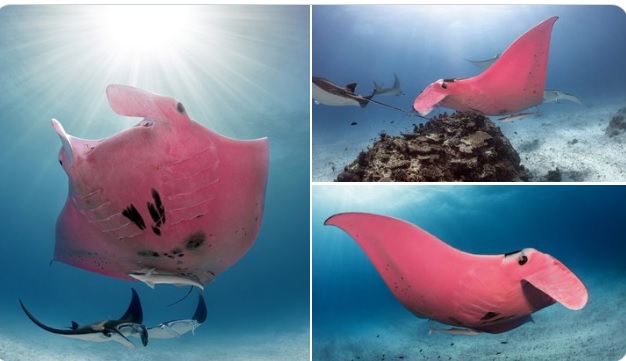
Imagine the shock photographer Kristian Laine got last month when he was diving off Lady Elliot Island in the Great Barrier Reef, in Australia. He encountered a one-of-a-kind pink, male manta ray, and was so surprised he very nearly didn’t get photographs of it. At first, Laine thought either his eyesight or his camera was playing tricks on him, but once he looked for a few long moments, he realized that yes, he was face to face with a startling, pink manta ray. And he’s got the pictures to prove it.
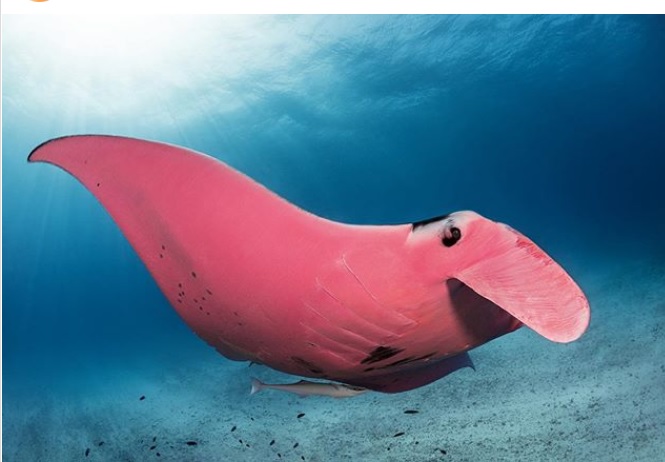
Formally called a pink reef manta, the oddball creature was first spotted five years ago, by diving instructor Ryan Jeffrey, who also got pictures. It is such an anomaly in nature that the ray earned his own name, Inspector Clouseau, after the famous, clumsy detective in the “Pink Panther” movie series, with Peter Sellers. But he has warranted some serious investigation, too, because marine biologists aren’t sure what has caused the colourizing of his skin. He is very timid and retiring, and though he’s been spotted about 10 times since Jeffrey’s initial sighting, he is elusive when researchers try to get too close.
Nonetheless, Project Manta, an organization devoted to studying manta rays in Australia, has had a chance to see Inspector Clouseau, and even got a skin sample to biopsy in 2016. According to ecologist Asia Haines, who is with the group, the pink manta ray is a tough case to examine. She recently told sciencealert.com, “There has not been a thorough investigation into diet or stable isotope analysis,” she explained, “but given the stability of the white ‘birthmark’ and pink colouring over time we think diet can be ruled out. The working theory is that it is just a different, very unique expression of the melanin, (in his skin) but that is still to be confirmed.”
Whatever the reason Clouseau is the dusty rose shade he is, Laine is just glad to be one of the few who’ve seen him up close. “Overall,” he told sciencealert.com, “it was just very calm and let me be there. Later, when I realized what I had witnessed I was stoked — I just couldn’t believe how rare a moment I had experienced.”
Indeed, just being close to a massive creature like Clouseau would be memorable — he’s more than 11 feet long. But seeing the pink that Mother Nature has bestowed upon Clouseau would take that memory to the next level — from enjoyment to amazement to wonder. It’s the kind of experience the Great Barrier Reef is famous for, and now this pink manta ray is every bit as famous, too.






 The MarkoZen Blog