Stare down

Three faces in one

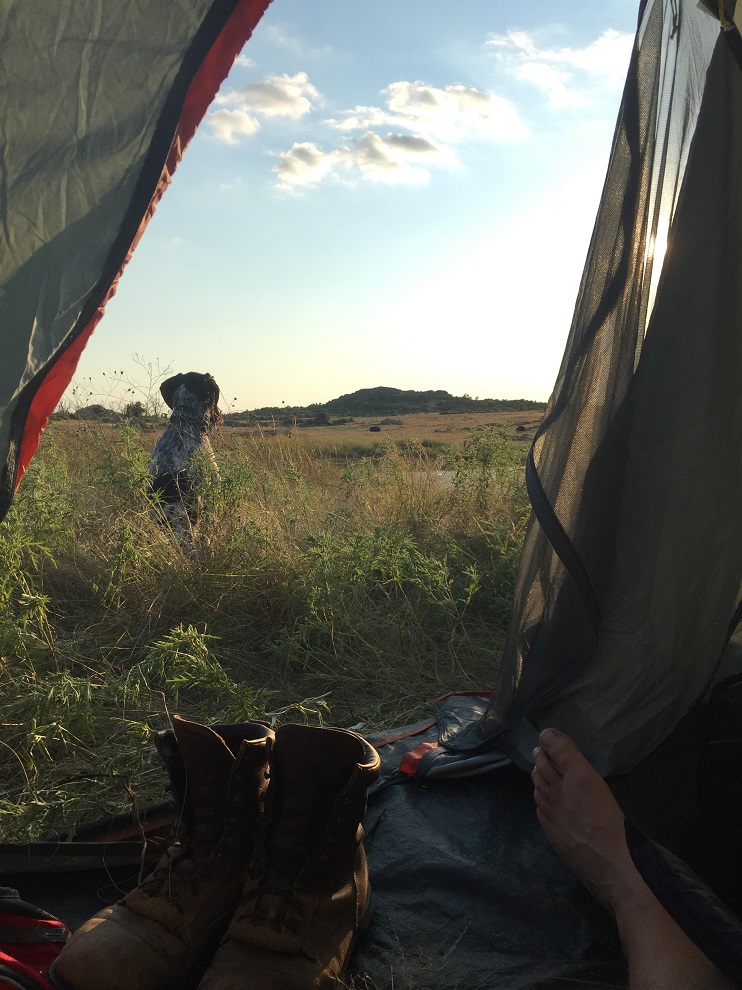
Best friend up early watching the bison
From wet to fluffy

Melissa and Gooch

No comment

Buddies


Great new day

Another load of tourists

Doesn’t even have to get its snout wet

The Pantheon is a building in Rome, Italy, on the site of an earlier building commissioned by Marcus Agrippa during the reign of Augustus (27 BC – 14 AD). The present building was completed by the emperor Hadrian and probably dedicated about 126 AD. He retained Agrippa’s original inscription, which has confused its date of construction.
The building is circular with a portico of large granite Corinthian columns (eight in the first rank and two groups of four behind) under a pediment. A rectangular vestibule links the porch to the rotunda, which is under a coffered concrete dome, with a central opening (oculus) to the sky. Almost two thousand years after it was built, the Pantheon’s dome is still the world’s largest unreinforced concrete dome. The height to the oculus and the diameter of the interior circle are the same, 43.3 metres (142 ft).

The 4,535 metric tons (4,999 short tons) weight of the Roman concrete dome is concentrated on a ring of voussoirs 9.1 metres (30 ft) in diameter that form the oculus, while the downward thrust of the dome is carried by eight barrel vaults in the 6.4 metres (21 ft) thick drum wall into eight piers. The thickness of the dome varies from 6.4 metres (21 ft) at the base of the dome to 1.2 metres (3.9 ft) around the oculus. The materials used in the concrete of the dome also varies. At its thickest point, the aggregate is travertine, then terracotta tiles, then at the very top, tufa and pumice, both porous light stones. At the very top, where the dome would be at its weakest and vulnerable to collapse, the oculus actually lightens the load.

No tensile test results are available on the concrete used in the Pantheon; however, Cowan discussed tests on ancient concrete from Roman ruins in Libya, which gave a compressive strength of 20 MPa (2,900 psi). An empirical relationship gives a tensile strength of 1.47 MPa (213 psi) for this specimen. Finite element analysis of the structure by Mark and Hutchison found a maximum tensile stress of only 128 kPa (18.5 psi) at the point where the dome joins the raised outer wall.

The stresses in the dome were found to be substantially reduced by the use of successively less dense aggregate stones, such as small pots or pieces of pumice, in higher layers of the dome. Mark and Hutchison estimated that, if normal weight concrete had been used throughout, the stresses in the arch would have been some 80% greater. Hidden chambers engineered within the rotunda form a sophisticated structural system. This reduced the weight of the roof, as did the elimination of the apex by means of the oculus.

One World Trade Center (also known as the Freedom Tower, 1 World Trade Center, One WTC and 1 WTC) is the main building of the rebuilt World Trade Center complex in Lower Manhattan, New York City. It is the tallest building in the Western Hemisphere, and the fourth-tallest in the world. The supertall structure has the same name as the North Tower of the original World Trade Center, which was completely destroyed in the terrorist attacks of September 11, 2001. The new skyscraper stands on the northwest corner of the 16-acre (6.5 ha) World Trade Center site, on the site of the original 6 World Trade Center. The building is bounded by West Street to the west, Vesey Street to the north, Fulton Street to the south, and Washington Street to the east.

In early 2010, Eastern Concrete Materials, a U.S. Concrete company, began producing high-strength concrete for One World Trade Center (WTC). Within three years, the New York City-based producer had supplied 150,000 cubic yards of ready-mix for the tower’s superstructure—with a concrete strength that has never been used on such a scale in building construction. Collavino Construction Co. then pumped this mix as high as 103 stories.
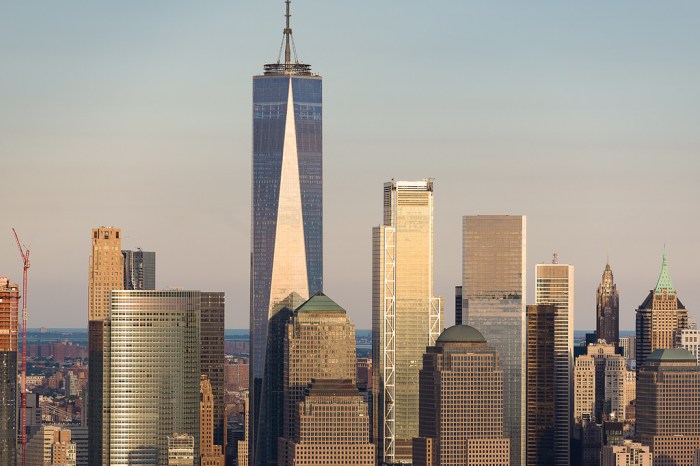
Construction began in 2006 and was completed in 2014. Its supporting columns are made of steel and concrete ranging in strength from 8600 psi to 14,000 psi. Columns on the first 40 floors are made from 12,000-14,000-psi concrete and the upper floors with 8,600–10,000-psi mix designs.
The ready-mixed concrete was pumped by Collavino’s crews to the highest elevation to which concrete has ever been pumped in the Americas. Because the mix design was so workable, pumping was accomplished with a single pump that moved the concrete directly from the ground to the top story, instead of to an intermediate station where it would have been remixed before being transferred to a second pump.
The Trump World Tower, the tallest all-residential building in the world when completed in 2001 and the tallest in New York until the 76-story Beekman Tower, engineered by WSP Cantor Seinuk, brought another technological marvel to New York: “super” cement. The super or high-strength concrete is produced by blending fly ash, slag cement and silica fume with concrete. Super high-strength concrete cannot be produced with only concrete.
Typically, the high-strength concrete used in skyscraper cores (in the 1990’s) would have a compressive strength of 8,000 to 10,000 pounds per square inch (psi). Because Trump World Tower is a rather slender high-rise, WSP Cantor Seinuk specified concrete compressive strength of 12,000psi for the first time in New York City.
“On One World Trade Center WSP Cantor Seinuk’s engineers worked on specifying the compressive strength and modulus of elasticity,” says Marcus. “But we needed even higher compressive strength—14,000 psi—for the taller One World Trade building.”

View from the top
Most of the concrete has gone into the tower’s monolithic pedestal. From a footprint of 200-by-200 feet, it rises up for 70 feet. Above ground, this has specially reinforced concrete to defend the building from the blast of a street-level bomb. Below grade, the reinforced-concrete structure is engineered to protect the tower’s structural integrity from a bomb even bigger than the one that exploded in 1993 in the World Trade Center’s parking garage.

The Japanese rail network is known throughout the world for its superiority and punctuality. In the capital city Tokyo, nearly 40 million passengers ride the rail every day, heavily outweighing other modes of transport like buses and private cars. Of these, 22% or 8.7 million take the subway.
The Tokyo subway network is a transportation marvel. On most lines, trains come every 5 minutes apart, on average, and during peak times, they tend to run every 2-3 minutes. That’s about 24 trains per hour going in one direction. Despite so many trains, the subway is extremely overcrowded, especially during rush hour. This page from the Ministry of Land, Infrastructure and Transport has data (from 2007) detailing the level of congestion at different stations of Tokyo’s subway. As you can see, nearly all of them run at over capacity with a few running at 200% over rated capacity.

“Oshiya” or “pushers” at Tokyo’s Shinjuku station trying to pack as many passengers as possible into the carriages during rush hour in 1967. Photo credit: CNN
In order to fit twice the number of passengers into a subway carriage, the stations employ uniformed staff known as oshiya or “pusher”, whose goal is to cram as many people as possible into the subway tram. These white glove-wearing personal actually pushes people into the train, so the doors can be shut. This is so surreal, it has to be seen to be believed.

When pushers were first brought in at Tokyo’s Shinjuku Station, they were called “passenger arrangement staff” and were largely made up of students working part-time. Nowadays, there are no dedicated “pushers”. The station staff and part-time workers fill these roles during rush hours.
Although a Japanese phenomenon now, subway pushers were an American invention and originated in New York City, nearly a century ago. They were not very well-liked because they were known to push and shove passengers with hostility. The vigor with which the guards often did their job earned them the reputation as “sardine packers”. Their brutality sometimes made national headlines. “The Anxious Subway Guard Who Guillotines His Passengers” —screamed a headline, and “Long Suffering New York Subway Riders Cheer Man Who Hit Guards” —reported another.
Pushers became out of fashion with the introduction of automatic door controls and automatic turnstiles. As the sadistic sardine packers began to lose their job in the 1920s, their demise were mourned briefly. Several movies about subway workers came out during this period including Subway Sadie (1926), Wolf’s Clothing (1927), The Big Noise (1928), Love Over Night (1928) and so on. Subway pushers were also depicted in a 1941 biographical movie called Pusher — the story takes place during World War 1.
More recently, in 2012, Hong Kong- based photographer Michael Wolf created a photo series named Tokyo Compression, where he captured the traumatized and pained expression of commuters as their faces were crushed against the windows. These pictures show how horrible and shameful the situation inside the subway is. Bodies are squished so tightly against one another that most people can’t physically move. Short persons suffer the risk of getting smothered against the coat of their fellow passenger. Getting off at the right station require strength and determination, and fire hazards and emergency evacuation are serious issues. The subways are also fertile grounds for pickpockets and gropers.


A jaw-dropping video from China shows an enormous sinkhole burst open in the middle of a street, leading to an unsuspecting man on a scooter plunging into the huge hole.
Captured via CCTV, the footage first shows a giant portion of a road suddenly collapse and, in what looks like a scene from a cartoon, a scooter comes barreling towards it mere seconds later.
In a troubling testament to our modern times, the man riding the bike apparently did not see the gigantic chasm in front of him because he was too busy looking at his phone!
Considering that his distracted state could have resulted in an injured pedestrian, it’s rather ironic that the rider, himself, wound up being the one worse for wear.
Fortunately, he emerged from the incident unscathed and even managed to pull himself out of the hole without any help.
While the unexpected tumble may have destroyed his cell phone, that might actually be for the best.

When constructed during the 1960s, the I-10 Katy from Houston, known as the Katy Freeway, was built with six to eight lanes wide barring side lanes, being modest by Houston standards because existing traffic demand to the farming area of West Houston was relatively low. As the population and economic activity increased in the area vehicular traffic increased, reaching an annual average daily traffic (AADT) of 238,000 vehicles just west of the West Loop in 2001.
In 2000 increased traffic levels and congestion led to plans being approved for widening of the freeway to 16 lanes with a capacity for 200,000 cars per day. An old railway running along the north side of the freeway was demolished in 2002 in preparation for construction which began in 2004. The interior two lanes in each direction between SH 6 and west I-610, the Katy Freeway Managed Lanes or Katy Tollway, were built as high-occupancy toll lanes and are managed by the Harris County Toll Road Authority. The section just west of SH 6 to the Fort Bend–Harris county line opened in late June 2006. Two intersections were rebuilt (Beltway 8 and I-610), toll booths were added, together with landscaping as part of Houston’s Highway Beautification Project. Most of the section between Beltway 8 and SH 6 had been laid by September 2006 and work was completed in October 2008.
Tolls on the managed lanes vary by vehicle occupancy, axle count and time of day. High occupancy vehicles may travel for free at certain times.

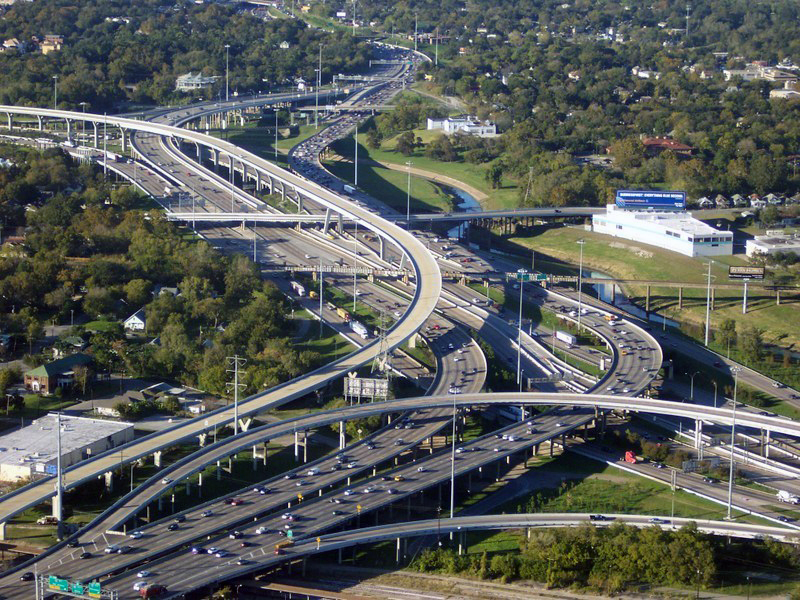
Interstate 10 (I-10) is the major east–west Interstate Highway in the Southern United States. In the U.S. state of Texas, it runs east from Anthony, at the border with New Mexico, through El Paso, San Antonio and Houston to the border with Louisiana in Orange, Texas. At just under 880 miles (1,420 km), the Texas segment of I-10, maintained by the Texas Department of Transportation, is the longest continuous untolled freeway in North America that is operated by a single authority, a title formerly held by Ontario Highway 401.



Just to think that not that many years ago ‘The Rock’ was smashing wrestlers heads into turnbuckles. He does seem like a genuinely nice guy.
Jackie Chan makes all kinds of money making movies in China. Still very popular in the Orient.

Adam Sandler is on the list because he produces his own movies. He sets his own salary.

A few Bollywood stars on the list. Movies are major entertainment in India.

A Japanese dog spa has taken pet pampering to a whole new level by offering “exorcisms” for their furry guests.
The D+Kirishima spa not only offers the latest in formal kaiseki doggy-owner dinners and spa baths together (yes, together in the same bath), but also a package called the “Pet Dog Exorcism Plan.”
A senior Shinto priest will come to the spa to conduct a ceremonial blessing to rid your pup of bad spirits and pray for its future health.
The ceremony is especially suggested for dogs in their “unlucky health years.”
“Seven-year-old, 10-year-old, and 13-year-old dogs need to be careful of their health, as it’s easier in those years for them to gets diseases of aging,” according to the spa’s pitch for the package.
“The exorcism for your dog is celebrated along with its owner at the Shingariyu shrine within the hotel.”
It only takes 30 minutes, according to the site. And it costs $430 — room and pet-owner dinner included.

This demon dog is levitating.

Definitely possessed















 The MarkoZen Blog