The Reflecting Rays of Solar Power Towers

In a patchwork of agricultural fields outside Seville, Spain, two giant 40-storey-high concrete towers rise. The obelisk-like structures are surrounded by an immense array of mirrors that reflect sunlight, bathing the top of the towers with a blinding white light. The rays of sunlight reflected by hundreds of huge mirrors are so intense that they illuminate the water vapor and dust hanging in the air creating visible beams. The otherworldly spectacle is the world’s first commercially operating power station using the Sun’s thermal energy to produce steam, which is used to power turbines to generate electricity.

The plant’s operator, Abengoa Solar, claims that it generates 11 Megawatts (MW) of electricity without emitting a single puff of greenhouse gas. The solar power plant, currently powers 60,000 homes, but when the project is completed sometime around this year, the plant should generate enough power to service 180,000 homes. The final project, which will be able to produce over 300MW, will include a series of towers, two more of which are being built, and standard photovoltaic power plants, as well as a mixture of newer parabolic solar collectors which will be installed at a later stage.


asolar

The power plant consist of two towers – PS10 and PS20. PS10 is surrounded by 624 heliostats – huge mirrors that track the sun throughout the year, reflecting the sun’s rays to the top of the tower where a solar receiver and a steam turbine are located. The PS20 plant is even larger with 1,255 heliostats and will produce up to 20 megawatts when fully operational in 2013. The towers together will prevent emissions of more than 600,000 tones of carbon dioxide into the atmosphere per year over its 25-year life.

The solar plant is supported by a 1.2 MW Sevilla PV plant composed of 154 silicon plate heliostats that produce electricity from solar radiation. The plant can generate 2.1GWh of clean energy annually. The remaining power plants, which will be built over the next few years, will include low- and high-concentration photovoltaic, tower thermoelectric, parabolic-trough collector and Stirling dish plants.

Although power from the plant will initially be more expensive than from conventional sources, prices will fall as the technologies develop.

Solar power plant producing electricity this way are being constructed elsewhere around the world. An even larger plant, Gemasolar Thermosolar Plant, also is Seville Spain operates with 2650 heliostats and produces 19.9 MW of electricity. Gemasolar is the worlds’ first solar power plant capable of delivering power round the clock.

asolar2


asolar1


The towers are 571 feet tall (174 m)

asolar3


asolar4


asolar5


asolar6


asolar7


asolar8


asolar9


Two newer solar power tower facilities have come online in the United States that make the Seville power facility look small.

Power plants Installed capacity (MW) Yearly production (GWh) Country Developer/Owner Completed
Ivanpah Solar Power Facility 392 (U/C) 420 United States BrightSource Energy 2013
Crescent Dunes Solar Energy Project 110 (U/C) 500 United States SolarReserve 2013
PS20 solar power tower 20 44 Spain Abengoa 2009
Gemasolar 17 100 Spain Sener 2011
PS10 solar power tower 11 24 Spain Abengoa 2006
Sierra SunTower 5 United States eSolar 2009
Jülich Solar Tower 1.5 Germany 2008

GWh Gigi Watt hours

The Ivanpah Solar Electric Generating System, is a solar thermal power project currently under construction in the California Mojave Desert, 40 miles (64 km) southwest of Las Vegas, with a planned capacity of 392 megawatts (MW). It will deploy 170,000 heliostat mirrors focusing solar energy on boilers located on centralized solar power towers.


Ivanpah_SEGS_(2)


Ivanpah_Solar_Power_Facility_Online

Ivanpah Solar Power Facility Online

According to the State of California Energy Resources Conservation and Development Commission Opening Briefs regarding this project, “The project itself is visually imposing. It would cover roughly 4,000 acres (1,600 ha), most of which would be covered with mirror fields. The panoramic expanse of mirror arrays would present strong textural contrast with the intact, natural character of the desert floor [and] would rise to a height of roughly 459 feet [140 m]; an additional 10 to 15 feet [3–5 m] above that height would consist of lighting to meet Federal Aviation Administration (FAA) requirements.”

Each heliostat is roughly 1-2 square metres.

A photographer hired a helicopter pilot and flew over airports and boneyards

by mpkelley

LAX Terminal 4

Tom Bradley International Terminal


Air France and British Airways A380s


Southern California Logistics Airport


Southern California Logistics Airport


Mojave Air and Space Port


Southern California Logistics Airport

Magical Ha Long Bay, Vietnam

Hạ Long Bay is a UNESCO World Heritage Site and popular travel destination in Quảng Ninh Province, Vietnam. Administratively, the bay belongs to Hạ Long City, Cẩm Phả town, and is a part of Vân Đồn District. The bay features thousands of limestone karsts and isles in various shapes and sizes. Hạ Long Bay is a center of a larger zone which includes Bái Tử Long Bay to the northeast, and Cát Bà Island to the southwest. These larger zones share a similar geological, geographical, geomorphological, climate and cultural characters.

Hạ Long Bay has an area of around 1,553 km2, including 1,960–2,000 islets, most of which are limestone. The core of the bay has an area of 334 km2 with a high density of 775 islets. The limestone in this bay has gone through 500 million years of formation in different conditions and environments. The evolution of the karst in this bay has taken 20 million years under the impact of the tropical wet climate. The geo-diversity of the environment in the area has created biodiversity, including a tropical evergreen biosystem, oceanic and sea shore biosystem. Hạ Long Bay is home to 14 endemic floral species and 60 endemic faunal species.


halong


halong3


ha-long-bay-map


halong1


halong2


wallup.net

halong4

halong7

ha-long-61-e1467707293594

ha-long-bay-16632

Footage for the movie Kong Skull Island was shot at Ha Long Bay.

kongskullislandposter

Cocky Skunk makes a Cougar Hightail it to the Hills

A man driving near a conservation area in Canada captured a remarkable encounter between a cougar and a rather feisty skunk.

Greg Shyba spotted the strange exchange as he passed through the Ann & Sandy Cross Conservation Area in Alberta.

In the awesome video, shot from the safety of Shyba’s car, a solitary skunk can be seen trotting down a dirt road as a hungry-looking mountain lion suddenly darts out from the nearby brush.

The two creatures appear to run alongside each other for a brief stretch, likely sizing the other animal up, before the skunk pulls off a surprising move by charging at the cougar!

No doubt taken aback by the aggressive maneuver and possibly by a scent-based attack by the surly skunk, the startled cougar dashes back into the tall grass seemingly content with now just watching Shyba’s car.

However, the skunk was apparently not finished with the big cat as the diminutive, black and white creature appears out of nowhere to give the cougar one more scare and send it running away from the area.

Price soars after filmmaker’s spoof used car ad goes viral

Spoof Honda adImage copyrightFULARIOUSTV/YOUTUBE
Image captionMr Lanman hired an actress to play his girlfriend.

Squint and it could be a real car ad.

With sweeping aerial shots and professional-looking production, Max Lanman’s advert for a Honda Accord wouldn’t look out of place on TV.

But the Accord in question is a used 1996 model owned by Mr Lanman’s girlfriend, with 141,095 miles on the clock and a $499 (£380) price tag.

When she wanted to sell, filmmaker Mr Lanman applied his talents to produce a spoof ad, and it may have paid off – bids on Ebay currently top $100,000.

Whether that transpires to be a real bid remains to be seen, but the ad has gone viral and the old car, nicknamed Greenie, looks set to go for far more than the price advertised in the short film.

The ad, with a cinematic voice-over which parodies the real deal, features an actress driving the car in LA.

There are close-ups of a vintage-looking tape-deck, as well as rubber duckies and a coffee pot strapped into the passenger seat.

“You, you’re different,” the narrator says, as the ad begins. “You do things your way. That’s what makes you one of a kind.”

The one-minute spot culminates with its own spoof tongue in cheek tagline: “Luxury is a state of mind”.

Still from Honda Accord adImage copyrightFULARIOUSTV/YOUTUBE
Image captionSweeping drone shots advertise the car’s mileage
Spoof Honda car adImage copyrightFULARIOUSTV/YOUTUBE
Image captionBids on Ebay – real or not – have apparently topped $100,000

“The inspiration to make the ad came while my girlfriend Carrie and I were driving up the coast on Highway 1, heading to Big Sur to go camping,” Mr Lanman told the BBC.

“It dawned on me that it would be really funny to film a car commercial for a really crappy car against such a gorgeous backdrop.”

It was an “absolutely insane” experience watching the spoof ad go viral, Mr Lanman said.

“It is surreal to think that something that I made with my friends, that two days ago sat on my computer, is now being watched around the world. Thank God for the internet.”

Max and friendImage copyrightMAX LANMAN
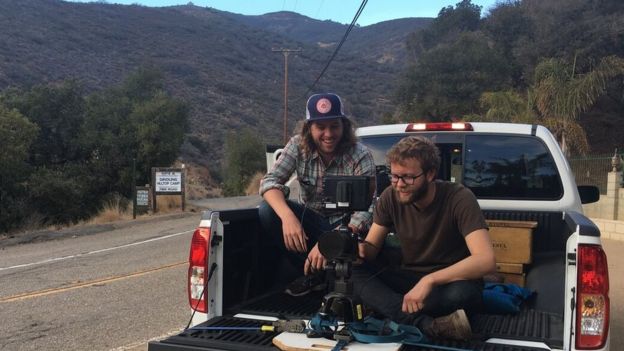
Image captionMr Lanman and a friend set up a camera on the back of a truck

Smallest Jet in the World

The BD-5 Micro is a series of small, single-seat homebuilt aircraft created in the late 1960s by US aircraft designer Jim Bede and introduced to the market primarily in “kit” form by the now-defunct Bede Aircraft Corporation in the early 1970s.

In total, only a few hundred BD-5 kits were completed, although many of these are still being flown today. The BD-5J version holds the record for the world’s lightest jet aircraft, weighing only 358.8 lb (162.7 kg).

jet1806342


jet5907685284_0d4d740546_z

With the demise of the Bede Aircraft Company, the BD-5 entered a sort of limbo while builders completed their kits. The early safety problems and the challenge of adapting a suitable engine exacerbated delays. Over the next few years, however, solutions to most of these problems arrived in one form or another. Many other changes have also been incorporated to improve the original design. Today the BD-5 is a rewarding, if demanding aircraft.

jeta84a021dd1


jetBD-5_AP2011_0157_800


jetBede_BD-5B


jetFLS-microjet-worlds-smallest-jet


jetPhlog_BD-5_2168050525_84babac237_o


jetsp195489496-3

General Characteristics

  • Crew: one, pilot
  • Length: 12 ft to 13.5 ft w/stretch kits (3.88 m to 4.11 m)
  • Wingspan: 14 ft to 21 ft 6 in (4.26 m to 6.55 m)
  • Height: 5 ft 2 in (1.6 m)
  • Wing area: Depends on wing used (-5A, -5B or -5J)
  • Empty weight: 167 kg and up
  • Loaded weight: 407 lb to 809 lb
  • Max. takeoff weight: 1,100 lb (530 kg)
  • Powerplant: 1 × Various reciprocating engines, from Rotax to Turbo Honda; turboprop with modified Solar T62; jet with Microturbo Couguar or TRS-18,

Performance

  • Maximum speed: 200+ mph (320+ km/h) recip, 300 mph (500 km/h) jet
  • Range: 720+ miles (1,152+ km) recip, 300+ miles (500 km) jet
  • Service ceiling: 12,000 ft (3,700 m) recip, 23,000 ft (7,000 m) jet
  • Rate of climb: 1,900 ft/min (579 m/min) recip, 4,000 ft/min (1,219 m/min) jet
  • Wing loading: Varies depending on wing selected and aircraft weight


jetxMG_2899

The Monster Waves at Nazare, Portugal

The pretty seaside town and resort of Nazaré on the west coast of Portugal remains crowded throughout the summer with tourists who flock to its long sandy beaches to relax, swim and surf. But when winter arrives, only the most serious thrill seekers stay. At this time, the beaches are dangerous. Massive waves up to 100 feet high regularly break along the rocky coastline.

Nazare’s monster waves attract big wave surfers from all around, but until very recently, the town and its surfing potential was relatively unknown outside Europe. Nazare hit headlines only in November 2011 when Hawaiian surfer Garrett McNamara surfed a record breaking giant wave measuring 78 feet from trough to crest. In January 2013, McNamara returned to Nazare and broke his own record by successfully riding a wave that was estimated to be 100 feet tall. Later in October the same year, Brazilian big-wave hero Carlos Burle rode a wave that appeared to be even bigger. Nazaré on the Atlantic coast has now become a legendary spot in the world of big wave surfing.

nazare-big-waves-3

How does Nazaré manage to generate waves of colossal size with such regularity? The answer lies in Nazare’s rare undersea geography. Just off the coast of Nazare is the biggest underwater ravine in Europe called Nazaré Canyon. This huge canyon runs 125 miles from the abyssal plain of the Atlantic Ocean to less than half a mile from the coastline, pointing towards the town like an arrow. At its deepest point, the canyon floor is more than 3 miles beneath the surface and it rises rapidly to a canyon “headwall” that rises to between 100 and 150 feet just off the coast of Praia do Norte beach, which is where some of the biggest waves has been known to occur.

The swells originate in the North Atlantic from giant storms in wintertime, and as they arrive near Nazare their energy gets focused and amplified by the narrow canyon just like a magnifying glass focuses the suns energy into a small region. From the headwall to the coastline, the seabed rises abruptly that enables the waves to climb really big all of a sudden. Just before it reaches the coastline, the sea becomes shallow enough for the now amplified swells to break in gigantic waves.

All other big wave spots around the globe — Teahupoo in Tahiti, the Banzai Pipeline in Hawaii, and Mavericks off northern California — have similar undersea geography.

nazare-big-waves-9


nazare-big-waves-10

Surfer Sebastian Steudtner from Germany rides a big wave, while above a crowd watches from the cliffs at Praia do Norte in Nazaré.

nazare-big-waves-4


nazare-big-waves-5


nazare-big-waves-7

A surfer drops in on a large wave at Praia do Norte, in Nazare December 11, 2014. Praia do Norte beach has gained popularity with big wave surfers since Hawaiian surfer Garrett McNamara broke a world record for the largest wave surfed here in 2011.

nazare-big-waves-8


nazare-big-waves-11


nazare-big-waves-12


Sources: NPR / Telegraph