





∇
An exorcist in Italy is raising eyebrows due to a number of worrisome statements in which he mused that the world is coming to an end.
A frequent speaker on the nature of evil and the devil, Don Antonio Mattatelli recently responded to inquiries about an earthquake which rocked his home country as well as the powerful hurricanes which hit the United States.
In an interview with an Italian radio program, the exorcist did not mince words, musing that “all natural disasters, such as hurricanes and earthquakes, demonstrate that the end of the world is coming.”
Although such events have taken place in the past, Mattatelli pointed to the ‘power and persistence’ of nature disasters in modern times as an indication that the proverbial end is near.
Fortunately, he assured concerned listeners, “it will not be the end of the world, in general, but of this world, yes.”
As to what the ‘next world’ may be, Mattatelli did not say, but did share an unsettling analysis of North Korea’s leader which could spell trouble in the future.
“Behind Kim Jong-Un is surely Satan,” he declared, “in North Korea all are forbidden religion and there is only the idolatry of the leader who has replaced God.”
But things may not be quite that dire as he indicated that some kind of ‘remote exorcism’ could be held to unbind the unhinged dictator from the spell of Satan.
Whether Mattatelli will be the man to perform what sounds like a rather elaborate and challenging endeavor remains to be seen, but if we suddenly see a change in attitude from the North Korean leader, perhaps we’ll know why.
Help us Priest


Mobula is a genus of ray in the family Myliobatidae (eagle rays). Their appearance is similar to that of manta rays, which are in the same family. Species of this genera are often collectively referred to as “flying mobula” or simply “flying rays”, due to their propensity for breaching, sometimes in a spectacular manner. The devil fish can attain a disc width of up to 5.2 m (17 ft) and can probably weigh over a ton, second only to the Manta species in size. Despite their size, little is known about this genus, much of it being from anecdotal accounts.


The above photo appears to be of a European city, but no, it’s Pennsylvania, USA.
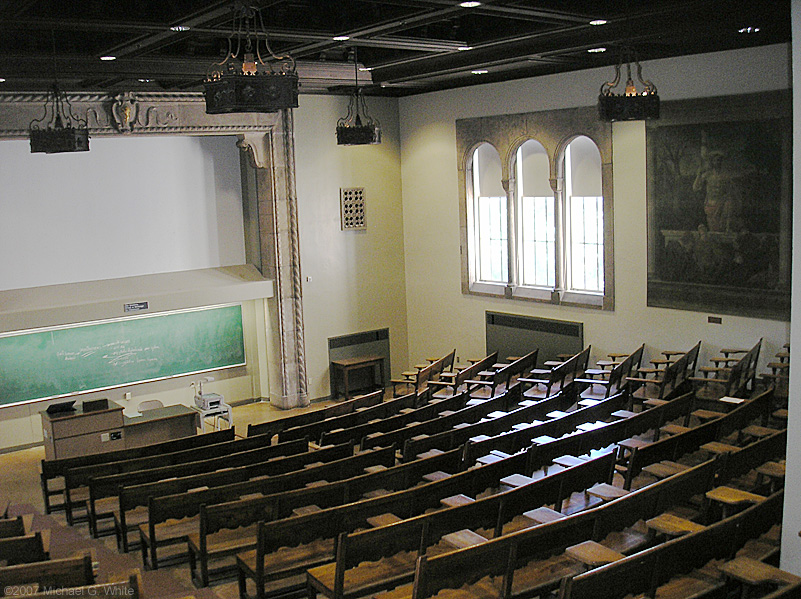
The Cathedral of Learning, a Pittsburgh landmark listed in the National Register of Historic Places, is the centerpiece of the University of Pittsburgh’s main campus in the Oakland neighborhood of Pittsburgh, Pennsylvania, United States. Standing at 535 feet (163 m), the 42-story Late Gothic Revival Cathedral is the tallest educational building in the Western hemisphere and the second tallest university building (fourth tallest educationally-purposed building) in the world. It is also the second tallest gothic-styled building in the world. The Cathedral of Learning was commissioned in 1921 and ground was broken in 1926. The first class was held in the building in 1931 and its exterior finished in October 1934, prior to its formal dedication in June 1937.
Colloquially referred to as “Cathy” by Pitt students, the Cathedral of Learning is a steel frame structure overlaid with Indiana limestone and contains more than 2,000 rooms and windows. It functions as a primary classroom and administrative center of the university, and is home to the Dietrich School of Arts and Sciences and many of its departments, as well as the University Honors College. It served as home of the university’s College of General Studies until its relocation to Posvar Hall in 2014. It houses many specialty spaces, including a studio theater, food court, study lounges, offices, computer and language labs, 30 Nationality Rooms, and a 1⁄2-acre (2,000 m2), 4-story-high, vaulted, gothic study and event hall. The building contains noted examples of stained glass, stone, wood, and iron work and is often used by the university in photographs, postcards, and other advertisements.

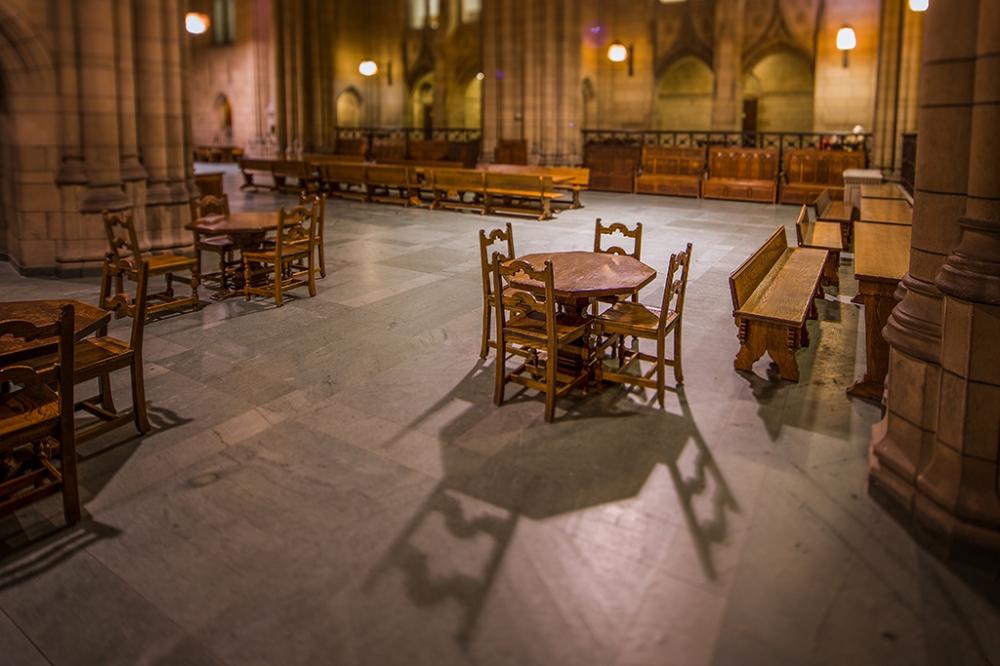
Commons room on the main floor

The basement and floors up to (and including) floor 40 are used for educational purposes, although most floors above 36 house the building’s mechanical equipment. These floors include theaters, computer laboratories, language laboratories, classrooms, and departmental offices. The basement contains a black box theater and the ground floor contains computer labs, language labs, classrooms, and the Cathedral Café food court. The “lobby”, comprising the first through third floors, contains a massive gothic “Commons Room” that is used as a general study area and for special events and is ringed by three floors of classrooms, including, on the first and third floors, the 30 Nationality Rooms designed by members of the Pittsburgh community in the styles of different nations and ethnic groups. Twenty-eight of these serve as functional classrooms while more conventional classrooms are located on the second floor and elsewhere throughout the building. The first floor also serves as the home to the offices of the Chancellor, Executive Vice Chancellor, and other administration offices, as well as the Nationality Rooms Gift Shop. The fourth floor, which used to be home to the main stacks of the university’s library, is now occupied by the McCarl Center for Nontraditional Student Success. The fifth floor originally housed the main borrowing, reference, and reading rooms of the university library, and now houses the Department of English. The Pitt Humanities Center is housed on the sixth floor. Additionally, the University Honors College is located on the 35th and 36th floors.


The Cathedral of Learning houses the Department of Philosophy, considered one of the top five in the United States, and the Department of History and Philosophy of Science, consistently ranked at the top of the field. Other departments in the Cathedral include English, Religious Studies, Statistics, Theatre Arts, and the School of Social Work which maintains the highest classrooms in the building located on the 23rd floor. Floors 37–40 are closed to the general public, as they contain electrical wiring for the building, as well as the Babcock Room, a large conference room on the 40th floor used for meetings, seminars, and special events and which provides a panoramic view of downtown Pittsburgh and the rest of the university. The 40th floor balcony also houses a nesting pair of Peregrine falcons. A view from the top is available via a webcam. Golden lights, dubbed “victory lights,” surround the outside of the highest floors and are lit following Pitt football wins and other notable victories, giving the upper part of the Cathedral an amber glow.


A cat missing for more than a year has been reunited with his owner after he was found “feasting” in a pet food warehouse. Norwegian Forest cat Clive vanished from his home in Toton, Nottinghamshire, in October 2014.
He was found at the Kennelgate Pet Superstores warehouse, about two miles away, where he had repeatedly set off the alarms during the night.
His owner Tanya Irons said she could not believe he was “so porky”.

“It’s amazing, he’s so big and fluffy because it’s winter,” she said. “He liked to go outside a lot, but we think somebody must have been feeding him, he’s such a lovely cat.
“I can’t believe he’s so porky.”
When Clive first went missing Ms Irons put out appeals for help but heard nothing, assuming he had been taken in by a new owner.
But in recent weeks staff at the warehouse began to notice that something was amiss.

Colin Lewis, retail operations director, said: “The warehouse operations director was getting alarm calls because there was something active in the warehouse at night – it was setting the alarms off.
“We eventually found it was a cat – we just couldn’t catch it.”
Using a cat trap, the staff managed to apprehend Clive and reunited him with Ms Irons and her family this week – although they warned her he “smelled a bit”.
Mr Lewis said: “It’s great to see…I’m happy they’re back together again.
“It’s been a strange day at the office.”
Conservationists in Kenya have captured footage of two incredibly rare and breathtaking white giraffes.
The unique-looking giraffes owe their odd appearance to a genetic condition known as leucism, where skin cells do not possess pigmentation.
So exceptional are the animals that this marks only the third time that white giraffes have been seen in the wild and this particular encounter is the first instance of the creatures being caught on film.
The giraffes were spotted earlier in the summer by a villager who noticed the seemingly out-of-place animals at the conservancy near his home and reported it to wildlife experts tasked with overseeing the site.
The conservationist who subsequently located the mother and baby giraffe noted that the younger animal appeared to still possess some very light spots on its skin.
This observation left him wondering if the the markings fade over time, since the adult giraffe looked to be almost completely white.
Since the animals seem to be residing in the conservancy, one hopes that they remain there under the protection of scientists who can continue to keep an eye on the creatures and get a better understanding of how their condition develops.
Fort Jefferson is a massive but unfinished coastal fortress. It is the largest brick masonry structure in the Americas, and is composed of over 16 million bricks. Among United States forts, only Fort Monroe in Virginia and Fort Adams in Rhode Island are larger. The fort is located on Garden Key in the lower Florida Keys within the Dry Tortugas National Park, about 70 miles (110 km) west of the island of Key West. The Dry Tortugas are part of Monroe County, Florida, United States.

The fort was built in 1861 and is located 90 miles west of Key West. It’s now a national park.
It was built to maintain an American presence in the Gulf and to scare off pirates. During the Civil War it was mainly a prison. But it looks to me like it would be one great place to set up some tents, crack open the beer and let the festivities begin.




Chocolate topography exists on the planet. It is the colour of these high areas that lead to the names. There is one in the Philippines and one in California.
The Chocolate Hills

The Chocolate Hills (Filipino: Tsokolateng Burol) are a geological formation in the Bohol province of the Philippines. There are at least 1,260 hills but there may be as many as 1,776 hills spread over an area of more than 50 square kilometres (20 sq mi). They are covered in green grass that turns brown (like chocolate) during the dry season, hence the name.

The Chocolate Hills form a rolling terrain of haycock hills – mounds of a generally conical and almost symmetrical shape. Estimated to be from 1,268 to about 1,776 individual mounds, these cone-shaped or dome-shaped hills are actually made of grass-covered limestone. The domes vary in sizes from 30 to 50 metres (98 to 164 ft) high with the largest being 120 metres (390 ft) in height.

The Chocolate Hills are conical karst hills similar to those seen in the limestone regions of Slovenia, Croatia, northern Puerto Rico, and Pinar del Río Province, Cuba. These hills consist of Late Pliocene to Early Pleistocene, thin to medium bedded, sandy to rubbly marine limestones. These limestones contain the abundant fossils of shallow marine foraminifera, coral, mollusks, and algae. These conical hills are geomorphological features called cockpit karst, which were created by a combination of the dissolution of limestone by rainfall, surface water, and groundwater, and their subaerial erosion by rivers and streams after they had been uplifted above sea level and fractured by tectonic processes.

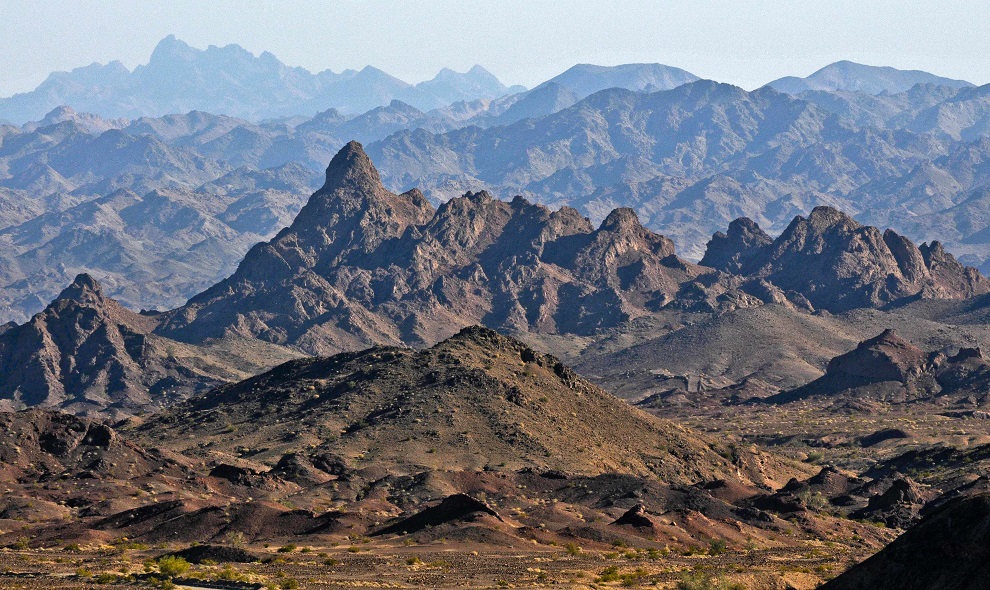
The Chocolate Mountains of California are located in Imperial and Riverside counties in the Colorado Desert of Southern California. The mountains stretch more than 60 miles (100 km) in a northwest to southeast direction, and are located east of the Salton Sea and south and west of the Chuckwalla Mountains and the Colorado River. To the northwest lie the Orocopia Mountains.

The Chocolate Mountains form the northeast boundary of the Salton Trough extending as a narrow range some 80 miles (130 km) southeast from the Orocopia Mountains to the Colorado River valley. The mountains are located about 30 miles (48 km) west of the Chocolate Mountains of Arizona, but the two ranges are not connected. The range reaches an elevation of 2,475 feet (754 m) at Mount Barrow, and serves as a drainage divide for the Salton Watershed to the west.


The mountain range is occupied by the Chocolate Mountain Aerial Gunnery Range, an aerial and gunnery practice area used by the US Navy and Marines. A large part of the Chocolate Mountains lies within the gunnery range, and is closed to the public.

Mother Nature Network
The future is always unknown, especially the distant future, but that shouldn’t stop us from making educated guesses. That’s exactly what artist and researcher Nickolay Lamm did with help from Dr. Alan Kwan, who has a doctorate in computational genomics from Washington University. Their starting point was the question: “What do you think the human face might look like in 100,000 years and why?”
From there, they reasoned out how humanity with advanced genetic engineeringtechnology might reshape itself over time, taking over the role played by natural selection so far. Lamm then created a series of images of what he thinks the human face might look like 20,000 years, 60,000 years and 100,000 years in the future (Note: He said that we shouldn’t read too much into the fact that the man and woman are Caucasian because those were just the best models he could find).
Image: Today

The first image is an unmodified photo of a man and woman from the present. Nothing special.
Image: 20,000 years

This one shows some changes, but they are not too major yet. Heads are a bit bigger to accommodate larger brains, and those yellow rings that you see in the models’ eyes are special lenses that act kind of like Google Glass does today, but in a much more powerful way.
Image: 60,000 years

In the 60,000 years image, we’re starting to see some major changes. Heads are even larger, but the eyes have grown too. Lamm speculates that this would be a result of human colonization of the solar system, with people living farther away from the sun where there is less light. Skin pigmentation would change and our eyelids would become thicker to offer more protection against UV rays for those living outside of the Earth’s protective ozone layer.
Image: 100,000 years

100,000 years! Here Lamm predicts big changes, the most notable of which is the big Japanese Manga-style eyes that may feature “eye-shine enhance low-light vision and even a sideways blink from re-constituted plica semilunaris” to offer extra protection against cosmic rays. These futuristic faces follow the golden ratio proportions and are perfectly symmetrical from left to right, and have larger nostrils to make breathing in off-planet environments easier, as well as denser hair to contain heat loss from their even larger heads. Various implants might allow the man and woman of the future to always be connected, but these would be subtle and almost invisible.
Now remember, Nickolay Lamm and Dr. Kwan stress that this is not a prediction, but rather speculation (“one possible timeline”), and that it is impossible to know for sure what the future holds. This is just their answer to the question “What do you think the human face might look like in 100,000 years and why?” There are, without a doubt, many other answers, some of which might seem more plausible. But it’s interesting food for thought.
Personally, if I had to criticize this project, I would say that the timeline is probably too long. We’re already starting to have the ability to modify ourselves, so if we ever decide to do so (it’s probably a question of “when” rather than “if”), it probably won’t take thousands of years. Just in the past 100 years, we’ve gone from barely having mastered powered flight with the Wright Brothers to landing space probes on almost all planets and moons of the solar system, from Morse code telegraphs to a worldwide communication network made up of billions of electronic devices, each of which is more powerful than the supercomputers of a few decades ago. So technological and scientific progress is really fast and it’s accelerating. The human race’s capabilities in 50 years should be even more impressive to us today than today’s tech would be for someone from 50 years ago — and that’s saying something.
My own speculation on how humans might modify themselves over time would probably go into a different direction than Lamm’s — and wouldn’t result in very striking images because I think most changes wouldn’t be visible. For example, if we successfully cure the diseases of aging (the SENS Research Foundation is working on this, for example), we would look the same, except that people would keep their young adult bodies, and you might not be able to superficially tell the difference between someone who is 30 and someone who is 60 years old. Maybe we’ll upgrade the human eye to give ourselves piercing hawk-like vision and awesome low-light capabilities, but that eye 2.0 might not look different from the outside. Same if we improve our red blood cells so they can carry 10 times more oxygen, our livers to better eliminate toxins or our metabolisms to maintain a healthy weight whatever we do. All these changes would be huge for humanity, yet they might not be visible in a photograph.
But all that is just speculation, one of many possible futures. The bottom line is we can all have an impact on how the future turns out, so let’s make it a good one.
Hope the heck we don’t turn out to look something like this:


 The MarkoZen Blog