Markosun’s Blog is now The MarkoZen Blog

Due to technical issues combined with some support personnel pushing the wrong buttons, my blog Markosun’s Blog is frozen in time. So I had to start a new blog, this one. If any followers from the previous blog search Google to find out why Markosun is inactive, this is the new blog. Same kind of stuff, basically anything, although it will still be family friendly. Thanks Google.

marko

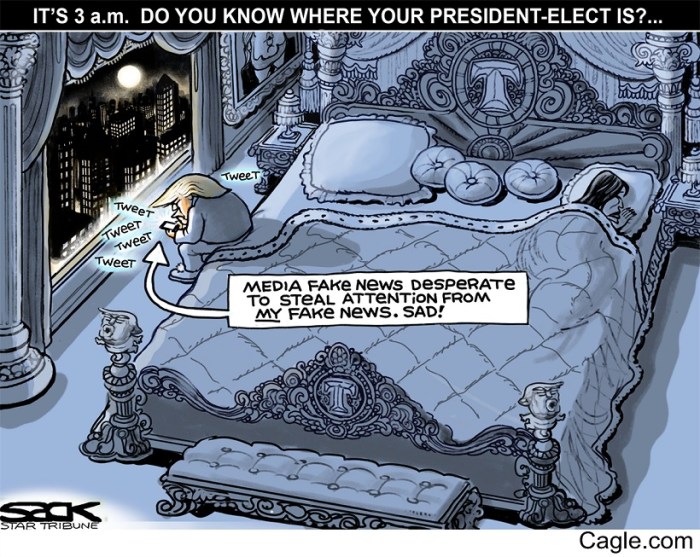
Trumpetweet

This is one of the strangest things ever in American politics. A president that comments on issues, and basically anything that comes into his head, on social media. The vast majority of Donald Trump’s tweets are about him. He is so thinned skinned that any kind of criticism will be countered with forceful insults and vindictiveness. A man with this kind of volatile temperament better have handlers nearby that can quickly and effectively reign him in.

new6

BBC

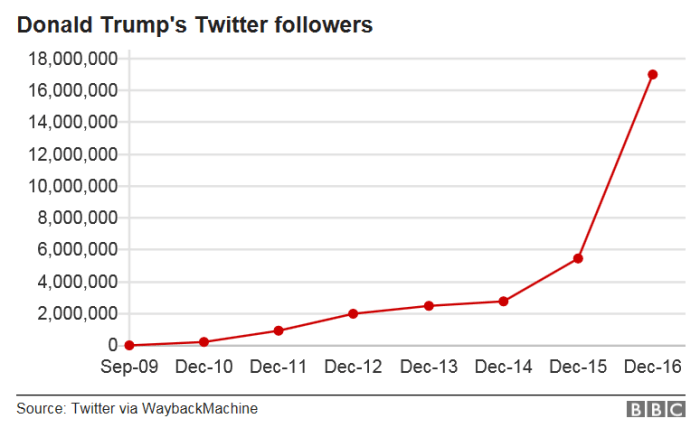
Donald Trump’s Twitter account wasn’t always the powerful spectacle it has become. Journalist Adam Harris goes through the archives to see how it evolved.

In the month since the election, Mr Trump has taken to Twitter to lambast what he views as unfavourable media coverage, rail against corporations who might take jobs overseas and defend his phone calls with international leaders.

Journalists and pundits are still trying to discover if there is a method to Mr Trump’s Twitter madness. We looked at his seven-year Twitter history to see what could be learned.

His interaction with Twitter began much like any other high profile account managed by a group of marketing professionals.

In May 2009, Mr Trump, then a private businessman, sent his first tweet promoting a forthcoming appearance on the Late Show with David Letterman.

 At the time, Peter Costanzo, a marketing staffer at his publishing company, suggested a social media push for Mr Trump’s book, Think Like a Champion. Someone had been sending out parody tweets under the @DonaldTrump hashtag, and so the businessman took @RealDonaldTrump, Costanzo told journalist Jacob Weisberg on the Slate Trumpcast.

There were tweets about The Apprentice, his appearances, family milestones and quotes from Mr Trump himself. The tweets directly from him were usually tagged “from Donald Trump,” but rarely veered into politics.

By June 2011, tweets no longer acknowledged whether they were directly from Mr Trump or originated with his team and the lines between his businesses and political pursuits began to blur.

Methods to his medium

But Mr Trump still prefers tweets to more traditional media – he hasn’t held a press conference since 27 July. Although he has only given a handful of interviews since being elected, he has tweeted more than 130 times about topics ranging from the media to foreign policy to domestic affairs.

Indeed, Mr Trump does favour tweets over contact with the press – a policy he tweeted out, of course.
new8

“If the press would cover me accurately & honourably,” he tweeted on Monday, “I would have far less reason to ‘Tweet’.”

On the other hand, his tweets appear to be influenced by the media – his tweet that said flag burners should be jailed came roughly 30 minutes after Fox News ran a story on flag burners.

And on 29 November, Mr Trump tweeted that Green Party nominee Jill Stein’s recount effort was a “scam”, joined by “badly defeated” Democrats. The tweet, however, followed a Fox News segment reporting that the Clinton campaign would join the recount efforts in Michigan, Pennsylvania and Wisconsin.

Real-life impact

As the President-elect, Mr Trump’s tweets have added import.

On Tuesday, Mr Trump criticised Boeing for the price tag associated with the manufacture of Air Force One, which he said would cost taxpayers $4bn. The company saw a near immediate dent in its share prices, but recovered after revealing that it does not yet have the contract to build it. Instead it has a development deal with the government.

“We are currently under contract for $170 million to help determine the capabilities of these complex military aircraft that serve the unique requirements of the President of the United States,” said Boeing spokesman Todd Belcher in a statement.

“We look forward to working with the US Air Force on subsequent phases of the programme allowing us to deliver the best planes for the president at the best value for the American taxpayer.”

It took six years after being inaugurated for Mr Obama to give up his Blackberry.

According to senior advisor Kellyanne Conway, who spoke during in an interview with Jake Tapper, it is still undecided whether Trump will continue to have personal access to his Twitter account when he assumes office.

Today’s Tweets

tweet1

tweet

tweet2

new7


How Antarctic bases went from wooden huts to sci-fi chic

BBC Magazine

ant

How do you build in the most isolated place on Earth? For decades Antarctica – the only continent with no indigenous population – hosted only the simplest huts as human shelters. But, as Matthew Teller finds out, architecture in the coldest, driest, windiest reaches of our planet is getting snazzier.

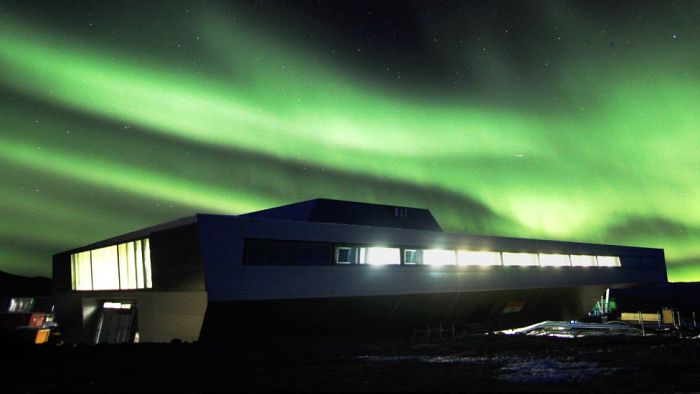
It’s an eye-popping, futuristic design – a dark, sleek building, low and long, that is destined to be a temporary waterfront home for up to 65 people at a time.

The price tag is a hefty $100m (£80m). And while a Chinese company is building it, it’s not in China, and almost no-one will ever see it.

ant1

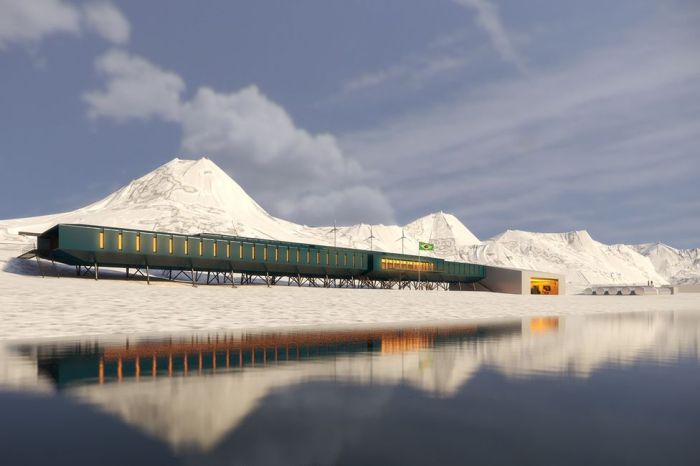
Welcome to Brazil’s Comandante Ferraz Antarctic research station.

After the original burned down in 2012, the Brazilian navy launched an architectural competition for a replacement design – won by a local firm – and then awarded the building tender to a Chinese defence and engineering contractor, CEIEC. It’s due to be completed in 2018.

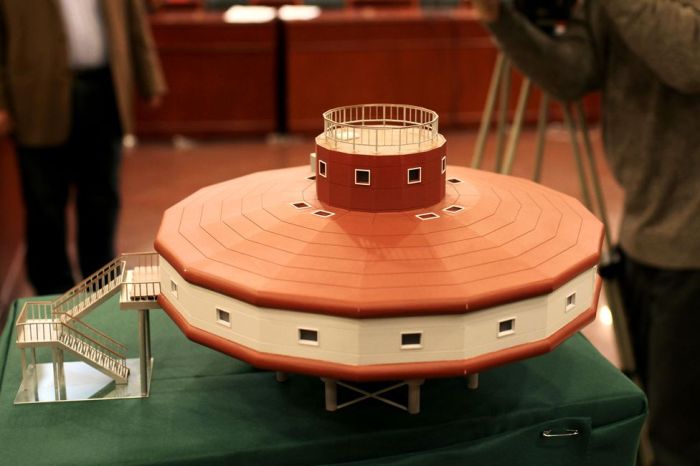
A design of the Brazilian Comandante Ferraz station

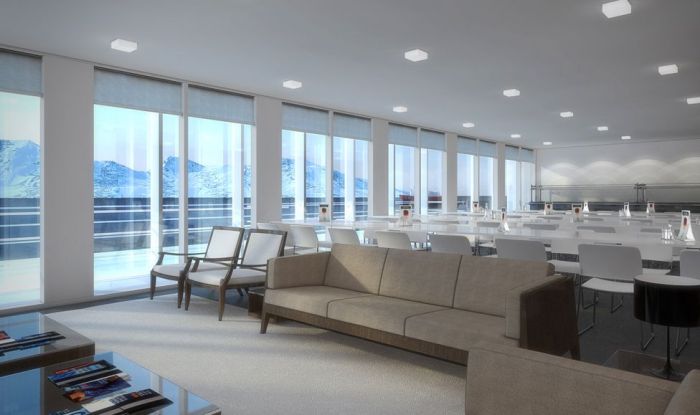
Image caption The upper block will contain cabins, dining and living space; the lower block will house laboratories and operational areas

Located on a small island just off the coast of Antarctica, it lies almost 1,000km (600 miles) south of the tip of South America. No scheduled air routes come close and it’s way off any shipping lanes.

And even if you could reach it yourself, like all Antarctic research stations Comandante Ferraz will be closed to the public. Virtually nobody other than the crews posted there will ever see it in the flesh. So why, you may ask, spend so much on architectural style? Wouldn’t a dull but functional building do just as well?

Brazil is not alone in paying for eye-catching design, though.

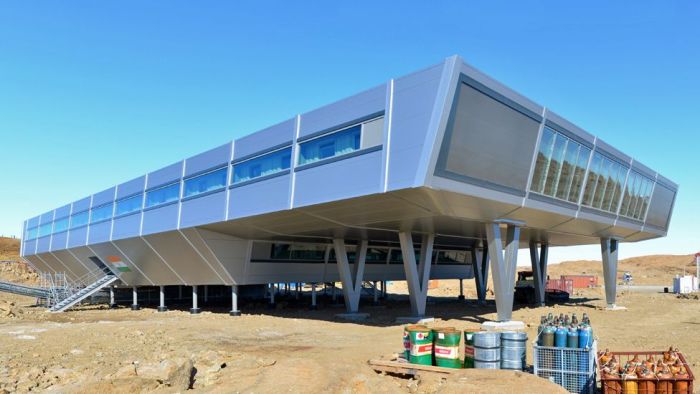
In 2013, India unveiled its Bharati station, with a similar modernist design.

ant2

Designed by bof arkitekten, Bharati overlooks the sea and is used to study polar marine life

It was made from 134 prefabricated shipping containers, for ease of transport and construction, but you would never guess it from the outside.

ant3

And the following year, South Korea opened its Jang Bogo station – a grand, triple-winged module lifted on steel-reinforced blocks, capable of supporting a crew of 60.

ant4

What is the explanation for this architectural flamboyance?

“Antarctic stations have become the equivalent of embassies on the ice,” says Prof Anne-Marie Brady, editor-in-chief of the Polar Journal and author of China as a Polar Great Power.

“They are showcases for a nation’s interests in Antarctica – status symbols.”

Those interests could be purely scientific. But a moratorium on mineral prospecting runs out in just over 40 years’ time, and every Antarctic player also wants to be ready to take advantage, should it not be extended.

Planting a dramatic building on the ice has become the modern equivalent of explorers of old planting a flag.

It wasn’t always like this.

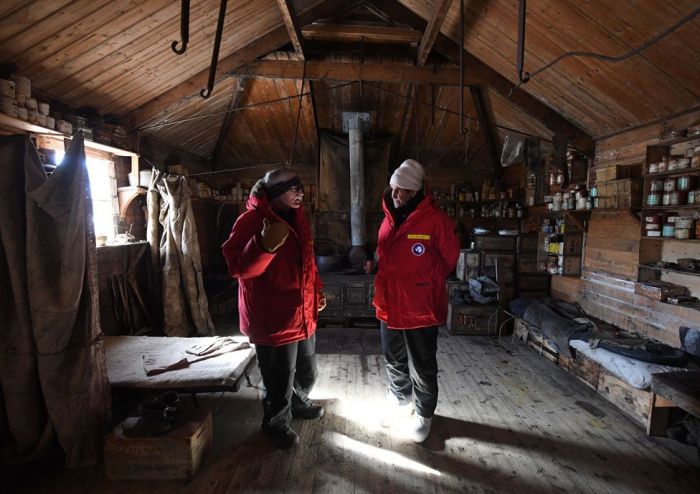
In March 1903, the 33 men of the Scottish National Antarctic Expedition landed on the outlying South Orkney Islands and built a dry-stone shack.

ant5

John Kerry visited the hut in November.

Then came a – relative – building boom, spurred by the International Geophysical Year (IGY) of 1957-58, a global project for co-operation in science. The 1959 Antarctic Treaty, which resulted from the IGY, suspended all territorial claims, but that led many countries to set about consolidating their presence in other ways, such as construction.

The treaty’s clause giving countries conducting “substantial research activity” in Antarctica a vote in meetings to determine the continent’s future was another incentive to maintain a physical presence.

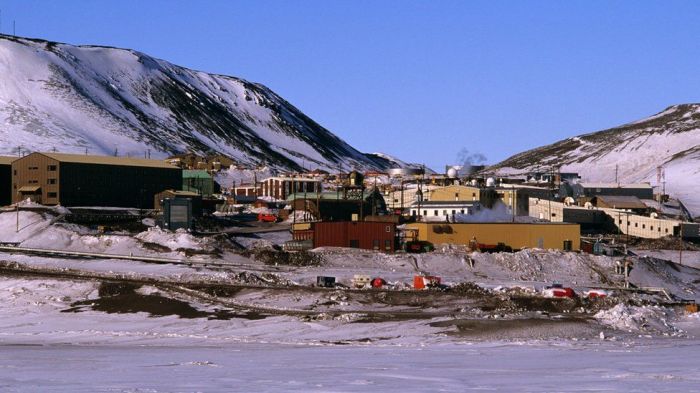
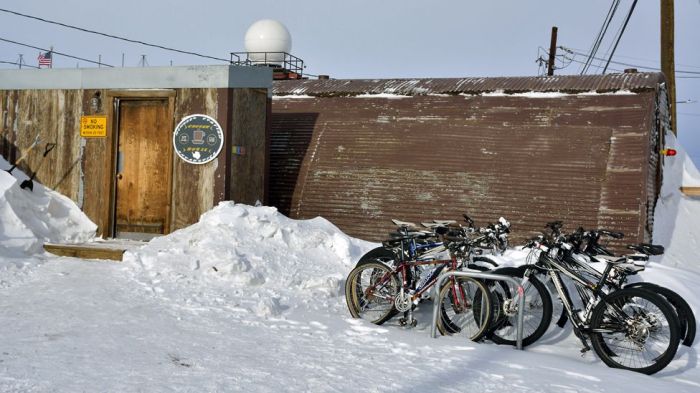
The US’s sprawling McMurdo research station dates from this period. Powered from 1962 to 1972 by a nuclear reactor, it is the biggest settlement on the continent, housing a summer population of about 1,200.

ant6

The McMurdo station has a harbour, landing strips on sea ice and shelf ice, and a helicopter pad

ant7

The McMurdo coffee house serves hot drinks to workers and is attached to a small cinema – the chapel of the snows, a non-denominational Christian church, is nearby

ant8

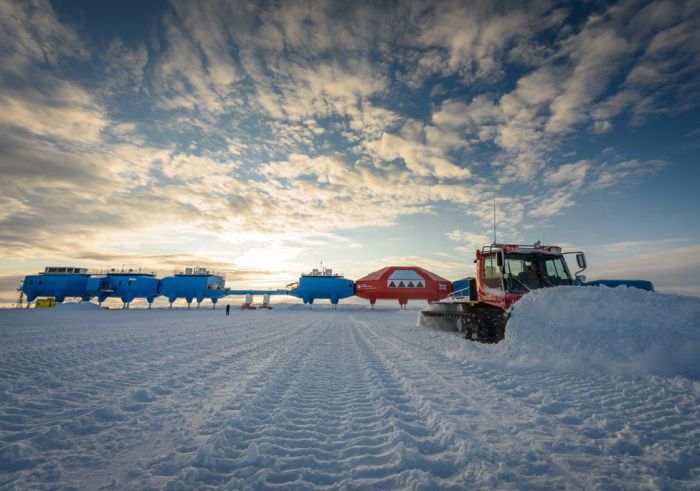
 Designed by Hugh Broughton Architects and Aecom, Britain’s Halley VI’s red module contains the communal areas

Halley VI, however, is Antarctica’s first relocatable research station. Its eight connected pods – like giant, colourful train carriages, which can be isolated to limit the spread of fire – sit on hydraulic legs mounted on huge, 8m-long skis. This means that the pods can be detached from each other, dragged by bulldozers to a new location, and the whole station reassembled.

That design is being put to good use, as Halley is currently being moved to avoid a chasm that is opening up in the ice nearby.

And Halley VI is both glamorous and comfortable.

Halley VI bedroom

Unlike earlier Halley stations, each bedroom now has a window to the outside

ant9


“All the newest bases look good as well as do the science – it’s a reflection of the priorities of our era,” says Anne-Marie Brady.

South Africa was one of the first countries to solve the problem of snow accumulation with its SANAE IV base, which opened in 1997. It was designed with stilt-like legs, which let snow blow under the building.

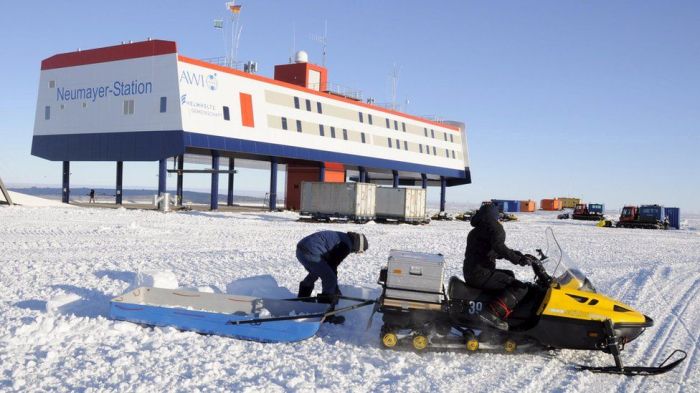
Germany applied the same concept to its Neumayer III base, which opened in 2009, with an extra refinement. Sixteen hydraulic pillars allow the entire two-storey structure to be raised every year by around a metre. The foot of each pillar is then lifted and replaced on a new firm base of packed snow.

ant10

Neumayer III always stands 6m above the ice – up to 50 people live there during the summer and nine in the winter

ant11

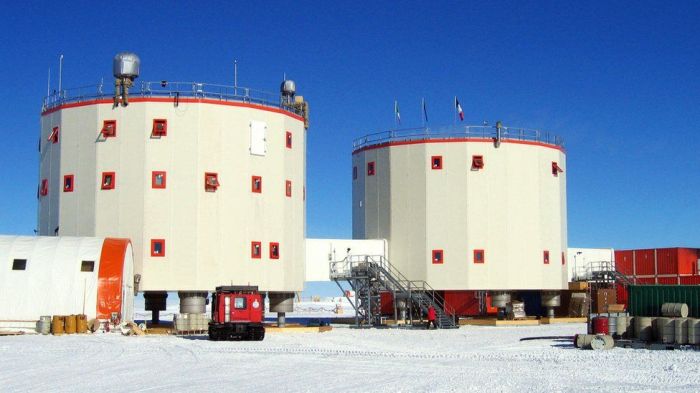
Like the UK’s Halley base, Concordia, an Italian and French research facility is used by the European Space Agency to study the physical and psychological effects of isolation – the nearest people are stationed 600 km (370 miles) away

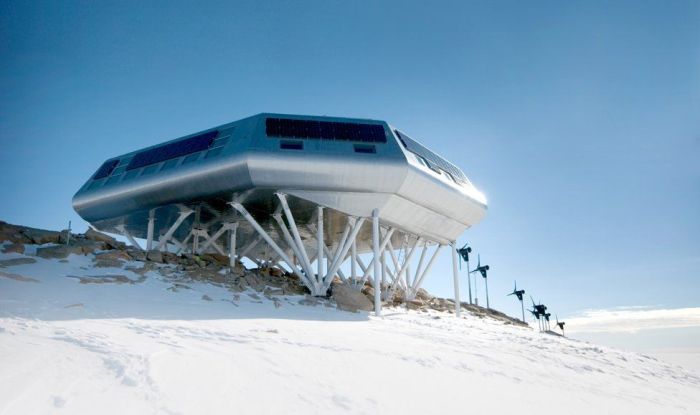
Another element of Antarctic architecture that has become critical is energy efficiency. Most stations run on polar diesel, which is expensive, polluting and difficult to transport. Belgium’s Princess Elisabeth station, an aerodynamic pod raised on steel legs, is the first with zero emissions.

Since its inauguration in 2009 it has run entirely on solar and wind energy, and – even here – has no heating. The station’s layered design means interior temperatures are maintained from waste heat generated by electrical systems and human activity, and dense wall insulation reduces heat loss to almost zero.

ant12

ant13

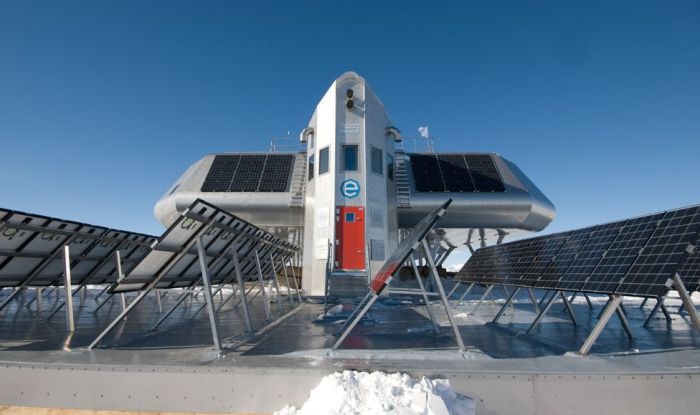
Photovoltaic solar panels also provide electricity, while thermal solar panels melt snow and heat water for bathrooms and kitchens

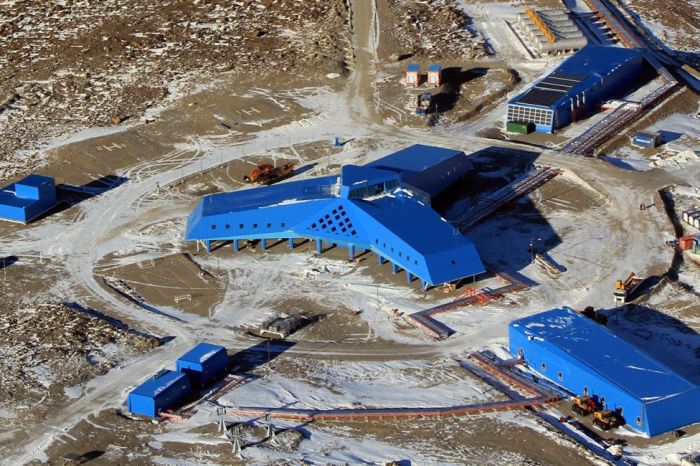
If the Princess Elisabeth station looks like something out of a Bond movie, China’s latest Antarctic station Taishan – its fourth – has been likened to a flying saucer. It was rush-built in 45 days in 2013-14, and is intended to last only a few years.

ant14

Provocative Photo surfaces of Donald Trump in Russia in 2013

A rogue Russian intelligence super-agent purportedly has released a compromising photo of Donald Trump when he was in Moscow in 2013 promoting the Miss Universe Pageant. The Russian espionage agent defected to Mongolia, then contacted CNN regarding the photo, it is rumoured the news network paid 20 million dollars to the spy for the picture.

The image was captured at the Moscow Marriott Royal Aurora Hotel. Trump was staying in the Deluxe Imperial Cossack Penthouse suite by himself. Russian military intelligence agency (GRU) had the room rigged with micro cameras and hyper sensitive listening devices. One unsubstantiated report is that the Russians recorded Donald having a six minute urination. So much for the small hands.

Trump’s security detail made up of former U.S. Marines and Navy Seal operators scanned the room and did find six cameras. However, leaked reports to Buzzfeed.com says that at least two cameras escaped detection. The camera that captured Trump in the compromising circumstance was located in the middle of a 95 inch flat-screen television. The camera was so small that it appeared to be comprised of nano technology.

The photo itself shows a naked Donald Trump siting on the edge of a bed, he appears to be in very deep contemplation. To Donald’s right is well-known Moscow socialite and sex fiend Zlata Ludmila Bolshakov-Voskoboynikov, also naked. Zlata is also known for her penchant for rough and deranged sex, very deranged rough sex. In the photo she has a very big double edged battle ax in her hands. Now that must have been one hell of a night! Hey Donald! You Beast!

The controversial and potentially explosive photo:

rosie-sister

In compliance with the World Telecommunications disinformation and propaganda charter 27b-6. This news item must be categorized as

Fake News!

Sorry.

Demographics in Manitoba

culture

The majority of Manitoba’s population (73 per cent) identifies English as their mother tongue, according to the 2011 Census. Other prevalent first languages are German (6 per cent), French (4 per cent), Tagalog (3 per cent), Cree (2 per cent) and Ukrainian (1 per cent).

According to the 2011 National Household Survey, about 72 per cent of Manitoba’s population is of European ethnic origin. Among this group, those who claim British Isle ancestry are the largest, followed by German, Ukrainian and French. Since the establishment of the New Iceland settlement on the western shore of Lake Winnipeg in 1875, Manitoba has also had a relatively large population with Icelandic origins (about 3 per cent). Those of Indigenous origin, including First Nations, Méti and a small number of Inuit, comprise roughly 17 per cent of the population. The province is also home to a large number of persons of Filipino and Chinese origins (5 per cent and 2 per cent respectively), concentrated primarily in Winnipeg.

The Canadian Museum for Human Rights Museum in downtown Winnipeg. July 3, 2012  (BORIS MINKEVICH / WINNIPEG FREE PRESS)

List of Manitoba’s 10 Largest Cities

Name Population
Winnipeg 663,617
Brandon 46,061
Springfield 14,069
Hanover 14,026
Steinbach 13,524
Thompson 13,123
Portage la Prairie 12,996
St. Andrews 11,875
Winkler 10,670
St. Clements 10,505


Population since 1871

1871 25,228
1881 62,260
1891 152,506
1901 255,211
1911 461,394
1921 610,118
1931 700,139
1941 729,744
1951 776,541
1956 850,040
1961 921,686
1966 963,066
1971 988,245
1976 1,021,505
1981 1,026,241
1986 1,063,015
1991 1,091,942
1996 1,113,898
2001 1,119,583
2006 1,148,401
2011 1,208,268