Lakes Among Sand Dunes in Brazil


The Lençóis Maranhenses National Park located in Maranhão state, in northeastern Brazil, is one of the most marvelous and unique places in the world. An area encompassing about 1000 square kilometers of white silky sands intercepted at regular intervals by endless cool oases of turquoise lakes.

At first glance Lençóis Maranhenses looks like an archetypal desert. In fact it isn’t actually a desert just like the Tottori Sand Dunes aren’t. Lying just outside the Amazon basin, the region is subject to a regular rain season during the beginning of the year. The rain water accumulates in the valleys in between sand dunes and forms clear blue and green lagoons that reach their fullest between July and September. The area is also surprisingly home to a variety of fish which, despite the almost complete disappearance of the lagoons during the dry season, have their eggs brought from the sea by birds. Mangroves, deserted beaches, buritis – a graceful kind of palm tree – and the Preguiças River help compose the park’s diversity.


Lençóis Maranhenses has been formed over thousands of years, as the sand from riverbeds is deposited at the mouth of the rivers and brought back to the continent by winds and sea currents.

The dunes advance as far as 31 miles into the continent and stretch along 27 miles of coastline, mostly deserted beaches. Some of the lagoons at Lençóis Maranhenses National Park are huge. Lagoa Bonita and Lagoa Azul are near the town of Barreirinhas. Lagoa Tropical, also worth a visit, is closer to the village of Atins. Lagoa da Gaivota (Seagull Lagoon), one of the park’s largest and most beautiful, is near Santo Amaro do Maranhão, a village located about 60 miles from Barreirinhas.


The best time to visit the park is roughly from May to September, when it’s sunny, yet the lagoons are still full.


Chewbacca’s Family Reunion

Tribute to Peter Mayhew: Peter William Mayhew (19 May 1944 – 30 April 2019) was an English-American actor, best known for portraying Chewbacca in the Star Wars film series. He played the character in all of his live action appearances from the 1977 original to 2015’s The Force Awakens before his retirement from the role.

Chewbacca, a 200-year-old Wookiee. Wookiees are a species of intelligent bipeds from the planet Kashyyyk in the Star Wars universe.  Standing at 8 feet tall, Chewbacca is covered with long hair, and wears only a bandolier. His weapon of choice is the Wookiee bowcaster (a crossbow-shaped directed-energy weapon).

Chewbacca’s family had the chance to come together as their paths were crossing for the first time in decades. The most convenient location was Crawford, Texas, as the Wookiee family members would all be travelling within close range of that Texas town. Many members of the family arrived in Crawford on various ships from the far reaches of the galaxy. The family reunion was a great success. 

Reunion Photos


chewbacca1

Portrait of a group of cousins


choo

Chewie enjoying beverages with Hans Solo’s great-great granddaughter.


awkward-family-photos-29

Painted portrait of Chewie, the wife and kids, and cat.


three_generations_of_rwook

Chewie with some family elders.


chewka

Cousin Hoolacca arrives at the Crawford spaceport.


chewy


funny-bigfootx

Chewing the fat with his step-brother Leroy the Sasquatch.


Chewie throwing out the first pitch at a Crawford Rattlers baseball game.

baseball

Churchtanks: Sculptures of Churches Turned Into Tanks

Religion and war have always been mixing and closely related throughout history. Missouri-born artist Kris Kuksi took notice of this connection, repeating itself throughout history, and decided to unveil it in his Churchtanks sculpture series. By creating the juxtaposition between the classical world and the modern war gear, Kuksi transforms churches into tanks, blending the two structures smoothly and seamlessly.


churchtank22


As explained in his statement, creation of the sculptures is a “process that requires countless hours to assemble, collect, manipulate, cut, and re-shape thousands of individual parts, finally uniting them into an orchestral-like seamless cohesion that defines the historical rise and fall of civilization and envisions the possible future(s) of humanity.” Churchtanks thus represent the ability of art to fascinate and at the same time to raise awareness.


churchtank1


churchtanks


churchtanks1


churchtanks-facebook

Division between church and state.


churchtanks-kris-kuksi-5


churchtankss


Bank tank.


church-bank_tank_1email0

The habitat ranges of very dangerous snakes in the U.S.

I’m glad I live in the middle of the Great White North. No venomous snakes! For some inexplicable reason I had a dream about being in Florida the other night. That sounds like a good dream: Disneyworld, Miami Beach and warm temperatures. But what was odd about this dream was that I was in a semi-swampy area where there were hordes of aggressive, large poisonous snakes. It was a freaky dream, lots of running away from snakes. Having snakes crawl from under couches etc. The last I remember about the dream I was attacking some smaller snakes in a motel room with a spade. Crazy dreams!

That dream led me to research deadly snakes in the United States. The bastards are all over the place.

The Eastern Diamondback Rattlesnake.


eastern


aa-eastern-diamonback

This is a big bitch. Up to 8 feet long and 35 pounds. Some think it is the biggest pit viper in the world. Run into this thing while searching for the golf ball in the scrub and I would instantly meet the maker, and that is without getting bitten. Notice it’s throughout Florida.


Western Diamondback Rattlesnake


aa-western-diamondback

Very similar to the Eastern but a lot smaller. Likes the desert as opposed to it’s cousin which likes lush forested areas.


Cottonmouth, also known as the Water Moccasin


cottonmouth


aa-cottonmouth


This is a nasty little bastard. The cottonmouth is one of the most feared venomous snakes in North America. Its powerful cytotoxic venom is so destructive that it can eat away flesh and result in grisly amputations. Their preference for hiding in water and attacking when least expected means that bites are also relatively frequent. Again, another deadly snake that slithers throughout Florida.

Copperhead

copperhead

aa-copperhead

For some reason this snake avoids Florida.

The copperhead is perhaps responsible for the most bites of any snake on this list. It’s not because the snake is inherently more aggressive, but because copperheads tend to “freeze” when met with approaching humans—instead of fleeing like most other, sensible snakes—and will bite when stepped on.

The copperhead also has what is believed to be the weakest venom potency of all pit vipers, which is a happy coincidence for the snake that is otherwise most likely to bite you.


Timber Rattlesnake


aa-timber-rattlesnake

I never realized there were so many rattlesnakes in the east. Florida spared again.


Coral Snakes


aa-coral-snake

Eastern coral snakes are very reclusive and are rarely seen, which is great for hunters and hikers across the American Southeast. The eastern coral snake was once seen as the most dangerous snake in the region. While that reputation hasn’t exactly subsided, experts now say that fatalities from this dangerous species are actually very rare. This is thought to be because the coral snake has very little control of how much venom it can inject into a victim.


Massasauga Rattlesnake


Canada isn’t entirely left out

aa-massasauga-rattlesnake

These pesky rattlesnakes go all the way up to the tip of southern Ontario. To the edges of Canada’s number one city Toronto, at least that is what the residents of Toronto think.


Prairie Rattlesnake


aa-prairie-rattlesnake

More Canadian content here. These critters crawl all the way up to Saskatchewan and Alberta. Florida is spared again!

Ghosts In Haunted Houses Might Be Caused By Carbon Monoxide Leaks

We all have our views and opinions on the supernatural. Many people are highly skeptical regarding the existence of ghosts, ghouls, phantoms, and other supernatural entities, while believers will adamantly argue that the paranormal is very real, backing up their claims with countless stories and alleged sightings of the past. There are also plenty of people who find themselves somewhere in the middle, not quite sure what to believe.

rheaultx

No matter where you find yourself on the spectrum of skeptic to believer, the subject of spooky sightings and haunted houses is always an interesting one.

Leap castle in Coolderry, Ireland is reputedly one of the most haunted castles in the world

A Gallup poll from 2005 revealed that around 37 percent of Americans believed in haunted houses, and many people love to hear stories about these kinds of spooky old homes and eerie abandoned mansions. But it turns out that science might have a very rational explanation for these kinds of tales.

For years, people have attempted to debunk ghost stories and find logical explanations for so-called haunted houses. In many cases, creaky floorboards and strange bumps in the night really do have perfectly logical explanations and causes. Anything from faulty wiring to drafts and old pipes could cause the likes of cold spots and strange sounds, but what about ghostly apparitions and sightings of spooky figures?
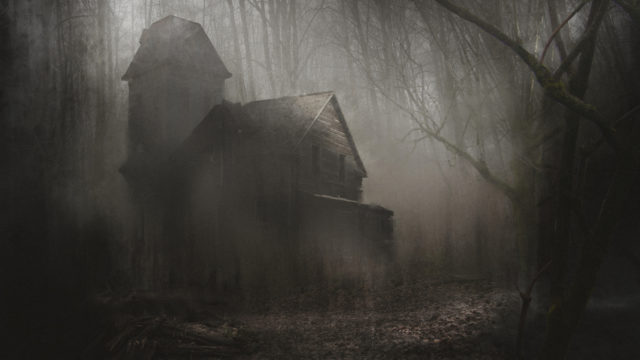
Well, there might be a reasonable explanation for these instances as well. A Halloween-themed episode of the This American Life podcast began with the retelling of a story that had been documented in the American Journal of Ophthalmology back in the 1920s. On November 15, 1921, to be precise, a woman claimed that she and her family had experienced some very odd events in their home.

She revealed that she’d heard footsteps passing overhead when nobody was there. Her nights would be disturbed by loud noises like furniture being moved around, she experienced an eerie feeling like someone was following her as she walked along the halls of the house, her bed sheets would be torn away in the middle of the night, and, most distressingly of all, she once saw a man and a woman sitting right at the foot of her bed.

It all sounds like the perfect plot for a horror movie, but it was a very real and terrifying experience for the woman and her family. She spoke to medical professionals, friends and family members about her ghostly encounters and couldn’t seem to get any real answers or help — until one day, her brother-in-law suggested that the family was being poisoned and suffering from hallucinations as a result.

It turned out that the brother-in-law’s informed opinion was right on the money. The woman called in some experts to take a look around the home and it was quickly discovered that a faulty furnace was leaking carbon monoxide around the house, rather than expelling it up the chimney as it should have done. The family were being slowly poisoned every single second they lived in the house.

Carbon monoxide is a deadly gas that can cause all kinds of medical symptoms from headaches and dizziness to vomiting, chest pains, and even death in large enough doses.

It attacks the body by latching onto red blood cells, preventing oxygen from being carried around to the organs, muscles, and brain. Essentially, this is what caused the family’s hallucinations, as a lack of oxygen to the brain, combined with dizziness, drowsiness, and other symptoms, could make it very easy for someone to think they were hearing sounds or seeing shadowy figures.

NBC reports that a very similar case occurred in 2005. A terrified woman was found after allegedly seeing a ghost in her shower. It turned out that a new water heater that had been recently fitted was faulty, leading to a carbon monoxide leak.

This shows just how dangerous and scary carbon monoxide poisoning can be, proving yet again how important it is to get boilers and water heaters checked regularly and to have carbon monoxide detectors fitted around the home.

Of course, not all haunted house stories can be traced back to carbon monoxide poisoning, but these true stories show that there are some cases where ghosts and ghouls really aren’t all they seemed to be. There are still a lot of believers in haunted houses out there, and plenty of strange stories and grisly mysteries left unexplained and unsolved.

The vintagenews.com


India puts Gujarat lions on trial after three people killed

asia2

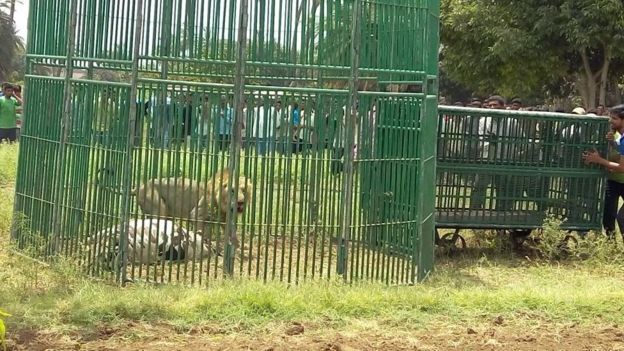
Officials in India have “arrested” 18 lions as they try to find a man eater suspected of killing three people.

Forest officials in Gujarat state will test the lions’ prints and excrement in an attempt to identify the killer.

The “guilty lion” will be kept in a zoo for life while the others will be released back into the Gir sanctuary, the officials told BBC Hindi.

Six attacks on humans have been reported recently near the sanctuary, the only habitat of the Asiatic lion.

Gujarat’s top forest official, JA Khan, said that the lions had been “arrested” over the past two months and were now being held in separate cages while tests were carried out.

“We think we have pinpointed the guilty lion, but we are still awaiting the results of nine more animals,” he said.
asia
Innocent lions will be released back into the Gir forest

Wildlife expert Ruchi Dave told the BBC that the “tests” involved studying the pug marks and faecal matter of the lions.

“The officials are also studying the animals’ behaviour. Man eating lions usually get aggressive at the sight of a human being,” she said.

Another wildlife expert Revtubha Raizada said the man-eating lion would be caged for the rest of its life, as it was too unsafe to release it back into the wild.

Some experts feel that the thriving lion population in Gir forest is to blame for the “unusual” behaviour by the lions.

Govind Patel, the former chief wildlife warden of Gujarat, told the Indian Express newspaper that Gir could accommodate only 270 lions, forcing some prides to settle outside the boundaries of the sanctuary.

India’s Supreme Court has ruled that Gujarat needed to relocate some of its lions to other states to avoid the possibility of disease or other disaster wiping out the entire population.

However the state has expressed reluctance and has not yet complied with the order.


asia1

Six cases of lions attacking humans have been recently reported near the Gir forest

The Asiatic lion (Panthera leo persica), also known as the Indian lion or Persian lion, is a lion subspecies that exists as a single population in India’s Gujarat state. It is listed as Endangered by IUCN due to its small population size. Since 2010, the lion population in the Gir Forest National Park has steadily increased.

In May 2015, the 14th Asiatic Lion Census was conducted over an area of about 20,000 km2 (7,700 sq mi); the lion population was estimated at 523 individuals, comprising 109 adult males, 201 adult females and 213 cubs.

asiatic4


asiatic5

Asiatic lion at Gir Forest National Park.

The Photographer Who Took This Picture Barely Escaped With His Life

Pakistani nature photographer Atif Saeed managed to capture this stunning shot of a lion — just before it leapt at him.

lion

This photograph was snapped by Atif Saeed at a safari zoo park near Lahore. He got out of his jeep to take the photo, but the sound of the lens’s whizzing caught the lion’s attention. Saeed figures the big cat got as close as 10 feet, before he was able to reach the safety of his jeep.

Once safely inside his vehicle, Saeed started to laugh about what had happened. But after some retrospection he came to realize just how close he came to death — and vowed to never do anything quite as reckless again.

lion1