Fire Glass

Fire glass is tempered glass manufactured as a medium to retain and direct heat in fireplaces and gas fire pits. Fire glass does not burn, but retains heat and refracts light as a result of burning gas. Fire glass, like artificial logs and stones, is additionally used to obscure the gas plumbing inherent in gas fireplaces or stoves.


A vast assortment of fire glass shapes, sizes and colors are available to match a wide variety of contemporary décors. During the manufacturing process, sheets of glass are tempered to withstand heat. This process prevents the glass from “popping” when used in a fire and negates the threat of sparking seen in traditional wood-burning fireplaces or fire features. These tempered sheets of glass are then shattered. and professionally packaged. Although a variety of fire glass types exist, variations are purely aesthetic, and all varieties serve the same purpose within a fire feature.


Fire glass leaves no trace of ash, soot, grease or discernible odor when used as a medium. Flames produced using natural gas do not produce any smoke, produce less toxic gases and leave no trace of residual pollutants such as tar within the home. The combination is considered an eco-friendly burning solution. Additionally, fire glass is often made from recycled glass, making for a “green” fire media option.

Recent UFO Encounters With Navy Pilots Occurred Constantly Across Multiple Squadrons

The War Zone

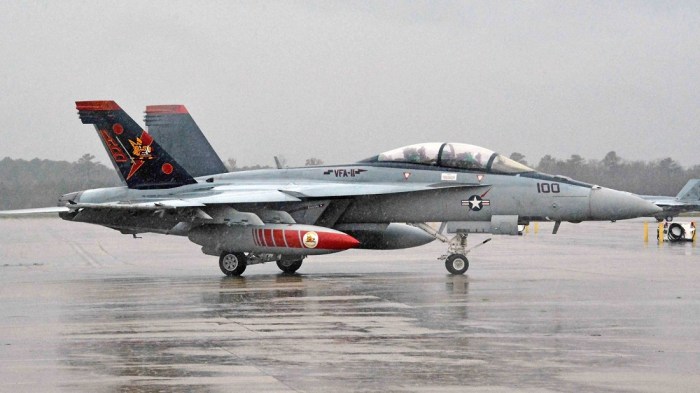
One of the biggest questions surrounding the most recent known spate of UFO encounters with U.S. Navy pilots—those that occurred off the southeastern seaboard of the United States between 2014 and early 2015—pertains to how persistent they actually were. We know Super Hornet aircrews from Strike Fighter Squadron 11 (VFA-11), the Red Rippers, detected unknown objects multiple times on radar and one aircrew even had a close encounter visually with one of them, but what about the rest of the many Hornet squadrons based at Naval Air Station Oceana, not to mention the E-2 Hawkeye squadrons from nearby NAS Norfolk? We have the answer to this question and it is remarkable.

A source with knowledge of the events has made it clear to The War Zone that presence of the mysterious objects in the restricted training airspace off America’s east coast was so pervasive that it was largely common knowledge among local flying units. They noted that the majority of the Super Hornet squadrons equipped with AN/APG-79 Active Electronically Scanned Array (AESA) radars—you can read all about this technology and how it was key in detecting these objects in our exclusive piece on the subject—at the time were having the same experiences, as well as the crews flying the new E-2D Hawkeye with its incredibly powerful AN/APY-9 radar suite. It literally became such a common and near everyday occurrence that Naval Aviators and Naval Flight Officers from the base would talk about it informally with regularity.

The E-2D Hawkeye is one of the most capable aerial surveillance platforms ever created.

But that doesn’t mean formal action wasn’t taken. Beyond filing an official safety report after one of the jets almost hit one of the unidentified objects—described eerily as a translucent sphere with a cube structure suspended inside of it—Notices To Airman (NOTAMs) were posted regarding the dangers potentially posed by unknown aerial vehicles flying in the same military operating areas that aircraft from NAS Oceana frequented for training. This action was taken by the base’s command leadership as they couldn’t figure out how else to address the bizarre issue and its perceived threat to their aircrews’ safety.

We have since filed Freedom Of Information Act (FOIA) requests for copies of these NOTAMs, as well as documents regarding how the decision to file the NOTAMs was made at the command level.

Another burning question surrounding these events pertains to whether or not additional visual encounters occurred beyond the one near miss with the Super Hornet and the ‘cube inside an orb’ object. Our source tells us that there were many more, and yes, they all resulted in the exact same description of the object. So, we are talking about a uniform set of very strange looking objects here that were spotted on radar, by infrared targeting pods, and by the naked eye, frequently over 2014 and the first part of 2015 above the waters off America’s southeastern coastline.

As we noted in our last piece on the subject, these encounters dropped off to the point they were described as fleeting and inconclusive at best once VFA-11 and its carrier air wing went on cruise to the Middle East in early Spring of 2015. In addition, we know that the carrier strike group and its aircraft were equipped with key new sensor fusion technologies for that deployment, a fact that is eerily similar to the circumstances surrounding the now famous ‘Tic Tac’ incident nearly a decade earlier. All of which makes these objects’ presence during the time leading up to that deployment that much more curious.

Yet at the same time, the fact that the volume of these recent encounters seems much greater and spread over a much larger period of time versus the infamous incident in 2004 is puzzling. And none of this even addresses the very peculiar physical appearance of these objects, but we have another report on that subject that will be filed in the very near future.

Still, at least we now have a much better sense of how widespread these encounters were and the cultural impact that they had on the Navy’s east coast master fighter jet base. This also underscores just how taboo this topic was to military aviators. The fact that these types of events could have been so pervasive, yet kept so hushed-up outside of Navy tactical aircraft aircrew circles, is telling in itself and provides good evidence as to why the Navy had to officially change is procedures for its personnel reporting such strange incidents.

All this comes as Congress is taking a high-interest in the subject as of late, with multiple briefings being given to key lawmakers with the military’s top witnesses.

Whatever the case may be, we are definitely entering into uncharted territory when it comes to this long shunned and abused topic. What exactly that will mean when it comes to actually getting to the truth of the matter remains to be understood.


A Cataclysmic Comedy Riot

That Darn Cat! is a 1965 American Walt Disney Productions thriller comedy film directed by Robert Stevenson and starring Hayley Mills (in her last of the six films she made for the Walt Disney Studios) and Dean Jones (starring in his first film for Disney) in a story about bank robbers, a kidnapping and a mischievous cat. The film was based on the 1963 novel Undercover Cat by Gordon and Mildred Gordon. The title song was written by the Sherman Brothers and sung by Bobby Darin. The 1997 remake includes a cameo appearance by Dean Jones.

A 21,000 Car Parking Lot

As part of the settlement after it got caught cheating on its emissions tests, Volkswagen has bought back about 350,000 of its U.S. diesel vehicles. The automaker so far has spent more than $7.4 billion on the cars, according to court filings seen by Reuters.

Where does VW put all those cars? Wherever it can find the space.

The German automaker has 37 remote storage facilities across the U.S., and they’re not just parking lots. The sites include a former football stadium in the Detroit suburbs, an old paper mill in Minnesota and a giant patch of land in the California desert.

A court filing seen by Reuters said that, “Volkswagen had reacquired 335,000 diesel vehicles, resold 13,000 and destroyed about 28,000 vehicles. As of the end of last year, VW was storing 294,000 vehicles around the country.”

The Southern California Logistics Airport in Victorville, Calif., is already well-known as an “aircraft boneyard” — a sort of desert purgatory for old airplanes.

Now VW has made it a major place to store its diesel VWs and Audis.

“These vehicles are being stored on an interim basis and routinely maintained in a manner to ensure their long-term operability and quality, so that they may be returned to commerce or exported once U.S. regulators approve appropriate emissions modifications,” VW spokeswoman Jeannine Ginivan said in a statement to Reuters about the Victorville facility.

VW reportedly leased 134 acres at the site. That is enough to hold 21,000 cars while the company decides their fate: whether to be fixed — or scrapped for parts.

The aircraft area


Cat Uses Up One of its Nine Lives after Washing Machine Ordeal

Cat survives 45-minute ordeal in washing machine

Felix the cat used up one of his nine lives last week after he survived a 45-minute trip through a washing machine.

“The personality on this guy is … it’s one of a kind,” said Felix’s owner, Stefani Carroll-Kirchoff of Maplewood. “He’s lovable, but he does get himself into trouble.”

The year-old black-and-white tabby is recovering from the Wednesday incident, when, unnoticed, he climbed into a front-loading washing machine. He got water in his lungs and suffered a concussion, and veterinarians feared he could be permanently blinded by the laundry detergent.

Felix the cat, who survived a 45-minute ordeal in a washing machine on June 19, 2019, is pictured in an oxygen chamber at an Oakdale animal hospital. Felix climbed into the front-loading washing machine, unnoticed. (Courtesy of Stefani Carroll-Kirchoff)

But he’s proving to be resilient.

He still needs help breathing in an oxygen chamber while he recovers at the Animal Emergency and Referral Center of Minnesota in Oakdale. But he’s standing and eating and seems to be regaining his sight.

Carroll-Kirchoff said he must have climbed into the washing machine when she left for a moment to fetch more clothes.

Unknowingly, she shut the door and started the wash cycle. She said it was fortunate she had selected the express wash, which uses less water and takes less time. When she opened the door, she found the soaked Felix wrapped up in a towel and in bad shape. He was rushed to the animal hospital.

Carroll-Kirchoff’s daughter, Asha Carroll, started a GoFundMe page when the veterinary bills climbed into the thousands. As of Saturday night, more than $3,000 of the $5,000 goal had been met.

“I said to my daughter, ‘This is a feel good thing,’” said Carroll-Kirchoff. “I didn’t know there were this many good people in the world. I have people reaching out and helping that I have never met before. I could never repay what they have done.

Felix is missed at his household by two other cats, Nala and Bleu, who make up the Three Musketeers, Carroll-Kirchoff said.

The family noted on the GoFundMe page that such incidents have been reported before. They issued a warning to others:

“To those of you with cats, PLEASE always close your washing machine and dryer doors in between washes, and ALWAYS check your washing machine and dryer doors prior to beginning a wash. You can prevent an accident like this from happening.”

The Pervasive Grain Bins of the Prairies

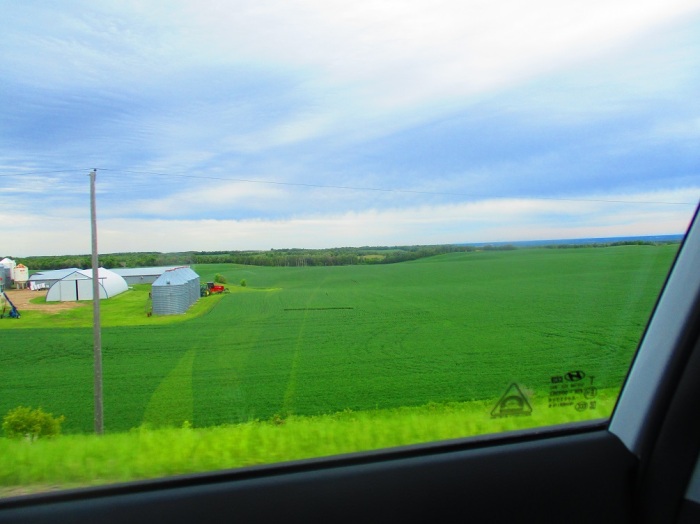
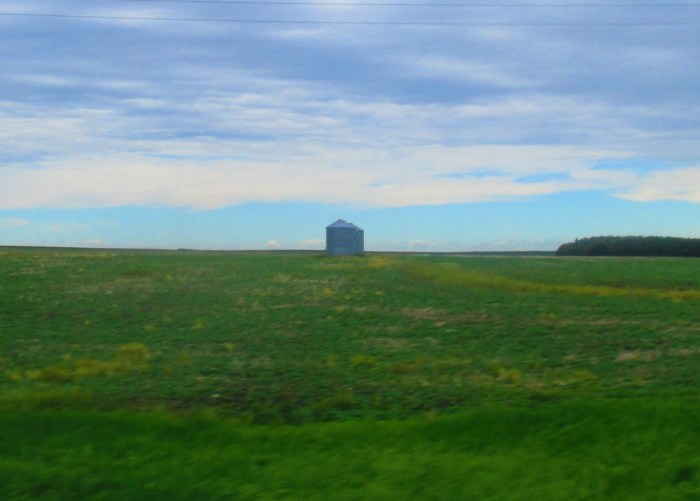
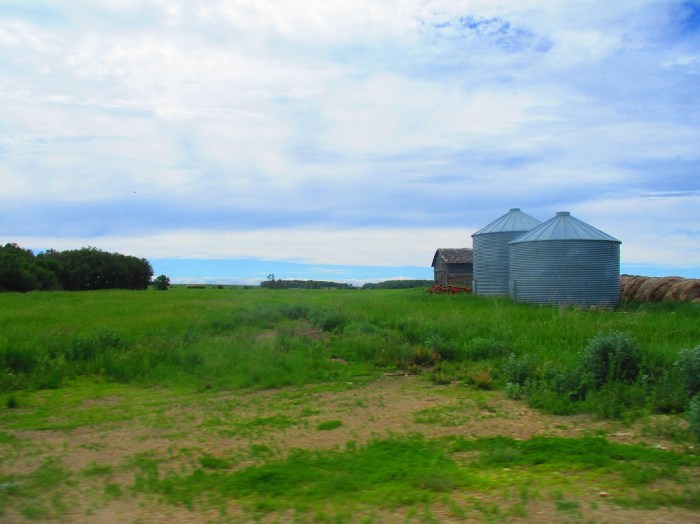
Grain bins, technically called steel grain silos, dot the the Prairies and Plains of North America. They come in many different sizes, tiny to massive. They first appeared in the 1920’s, they would last longer than wood structures and were stronger. Driving across grain country of the central U.S. and Canada they are everywhere.

I kept my eyes peeled for them on this latest trip to south central Manitoba. They are all over the place.

These big ones can hold up to 30,000 bushels of grain. Brock makes giant grain bins that can hold up to 71,000 bushels!

They have their own staircases up to the top.

Near Roseisle Manitoba above

Rathwell, Manitoba

A lonely solitary bin

Hopper bottom bins

Somerset, Manitoba