Technology
Backflipping Robot from Boston Dynamics
- Boston Dynamics is back with updates to Atlas, its humanoid robot. Now, Atlas can do a backflip.
- Google sold Boston Dynamics to Softbank earlier this year.
- Boston Dynamics’ robots are both cool and creepy.
Boston Dynamics may have switched owners from Google to Softbank a few months ago, but development of its creepy-but-cool robots continues apace.
For instance, here’s a new video of Boston Dynamics’ human-like Atlas, which can now do a backflip. But don’t worry, that’s definitely not something we mere humans should be scared about.
Check it out:
It’s so close to lifelike — and yet not.
It seems like Boston Dynamics is ready to show a little bit more about what it’s been working on. Earlier this week, the company demonstrated the newest version of its SpotMini robot dog in a video that shot to the top of the YouTube charts.
And because we’re getting closer to the holiday season, here’s Boston Dynamics’ 2015 Christmas card, in which older versions of SpotMini take “Santa” on a ride.
Everything is fine.
Inside Google’s Giant Data Centers
Inside the internet: Google allows first ever look at the eight vast data centres that power the online world
- Data centres range from vast warehouses in Iowa to a converted paper mill in Finland
- Buildings are so large Google even provides bicycles for engineers to get around them
- Street View tour of North Carolina facility reveals Stormtrooper standing guard
Google has given a rare glimpse inside the vast data centres around the globe that power its services.
They reveal an intricate maze of computers that process Internet search requests, show YouTube video clips and distribute email for millions of people.
With hundreds of thousands of servers, colourful cables and even bicycles so engineers can get around quickly, they range from a converted paper mill in Finland to custom made server farms in Iowa.
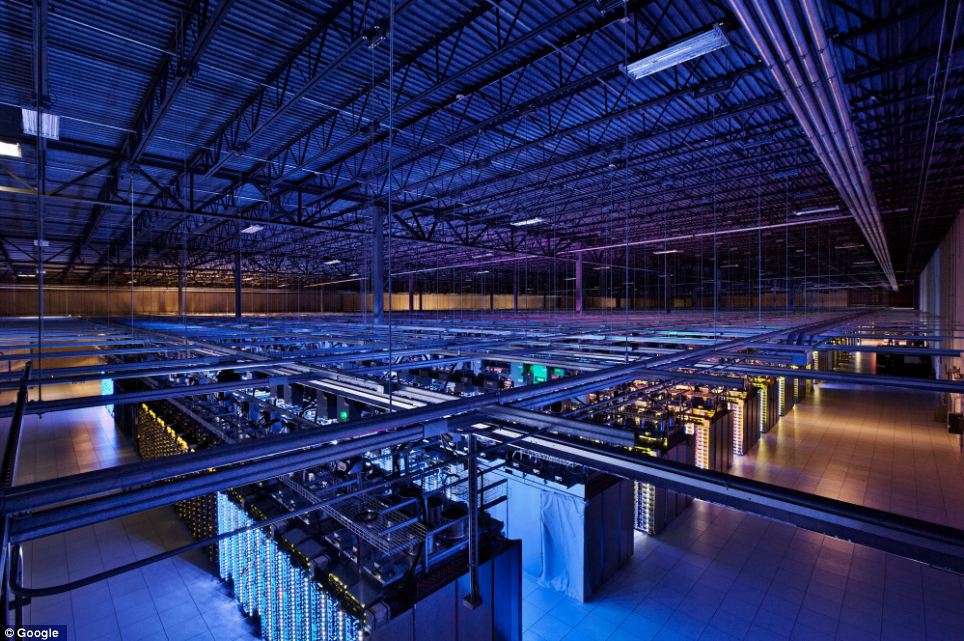
One of Google’s server farms in Council Bluffs, Iowa, which provides over 115,000 square feet of space for servers running services like Search and YouTube
‘Very few people have stepped inside Google’s data centers, and for good reason: our first priority is the privacy and security of your data, and we go to great lengths to protect it, keeping our sites under close guard,’ the firm said.
‘While we’ve shared many of our designs and best practices, and we’ve been publishing our efficiency data since 2008, only a small set of employees have access to the server floor itself.
‘Today, for the first time, you can see inside our data centers and pay them a virtual visit.
‘On Where the Internet lives, our new site featuring beautiful photographs by Connie Zhou, you’ll get a never-before-seen look at the technology, the people and the places that keep Google running.’
The site features photos from inside some of the eight data centers that Google Inc. already has running in the U.S., Finland and Belgium.
Google is also building data centers in Hong Kong, Taiwan, Singapore and Chile.
Virtual tours of a North Carolina data center also will be available through Google’s ‘Street View’ service, which is usually used to view photos of neighborhoods around the world.
The photographic access to Google’s data centers coincides with the publication of a Wired magazine article about how the company builds and operates them.
The article is written by Steven Levy, a journalist who won Google’s trust while writing ‘In The Plex,’ a book published last year about the company’s philosophy and evolution.
Google colour codes its servers depending on their location, while piping in the buildings is coded depending on what it carries – with cool water in blue tubes and warm in red

Google’s Douglas County data centre in Georgia is so large the firm provides Google branded bicycles for staff to get around on
The data centers represent Google’s nerve center, although none are located near the company’s headquarters in Mountain View, Calif.
As Google blossomed from its roots in a Silicon Valley garage, company co-founders Larry Page and Sergey Brin worked with other engineers to develop a system to connect low-cost computer servers in a way that would help them realize their ambition to provide a digital roadmap to all of the world’s information.
Initially, Google just wanted enough computing power to index all the websites on the Internet and deliver quick responses to search requests. As Google’s tentacles extended into other markets, the company had to keep adding more computers to store videos, photos, email and information about their users’ preferences.

A street view tour published by Google also reveals a hidden surprise – A Stormtrooper standing guard over a server in Google’s North Carolina server farm
The insights that Google gathers about the more than 1 billion people that use its services has made the company a frequent target of privacy complaints around the world.
The latest missive came Tuesday in Europe, where regulators told Google to revise a 7-month-old change to its privacy policy that enables the company to combine user data collected from its different services.
Google studies Internet search requests and Web surfing habits in an effort to gain a better understanding of what people like. The company does this in an effort to show ads of products and services to the people most likely to be interested in buying them. Advertising accounts for virtually all of Google’s revenue, which totaled nearly $23 billion through the first half of this year.
Even as it allows anyone with a Web browser to peer into its data centers, Google intends to closely guard physical access to its buildings. The company also remains cagey about how many computers are in its data centers, saying only that they house hundreds of thousands of machines to run Google’s services.
Google’s need for so many computers has turned the company a major electricity user, although management says it’s constantly looking for ways to reduce power consumption to protect the environment and lower its expenses.

Here hundreds of fans funnel hot air from the server racks into a cooling unit to be recirculated in Oklahoma. The green lights are the server status LEDs reflecting from the front of the servers

The Iowa campus network room, where routers and switches allow data centers to talk to each other. The fiber cables run along the yellow cable trays near the ceiling.

Even the water pipes reflect Google’s brand: These colorful pipes are responsible for carrying water in and out of an Oregon data center. The blue pipes supply cold water and the red pipes return the warm water back to be cooled.

Google’s server farm in Douglas County, Iowa

Denise Harwood, a Google Engineer, diagnoses an overheated CPU. For more than a decade, Google has built some of the world’s most efficient servers.

Each server rack has four switches, connected by a different colored cable. Colors are kept the same throughout data centers so staff know which one to replace in case of failure.
Green Bank, West Virginia, population 143, the quietest town in America: no cell phones, Wi-Fi, television or radio
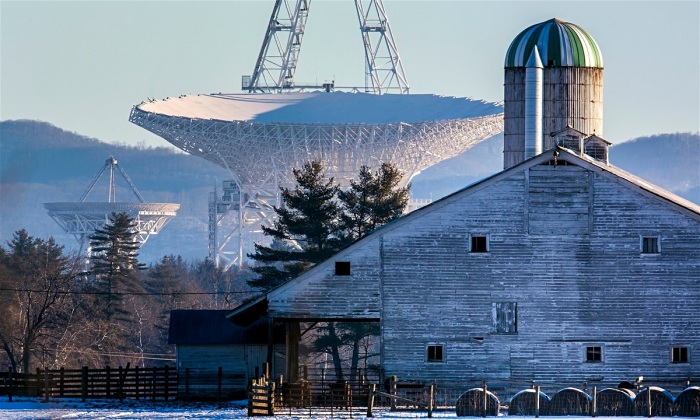
Green Bank, in Pocahontas County in West Virginia, the United States, is possibly one of the quietest residential places on earth. There is no cell phone reception here, no Wi-Fi, not even radio or television. But Green Bank is not technologically backward. On the contrary, it’s home to the world’s largest fully steerable radio telescope on earth – the Robert C. Byrd Green Bank Telescope (GBT), operated by the National Radio Astronomy Observatory. The GBT is the reason why this town is electromagnetically silent.
Radio telescopes work by detecting electromagnetic waves that come from distant galaxies. These signals are so faint that the slightest emission of radio waves from electronic gadgets can interfere with the readings of the radio telescopes. For this reason, all cell phones, Wi-Fi, radio and other communication devices are outlawed here. There are no cell phone towers for miles around, no music plays on the radio or soap operas on the television. Not even gas operated cars are allowed because gasoline engines use spark plugs to ignite the fuel-air mixture, and electric sparks produce electromagnetic waves.
![green-bank-virginia-24[6]](https://markosun.files.wordpress.com/2015/01/green-bank-virginia-246.jpg)

The boundaries of the device-free zone extend far beyond Green Bank, covering an area roughly equal to 13,000–square-mile. This region is called the National Radio Quiet Zone, and is located around the sparsely populated countryside that straddles the borders of West Virginia, Virginia, and Maryland. Almost all types of radio transmissions and certain electronic devices are banned here so that the powerful Green Bank Radio Telescopes can work without disturbance. Green Bank happens to be the closest community to the Green Bank Telescope.
The tech-free life in Green Bank may seem impossible for those who can’t live without their cell phones, but for the 140-odd residents of the town, life is a bliss. Kids aren’t glued to the glowing screens of their mobile devices. They actually talk to each other instead of texting. Older residents roll down their car windows to greet each other and leave their front doors unlocked. If they must speak to someone out of town, there are pay phones.

The current telescope, completed in 2000, was built following the collapse of the previous Green Bank telescope, a 90.44 m paraboloid erected in 1962. The previous telescope collapsed on 15 November 1988 due to the sudden loss of a gusset plate in the box girder assembly, which was a key component for the structural integrity of the telescope.
Living under the shadow of the giant telescope, some of the residents are not even aware of the technological advances elsewhere.
“We didn’t realize the rest of the world was getting connected and staying connected constantly, via phones and computers and all that,” said radio host Caleb Diller, who grew up in Pocahontas County. “So we were kinda back in time a little bit. We hadn’t progressed to that.”
Over the last few years, many people have taken up residence in Green Bank. These people claim to suffer from electromagnetic hypersensitivity, or EHS—a disease not recognized by the scientific community. It’s said that people suffering from EHS get symptoms like dizziness, nausea, rashes, irregular heartbeat, weakness, and chest pains from electromagnetic radiations.
“Life isn’t perfect here,” said Diane Schou, one of the first “electrosensitive” immigrants who came to Green Bank with her husband in 2007. “There’s no grocery store, no restaurants, no hospital nearby. But here, at least, I’m healthy. I can do things. I’m not in bed with a headache all the time.” As of 2013, an estimated 36 people have moved to Green Bank to escape the effects of electromagnetic hypersensitivity.

The previous telescope

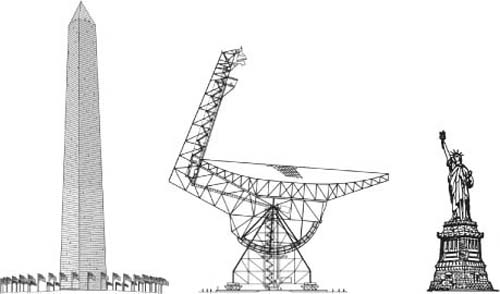
The GBT is fully steerable, and 85% of the entire celestial sphere is accessible. The structure weighs 8500 tons and stands 450 feet above ground. The surface area of the GBT is a 100 by 110 meter active surface with 2,209 actuators (a small motor used to adjust the position) for the 2,004 surface panels. The panels are made from aluminium to a surface accuracy of better than 0.003 inches (76 µm) RMS. The actuators adjust the panel positions to correct for distortions due to gravity which change as the telescope moves. Without this so-called “active surface”, observations at frequencies above 4 GHz would not be as efficient.

Bringing Eye Contact back to the 21st Century with the Texting Hat

Okay, so maybe this isn’t a real thing yet… but, c’mon, you know it’s coming! With the tagline “Bringing eye contact back to the 21st century” the Texting Hat is here to solve all your phone zombie problems. What a great invention. You look like you actually care when in reality who gives a f#@k!

Star Trek becomes reality as Microsoft ‘Universal Translator’ turns spoken English into any of 26 different languages
- Software speaks in user’s own voice
- Can translate into languages from Spanish to Mandarin
- Speaks smoothly in sentences, not individual words
- Could be built into smartphone language apps
It has long been used by James T Kirk to speak to aliens and blue women from space – but now Microsoft is on the brink of making a real, working Universal Translator.
Frank Soong and Rick Rashid have created software which converts English language speech into any of 26 foreign languages – and which ‘speaks’ in the user’s own voice.
All the user has to do is speak English into the machine and it will convert it into anything from Spanish to Mandarin.

William Shatner as James T Kirk: The new device is similar to the Universal Translator used in Star Trek, and takes around one hour to get used to a person’s voice then works by comparing the words that have been recorded with stock models for the target language.
The hope is that the device will one day allow visitors to foreign countries to have conversations with other people, even though they do not speak the same language – just like in Star Trek.
Mr Soong told Technology Review that his breakthrough could help language students and might also work with navigational devices.
In theory it could one day be installed into a smart phone meaning tourists have a ready made translation device sitting in their pockets.
Mr Soong said: ‘We will be able to do quite a few scenario applications. ‘For a monolingual speaker traveling in a foreign country, we’ll do speech recognition followed by translation, followed by the final text to speech output in a different language, but still in his own voice’.
Mr Soong and Mr Rashid work at Microsoft’s HQ in Redmond, Washington. They created the system with colleagues at Microsoft Research Asia in Beijing, the company’s second-largest research lab.

In Star Trek it was supposedly introduced in the late 22nd century and helped the crew of the Enterprise communicate with aliens as the explored the universe.
Mr Soong and Mr Rashid however have made their version today, even if the voice which comes out in the foreign language still sounds a little mechanical.
Their device needs around one hour to get used to a person’s voice then works by comparing the words that have been recorded with stock models for the target language.
The technology has been designed so that it does not just translate words, which would give it a computerised and disjointed sound.
Instead the sounds are carefully manipulated to mimic real speech as realistically as possible.
National Security Agency (NSA) has formidable offensive cyber weapons program

INFILTRATION. SABOTAGE. MAYHEM. FOR YEARS FOUR-STAR GENERAL KEITH ALEXANDER HAS BEEN BUILDING A SECRET ARMY CAPABLE OF LAUNCHING DEVASTATING CYBERATTACKS. NOW IT’S READY TO UNLEASH HELL.
Inside Fort Meade, Maryland, a top-secret city bustles. Tens of thousands of people move through more than 50 buildings—the city has its own post office, fire department, and police force. But as if designed by Kafka, it sits among a forest of trees, surrounded by electrified fences and heavily armed guards, protected by antitank barriers, monitored by sensitive motion detectors, and watched by rotating cameras. To block any telltale electromagnetic signals from escaping, the inner walls of the buildings are wrapped in protective copper shielding and the one-way windows are embedded with a fine copper mesh.
This is the undisputed domain of General Keith Alexander, a man few even in Washington would likely recognize. Never before has anyone in America’s intelligence sphere come close to his degree of power, the number of people under his command, the expanse of his rule, the length of his reign, or the depth of his secrecy. A four-star Army general, his authority extends across three domains: He is director of the world’s largest intelligence service, the National Security Agency; chief of the Central Security Service; and commander of the US Cyber Command. As such, he has his own secret military, presiding over the Navy’s 10th Fleet, the 24th Air Force, and the Second Army.
Alexander runs the nation’s cyberwar efforts, an empire he has built over the past eight years by insisting that the US’s inherent vulnerability to digital attacks requires him to amass more and more authority over the data zipping around the globe. In his telling, the threat is so mind-bogglingly huge that the nation has little option but to eventually put the entire civilian Internet under his protection, requiring tweets and emails to pass through his filters, and putting the kill switch under the government’s forefinger. “What we see is an increasing level of activity on the networks,” he said at a recent security conference in Canada. “I am concerned that this is going to break a threshold where the private sector can no longer handle it and the government is going to have to step in.”
In its tightly controlled public relations, the NSA has focused attention on the threat of cyberattack against the US—the vulnerability of critical infrastructure like power plants and water systems, the susceptibility of the military’s command and control structure, the dependence of the economy on the Internet’s smooth functioning. Defense against these threats was the paramount mission trumpeted by NSA brass at congressional hearings and hashed over at security conferences.
But there is a flip side to this equation that is rarely mentioned: The military has for years been developing offensive capabilities, giving it the power not just to defend the US but to assail its foes. Using so-called cyber-kinetic attacks, Alexander and his forces now have the capability to physically destroy an adversary’s equipment and infrastructure, and potentially even to kill. Alexander—who declined to be interviewed for this article—has concluded that such cyberweapons are as crucial to 21st-century warfare as nuclear arms were in the 20th.
And he and his cyberwarriors have already launched their first attack. The cyberweapon that came to be known as Stuxnet was created and built by the NSA in partnership with the CIA and Israeli intelligence in the mid-2000s. The first known piece of malware designed to destroy physical equipment, Stuxnet was aimed at Iran’s nuclear facility in Natanz. By surreptitiously taking control of an industrial control link known as a Scada (Supervisory Control and Data Acquisition) system, the sophisticated worm was able to damage about a thousand centrifuges used to enrich nuclear material.

Cubesats: Miniature research satellites launched from the International Space Station
A CubeSat is a type of miniaturized satellite for space research that usually has a volume of exactly one liter (10 cm cube), has a mass of no more than 1.33 kilograms, and typically uses commercial off-the-shelf components for its electronics.
Beginning in 1999, California Polytechnic State University (Cal Poly) and Stanford University developed the CubeSat specifications to help universities worldwide to perform space science and exploration.

The CubeSat specification accomplishes several high-level goals. Simplification of the satellite’s infrastructure makes it possible to design and produce a workable satellite at low cost. Encapsulation of the launcher–payload interface takes away the prohibitive amount of managerial work that would previously be required for mating a piggyback satellite with its launcher. Unification among payloads and launchers enables quick exchanges of payloads and utilization of launch opportunities on short notice.


Since CubeSats are all 10×10 cm (regardless of length) they can all be launched and deployed using a common deployment system. CubeSats are typically launched and deployed from a mechanism called a Poly-PicoSatellite Orbital Deployer (P-POD), also developed and built by Cal Poly. P-PODs are mounted to a launch vehicle and carry CubeSats into orbit and deploy them once the proper signal is received from the launch vehicle. P-PODs have deployed over 90% of all CubeSats launched to date (including un-successful launches), and 100% of all CubeSats launched since 2006. The P-POD Mk III has capacity for three 1U CubeSats, or other 1U, 2U, or 3U CubeSats combination up to a maximum volume of 3U.


Future projects
QB50
QB50 is a proposed international network of 50 CubeSats for multi-point, in-situ measurements in the lower thermosphere (90–350 km) and re-entry research. QB50 is an initiative of the Von Karman Institute and is funded by the European Commission as part of the 7th Framework Programme (FP7). Double-unit (2U) CubeSats (10×10×20 cm) are developed, with one unit (the ‘functional’ unit) providing the usual satellite functions and the other unit (the ‘science’ unit) accommodating a set of standardised sensors for lower thermosphere and re-entry research. 35 CubeSats are envisaged to be provided by universities in 19 European countries, 10 by universities in the US, 2 by universities in Canada, 3 by Japanese universities, 1 by an institute in Brazil, and others. Ten 2U or 3U CubeSats are foreseen to serve for in-orbit technology demonstration of new space technologies.
The Request for Proposals (RFP) for the QB50 CubeSat was released on February 15, 2012. Two “precursor” QB50 satellites were launched aboard a Dnepr rocket on June 19, 2014. All 50 CubeSats were supposed to be launched together on a single Cyclone-4 launch vehicle in February 2016, but due to the unavailability of the launch vehicle, 40 satellites are now planned to be launched aboard Cygnus CRS OA-7 in March 2017 and subsequently deployed from the ISS. Eight other cubesats have been manifested on two further Dnepr flights but the availability of this launcher has been in doubt since its last flight in 2015.
2018 InSight mission: MarCO CubeSats
The May 2018 launch, of the InSight stationary lander to Mars, will include two CubeSats to flyby Mars to provide additional relay communications from InSight to Earth during entry and landing. This will be the first flight of CubeSats in deep space. The mission CubeSat technology is called Mars Cube One (MarCO), a six-unit CubeSat, 14.4 inches (36.6 centimeters) by 9.5 inches (24.3 centimeters) by 4.6 inches (11.8 centimeters). MarCo is an experiment, but not necessary for the InSight mission, to add relay communications to space missions in important time durations, in this landing from the time of InSight atmospheric entry and landing.
MarCO will launch in May 2018 with the InSight lander and will separate after launch and then travel in their own trajectories to Mars. After separation, MarCO will deploy two radio antennas and two solar panels. The high-gain, X-band antenna is a flat panel to direct radio waves. MarCO will navigate to Mars independently from the InSight lander, making their own course adjustments on the flight.
During InSight’s planned entry, descent and landing (EDL) in November 2018, the lander will transmit information in the UHF radio band to NASA’s Mars Reconnaissance Orbiter (MRO) flying overhead. MRO will forward EDL information to Earth using a radio frequency in the X band, but cannot simultaneously receive information in one band if transmitting on another. Confirmation of a successful landing could be received on Earth several hours after, so MarCO would be a technology demonstration of real-time telemetry during the landing.

InSight lander with labeled instruments
Very Cool Vintage TV’s
When televisions were still a luxury, high-tech item, designers wanted to make them look as crazily futuristic and beautiful as possible. Here are some of the most bizarre and breathtaking television sets that ever existed.

Kuba Komet (1957-1962, Wolfenbuttel, West Germany)

The sailboat-like ultra-heavy (it was 289 lb. or 130 kg) home entertainment system of its time had a 23″ black and white television, eight speakers, a Telefunken phonographs and a multi-band radio receiver. The Komet cost more than a year’s average wage.

Marconiphone Television 702 with a 12-inch screen from 1937, by the British Marconi

A Baird Lyric with a 12-inch screen, 1946

Tele-Tone TV-209 (1949)


A Teleavia Panoramic III, designed by Philippe Charbonneaux, 1957


The 21-inch Philco Tandem Predicta with a 25 ft. cord between the screen and the cabinet, 1958


Philco Safari, the first transistor portable television, 1959

The 15 pound (6.8 kg) set had a 2 inch display and worked with a 7.5V rechargeable battery.
Panasonic/National Flying Saucer (but also known as The Eyeball, originally TR-005 Orbitel), produced by Panasonic in the late 1960s and early 1970s

It had a five-inch screen, earphone jack, and could rotate 180 degrees on its chrome tripod.
The Keracolor Sphere, designed by Arthur Bracegirdle, 1968-1977

This English set, an icon of the Space Age, was really expensive because of its small size. It was available in various colors.
The JVC Videosphere, introduced in 1970, and produced to the early 1980s

Inspired by Kubrick’s 2001: A Space Odyssey, and appeared in the Conquest of The Planet of the Apes (1972) and in The Matrix (1999).

Sinclair Microvision TV (Model MTV-1), 1977

The first ever miniature television with its 2 inch screen wasn’t a real sales success: it was really expensive, priced like the average models.

Seiko T 001 TV Watch, 1982

Casio TV-70, the portable TV from the early 1980s with “Solar Projection System”, 1986

Behind the cool name it was just a mirror that reflects the picture from the LCD screen. The only 13 mm thin TV worked with 3 AAA-size batteries and had a 2-inch black and white screen.

Not exactly sure what the make and name of this wild TV is. Almost looks like a stove is built into it. But what an enjoyable way to cook dinner, watching Spock and Bones McCoy sparring.

 The MarkoZen Blog