US Air Force’s secretive space plane lands after two years in orbit

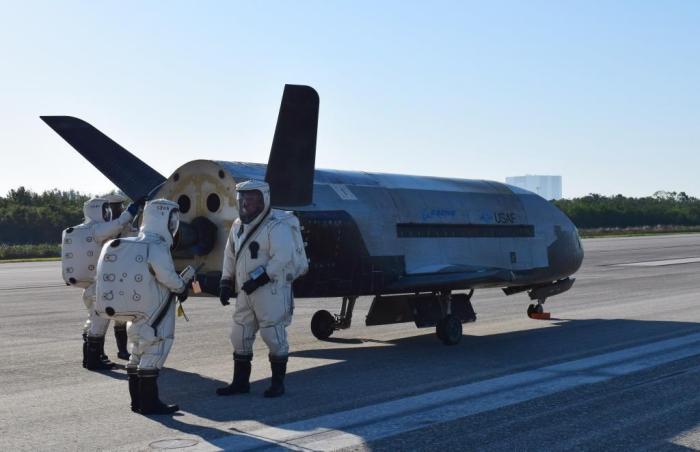
X-37B OTA4 lands at Kennedy Space Center

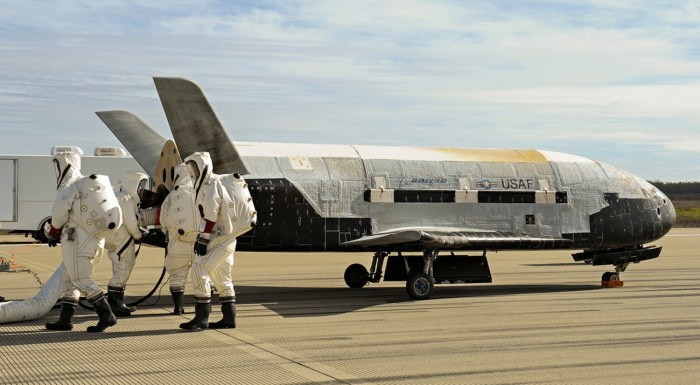
The X-37B Orbital Test Vehicle (OTV-4), an unmanned, reusable space plane operated by the US Air Force, has landed at Nasa’s Kennedy Space Centre in Florida after two years in orbit.

US Air Force officials confirmed the craft’s landing and said they were “excited about the data gathered”.

According to a press release, the programme is designed to experiment on and develop reusable space vehicles.

But what the OTV-4 has been doing for the last 24 months isn’t clear.

“The hard work of the X-37B OTV team and the 45th Space Wing successfully demonstrated the flexibility and resolve necessary to continue the nation’s advancement in space,” said Randy Walden, the director of the Air Force Rapid Capabilities Office.
x-37b-landing-640x353

Role Unmanned spaceplane
National origin United States
Manufacturer Boeing Defense, Space & Security
First flight 7 April 2006 (first drop test)
Introduction 22 April 2010 (first spaceflight)
Status
  • In service
  • 4 spaceflights completed
Primary user
  • X-37A: NASA?Darpa
  • 37B: United States Air Force
Number built
  • X-37A: 1
  • X-37B: 2
Developed from Boeing X-40

“The ability to land, refurbish, and launch from the same location further enhances the OTV’s ability to rapidly integrate and qualify new space technologies.”

Because the X-37B started life as a Nasa programme, the Air Force is in a position to talk openly about the craft’s design but its precise purpose remains classified.

Back in 2010, when the vehicle was first launched, Gary Payton, the Air Force’s deputy undersecretary for space programmes, tried to calm worries about the potential weaponisation of space.

“I don’t know how this could be called weaponisation of space. It’s just an updated version of the space shuttle type of activities in space,” he said.

“We, the Air Force, have a suite of military missions in space and this new vehicle could potentially help us do those missions better.”

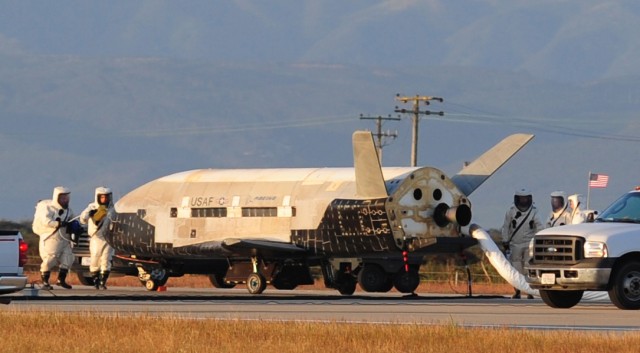
X_37_14

Given that its landing on Sunday caused a sonic boom, waking residents in central Florida, it would be hard for US Air Force officials to deny something had happened.

“Today marks an incredibly exciting day for the 45th Space Wing as we continue to break barriers,” said Brig Gen Wayne Monteith, the 45th SW commander.

“Our team has been preparing for this event for several years, and I am extremely proud to see our hard work and dedication culminate in today’s safe and successful landing of the X-37B.”
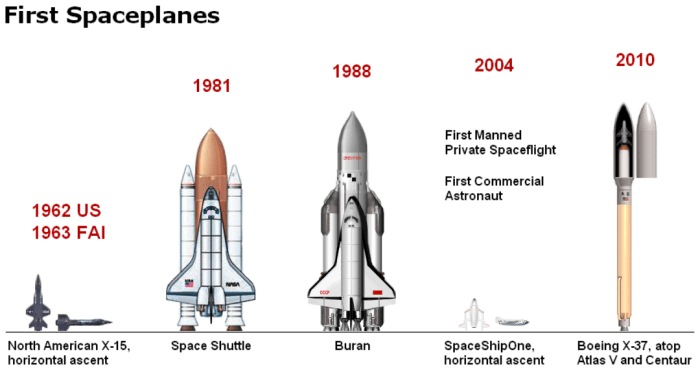
xWorld's_First_Five_Spaceplanes

X-37B OTV Mission 3 Landing

General characteristics
Crew: none
Length: 29 ft 3 in (8.92 m)
Wingspan: 14 ft 11 in (4.55 m)
Height: 9 ft 6 in (2.90 m)
Max takeoff weight: 11,000 lb (4,990 kg)
Electrical power: Gallium arsenide solar cells with lithium-ion batteries
Payload bay: 7 × 4 ft (2.1 × 1.2 m)
Performance
Orbital speed: 28,044 km/h (17,426 mph)
Orbit: Low Earth orbit
Orbital time: 270 days (design)

Cubesats: Miniature research satellites launched from the International Space Station

A CubeSat is a type of miniaturized satellite for space research that usually has a volume of exactly one liter (10 cm cube), has a mass of no more than 1.33 kilograms, and typically uses commercial off-the-shelf components for its electronics.

Beginning in 1999, California Polytechnic State University (Cal Poly) and Stanford University developed the CubeSat specifications to help universities worldwide to perform space science and exploration.
iss7

The CubeSat specification accomplishes several high-level goals. Simplification of the satellite’s infrastructure makes it possible to design and produce a workable satellite at low cost. Encapsulation of the launcher–payload interface takes away the prohibitive amount of managerial work that would previously be required for mating a piggyback satellite with its launcher. Unification among payloads and launchers enables quick exchanges of payloads and utilization of launch opportunities on short notice.

iss

iss1

iss3

Since CubeSats are all 10×10 cm (regardless of length) they can all be launched and deployed using a common deployment system. CubeSats are typically launched and deployed from a mechanism called a Poly-PicoSatellite Orbital Deployer (P-POD), also developed and built by Cal Poly. P-PODs are mounted to a launch vehicle and carry CubeSats into orbit and deploy them once the proper signal is received from the launch vehicle. P-PODs have deployed over 90% of all CubeSats launched to date (including un-successful launches), and 100% of all CubeSats launched since 2006. The P-POD Mk III has capacity for three 1U CubeSats, or other 1U, 2U, or 3U CubeSats combination up to a maximum volume of 3U.

iss2

iss4

iss5

iss6

Future projects

QB50

QB50 is a proposed international network of 50 CubeSats for multi-point, in-situ measurements in the lower thermosphere (90–350 km) and re-entry research. QB50 is an initiative of the Von Karman Institute and is funded by the European Commission as part of the 7th Framework Programme (FP7). Double-unit (2U) CubeSats (10×10×20 cm) are developed, with one unit (the ‘functional’ unit) providing the usual satellite functions and the other unit (the ‘science’ unit) accommodating a set of standardised sensors for lower thermosphere and re-entry research. 35 CubeSats are envisaged to be provided by universities in 19 European countries, 10 by universities in the US, 2 by universities in Canada, 3 by Japanese universities, 1 by an institute in Brazil, and others. Ten 2U or 3U CubeSats are foreseen to serve for in-orbit technology demonstration of new space technologies.

The Request for Proposals (RFP) for the QB50 CubeSat was released on February 15, 2012. Two “precursor” QB50 satellites were launched aboard a Dnepr rocket on June 19, 2014. All 50 CubeSats were supposed to be launched together on a single Cyclone-4 launch vehicle in February 2016, but due to the unavailability of the launch vehicle, 40 satellites are now planned to be launched aboard Cygnus CRS OA-7 in March 2017 and subsequently deployed from the ISS. Eight other cubesats have been manifested on two further Dnepr flights but the availability of this launcher has been in doubt since its last flight in 2015.

2018 InSight mission: MarCO CubeSats

The May 2018 launch, of the InSight stationary lander to Mars, will include two CubeSats to flyby Mars to provide additional relay communications from InSight to Earth during entry and landing. This will be the first flight of CubeSats in deep space. The mission CubeSat technology is called Mars Cube One (MarCO), a six-unit CubeSat, 14.4 inches (36.6 centimeters) by 9.5 inches (24.3 centimeters) by 4.6 inches (11.8 centimeters). MarCo is an experiment, but not necessary for the InSight mission, to add relay communications to space missions in important time durations, in this landing from the time of InSight atmospheric entry and landing.

MarCO will launch in May 2018 with the InSight lander and will separate after launch and then travel in their own trajectories to Mars. After separation, MarCO will deploy two radio antennas and two solar panels. The high-gain, X-band antenna is a flat panel to direct radio waves. MarCO will navigate to Mars independently from the InSight lander, making their own course adjustments on the flight.

During InSight’s planned entry, descent and landing (EDL) in November 2018, the lander will transmit information in the UHF radio band to NASA’s Mars Reconnaissance Orbiter (MRO) flying overhead. MRO will forward EDL information to Earth using a radio frequency in the X band, but cannot simultaneously receive information in one band if transmitting on another. Confirmation of a successful landing could be received on Earth several hours after, so MarCO would be a technology demonstration of real-time telemetry during the landing.

insight

InSight lander with labeled instruments

“Criminal Alien” Hotline Gets Overheated

Trump’s immigrant crime hotline trolled with calls about aliens and UFOs

bad aliens

Have you seen this Alien?

When the US government uses the term “criminal alien”, it means someone who is not a US citizen that has been convicted of a crime.

Twitter, meanwhile, thinks flying saucers and The X-Files.

On Wednesday, the Department of Homeland Security opened a new office, called VOICE, to “serve the needs of crime victims and their families who have been impacted by crimes committed by removable criminal aliens”.

The centrepiece is a new hotline that victims can call for support and assistance. It was set up under the authority of an executive order on immigration from President Trump in January.

People began making clear exactly what people should not be using the line for.

aliens

aliens2

aliens3

aliens4

aliens5

aliens6

It’s unclear how many people actually placed calls to the hotline, and several Twitter users reported long wait times to get through. But the US Immigration and Customs Enforcement (ICE) agency suggested it had impacted their service.

“There are certainly more constructive ways to make one’s opinions heard than to prevent legitimate victims of crime from receiving the information and resources they seek because the lines are tied up by hoax callers,” a spokesperson told Buzzfeed News
President Trump famously enraged Mexicans by suggesting in June 2015 that the country’s immigrants were criminals and “rapists”, and he has continued to take a tough line on illegal immigration since entering the White House.

Steep decreases in the number of people arrested while illegally crossing the border from Mexico in recent months have been touted by the administration as a sign that Mr Trump’s policies are having the desired effect.

Tales of deportation in Trump’s America
The government says the VOICE office will keep victims of alleged crimes by undocumented migrants updated as the suspect moves through the immigration system, including if they are deported.
Opponents of the administration’s policies and rhetoric focusing on immigrants and crime point out that numerous studies have shown immigrants are less likely to commit serious crimes or be jailed than the native-born population.
The American Immigration Council says this “holds true for both legal immigrants and the unauthorised, regardless of their country of origin or level of education”.

Now here is a very BAD “criminal alien”!

bad alien4

Nazi UFOs? Very Interesting

Is it possible that an evil race of Aliens allied with the Nazis during World War II?  That would have been a formidable alliance to deal with.  Especially if the Aliens provided the Nazis with UFO technology.  I can’t see a P-51 Mustang defeating a souped up UFO.  But then again, maybe the Americans and Russians had their own Alien benefactors.

In science fiction, conspiracy theory, and underground comic books, there are a number of stories or claims regarding Nazi UFOs (in German: Rundflugzeug, Feuerball, Diskus, Haunebu, Hauneburg-Geräte, VRIL, Kugelblitz, Andromeda-Geräte, Flugkreisel, Kugelwaffen, Reichsflugscheiben). They relate supposedly successful attempts to develop advanced aircraft or spacecraft in Nazi Germany prior to and during World War II, and further claim the post-war survival of these craft in secret underground bases in Antarctica, South America or the United States, along with their Nazi creators.

Nazi UFO tales and myths very often conform largely to documented history on the following points:

  • Nazi Germany claimed the territory of New Swabia in Antarctica, sent an expedition there in 1938, and planned others.
  • Nazi Germany conducted research into advanced propulsion technology, including rocketry, Viktor Schauberger’s engine research, flying wing craft and the Arthur Sack A.S.6 experimental circular winged aircraft.
  • Some UFO sightings during World War II, particularly those known as foo fighters, were thought by the allies to be prototype enemy aircraft designed to harass Allied aircraft through electromagnetic disruption; a technology similar to today’s electromagnetic pulse (EMP) weapons.


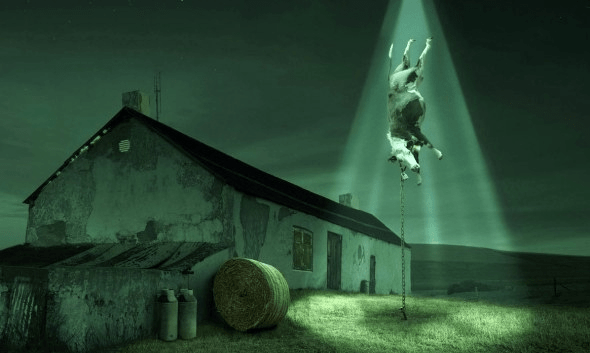
Alien Cow Abduction Lamp

Always the cows getting abducted by the Space Aliens. What do those sneaky Aliens want with the bovine?  They sometimes seem to release the cows, sometimes not.

cow

cow1

Some entrepreneur has come up with a really cool idea. An abduction lamp.

cow2

I have to get this lamp.

cow3

Why always dairy cows? This could be more about milk than beef. After travelling a billion light years and only half way to their destination, the space aliens have run out of milk, they know cows exist on Earth. So why not take a small side trip to the blue planet and beam up some cows, get a human abductee farmer to milk them. Voila, fresh, glorious cold milk. Totally worth the trip.

cowxx6

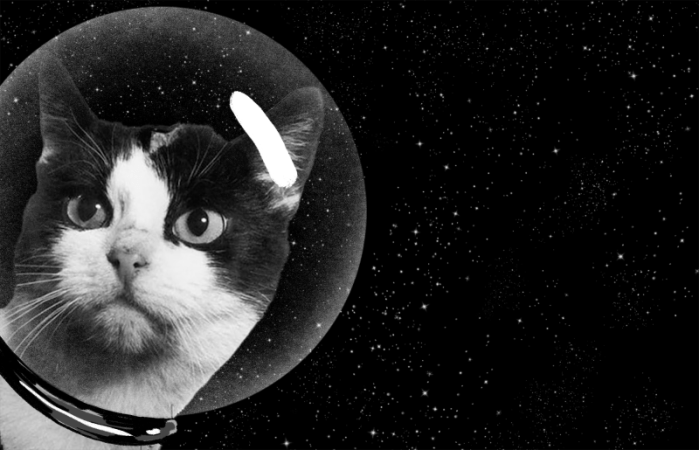
The Secret History of the First Cat in Space

Gizmodo.com

cat

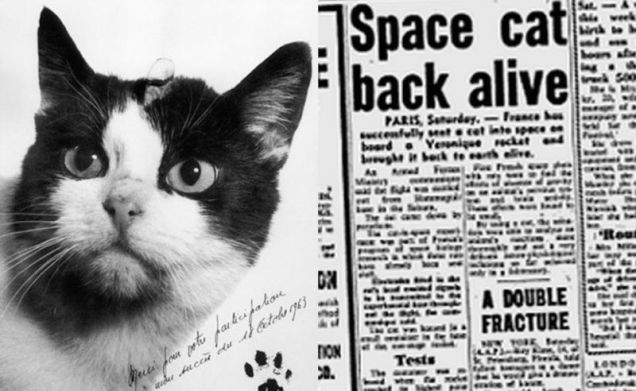
On October 18th, 1963, the Centre national d’etudes in France was set to send a small cat named Félix into space. After lagging behind its Soviet and American competitors, France was eager to stake its claim in the space race—with cats, for some reason. But on launch day, the mischievous little beast went missing—and an accidental heroine stepped in to take his place. Her name was Félicette.

From the streets of Paris, this tuxedo kitty—nicknamed “Astrocat”—would reach heights never achieved by feline kind. On October 24th, 1963, Félicette jetted 130 miles above Earth on a liquid-fueled French Véronique AG1 rocket, soaring high above the Algerian Sahara Desert. She returned just fifteen minutes later, already a decorated heroine for her nation.


After her landing, French scientists at the Education Center of Aviation and Medical Research (CERMA) studied Félicette’s brain waves to see if she had changed at all since her voyage. While not much is known about their findings—or about Félicette’s eventual fate—the CERMA said she had made “a valuable contribution to research.”

Unfortunately, Félicette’s story has been lost in the sands of time; A victim of our puptriarchal society that favors the achievements of dogs above all others. But France’s place in the overall space race—or lack thereof—could explain her erasure.
“I think it may be a matter of how history played out,” space historian and editor of the space history site collectSPACE Robert Pearlman told Gizmodo. “The effort that led to launching humans into space—and then ultimately, to the moon—was the space race between the United States and the Russians.”

The pioneering efforts of brave pups, monkeys and other animals paved the way for humans in the US-Russia space race to the moon. Scientists used animals as test subjects to see how a lack of gravity would impact them, and in effect, humans. If animals could survive the harsh conditions of space, so could we. At least that was the idea.

cat1

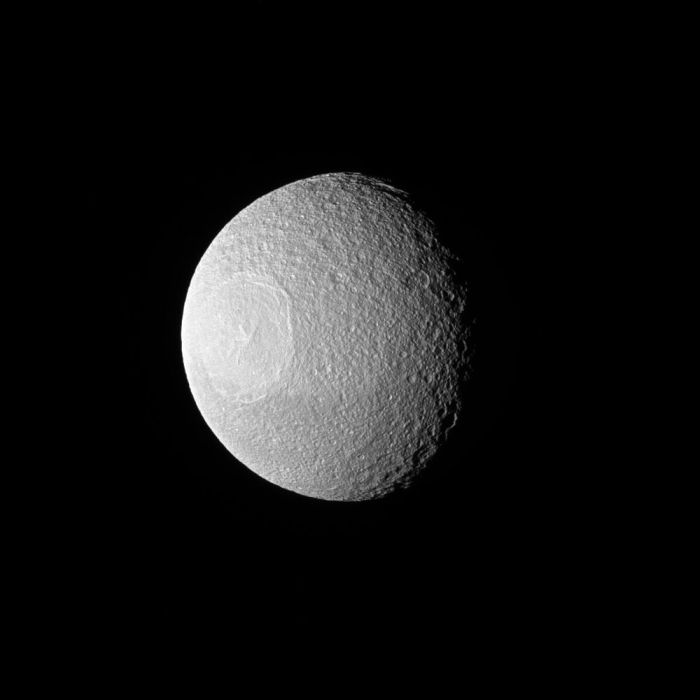
Saturn’s Moon Resembles the ‘Death Star’

star1

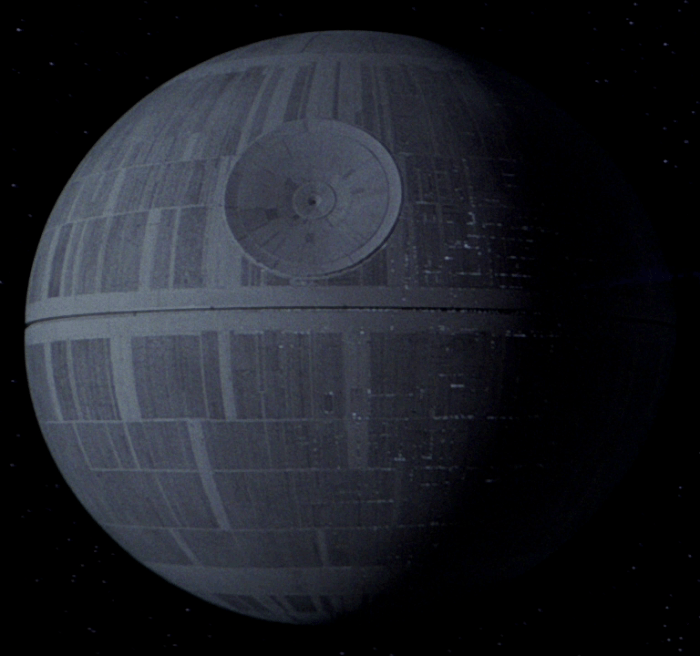
A new image from NASA’s Cassini probe is raising eyebrows among sci fi fans for its eerie resemblance to the infamous Death Star from the Star Wars films.

The unsettling celestial body, dubbed ‘Tethys,’ is one of Saturn’s icy moons and measures about 660 miles across.

With its enormous crater positioned in just the right spot when photographed by the spacecraft, the moon looks remarkably similar to the monstrous weapon at the center of the epic space opera.

While it is almost certainly not a fabricated space ship designed to destroy planets and wreak havoc across the universe, who knows what creatures could lurk in the deep deep depths of the moon?

star2

star

Popsci.com