


 `
`


On September 22, 2010, with the departure of the Expedition 23 crew, Colonel Douglas H. Wheelock assumed command of the International Space Station and the Expedition 25 crew. He has been tweeting pictures to his followers since he arrived at the space station. We thought that we should put some of them together as a tribute to him and the whole ISS crew.
Discovery launch September, 2010.

Soyuz 23S, “Olympus” docked to the nadir side of the Space Station. This will be our ride back home to planet Earth when our work is complete here. Thought I would tweet this view out of the Cupola, as we were passing over the majestic snow-capped Caucuses. The sun rising and reflecting off the Caspian Sea (9-26-2010). Space Photo: NASA, Astronaut Wheelock.

Western Europe


Patagonia, southern tip of South America


Egypt, Israel, Mediterranean Sea and Red Sea.

Our ‘Progress 39P’ unmanned resupply spaceship on final approach for docking this past Sunday. It was laden with food, fuel, spare parts, and much needed supplies for our orbiting outpost. The greatest gift was just inside the hatch…some bags of fresh fruit and vegetables. Such a wonderful treat after 3 months of eating out of tubes and plastic pouches (9-15-2010)! Space Photo: NASA, Astronaut Wheelock.

Ayers Rock, Australia. This beast is 2.2 miles long and 1.4 miles wide.

The ‘Cupola’, attached to the nadir side of the Space Station, gives a panoramic view of our beautiful planet. Cosmonaut Fyodor took this picture from the window of the Russian Docking Compartment (Airlock). Here I am in the Cupola preparing a camera for our late evening Hurricane Earl flyover…trying to capture the moment…(8-31-2010). Space Photo: NASA, Astronaut Wheelock.

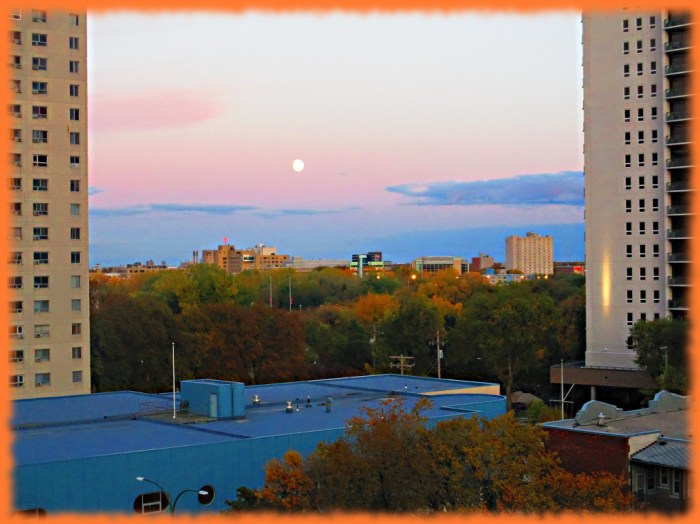
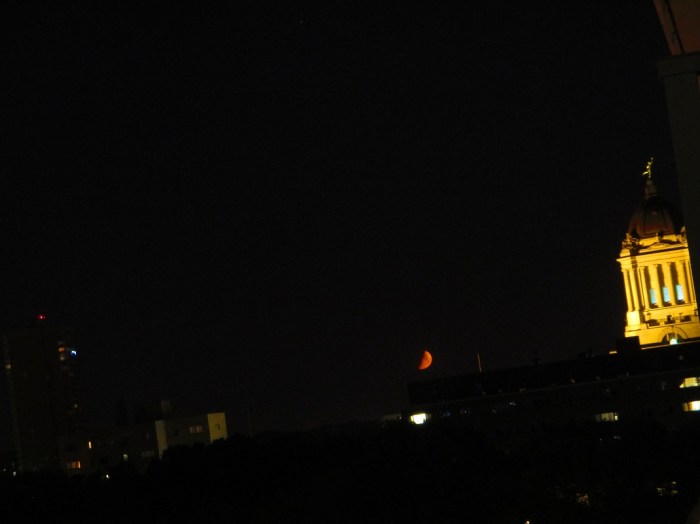
At its closest point, known as the perigee, the Moon is only 363,104 km (225,622 miles). And at its most distant point, called apogee, the Moon gets to a distance of 406,696 km (252,088 miles).


SpaceX can add another first to its ever-increasing list: On Thursday, it successfully launched the U.S. Air Force’s X-37B experimental spaceplane for the first time. This makes it the only launch provider to accomplish this besides the United Launch Alliance, and should help ensure SpaceX gets more business from U.S, defense contracts in future.
The launch vehicle used was SpaceX’s Falcon 9 rocket, which took off from the company’s LC-39A launch facility at Kennedy Space Center on Thursday morning at 10 AM ET (7 AM PT). The Falcon 9 deployed the X-37B Orbital Test Vehicle, as the payload is officially called, and then its first stage booster returned to Earth for a planned recovery at Cape Canaveral Air Force base via SpaceX’s LZ-1 landing pad. The goal was to get the launch up before the arrival of Hurricane Irma, and they succeeded.
While the specifics of the X-37B’s mission aren’t available to the public, it will be “conducting experiments” post-launch. Its last mission saw it orbit Earth for two years before returning via a landing in May. The X-37B, built by Boeing, is an uncrewed vehicle, but resembles the Space Shuttle on a smaller scale. It’s also designed to land like the Shuttle, using a landing strip like you’d use for an airliner.
The X-37B is the first uncrewed space plane for the U.S., and is designed for reusability at a reasonable cost. It’s aim is to fly and test new tech, and to return experimental results in a way that protects cargo and makes it suitable for post-operation examination. One of the goals with this launch was basically just to prove SpaceX as a viable launch option, which Boeing says will help ensure the flexibility and continued viability of the X-37B for experimental use.
For SpaceX, this marks the 16th recovery of a Falcon 9 first stage. The next mission to reuse a refurbished recovered booster is EchoStar 105’s SES-11 mission, which is taking place in October and which will reuse a booster first used for the CRS-10 ISS resupply mission.
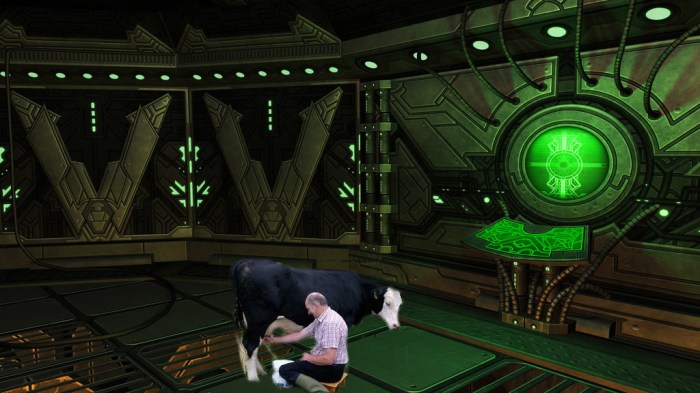
Always the cows getting abducted by the Space Aliens. What do those sneaky Aliens want with the bovine? They sometimes seem to release the cows, sometimes not.


Some entrepreneur has come up with a really cool idea. An abduction lamp.


Why always dairy cows? This could be more about milk than beef.
Pic below: they beamed up the farmer along with the cow.

Some imaginative fellow was on an airplane flying over Nevada when he was sure he saw a giant UFO below the airplane. It was massive and giving off extremely bright lights. The guy must have thought Earth was under alien attack.
He took some photos below:


The “I want to believe” UFO community was abuzz when they saw the photos. Maybe some real evidence that the little green bastards do exist! But then a skeptic pointed out that the sighting was almost 99.999 percent a solar energy facility in the desert.
The Ivanpah Solar Electric Generating System is a concentrated solar thermal plant in the California Mojave Desert, 64 km (40 miles) southwest of Las Vegas, with a gross capacity of 392 megawatts (MW). It deploys 173,500 heliostats, each with two mirrors, focusing solar energy on boilers located on three centralized solar power towers. Unit 1 of the project was connected to the grid in September 2013 in an initial sync testing. The facility formally opened on February 13, 2014, and it is currently the world’s largest solar thermal power station.
There are ten huge Solar Generating facilities in the Mojave Desert. The airplane passenger should have done some research before he came to a UFO conclusion.
Ivanpah
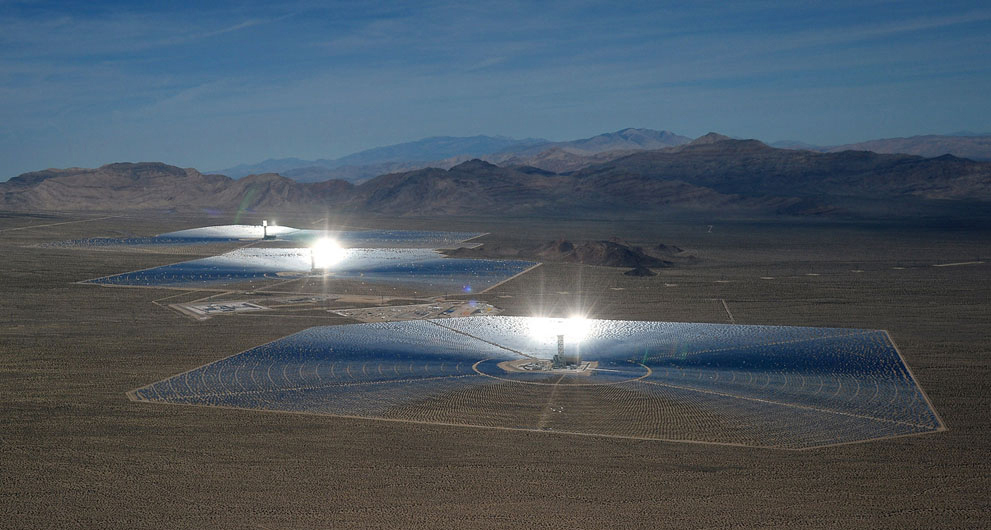

173,500 of these heliostats (mirror reflectors).


US rocket company SpaceX completed back-to-back launches at the weekend.
Late on Friday, it used one of its refurbished Falcon 9 vehicles to put up a Bulgarian satellite from Florida.
Then on Sunday, SpaceX lofted another 10 spacecraft for telecommunications company Iridium. This time, the rocket flew out of California.
Both missions saw the Falcon first-stages come back to Earth under control to drone ships that had been positioned out on the ocean.
It means SpaceX has now had 13 landing successes for those missions it has sought to recover the booster. That said, Friday’s first-stage had a particularly hard landing, and looked bent over on the live video feed.

“Rocket is extra toasty and hit the deck hard (used almost all of the emergency crush core), but otherwise good,” quipped SpaceX chief executive, Elon Musk, on Twitter.
His firm does not expect to recover every booster, because the flight profile required on many satellite launches will lead to re-entry speeds that are simply too fast to curtail with the available propellant.
Friday’s mission was launched from the US East Coast, from the Kennedy Space Center’s famous Apollo and shuttle pad, 39A.
The “second-hand” Falcon 9 lifted off at 15:10 local time (1910 GMT).
Its passenger, BulgariaSat-1, was dropped off in orbit, some 30 minutes later.
The spacecraft will be used to beam TV into homes in Bulgaria and Serbia.
The Falcon booster was last flown in January, to launch 10 satellites for the Iridium sat-phone and data-relay company. And it was another Iridium launch that topped out the weekend’s activities.
This second mission, on a brand new Falcon, occurred on the West Coast, from the Vandenberg Air Force Base.
Iridium is in the midst of replacing its global network of satellites. Another 10 went up on this latest flight.
SpaceX has another six launches on the books for Iridium, whose existing network of more than 60 spacecraft is now well past its design life.
Sunday’s lift-off occurred at 13:25 local time (20:25 GMT). The returning booster on this occasion sported new titanium grid fins to help steer the vehicle back to its waiting drone ship.
The titanium ought to be more robust than the previous aluminium type, said Mr Musk, removing the requirement for repair or replacement. This should speed the turnaround of future boosters for re-use.
“New titanium grid fins worked even better than expected. Should be capable of an indefinite number of flights with no service,” the CEO tweeted.
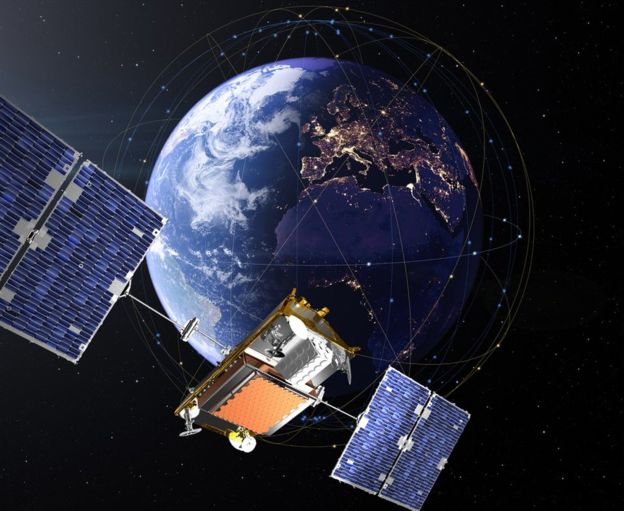
The new Iridium satellites are replacing a network that is more than 20 years old
Iridium’s business is mobile communications, providing connections to anyone who is not near a fixed line. These customers include the military, oil and gas platforms, ships and broadcasters.
Increasingly, it also includes remote machinery reporting in its status to a central server. This machine-to-machine service has a big future, especially as more and more devices are linked together in the coming, so-called “internet of things”.
The new Iridium satellites also host payloads for two tracking companies. One of is Aireon, which aims to offer a service that reports the positions of aircraft by sensing their ADS-B (Automatic Dependent Surveillance-Broadcast) transmissions. This would be useful in following planes that are beyond radar coverage, but could also help airlines plan more efficient routing.
The other hosted payload is for ExactEarth, which does something very similar with ships. Large vessels transmit an Automatic Identification System message that can be sensed from orbit.
Again, shipping companies can use the tracking service to keep tabs on vessels and to plot the best available course to a port.
CubeSats

The first satellite for UFO research is being planned and intended to search low-Earth orbit for any sign of unidentified objects. Dave Shock, the project coordinator of CubeSat For Disclosure says the shoebox-sized device will contain two cameras, “one pointing down and one pointing up.” He believes that the crowd-funded project has a good chance to photograph anomalous objects in space, as well as measure any fluctuations in magnetic fields or radiation readings with other instruments on board. It is scheduled to launched in early 2018 into a polar orbit at 193 miles above the planet. The satellite will be aloft for approximately three months until the orbit decays and it burns up in the atmosphere.

Ionized radiation: we have a scintillation counter, that enables us to measure the various radiation in our satellites environment. This is significant as it enables us to detect high energy particles, radiation, and other phenomenon.
Cameras: we will use two cameras with parabolic lenses, giving us a clear 360 degree view around our satellite.
Our instruments will allow us to scientifically verify visual anomalies with correlated radiation. This adds to the burden of proof required for extra-ordinary claims.
Got to give these guys an A+ for effort and creativity. Good luck!
The Lunar Reconnaissance Orbiter (LRO) is a NASA robotic spacecraft currently orbiting the Moon in an eccentric polar mapping orbit. Data collected by LRO has been described as essential for planning NASA’s future human and robotic missions to the Moon. Its detailed mapping program is identifying safe landing sites, locating potential resources on the Moon, characterizing the radiation environment, and demonstrating new technologies.
The probe has made a 3-D map of the Moon’s surface and has provided high resolution images of Apollo landing sites. The first images from LRO were published on July 2, 2009, showing a region in the lunar highlands south of Mare Nubium (Sea of Clouds).
Launched on June 18, 2009, in conjunction with the Lunar Crater Observation and Sensing Satellite (LCROSS), as the vanguard of NASA’s Lunar Precursor Robotic Program, LRO was the first United States mission to the Moon in over ten years. LRO and LCROSS were launched as part of the United States’s Vision for Space Exploration program.
Artist’s illustration of the LRO


Tycho Central Peak
Far side of the Moon

Near side of the Moon


1965-2015
‘Spacewalkin’
50 years ago Ed White became the first American to step into space.

June 3, 1965
Astronaut Edward H. White II, pilot for the Gemini-Titan 4 space flight, floats in space during America’s first spacewalk. The extravehicular activity (EVA) was performed during the Gemini 4 mission on June 3, 1965. White spent 23 minutes maneuvering around his spacecraft as Jim McDivitt remained inside the spacecraft. White is attached to the spacecraft by a 25-foot umbilical line and a 23-foot tether line, both wrapped in gold tape to form one cord. In his right hand, White carries a Hand-Held Self Maneuvering Unit (HHSMU), which he used to help move him around the weightless environment of space. The visor of his helmet is gold plated to protect him from the unfiltered rays of the sun.
It’s half a century since Ed White became the first American to step into space, in 1965. Now an almost routine part of any space mission, the EVA (Extra Vehicular Activity), or “spacewalk” was once a hazardous procedure.
During the 1950s and 1960s, the USSR scored a few early firsts in the Space Race: first satellite (Sputnik 1); first man in space (Yuri Gagarin); and first spacewalk (Alexei Leonov on March 8, 1965).
Leonov encountered many difficulties during his own spacewalk. He could only maneuver by pulling on the umbilical cord that tethered him to the spacecraft, and his suit over-inflated in the vacuum of space. Leonov had to bleed some oxygen from the suit to be able to get back in the hatch. The extent of these problems was not revealed until after the end of the Cold War.

June 3, 1965
Ed White over the Gulf of Mexico.
NASA scheduled its first spacewalk to take place during the Gemini 4 mission. On June 3, 1965, Ed White left the Gemini spacecraft and, with the aid of a Hand-Held Self Manoeuvring Unit (HHSMU), or “zip gun,” White was able to move 15 feet (5 meters) from the craft.
Communication problems meant White had to be actively ordered to re-enter the spacecraft. Opening and closing the hatch was problematic, and a planned dump into space of White’s used spacewalk equipment was abandoned.
Several more spacewalks were performed during the Gemini missions, but the astronauts tired quickly and experienced overheating. It was Buzz Aldrin who first overcame these problems, working for just over two hours outside Gemini 12. Aldrin’s experiences as a scuba diver inspired NASA’s move to training astronauts for spacewalks in large water tanks to simulate the weightlessness of space.

Nov. 12, 1966
Edwin E. Aldrin Jr., pilot of the Gemini 12 spacecraft, performs extravehicular activity (EVA) during the second day of the four-day mission in space. Aldrin is positioned next to the Agena work station.
With the advent of the space shuttle, spacewalks became routine. In 1983, NASA astronauts began using the Extravehicular Mobility Unit (EMU), a self-contained life support device. The Shuttle Remote Manipulator System (SRMS), also known as Canadarm, was developed by Canada and delivered to NASA in 1981, the first of five such arms. This machine could be used as an anchor for astronauts during spacewalks.
On Feb. 7, 1984, the Manned Manoeuvring Unit (MMU) was deployed. For the first time, this allowed an astronaut to work untethered. Using the MMU, Bruce McCandless became the first astronaut to fly free in space, moving 320 feet (98 meters) away from the shuttle.
In 2001, Susan Helms and James Voss set the record for the spacewalk with the longest duration, at eight hours and 56 minutes.

Mar. 6, 1969
Apollo 9 Command/Service Modules (CSM), nicknamed “Gumdrop,” and Lunar Module (LM), nicknamed “Spider,” are shown docked together as Command Module Pilot David R. Scott stands in the open hatch. Astronaut Russell L. Schweickart, Lunar Module pilot, took this photograph of Scott during his EVA as he stood on the porch outside the Lunar Module. Apollo 9 was an Earth orbital mission designed to test docking procedures between the CSM and LM, as well as test fly the Lunar Module in the relative safe confines of Earth orbit.

Feb. 12, 1984
Mission Specialist Bruce McCandless II, is seen further away from the confines and safety of his ship than any previous astronaut had ever been. This space first was made possible by the Manned Manuevering Unit or MMU, a nitrogen jet propelled backpack. After a series of test maneuvers inside and above Challenger’s payload bay, McCandless went “free-flying” to a distance of 320 feet away from the Orbiter.

Sept. 16, 1994
Astronauts Carl J. Meade and Mark C. Lee (red stripe on suit) test the Simplified Aid for EVA Rescue (SAFER) system some 130 nautical miles from Earth. The pair were actually performing an in-space rehearsal or demonstration of a contingency rescue using the never- before-flown hardware. Meade, who here wears the small backpack unit with its complementary chest-mounted control unit, and Lee, anchored to Discovery’s Remote Manipulator System (RMS) robot arm, took turns using the SAFER hardware during their shared space walk.

Sep. 16, 1995
The pale blue Earth serves as backdrop for astronaut Michael Gernhardt during his Extravehicular Activity (EVA). He is standing on a Manipulator Foot Restraint (MFR) attached to the Remote Manipulator System (RMS). He is positioned over the Payload Bay, and Endeavour’s forward section is reflected in his visor. A thermal cube is attached to the RMS and records temperatures during spacesuit evaluations. Unlike earlier spacewalking astronauts, Gernhardt was able to use an electronic cuff checklist, a prototype developed for the assembly of the International Space Station (ISS).

Nov. 14, 1984
Astronaut Dale A. Gardner, having just completed the major portion of his second extravehicular activity (EVA) period in three days, holds up a “For Sale” sign referring to the two satellites, Palapa B-2 and Westar 6, that they retrieved from orbit after their Payload Assist Modules (PAM) failed to fire. Astronaut Joseph P. Allen IV, who also participated in the two EVAs, is reflected in Gardner’s helmet visor. A portion of each of two recovered satellites is in the lower right corner, with Westar 6 nearer Discovery’s aft.

Russian cosmonaut conducting maintenance on the ISS
 The MarkoZen Blog