India puts Gujarat lions on trial after three people killed

asia2

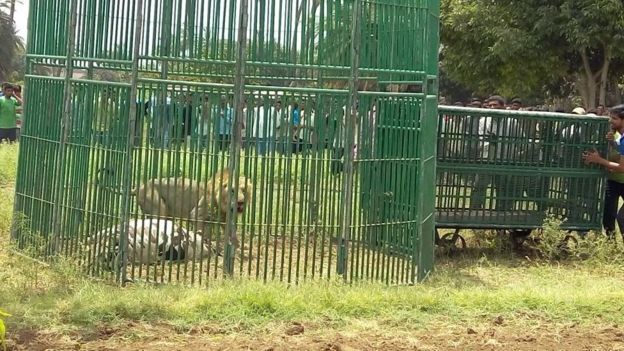
Officials in India have “arrested” 18 lions as they try to find a man eater suspected of killing three people.

Forest officials in Gujarat state will test the lions’ prints and excrement in an attempt to identify the killer.

The “guilty lion” will be kept in a zoo for life while the others will be released back into the Gir sanctuary, the officials told BBC Hindi.

Six attacks on humans have been reported recently near the sanctuary, the only habitat of the Asiatic lion.

Gujarat’s top forest official, JA Khan, said that the lions had been “arrested” over the past two months and were now being held in separate cages while tests were carried out.

“We think we have pinpointed the guilty lion, but we are still awaiting the results of nine more animals,” he said.
asia
Innocent lions will be released back into the Gir forest

Wildlife expert Ruchi Dave told the BBC that the “tests” involved studying the pug marks and faecal matter of the lions.

“The officials are also studying the animals’ behaviour. Man eating lions usually get aggressive at the sight of a human being,” she said.

Another wildlife expert Revtubha Raizada said the man-eating lion would be caged for the rest of its life, as it was too unsafe to release it back into the wild.

Some experts feel that the thriving lion population in Gir forest is to blame for the “unusual” behaviour by the lions.

Govind Patel, the former chief wildlife warden of Gujarat, told the Indian Express newspaper that Gir could accommodate only 270 lions, forcing some prides to settle outside the boundaries of the sanctuary.

India’s Supreme Court has ruled that Gujarat needed to relocate some of its lions to other states to avoid the possibility of disease or other disaster wiping out the entire population.

However the state has expressed reluctance and has not yet complied with the order.
 

asia1

Six cases of lions attacking humans have been recently reported near the Gir forest

The Asiatic lion (Panthera leo persica), also known as the Indian lion or Persian lion, is a lion subspecies that exists as a single population in India’s Gujarat state. It is listed as Endangered by IUCN due to its small population size. Since 2010, the lion population in the Gir Forest National Park has steadily increased.

In May 2015, the 14th Asiatic Lion Census was conducted over an area of about 20,000 km2 (7,700 sq mi); the lion population was estimated at 523 individuals, comprising 109 adult males, 201 adult females and 213 cubs.

asiatic4


asiatic5

Asiatic lion at Gir Forest National Park.

Ohio Man Gives Up Solid Food, Goes on 46 Day Beer Diet for Lent

Inspired by 17th century German monks who allegedly survived on a rich beer called doppelbock during Lent, an Ohio man has embarked on a 46-day beer diet, dropping all solid food until Easter Sunday.

Many Christians choose not to consume beer during Lent, as a way of abstaining for something they find pleasurable, but Dell Hall, the director of sales at Fifty West Brewing Company in Cincinnati, Ohio, is doing the exact opposite. On March 6th, he embarked on a 46-day beer diet, dropping all solid food and getting his nutrients only from beer and vitamin supplements. Although he admits the first few days were rough, Hall claims he now feels amazing and is 25 pounds lighter than when he started.

Dell Hall

beer

“Day two and three were pretty rough. I wanted to bash some Taco Bell after a few beers because that’s what we do,” Dell Hall told the Cincinnati Enquirer. “The last couple days I haven’t been hungry at all. I hope that’s going to be a good sign and I maintain this level of clarity.”

Although the monks that inspired his diet consumed a hearty type of beer they called “liquid bread” due to the high levels of carbohydrates it contained, Hall has opted for variety, drinking whatever beer he craves at that moment. Dell has his first beer at around noon, when the hunger really kicks in, and then a few more after work. He also drinks black coffee, unsweetened tea and sparkling water to keep himself from getting sick of beer.

Even though he claims the beer diet has nothing to do with wanting to shed extra pounds, Dell Hall has been monitoring his weight ever since he started, and by April 7th – a month into his Lent challenge – he had already lost 34 pounds. He’s already dreaming about having a steak After Easter Sunday, but plans to take it easy and allow his stomach to re-adjust to solid food.

“Your digestive system sort of shuts down,” he told Insider. “So you have to slowly reintroduce food.”

beer1


Carhenge

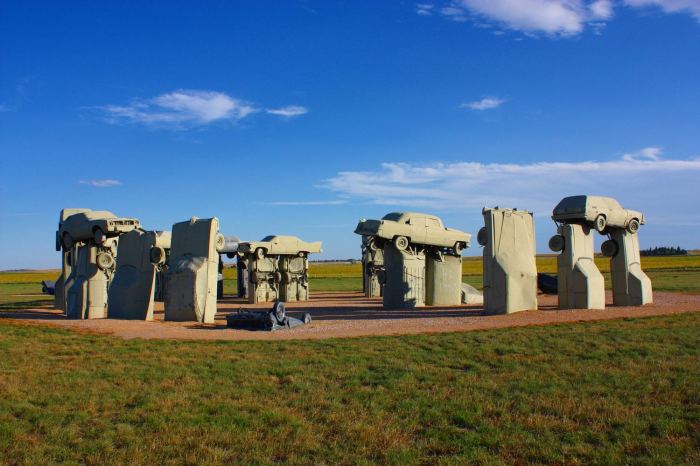
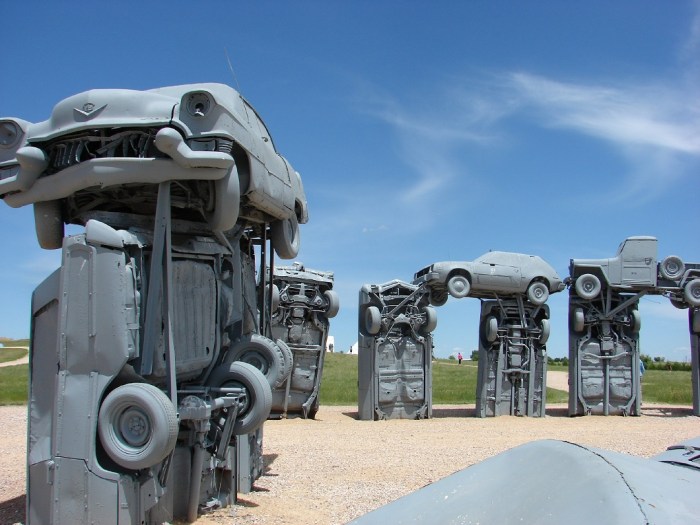
Carhenge is a replica of England’s Stonehenge located near the city of Alliance, Nebraska, in the High Plains region of the United States. Instead of being built with large standing stones, as is the case with the original Stonehenge, Carhenge is formed from vintage American automobiles, all covered with gray spray paint. Built by Jim Reinders, it was dedicated at the June 1987 summer solstice. In 2006, a visitor center was constructed to serve the site.

car4

car

Carhenge consists of 38 automobiles arranged in a circle measuring about 96 feet (29 m) in diameter. Some are held upright in pits 5 feet (1.5 m) deep, trunk end down, and arches have been formed by welding automobiles atop the supporting models. The heelstone is a 1962 Cadillac. Three cars were buried at Carhenge with a sign stating: “Here lie three bones of foreign cars. They served our purpose while Detroit slept. Now Detroit is awake and America’s great!”

Carhenge replicates Stonehenge’s current dilapidated state, rather than the original stone circle erected between 2500 BC and 2000 BC.

In addition to the Stonehenge replica, the Carhenge site includes several other artworks created from autos covered with various colors of spray paint.

car5

Carhenge was conceived in 1987 by Jim Reinders as a memorial to his father. While in England, he studied the structure of Stonehenge, which helped him to copy the structure’s shape, proportions, and size. Other automobile sculptures were subsequently added to the location of Carhenge, which is now known as the Car Art Reserve.

Reinders donated the 10-acre site to the Friends of Carhenge. In 2011 the Friends of Carhenge listed the attraction for sale for $300,000. In 2013 the Friends of Carhenge donated the site to the Citizens of Alliance.

Carhenge has appeared in film, popular music, television programs and commercials. It is the subject of the 2005 documentary Carhenge: Genius or Junk?, and features in the 2007 travel book 1,000 Places to See in the USA and Canada Before You Die.

The path of totality of the solar eclipse of August 21, 2017 included Carhenge. An estimated 4,000 people, including Nebraska governor Pete Ricketts, viewed the eclipse from the site. Reinders stated that at the time of Carhenge’s creation, he had not known about the eclipse that would occur 30 years later.

car2

car3