A Saudi Sheikh, Salah al-Luhaydan, has said that women in Saudi Arabia shouldn’t drive for health reasons. He says doing so could have negative health effects on their ovaries.
As Reuters recently reported, Saudi women activists have begun a new campaign to try and lift the regressive ban on female drivers in the Saudi kingdom. A petition this group posted on its website outlines the groups aims, that being, “If the state refuses to lift this ban on women, we call on it to offer citizens its justifications for the ban. The state is not a father or a mother and the citizens are not children.”
Al Arabiya in turn today had a report which tells us that Sheikh Salah al-Luhaydan has given some bizarre medical explanation for why Saudi women shouldn’t drive.
He claims that driving “could have a reverse physiological impact. Physiological science and functional medicine studied this side [and discovered] that it automatically affects ovaries and rolls up the pelvis. This why we find for women who continuously drive cars their children are born with clinical disorders of varying degrees.”
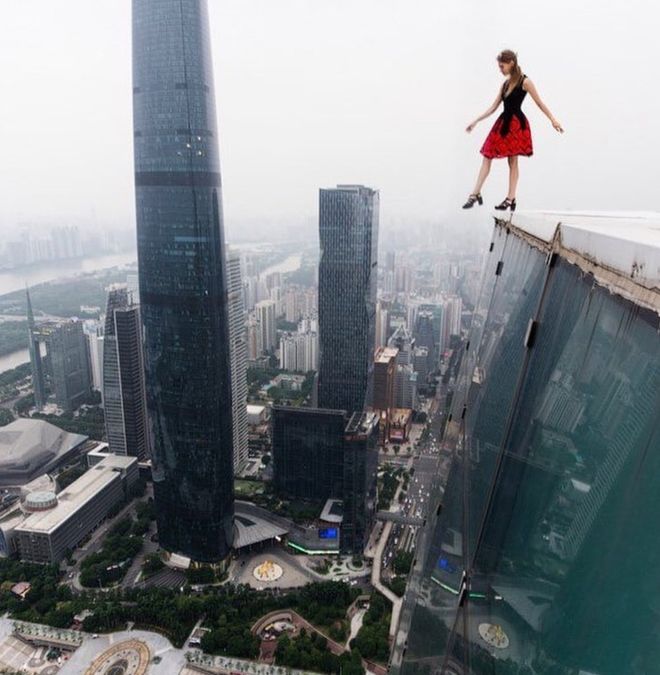
Surely this cleric won’t allow women to do what’s in the picture below. That could really bugger them up.
He went on to say that women should accordingly put “the mind before the heart and emotion and look at this issue with a realistic eye. The result of this is bad and they should wait and consider the negativity.”
“Little by little, and you end up with a hooligan. Tolerance of drinking is dangerous. There is but a step from drinking to crime.”
From the 1960s through the 1980s, artists throughout the Soviet Union designed propaganda posters to warn the public of the dangers of excessive alcohol consumption.
With striking, colorful graphics and stark metaphors, the posters cast alcoholism as a snake choking the life from vivacious young men, a bottle as a prison, and more.
Drinkers grow slothful and lazy, abandon their families, endanger their coworkers, or become murderous brutes.
1988
“Underpass — to the ‘next world.'”
IMAGE: S. SMIRNOV/ALCOHOL BY FUEL PUBLISHING
1985
“We will overcome!” (Text on snake: “Alcoholism.”)
IMAGE: E. BOR/ALCOHOL BY FUEL PUBLISHING
1972
“Not among trees or grasses, the serpent has warmed up among us. Don’t suck on him, mammals, or you’ll turn into a reptile yourself.”
1977
“Don’t drink your life away.”
IMAGE: I.M. MAISTROVSKY/ALCOHOL BY FUEL PUBLISHING
A number of young Russians are making names for themselves by posting videos of life-threatening stunts online. What drives these extreme selfie daredevils?
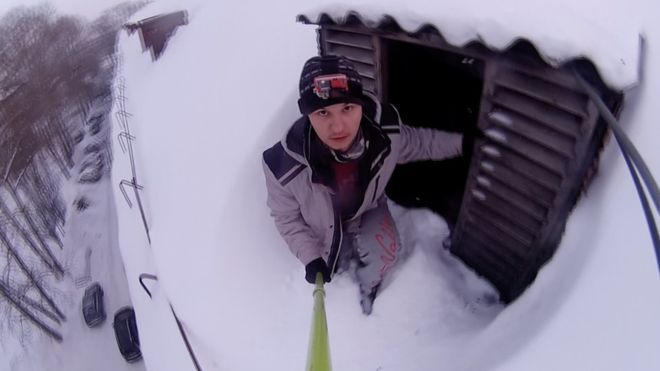
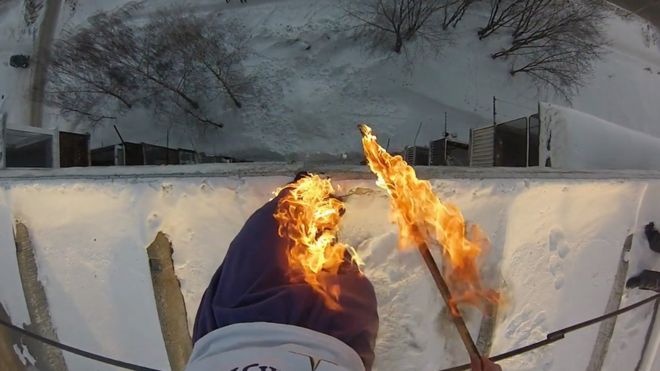
He’s got a camera strapped to his head and he teeters on the edge of the roof in a nine-storey apartment block in Siberia.
“Are you filming?” he asks, as a friend hands him a flaming torch. Orange flames engulf his legs and suddenly he jumps, somersaulting in the air like a stricken warplane before landing with a thud into a deep pile of snow.
Remarkably, he’s unhurt – if a little winded. Police tell a gaggle of onlookers to stop filming, but within hours, footage of this potentially deadly jump goes viral – various videos of the stunt filmed from different angles were watched millions of times on YouTube.
Many people were incredulous, even angry. “Is this the stupidest stunt ever?” screamed one headline.
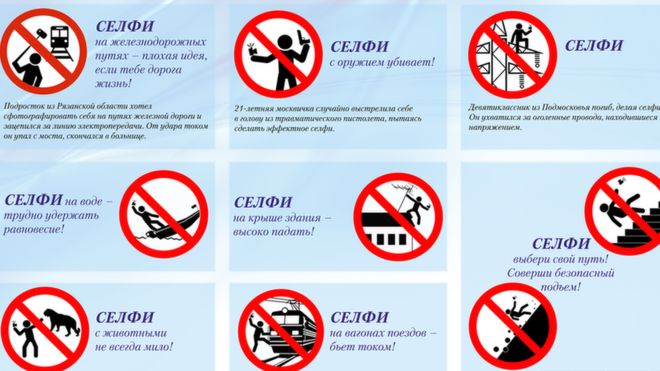
The young man’s appetite for risk is unusual but not unique. In fact a growing number of deaths and injuries, suffered by Russians who among other things have fallen from buildings and moving trains whilst taking pictures, have prompted the Russian Interior Ministry to launch a “safe selfie” campaign.
The Russian Ministry’s safe selfie campaign urges people to, for instance, avoid train tracks and roofs, and be cautious around staircases, wild animals and guns
Despite the deadly peril, some of the risk takers are attracted by fame and the possibility of becoming social media stars. In many places in Russia, tall buildings are accessible and fines for trespassing are low, if they exist at all. And one enthusiastic participant says extreme stunts can alleviate the boredom and pent up energy of many Russian men.
But what really drives some of the most notable Russian selfie daredevils?
The man jumping off of that Siberian apartment block, 23-year-old Alexander Chernikov, lives on the outskirts of Barnaul – 4,000km east of Moscow.
Even though it’s -18C and thick ice cakes the pavements, he’s dressed in a shiny burgundy bomber jacket, jeans and cowboy boots. The place where he made his infamous jump is a dreary, Soviet-era building with rusty balconies covered in satellite dishes.
“Up there you feel that you’re standing on the line between life and death – your life is hanging by a thread – that if something goes wrong you may die,” he says.
Alexander claims he is not afraid of death. “What’s the point of being scared? It’s inescapable. It comes to us all,” he says.
But would he go to such lengths if there were no cameras? “Probably not,” he admits. “I would find a different way to get on in life.”
Alexander sometimes gets temporary work as a labourer on building sites – there are also local jobs in factories or unloading cargo trains. But he dreams of a career as a stunt man or even a film star. He’s desperate to get out of the sleepy village where he still lives with his parents.
Soon after Alexander’s notorious jump, which has been viewed more than 10 million times online, he was invited onto a TV show in Moscow where a film director promised him a screen test. But on the show, he and his family were treated like country bumpkins.
Angela Nikolau
The daughter of a trapeze artist from Moscow’s best known circus, Angela has more than 400,000 followers on her Instagram account. Travel firms, fashion brands and camera companies sponsor her dangerous adventures in Russia and beyond.
Like Alexander Chernikov, the 24-year-old art student was invited onto a TV show to talk about her stunts. But unlike him, she was applauded and received a bouquet of pink roses from the presenter.
In one of her most extreme videos, Angela and her boyfriend climb what is said to be the world’s tallest crane in Tianjin, China.
She also climbs high buildings to perform eye-popping feats like a yoga backbend on a narrow ledge, or a ballerina’s arabesque on a turret. Sometimes she is pictured smiling casually under a selfie-stick with the ground hundreds of metres below her.
Angela says her grandmother was so upset when she first saw her photos, that she pretended they were Photoshopped.
For her, the presence of the camera is a key part of what she calls her art – although few artistic pursuits are as clearly dangerous.
“Sometimes I just climb up a building without a camera just to see a colourful sunrise or sunset,” she says. “But if you are asking why I film myself, imagine an artist painting all alone in his studio – painting, painting, painting for five years until he is practically drowning in his own work. And he thinks who am I doing this for – is there any point in my work? We need an audience – that is just part of the human condition.”





 The MarkoZen Blog