60 Minutes
Questions continue to surround the role Russia may have played in President Trump’s election last fall, and about the president’s professed admiration for Vladimir Putin’s skills as a strong leader.
What the president doesn’t talk about is the unfortunate fate that stalks some of Putin’s most prominent critics. They have been victims of unsolved shootings, suspicious suicides and poisonings. Tonight, the story of one of them.

Vladimir Kara-Murza was an opposition activist, on the front lines, protesting Putin’s policies, organizing demonstrations and town hall meetings. He knew he was on a dangerous mission. When we met him last year, he told us that one day in May 2015, he learned just how dangerous.
Vladimir Kara-Murza: I was in a work meeting with my colleagues in Moscow, when I suddenly started to feel really sick. And I went, within about 20 minutes, from feeling completely normal to feeling like a very sick man. Then I don’t remember anything for the next month.
Lesley Stahl: You were out for a month?
Vladimir Kara-Murza: I was in a coma for a week, and I don’t remember anything for a month and had basically a cascade of all my major life organs failing, one after another; just switching off you know the lungs, the heart, the kidneys
He was shuttled from hospital to hospital in Moscow for two days as doctors frantically tried to figure out what was wrong with him.
Vladimir Kara-Murza: I was at one point connected, I think to eight different artificial life support machines and doctors told my wife that there’s only gonna be about a five percent chance that I’ll survive.
But he beat the odds. When we spoke with him last year, he’d been recovering for a year, but he was still walking with a limp from nerve damage.
Lesley Stahl: So what happened?
Vladimir Kara-Murza: Well, it was some kind of a very strong toxin. We don’t know what it was because, you know, with these things, as people who know more about this than I do explained to me, you basically have to know exactly what you’re testing for in order to find it.
Lesley Stahl: So they never found the exact compound?
Vladimir Kara-Murza: They never did.
It wasn’t until the fourth day, and after he had been on a dialysis machine, that blood was drawn and sent to a toxicology lab in France. It found heavy metals in his blood, but no specific toxin. Still Kara-Murza maintains that he was poisoned.
Vladimir Kara-Murza: I have absolutely no doubt that this was a deliberate poisoning, that it was intended to kill because, as I mentioned already, the doctors told my wife that it’s about a five percent chance of survival. And when it’s that kind of percentage, it’s not to scare. It’s to kill.
Lesley Stahl: Can you be sure that what happened to you was directed by Mr. Putin?
Vladimir Kara-Murza: Well of that we have no idea. I don’t know the precise circumstances, I don’t know the who or the how, but I do know the why.
In recent years quite a few of Putin’s enemies have perished by swallowing things they shouldn’t have. In 2006, Russian-spy-turned-Kremlin-critic Alexander Litvinenko drank tea laced with polonium-210. Two years earlier the Ukrainian politician Viktor Yushchenko had somehow ingested dioxin. He survived but was disfigured.
But what would the motive be in the case of the critic Vladimir Kara-Murza? Cambridge educated, he was for years a Washington-based reporter for a Russian TV station. So he was well-connected and had perfect English, which he used to incessantly criticize the regime on the international stage.

Putin when he was a KGB agent
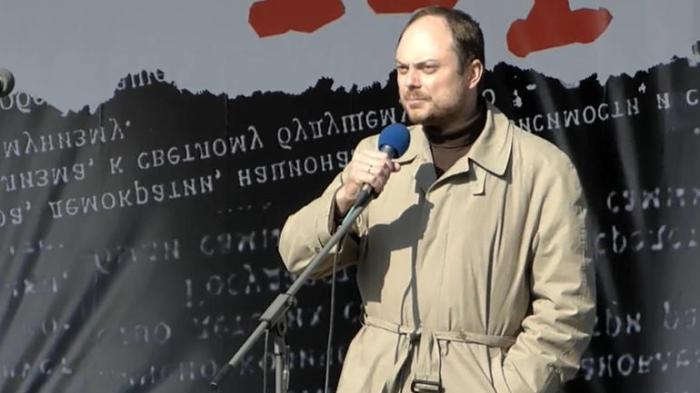
Vladimir Kara-Murza: A government that is based on genuine support does not need to jail its opponents.
As if his outspokenness wasn’t enough to anger the Kremlin, he made matters worse for himself when he joined forces with this man.
Bill Browder: It’s death if you cross the Putin regime.
Bill Browder was for years the largest foreign investor in Russia and Putin’s champion. But he turned into a dogged adversary when his Russian tax attorney Sergei
Magnitsky blew the whistle on alleged large-scale theft by government officials.
Bill Browder: We discovered massive corruption of the Putin regime. Sergei exposed it, testified against officials involved. He was subsequently arrested, put in pre-trial detention, tortured for 358 days and killed at the age of 37.
Browder was so outraged, he joined with Vladimir Kara-Murza to lobby the U.S. Congress for a law targeting those responsible for that death and other human rights violations. They succeeded: the Magnitsky Act passed in 2012. It is the first law that sanctions individual Russians, 44 so far.
Bill Browder: The Magnitsky Act is designed to sanction, to freeze the assets and to ban the visas for people who commit these types of crimes in Russia.
Lesley Stahl: So they can’t get their money which may be stashed in the United States.
Bill Browder: And so Vladimir Putin is extremely angry that the Magnitsky was going to be passed. He was even angrier when it got passed. And he was angrier when people started getting added, names started getting added to the Magnitsky list.
One reason Vladimir Kara-Murza is convinced he was targeted is because six people connected to the Magnitsky case, as he was, have ended up dead. One of them was Boris Nemtsov, a leader of Russia’s opposition and Kara-Murza’s partner in lobbying for the Magnitsky Act.
Vladimir Kara-Murza: On the 27th of February 2015, he was killed by five bullets in the back as he was walking home, as he always did, out in the open, without bodyguards—
This was an assassination. In some of the deaths, proving there was foul play has been a challenge. Take the case of this Russian banker who came forward with incriminating documents related to the Magnitsky case.
Bill Browder: Alexander Perepilichny was a whistleblower. At the age of 44, he went jogging outside his home in Surrey, outside of London and dropped dead. The police deemed it an unsuspicious, natural death.
Lesley Stahl: Well, they did look for poison. They just couldn’t find any.
Bill Browder: They did a very first round toxicology screen. They didn’t find anything on the first run through.
Detecting poison can be extremely difficult. And there’s a reason: this Cold War CIA memo reveals that the Soviets ran a “laboratory for poisons […] in a large and super secret installation […] known as the chamber” to test undetectable compounds.
In the case of the banker in London, the coroner wasn’t willing to give up. He ordered more tests — and three years later it was revealed in court that an exotic toxin was found with the help of an authority on flowers!
Bill Browder: A small sample of his stomach contents was sent to a botanical garden outside of London. And one of the scientists found a compound called Gelsemium Elegans which is a Chinese herb. They call it the heartbreak grass. And it causes a person to die unexpectedly without explanation.
Still, there’s no direct evidence of a Kremlin connection. But the list of those who’ve come to die unexpectedly after running afoul of Mr. Putin is long. Political opponents and human rights lawyers have been shot; rogue spies hunted down; overly inquisitive reporters have perished in mysterious plane crashes or by car bombs, by poison or gun-fire. Journalist reporter Anna Politkovskaya was poisoned and shot.
Then there are enemies who kill themselves, one by hanging, one by stabbing himself to death with two knives, and one by tying himself to a chair and jumping into a swimming pool. Some of Putin’s opponents are in prison, others forced out of the country like Mikhail Khodorkovsky, probably Putin’s most famous living critic.
Lesley Stahl: Are you afraid for your own life
Mikhail Khodorkovsky: For a period of over 10 years, Vladimir Putin had ample opportunity to put an end to my life very easily, just by snapping his fingers. Today, it’s a little more difficult.
Khodorkovsky was once the richest man in Russia — until he took to opposing Putin. He was put on trial, his oil company confiscated, and then thrown in prison for 10 years. Home is now London where he funds a Russian pro-democracy movement — and this is where the plot thickens because one of his senior organizers on the ground in Russia is none other than Vladimir Kara-Murza.
Lesley Stahl: There are people who say that what’s happened to Kara-Murza is a message to you, a message to you to back off.’
Mikhail Khodorkovsky: You know, for 10 years, I was receiving lots of messages from our authorities of various sorts. And, some of these messages were rather unpleasant, concerning my physical well-being. But the authorities saw I ignored these messages. I would like to believe that they have not forgotten that.
In 2015, once Vladimir Kara-Murza was stabilized, he was flown to Washington DC to continue treatment near his wife, Evgenia, and their three kids who live in the U.S. for their safety. But as soon as Kara-Murza got better, he was itching to go back to Russia.
Lesley Stahl: You were very, very sick and went back. Now, are you finished? Are you saying, “I’m not going back any”—
Vladimir Kara-Murza: Oh God no, of course not.
Lesley Stahl: You’re going to go back?
Vladimir Kara-Murza: Of course, I will absolutely go back to Russia. I am Russian, this is my country, and I believe in what I do, in what my colleagues do. There are many of us.
Lesley Stahl: But not many have almost died twice.
Vladimir Kara-Murza: Many, unfortunately, have died. I’m the fortunate one. I’m still here. I’m still talking to you. Many of my colleagues cannot do that.






 The MarkoZen Blog