Alaskan infant’s DNA tells story of ‘first Americans’

BBC

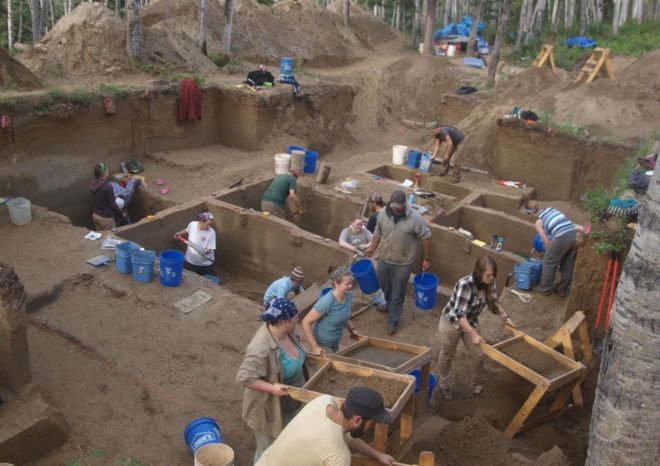
Excavations at the Upward Sun River archaeological site in AlaskaImage copyrightBEN POTTER
Image captionExcavations at the Upward Sun River archaeological site in Alaska

The 11,500-year-old remains of an infant girl from Alaska have shed new light on the peopling of the Americas.

Genetic analysis of the child, allied to other data, indicates she belonged to a previously unknown, ancient group.

Scientists say what they have learnt from her DNA strongly supports the idea that a single wave of migrants moved into the continent from Siberia just over 20,000 years ago.

Lower sea-levels back then would have created dry land in the Bering Strait.

It would have submerged again only as northern ice sheets melted and retreated.

The pioneering settlers became the ancestors of all today’s Native Americans, say Prof Eske Willerslev and colleagues. His team has published its genetics assessment in the journal Nature.
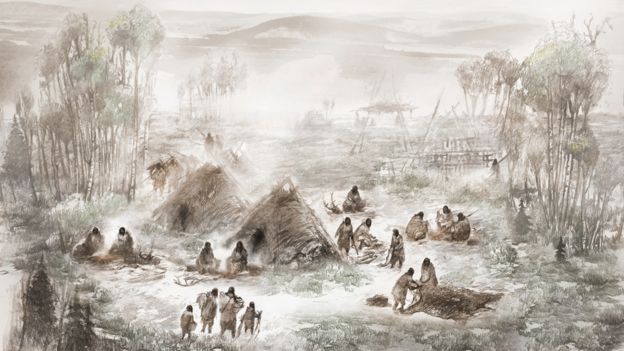
IllustrationImage copyrightERIC.S.CARLSON ILLUSTRATION
Image captionAn illustration of how the Ancient Beringians at Upward Sun River might have lived

The skeleton of the six-week-old infant was unearthed at the Upward Sun River archaeological site in 2013.

The local indigenous community have named her “Xach’itee’aanenh t’eede gay”, or “sunrise girl-child”.

The science team refers to her simply as USR1.

“These are the oldest human remains ever found in Alaska, but what is particularly interesting here is that this individual belonged to a population of humans that we have never seen before,” explained Prof Willerslev, who is affiliated to the universities of Copenhagen and Cambridge.

“It’s a population that is most closely related to modern Native Americans but is still distantly related to them. So, you can say she comes from the earliest, or most original, Native American group – the first Native American group that diversified.

“And that means she can tell us about the ancestors of all Native Americans,” he told BBC News.

Scientists study the history of ancient populations by analysing the mutations, or small errors, that accumulate in DNA down through the generations.

These patterns, when combined with demographic modelling, make it possible to draw connections between different groups of people over time.
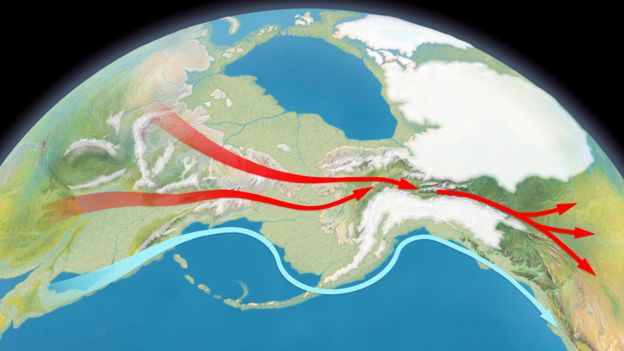
BeringiaImage copyrightSPL
Image captionDuring the height of the last ice age, lower sea-levels would have opened a land bridge

The new study points to the existence of an ancestral population that started to become distinct genetically from East Asians around 34,000 years ago, and which had completed the separation by roughly 25,000 years ago – indicative of the Bering land bridge connecting Siberia and Alaska having been crossed, or at the very least of the ancestral population having become geographically isolated in north-east Siberia.

The analysis further suggests that a group of Ancient Beringians, represented by USR1, then subsequently began to diverge from the pioneer migrants. This genetic separation occurs at about 20,000 years ago and is the result of these people staying put in Alaska for several thousand years.

Others in the pioneer wave, however, moved south to occupy territories beyond the ice.

This onward-moving branch ultimately became the two genetic groups that are recognised as the ancestors of today’s indigenous populations.

Prof Willerslev said: “Before this girl’s genome, we only had more recent Native Americans and ancient Siberians to try to work out the relationships and times of divergence. But now we have an individual from a population between the two; and that really opens the door to address these fundamental questions.”

More definitive answers would only come with the discovery of further remains in north-east Siberia and Alaska, the scientist added.

That is complicated in the case of the north-west American state because its acidic soils are unfavourable to the preservation of skeletons and in particular their DNA material.

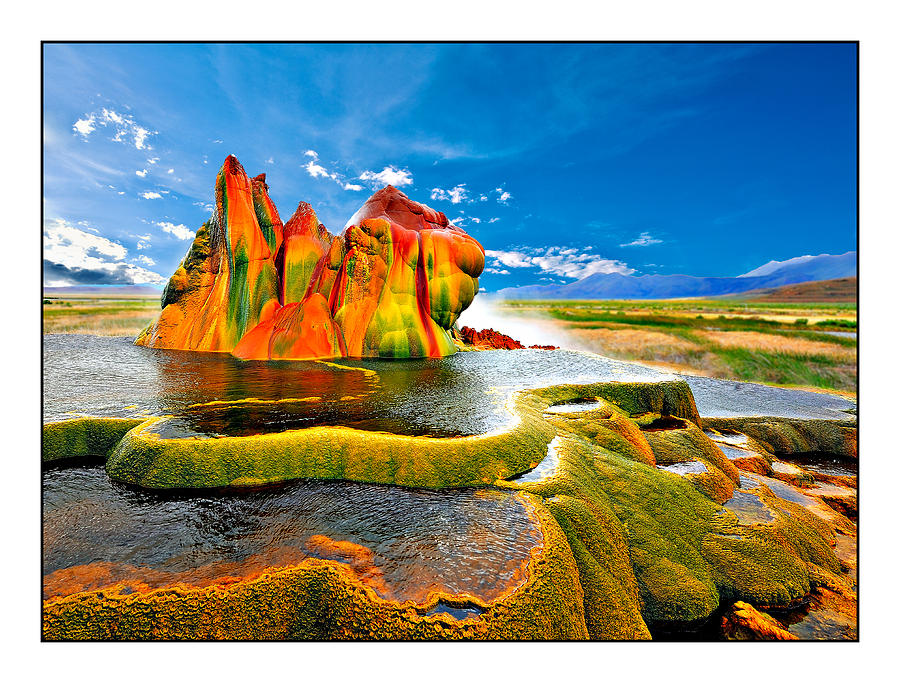
Stunningly beautiful little known Geyser in Nevada

Fly Geyser, also known as Fly Ranch Geyser or the Green Geyser is a man-made small geothermal geyser located in Washoe County, Nevada approximately 20 miles (32 km) north of Gerlach. Fly Geyser is located near the edge of Fly Reservoir and is only about 5 feet (1.5 m) high, by 12 feet (3.7 m) wide, counting the mound on which it sits.

fly

Fly Geyser is located on the private Fly Ranch in Hualapai Flat, about 0.3 miles (0.48 km) from State Route 34. The ranch is currently owned by Todd Jaksick. There is a high fence and a locked gate topped with spikes to exclude trespassers. The only access is a dirt road, but it is large enough to be seen from the road.


fly6

Looks like something from a science fiction movie set

Fly Geyser is not an entirely natural phenomenon; it was accidentally created by well drilling in 1964 exploring for sources of geothermal energy. The well may not have been capped correctly, or left unplugged, but either way dissolved minerals started rising and accumulating, creating the travertine mound on which the geyser sits and continues growing. Water is constantly released, reaching 5 feet (1.5 m) in the air. The geyser contains several terraces discharging water into 30 to 40 pools over an area of 74 acres (30 ha). The geyser is made up of a series of different minerals, but its brilliant colors are due to thermophilic algae.

The geyser in 1975

Fly_Geyser_1975_kelli_fly_a


fly2


fly4


Location

fly8


fly9


fly5


fly7


Fly-Geyser-001

fly-geyser-1-diana-thai


The “Gates of Hell”

door

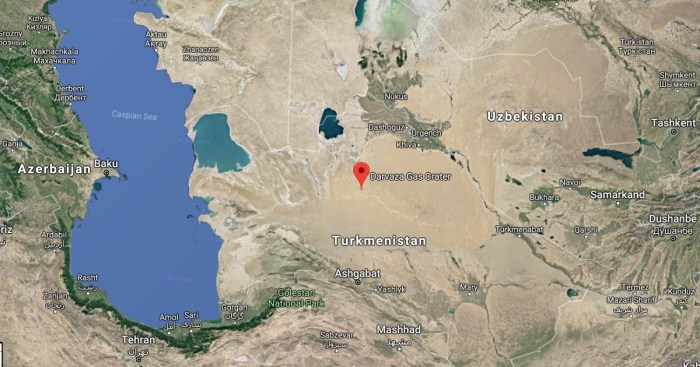
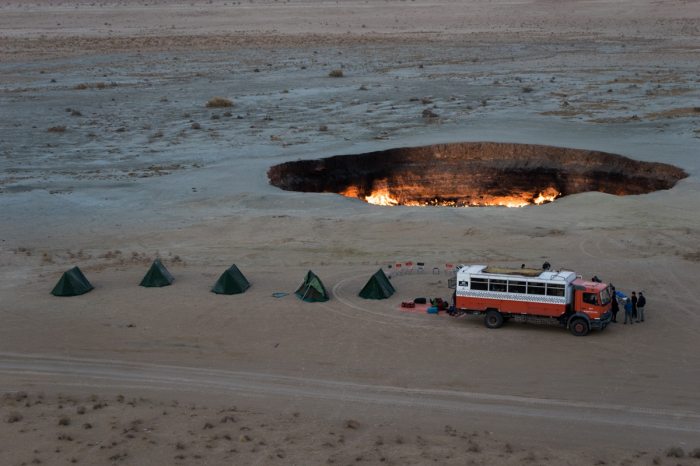
The Darvaza gas crater (Turkmen: Jähennem derwezesi, Җәхеннем дервезеси), known locally as the “Door to Hell” or ”Gates of Hell”, is a natural gas field in Derweze, Turkmenistan, that collapsed into an underground cavern, becoming a natural gas crater. Geologists set it on fire to prevent the spread of methane gas, and it has been burning continuously since 1971. The diameter of the crater is 69 metres (226 ft), and its depth is 30 metres (98 ft).
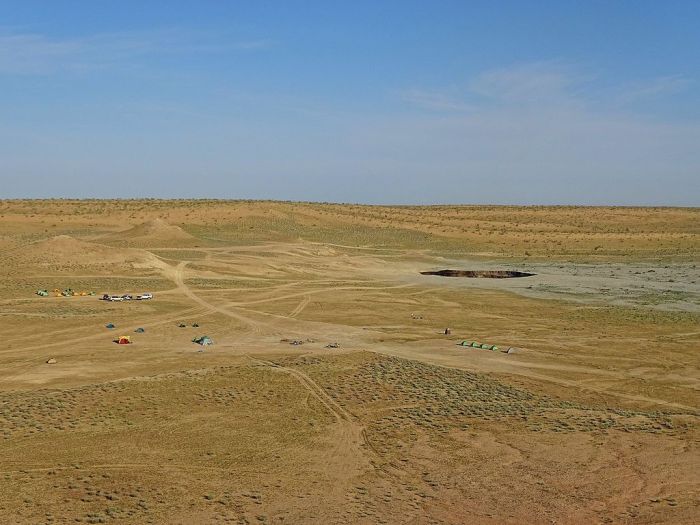
The crater is a popular tourist attraction. Since 2009, 50,000 tourists have visited the site. The gas crater has a total area of 5,350 m2. The surrounding area is also popular for wild desert camping.

The gas crater is located near the village of Derweze, also known as Darzava. It is in the middle of the Karakum Desert, about 260 kilometres (160 mi) north of Ashgabat, the capital of Turkmenistan. The gas reserve found here is one of the largest in the world. The name “Door to Hell” was given to the field by the locals, referring to the fire, boiling mud, and orange flames in the large crater, which has a diameter of 70 metres (230 ft). The hot spots range over an area with a width of 60 metres (200 ft) and to a depth of about 20 metres (66 ft).

door3

According to Turkmen geologist Anatoly Bushmakin, the site was identified by Soviet engineers in 1971. It was originally thought to be a substantial oil field site. The engineers set up a drilling rig and operations to assess the quantity of oil available at the site. Soon after the preliminary survey found a natural gas pocket, the ground beneath the drilling rig and camp collapsed into a wide crater and was buried.
Expecting dangerous releases of poisonous gases from the cavern into nearby towns, the engineers thought it best to burn the gas off. It was estimated that the gas would burn out within a few weeks, but it has instead continued to burn for more than four decades.

door2

In April 2010, the president of Turkmenistan, Gurbanguly Berdimuhamedow, visited the site and ordered that the hole should be closed. In 2013, he declared the part of the Karakum Desert with the crater a nature reserve.

The crater was featured in a Die Trying episode titled “Crater of Fire”. Explorer George Kourounis became the first person to ever set foot at the bottom, gathering samples of extremophile microorganisms. The episode was broadcast on the National Geographic Channel on July 16, 2014.

door1

Camping on the edge of the “Gates of Hell”

door4

Interesting Photos from around the World


macdonald's in norway

McDonald’s in Norway


rednew

Great reflection


cool zippo bradford penn

Street lights at the Zippo factory in Bradford, Pennsylvania


cobra

Just a Cape Cobra checking out the beach near Cape Town, South Africa.

The warm climes are nice to live in, but you do have to deal with this kind of crazy nonsense.


ireland

Powerful Atlantic storm off the coast of Ireland


 7.8 earthquake in Ecuador


7.8 ecuador


Japan earthquake 2016

japan quake


rednew3 japan quake


rednew1

Buddies


rednew2 florence

Photo shot using tilt frame making Florence, Italy look like a miniature.


tree

4 legged tree


whale

Surfing whales


rednew2 new zealand

Maori rock sculpture in New Zealand

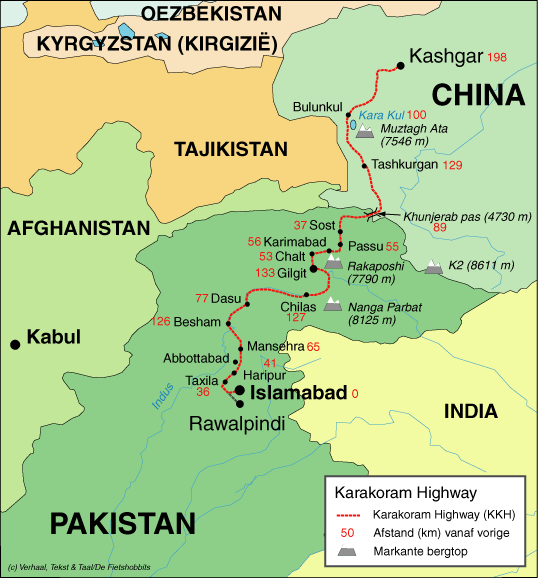
The Karakoram Highway

hwy3

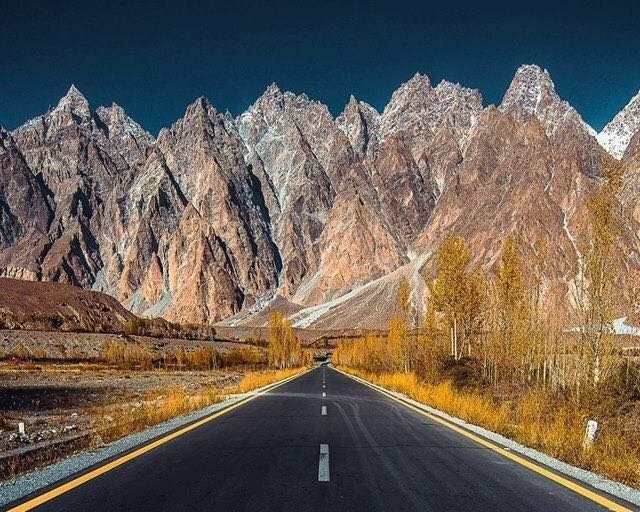
The N-35 or National Highway 35, known more popularly as the Karakoram Highway and China-Pakistan Friendship Highway, is a 1300 km national highway in Pakistan which extends from Hasan Abdal in Punjab province of Pakistan to the Khunjerab Pass in Gilgit-Baltistan, where it crosses into China and becomes China National Highway 314. The highway connects the Pakistani provinces of Punjab, Khyber Pakhtunkhwa and Gilgit-Baltistan with China’s Xinjiang Uyghur Autonomous Region. The highway is a popular tourist attraction, and is one of the highest paved roads in the world, passing through the Karakoram mountain range, at 36°51′00″N 75°25′40″E an elevation of 4,714 metres (15,466 ft). Due to its high elevation and the difficult conditions in which it was constructed, it is often referred to as the Eighth Wonder of the World. The highway is also a part of the Asian Highway AH4.

hwy4

hwy1

hwy

hwy5

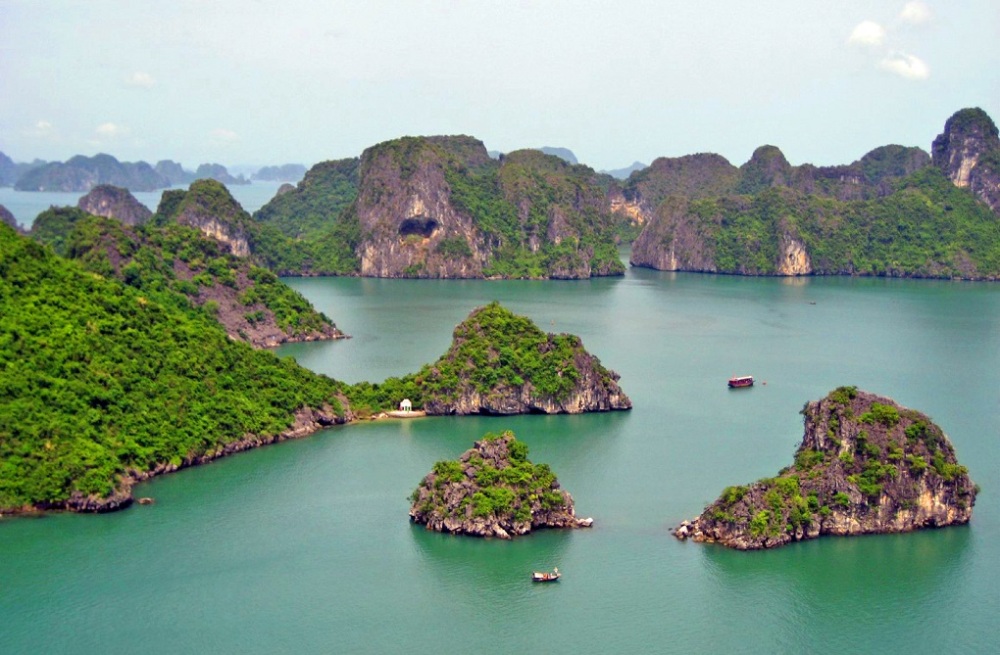
Magical Ha Long Bay, Vietnam

Hạ Long Bay is a UNESCO World Heritage Site and popular travel destination in Quảng Ninh Province, Vietnam. Administratively, the bay belongs to Hạ Long City, Cẩm Phả town, and is a part of Vân Đồn District. The bay features thousands of limestone karsts and isles in various shapes and sizes. Hạ Long Bay is a center of a larger zone which includes Bái Tử Long Bay to the northeast, and Cát Bà Island to the southwest. These larger zones share a similar geological, geographical, geomorphological, climate and cultural characters.

Hạ Long Bay has an area of around 1,553 km2, including 1,960–2,000 islets, most of which are limestone. The core of the bay has an area of 334 km2 with a high density of 775 islets. The limestone in this bay has gone through 500 million years of formation in different conditions and environments. The evolution of the karst in this bay has taken 20 million years under the impact of the tropical wet climate. The geo-diversity of the environment in the area has created biodiversity, including a tropical evergreen biosystem, oceanic and sea shore biosystem. Hạ Long Bay is home to 14 endemic floral species and 60 endemic faunal species.


halong


halong3


ha-long-bay-map


halong1


halong2


wallup.net

halong4

halong7

ha-long-61-e1467707293594

ha-long-bay-16632

Footage for the movie Kong Skull Island was shot at Ha Long Bay.

kongskullislandposter

The Monster Waves at Nazare, Portugal

The pretty seaside town and resort of Nazaré on the west coast of Portugal remains crowded throughout the summer with tourists who flock to its long sandy beaches to relax, swim and surf. But when winter arrives, only the most serious thrill seekers stay. At this time, the beaches are dangerous. Massive waves up to 100 feet high regularly break along the rocky coastline.

Nazare’s monster waves attract big wave surfers from all around, but until very recently, the town and its surfing potential was relatively unknown outside Europe. Nazare hit headlines only in November 2011 when Hawaiian surfer Garrett McNamara surfed a record breaking giant wave measuring 78 feet from trough to crest. In January 2013, McNamara returned to Nazare and broke his own record by successfully riding a wave that was estimated to be 100 feet tall. Later in October the same year, Brazilian big-wave hero Carlos Burle rode a wave that appeared to be even bigger. Nazaré on the Atlantic coast has now become a legendary spot in the world of big wave surfing.

nazare-big-waves-3

How does Nazaré manage to generate waves of colossal size with such regularity? The answer lies in Nazare’s rare undersea geography. Just off the coast of Nazare is the biggest underwater ravine in Europe called Nazaré Canyon. This huge canyon runs 125 miles from the abyssal plain of the Atlantic Ocean to less than half a mile from the coastline, pointing towards the town like an arrow. At its deepest point, the canyon floor is more than 3 miles beneath the surface and it rises rapidly to a canyon “headwall” that rises to between 100 and 150 feet just off the coast of Praia do Norte beach, which is where some of the biggest waves has been known to occur.

The swells originate in the North Atlantic from giant storms in wintertime, and as they arrive near Nazare their energy gets focused and amplified by the narrow canyon just like a magnifying glass focuses the suns energy into a small region. From the headwall to the coastline, the seabed rises abruptly that enables the waves to climb really big all of a sudden. Just before it reaches the coastline, the sea becomes shallow enough for the now amplified swells to break in gigantic waves.

All other big wave spots around the globe — Teahupoo in Tahiti, the Banzai Pipeline in Hawaii, and Mavericks off northern California — have similar undersea geography.

nazare-big-waves-9


nazare-big-waves-10

Surfer Sebastian Steudtner from Germany rides a big wave, while above a crowd watches from the cliffs at Praia do Norte in Nazaré.

nazare-big-waves-4


nazare-big-waves-5


nazare-big-waves-7

A surfer drops in on a large wave at Praia do Norte, in Nazare December 11, 2014. Praia do Norte beach has gained popularity with big wave surfers since Hawaiian surfer Garrett McNamara broke a world record for the largest wave surfed here in 2011.

nazare-big-waves-8


nazare-big-waves-11


nazare-big-waves-12


Sources: NPR / Telegraph

Amazing Park in New Zealand with a Dormant Volcano

Mount Taranaki, also known as Mount Egmont, on the west coast of New Zealand’s North Island, is said to be one of the most symmetrical volcanic cone in the world (another candidate is Mavon Volcano). The volcano was born 120,000 years ago and erupted last in 1775, but it’s not done yet. Volcanologists agree that Taranaki is only lying dormant, waiting, biding its time.

egmont2

The volcano is located at the center of the nearly circular Egmont National Park, whose boundary appears as a dark green circle in satellite and other high-altitude pictures, because of the difference in vegetation between inside and outside the park. The dark shade represents native forest while the light green areas are pasture land that butts right up to the park’s circular boundary. Most of New Zealand’s lowland forests have been cleared for agriculture, leaving only small fragmented pockets of native forest filled with old growth trees. The circle of Egmont National Park is about 19 km across.


egmont1


egmont


egmont3


egmont4


egmont5


egmont6


egmont7


egmont8


egmont9


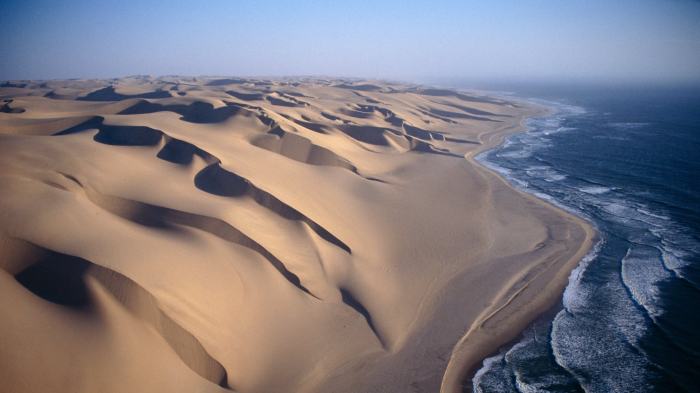
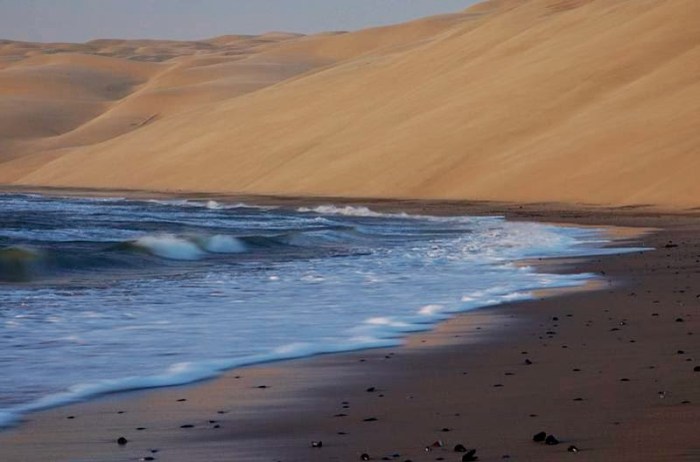
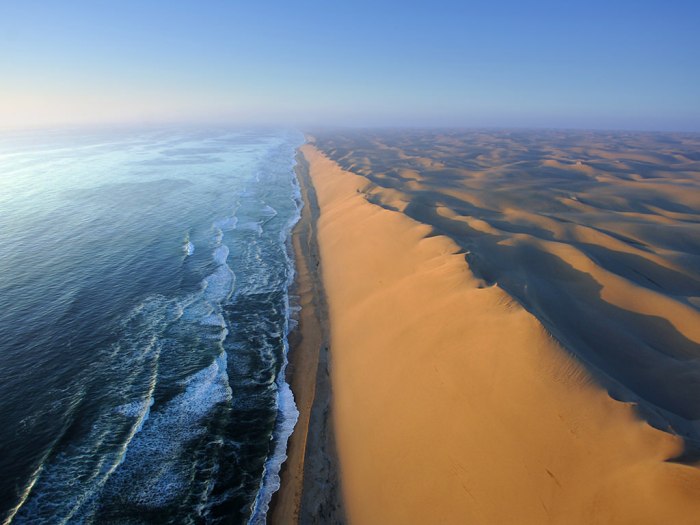
Now This is a Beach

namib.jpg

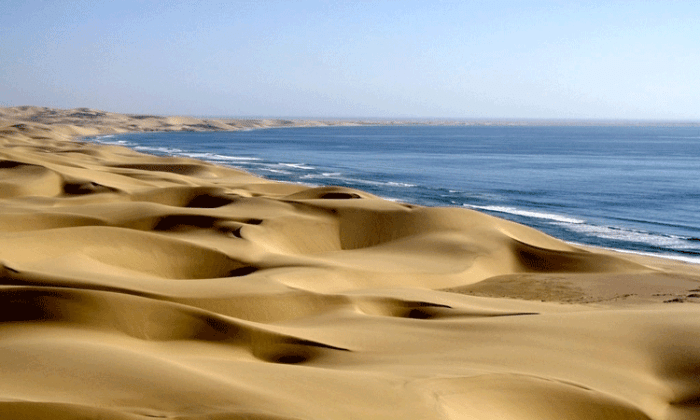
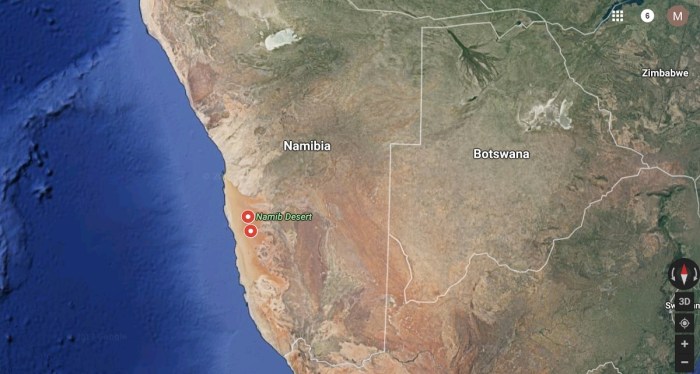
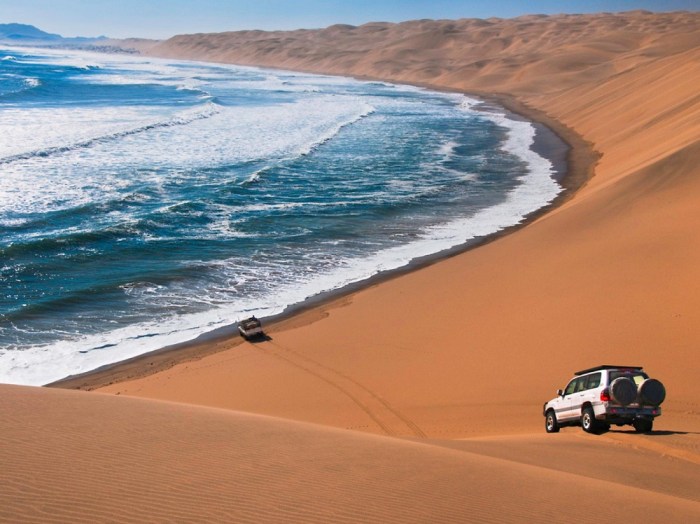
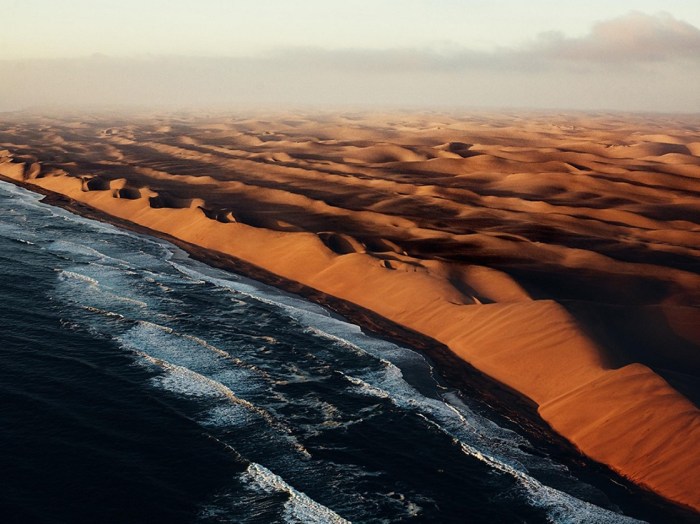
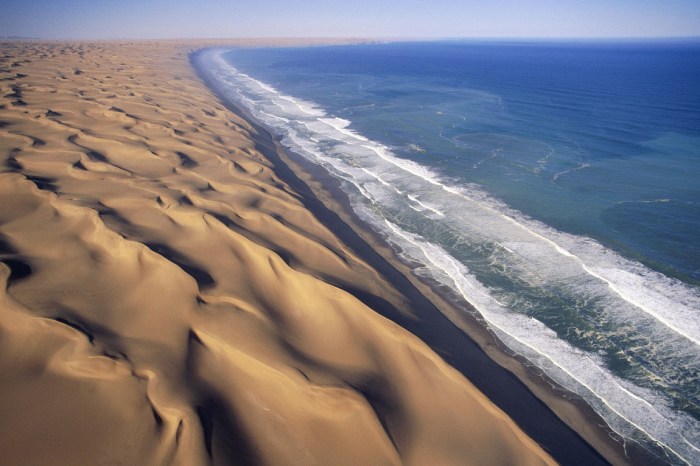
The Namib is a coastal desert in southern Africa. The name Namib is of Nama origin and means “vast place”. According to the broadest definition, the Namib stretches for more than 2,000 kilometres (1,200 mi) along the Atlantic coasts of Angola, Namibia, and South Africa, extending southward from the Carunjamba River in Angola, through Namibia and to the Olifants River in Western Cape, South Africa.

namib4

The desert geology consists of sand seas near the coast, while gravel plains and scattered mountain outcrops occur further inland. The sand dunes, some of which are 300 metres (980 ft) high and span 32 kilometres (20 mi) long, are the second largest in the world after the Badain Jaran Desert dunes in China.

Namib_Desert_Where_the_Desert_meets_the_Ocean_ritebook.in_003

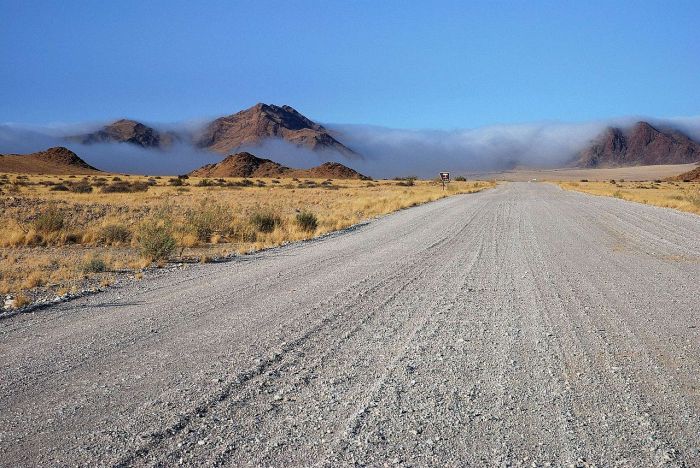
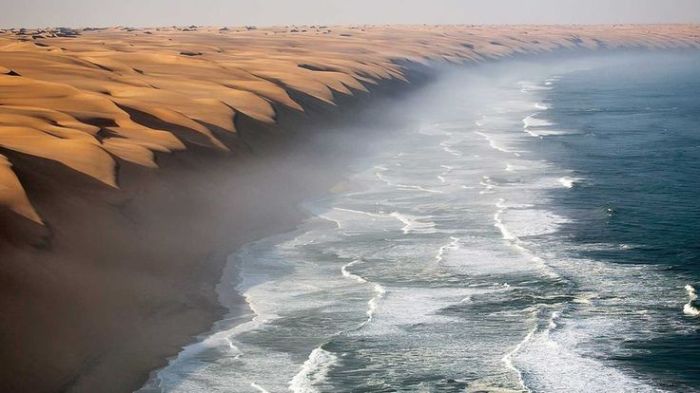
Winds coming from the Atlantic Ocean are pressed down by hot air from the east; their humidity thus forms clouds and fog. Morning fogs coming from the ocean and pushing inwards into the desert are a regular phenomenon along the coast, and much of the life cycle of animals and plants in the Namib relies on these fogs as the main source of water.

Fog rolling in

namibia

namibx

namib1

namib2

namib3

namib5

NHP-MWE001352A

namib-desert-meets-sea-4[2]

namib-desert-meets-sea-2[2]

namib-desert-meets-sea-7[2]