The Five Most Inaccessible Monasteries in the World

Buddhist monasteries are usually located in remote places far from the hub-bub of cities and towns. It takes more than a mild determination to reach them, but some of these are decidedly inaccessible. The idea is to keep all but only the most dedicated followers from reaching these holy places, while they also make the monks feel like they were closer to God in a place of peace and solitude. Today, however, most of these monasteries are tourist attractions and in favor of the tourists, several accessible methods like ropeways and stairs have been added. They still look formidable and require hundreds of meters of vertical trekking.

Monasteries of Meteora, Greece

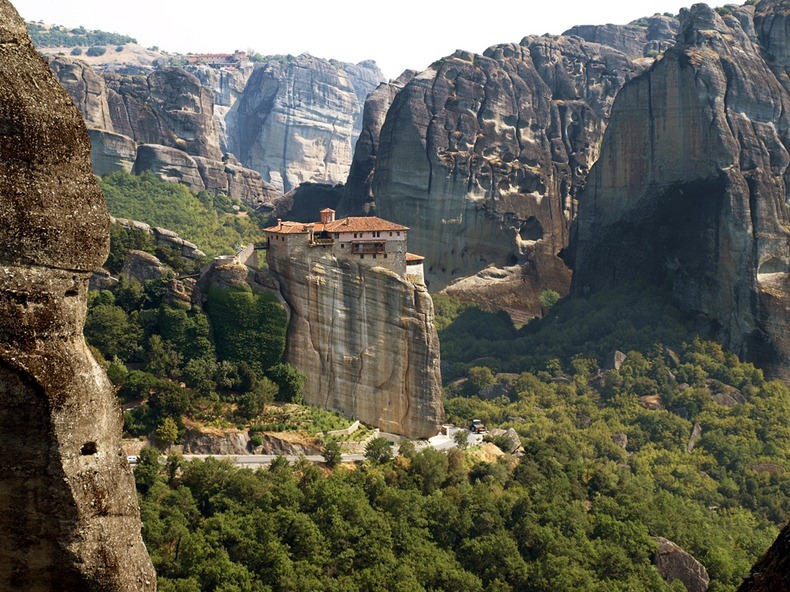
The Metéora (Greek for “suspended in the air” or “in the heavens above”) is a group of six monasteries and one of the largest and most important complexes of Eastern Orthodox monasteries in Greece. The six monasteries, built on natural sandstone rock pillars, are one of the most powerful examples of the architectural transformation of a site into a place of retreat, meditation and prayer.


amon


The monasteries are built on rock pinnacles of deltaic origin, known as Meteora, which rise starkly over 400 m above the Peneas valley and the small town of Kalambaka on the Thessalian plain. During the fearsome time of political instability in 14th century the monasteries were systematically built on top of the inaccessible peaks so that by the end of the 15th century there were 24 of them. They continued to flourish until the 17th century. Today, only four monasteries – Aghios Stephanos, Aghia Trias, Varlaam and Meteoron – still house religious communities.

Access to the monasteries was originally and deliberately difficult, requiring either long ladders lashed together or large nets used to haul up both goods and people. This required quite a leap of faith – the ropes were replaced, so the story goes, only “when the Lord let them break”. In the 1920s there was an improvement in the arrangements. Steps were cut into the rock, making the complex accessible via a bridge from the nearby plateau.
 

aamon


aamon1


Taung Kalat Monastery, Burma

The monastery of Taung Kalat is located on a top of a volcanic plug that rises 737 meters from the surrounding in central Burma (Myanmar) about 50 km southeast of Bagan, and near the extinct volcano Mount Popa. The monastery can be accessed by exactly 777 steps and those who reach the top are rewarded by a spectacular view.

To the north-west opens a view to distant temples of Bagan, and to the east is towering the forested Taung Ma-gyi summit. There is a big caldera, 610 metres wide and 914 metres in depth so that from different directions the mountain takes different forms with more than one peak. Many Macaque monkeys live here that have become a tourist attraction on Taung Kalat.


aamon2


aamon3


Taktsang Palphug Monastery, Bhutan

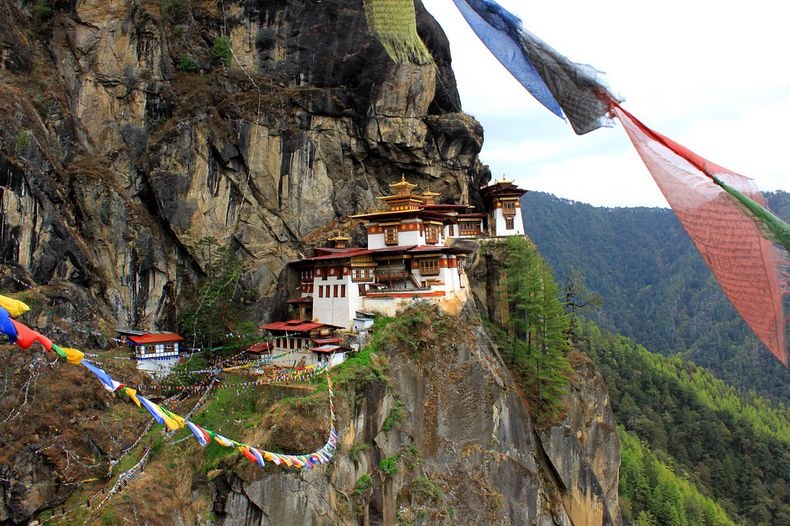
Taktshang monastery, also known as The Tiger’s Nest, is located on a precipitous cliff about 900 metres above the Paro valley, in Bhutan. The rock slopes are very steep – almost vertical – and the monastery buildings are built into the rock face. Though it looks formidable, the monastery complex has access from several directions, such as the northwest path through the forest, from the south along the path used by devotees, and from the north. A mule track leading to it passes through pine forest that is colourfully festooned with moss and prayer flags. On many days, clouds shroud the monastery and give an eerie feeling of remoteness.
 

00mon


00mon1


Sümela Monastery

The Sumela Monastery is built into the rock cliffs of the Altmdere Valley in Turkey. At an altitude of about 1,200 metres it is a major tourist attraction of Altındere National Park.

The monastery was founded in 386 AD during the reign of the Emperor Theodosius I (375 – 395). Legend has it that two priests undertook its creation after discovering a miraculous icon of the Virgin Mary in a cave on the mountain. During its long history, the monastery fell into ruin several times and was restored by various emperors. It reached its present form in the 13th century after gaining prominence during the reign of Alexios III.

The monastery was abandoned after World War I and the start of the population exchanges between Greece and Turkey that forced some 2 million ethnic Greeks and Turks to leave their long-established communities in Turkey or Greece and return to their ethnic homelands. It lay empty for decades before being partially restored and returned to life as a museum.


aamon4


aamon5


aamon6


Hanging Monastery, China

The Hanging Monastery or Hanging Temple is located in a canyon at the foot of the Mountain Heng in the province of Shanxi, China. The temple is built into the cliff side about 75 meter above the ground, and stands propped up by hidden rocks corridor and wooden beams inserted into the mountain. Over 40 halls, cabinets and pavilions within an area of 152.5 square meters are connected each other by corridors, bridges and boardwalks. They are evenly distributed and well balanced in height. Inside the temple are more than 80 bronze cast statues, iron cast statues, and clay sculptured statues and stone carvings banded down from different dynasties.

The temple was build to avoid the terrible flood, and use the mountain as protection from rain, snow and sunshine. Today, it is one of the main tourist attractions and historical sites in the Datong area.


aamon7


aamon8

Massive Underground Storage Facility outside of Pittsburgh in Limestone Cave

Iron Mountain Inc. is an enterprise information management services company founded in 1951 and headquartered in Boston, Massachusetts. Its records management, information destruction, and data backup and recovery services are supplied to more than 156,000 customers throughout North America, Europe, Latin America, and Asia.

OLYMPUS DIGITAL CAMERA

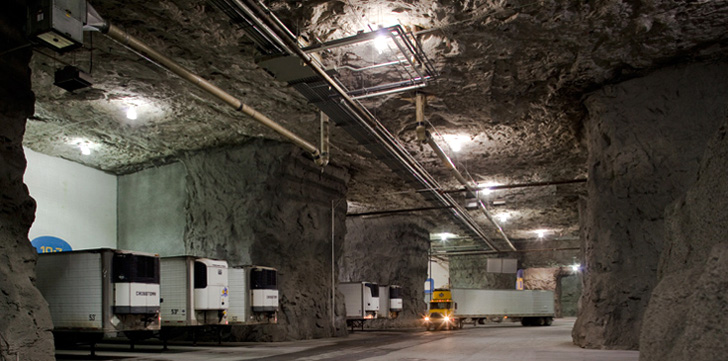
The Iron Mountain storage facility is a high-security storage facility in a former limestone mine at Boyers, Pennsylvania, near the city of Butler in the United States.

It began storing records in 1954 and was purchased by Iron Mountain in 1998. It is here that Bill Gates stores his Corbis photographic collection in a refrigerated cave 220 feet (67 m) underground. Nearby, the U.S. Office of Personnel Management leases another underground cavern to store, and process government employee retirement papers.

iron5

iron-mountain_750

Located inside a cavernous former limestone mine in rural Boyers, the underground, climate-controlled, 1.9 million square-foot facility houses some of the world’s most valuable information, including data centers, government archives — and notably, the Bill Gates-owned Corbis Image Collection. Hollywood’s major motion-picture studios also send original film reels to the facility — away from the threat of California’s earthquakes and wildfires — for safekeeping.

iron-mountain-4

Iron Mountain also boasts an underground lake fed by a natural spring that is used for cooling the data centers, as well as drinking water for its 2,200 employees. The facility also supplies its own fire trucks, should flames ever break out. There’s also a high-tech studio for digitizing and editing media. While we’re not allowed to spill the beans on what all is stored there (Iron Mountain keeps its customers’ information confidential), we can reveal that the facility’s locked, numbered vaults contain original films from a bevy of blockbuster and classic movies, as well as sound recordings from some of the biggest names in the music industry.

iron-mountain-14

iron3

iron4

The conspiracy theorists have a field day with these high-security underground facilities. They claim UFO space ships and space alien communities are housed in these facilities. If you are prone to outrageous conspiracies these underground secret facilities must make your mouth water.

iron2

What a bizarre place to work.

iron-mountain-7

iron-mountain-22-stories-underground-02

iron-mountain-9

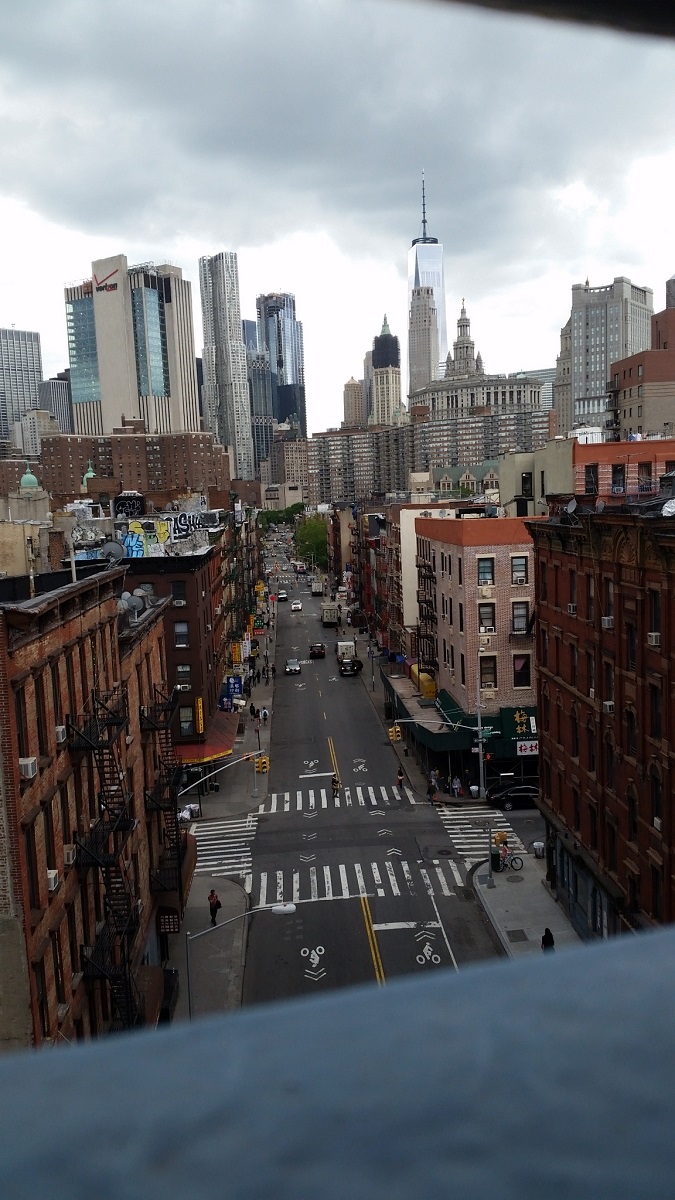
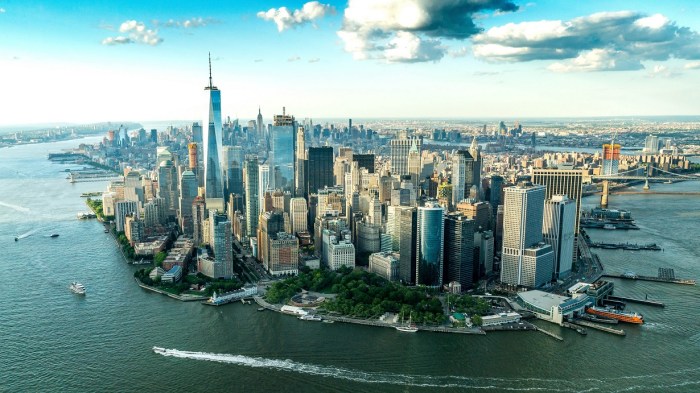
New York City Skyline

sky1

skyscraper

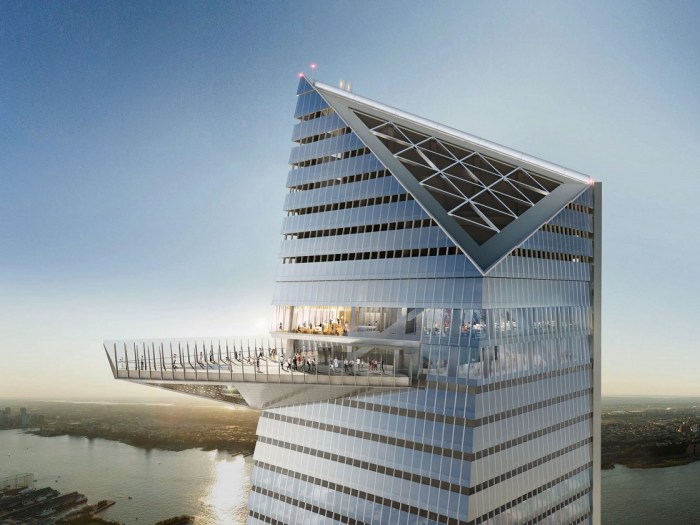
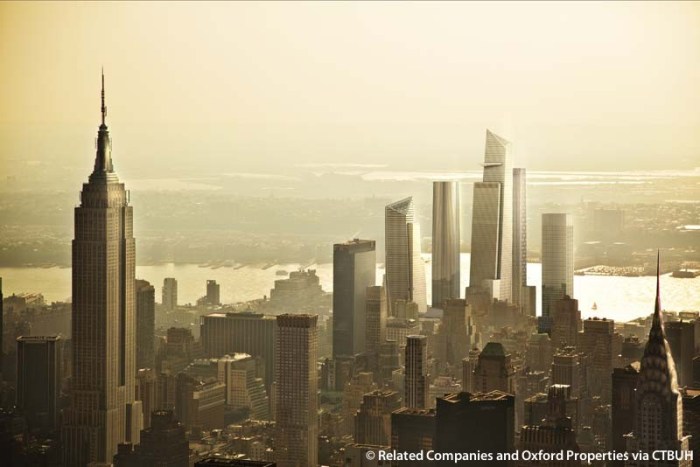
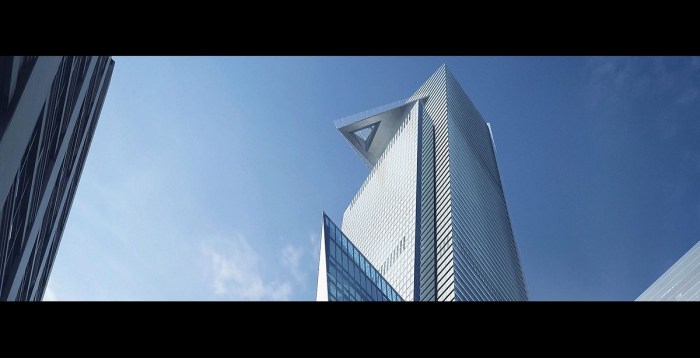
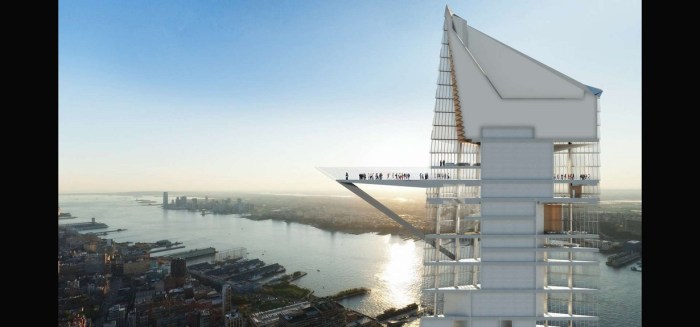
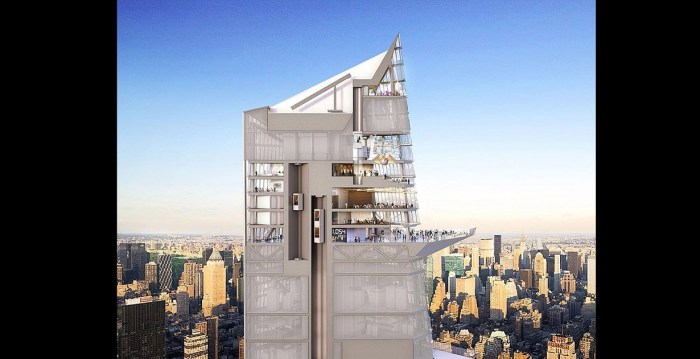
The changing skyline. The Hudson Yards development will add 5 huge new skyscrapers to the skyline. The main tower will be 30 Hudson Yard. It will have one of the most spectacular outdoor observation decks in the world. The building is scheduled for completion in 2019.

sky2

sky1a

sky3

sky4

sky5

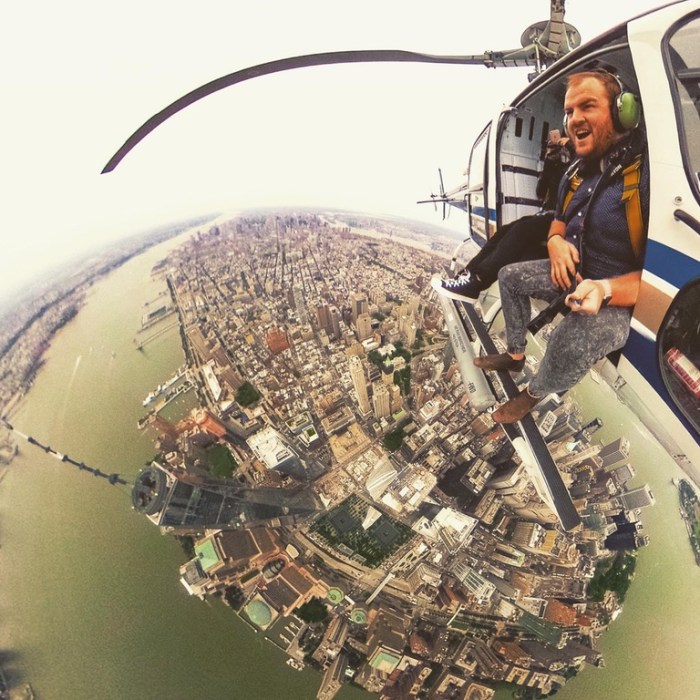
Heights don’t scare some people. Is that guy wearing yoga pants?

helicopter

Opulent Beverly Hills Mansion

In the United States, and the western world for the most part, if a person is very intelligent, ambitious, is a workaholic and has a burning desire to make tons of money, opulence can be achieved.  A person can make many millions of dollars, or for that matter billions of dollars.  What to do with all that wealth.  The sky is the limit, i.e. private jets. But back on earth one can build or buy outrageously ostentatious mansions.

The mansion below is listed at 41 million dollars. It is 13,200 square feet and has everything a Saudi prince would desire.

  beverly hills

beverly hills1

beverly hills2

beverly hills3

A lap pool that runs around half of the house.

beverly hills4

beverly hills5

beverly hills7

beverly hills6

beverly hills8

beverly hills9

Glass walled garage

beverly hills10

This is nuts!

The ramp leading up to a courtyard and the garage.

beverly hills11

beverly house 13,200 square feet

Beverly Hills, Oh my!

beverly hills12


The Pyramid of San Francisco

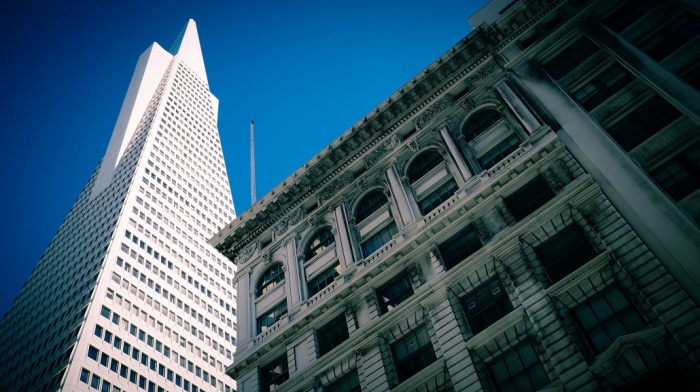
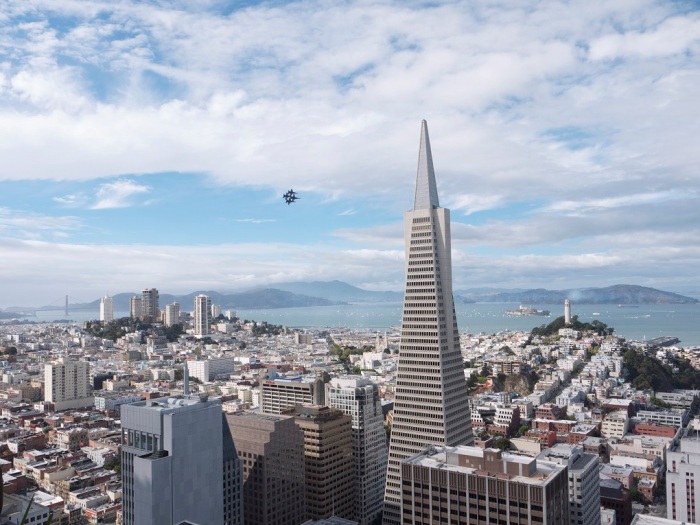
The Transamerica Pyramid is the tallest skyscraper in the San Francisco skyline. Its height is surpassed by Salesforce Tower, currently under construction. The building no longer houses the headquarters of the Transamerica Corporation, which moved its U.S. headquarters to Baltimore, Maryland, but it is still associated with the company and is depicted in the company’s logo. Designed by architect William Pereira and built by Hathaway Dinwiddie Construction Company, at 853 ft (260 m), on completion in 1972 it was the eighth tallest building in the world.

trans-america

Building facts:

There are 48 floors, 15 passenger elevators, 3 freight elevators, and 3,678 windows.

Because of the shape of the building, the majority of the windows can pivot 360 degrees so they can be washed from the inside.

transz

The decorative aluminum spire at the top is 212-feet tall – roughly 20 stories.

The spire is actually hollow and lined with a 100-foot steel stairway at a 60 degree angle, followed by two steel ladders.


tranxzxz

The conference room (with 360 degree views of the city) is located on the 48th floor and can be booked for $400-600 dollars…an hour.

transzzxx

The building is covered in crushed white quartz, giving it its pure white color.

transzw

It takes 18,000 work hours to get “brightened” every 10 years, last occurring in 2007.

transx

transzx

The building is a tall, four-sided pyramid with two “wings” to accommodate an elevator shaft on the east and a stairwell and a smoke tower on the west.

transx1

The Vertical Forest of Milan

avertical

Bosco Verticale (Vertical Forest) is a pair of residential towers in the Porta Nuova district of Milan, Italy, between Via Gaetano de Castillia and Via Federico Confalonieri near Milano Porta Garibaldi railway station. They have a height of 110 metres (360 ft) and 76 metres (249 ft) and will host more than 900 trees (approximately 550 and 350 trees in the first and second towers respectively) on 8,900 square metres (96,000 sq ft) of terraces. Within the complex is also an 11-story office building; its facade does not host plants.

The towers were designed by Boeri Studio (Stefano Boeri, Gianandrea Barreca and Giovanni La Varra). It also involved input from horticulturalists and botanists.

The building was inaugurated in October 2014.

avertical1

The project was designed as part of the rehabilitation of the historic district of Milan between Via De Castillia and Confalonieri. It consists of two residential towers of which the largest is 26 floors and 110 meters high (called Torre E) and the smaller tower is 18 floors and 76 meters high (called Torre D). It contains 400 condominium units priced from 3,000 – 12,000 Euro per square metre.

It is called Bosco Verticale because each tower houses trees between three and six meters which help mitigate smog and produce oxygen. It is also used to moderate temperatures in the building in the winter and summer. The plants also attenuate noise. The design was tested in a wind tunnel to ensure the trees would not topple from gusts of wind. Botanists and horticulturalists were consulted by the engineering team to ensure that the structure could bear the load imposed by the plants. The steel-reinforced concrete balconies are designed to be 28 cm thick, with 1.30 metre parapets.

avertical2

The construction of the towers began in late 2009 and early 2010, involving 6,000 onsite construction workers. Between mid-2010 and early 2011 construction progressed very slowly and the towers rose by only five floors while the core rose to the seventh floor. Construction progressed throughout 2011, and by the beginning of 2012 the structures were completed, and construction of the facades and installation of the plants began on 13 June 2012. The building was inaugurated in October 2014.

On April 11, 2012, one of the buildings was used as a temporary art gallery and opened to the public for an art exhibition hosted during Milan Fashion Week.

The two buildings have 730 trees (480 large, 250 small), 5,000 shrubs, and 11,000 perennials and groundcover on its facades. The original design had specified 1,280 tall plants and 920 short plants encompassing 50 species. Overall, the vegetation is the equivalent of that found in a one hectare woodlot. The innovative use of heat-pump technology is helping to slash heating and cooling costs.

avertical3

On November 19, 2014, Bosco Verticale won the International Highrise Award, prestigious international competition bestowed every two years, honouring excellence in recently constructed buildings that stand a minimum of 100 meters (328 feet) tall. The five finalists were selected from 26 nominees in 17 countries.

On the 12th of November 2015, the Council on Tall Buildings and Urban Habitat (CTBUH) Awards Jury selected Bosco Verticale, Milan, as the overall “2015 Best Tall Building Worldwide” at the 14th Annual CTBUH International Best Tall Building Awards Symposium, Ceremony & Dinner, celebrated at the Illinois Institute of Technology, Chicago.

Gardeners rappel down ropes

avertical4

avertical5

avertical6

avertical7

avertical8

avertical9

avertical10


Shibam: the Manhattan of the Desert

The city of Shibam, located in the central-western area of Hadhramaut Governorate, Yemen, in the Ramlat al-Sab`atayn desert, is best known for its towering mudbrick skyscrapers. This small town of 7000 is packed with around 500 mud houses standing between 5 and 11 stories tall and reaching 100 feet high, all constructed entirely of mud bricks. The bizarre skyline that the high rise buildings bestow upon the city has earned Shibam the moniker “Manhattan of the Desert.”

Shibam is often called “the oldest skyscraper city in the world” and is one of the oldest and best examples of urban planning based on the principle of vertical construction. Its plan is trapezoidal, almost rectangular; and it is enclosed by earthen walls within which a block of dwellings, also built from earth, have been laid out on an orthogonal grid. Shibam was founded in the 3rd century AD, but most of the houses you see here dates only to the 16th century, following a devastating flood of which Shibam was the victim in 1532-33. However, some older houses and large buildings still remain from the first centuries of Islam, such as the Friday Mosque, built in 904, and the castle, built in 1220.


In general the windowless lower floors are used for grain storage, with areas for domestic use above and those for family and leisure above that. The main room on the second floor is used by men for socializing. It often has wonderful carved plasterwork and freestanding decorated wooden columns supporting the ceiling, while women’s areas are found higher, usually on the third or fourth floor. The highest rooms are for communal use by the whole family, and on the upper levels there are often bridges and doors connecting the houses. These are a defensive feature, but also a practical one – especially for old people who find it difficult to walk up and down the interminable staircases.

The houses needed to be rebuilt over the centuries. Rain and erosion have been constant threats to the buildings here. To protect their homes, residents must thickly coat the facades and roofs with sealant, and ensure they are maintained and regularly renovated. Those who can afford it limewash their houses to protect them against termites.

Shibam was added to UNESCO’s World Heritage list in 1982.


Tiny Adobe Village in Winnipeg

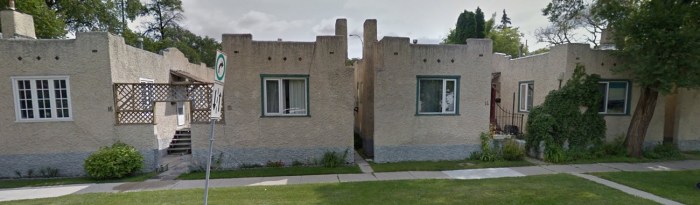
There is a group of residential structures near the intersection of St. Mary’s Road and Marion Street in Winnipeg that look like it is straight from the desert country of the American southwest.  I have noticed the buildings for years but never took a close look.  They are very interesting when viewed up close.

They are independent apartments situated a few feet apart in a group of around 20 structures.  They are roughly the size of a medium size trailer home.  But the interesting aspect of the buildings is the thick stucco on the outside walls.  The flat roofs are also somewhat different.  The thick stucco gives the buildings the distinct appearance of being adobe. 

An adobe structure is usually defined as being made out of natural building material made from sand, clay, water, and some kind of fibrous or organic material (sticks, straw, and/or manure).  These buildings look very adobe indeed.  The big concrete stucco walls also add to the adobe quality.

The buildings do look old.  They must have been built in the fifties or sixties.  Maybe earlier. It would be a great place to live if the rent wouldn’t be too high (maybe they are condos), because you would never hear your neighbour banging things or playing loud music.

Some pictures:


adobe

Are you a brave person who can take heights?

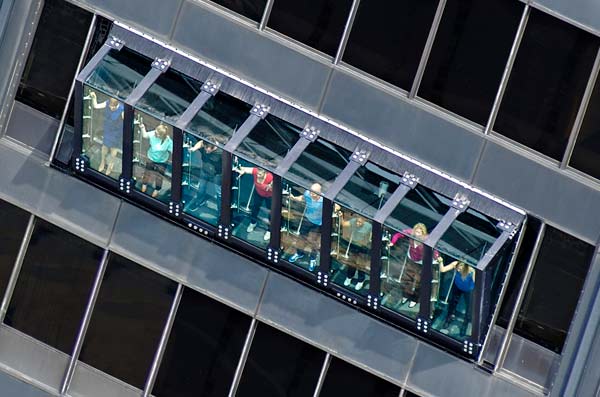
Brave tourists have been trying out Chicago’s newest attraction – a 1000ft-high viewing platform that offers spectacular downward facing views over the city.

TILT is housed in 360 CHICAGO on the 94th floor of the John Hancock Tower and, as the name suggests, the enclosed glass and steel platform tilts visitors forward for a unique perspective of the city’s The Magnificent Mile.

tilt

tilt1

tilt2

tilt3

Give me a bloody parachute in case the unexpected happens.

But Chicago, you have nothing on Toronto!

The CN Tower in Toronto opened a bizarre and frightening attraction back in 2011, a chance to show you are brave.

The tower’s EdgeWalk allows thrill-seekers to stroll outside on the world-famous tower on a 1.5 metre ledge that rings the main pod 356 metres (1,168 feet) above the ground.

Opened in August 2011, this walk of wobbly knees sends groups of six to eight people out on the ledge where they walk hands-free while attached to an overhead safety harness.

During the walk, specially trained guides will encourage visitors to push their personal limits, even allowing them to lean out 116 storeys above the city.

The EdgeWalk costs $175. While that may be pricey, CN Tower staff say it doesn’t cost walkers their lives.

“Our facilities and engineering team supervised the EdgeWalk project design and build to ensure that it is both exciting and safe,” said CN Tower chief operating officer Jack Robinson in a news release.

“EdgeWalk is both thrilling and unique and pushes visitors to their limits — literally and figuratively,” said Mark Laroche, president and CEO of Canada Lands Company, which owns and operates the CN Tower. The entire EdgeWalk experience takes about 90 minutes, with the walk itself lasting between 20 to 30 minutes.

They give you a breathalyzer before the walk to make sure you are not under the influence of alcohol.  Well there goes my opportunity, I would not touch this Edgewalk unless I had gulped down at least 10 ounces of Canadian rye whiskey.