







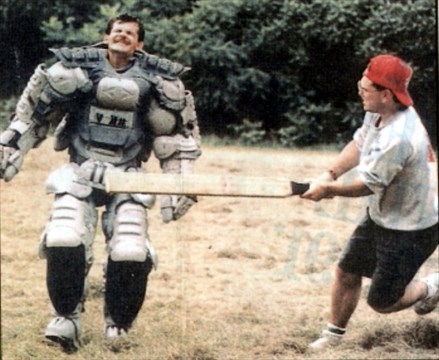
Troy James Hurtubise (born November 23, 1963 in Hamilton, Ontario) is an inventor and conservationist from North Bay, Ontario, Canada noted for his often bizarre creations that he tests on himself. Some of these inventions include the Ursus personal armor suit, firepaste (an ablative heatproofing material), various ray generators, and recently, Trojan, which is a type of body armor.
Hurtubise built a metal suit for protection from grizzly bears; recorded as a National Film Board documentary and called Project Grizzly, in which Hurtubise tested the capabilities of the suit using himself as the test subject. This resulted in his Ig Nobel Prize for Safety Engineering in 1998.

 Image copyrightREUTERS
A speeding car in California was hurled into the upper floor of an office building after it hit a road divider, reports say.
The crash, which left one half of the vehicle hanging out of the building, occurred early on Sunday morning.
Both people in the car survived the crash but suffered minor injuries, according to police.
Police told US media outlets that the driver had allegedly used drugs and was in hospital for observation.
One of the two people was able to get out of the car but the other was stuck inside for more than an hour until rescuers arrived.
The crash also set off a small fire which was put out by fire officials, who tweeted photos and updates through the day.
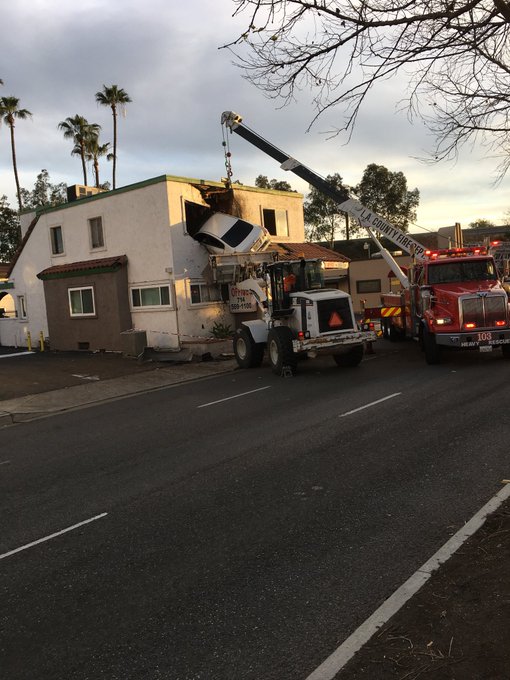
OCFA in Santa Ana of a vehicle that crashed into the building. The fire was quickly extinguished, both victims are out of the vehicle safely with minor injuries. Members from OCFA & LA COUNTY Urban Search & Rescue teams are removing the vehicle from the building.
Human beings never cease to amaze. What possessed these people to start carving stones into spheres. It must have taken months or years to complete one of these. Some people just have too much time on their hands. But then maybe it wasn’t humans who did this, does the term Space Aliens come to mind?

The stone spheres (or stone balls) of Costa Rica are an assortment of over three hundred petrospheres in Costa Rica, located on the Diquis Delta and on Isla del Caño. Known locally as Las Bolas, they are also called The Diquis Spheres.
The spheres range in size from a few centimetres to over 2 metres (6.6 ft) in diameter, and weigh up to 16 short tons (15 t). Most are sculpted from gabbro, the coarse-grained equivalent of basalt. There are a dozen or so made from shell-rich limestone, and another dozen made from a sandstone.

The stones are believed to have been carved between 200 BC and 1500 AD. However the only method available for dating the carved stones is stratigraphy, and most stones are no longer in their original locations. The culture of the people who made them disappeared after the Spanish conquest.
Spheres have been found with pottery from the Aguas Buenas culture (dating 200 BC – AD 600) and also they have been discovered with Buenos Aires Polychrome type sculpture (dating 1000 – AD 1500). They have been uncovered in a number of locations, including the Isla del Caño, and over 300 kilometres (190 mi) north of the Diquis Delta in Papagayo on the Nicoya Peninsula.

The spheres were discovered in the 1930s as the United Fruit Company was clearing the jungle for banana plantations. Workmen pushed them aside with bulldozers and heavy equipment, damaging some spheres. Additionally, inspired by stories of hidden gold workmen began to drill holes into the spheres and blow them open with sticks of dynamite. Several of the spheres were destroyed before authorities intervened. Some of the dynamited spheres have been reassembled and are currently on display at the National Museum of Costa Rica in San José.
The first scientific investigation of the spheres was undertaken shortly after their discovery by Doris Stone, a daughter of a United Fruit Co. executive. These were published in 1943 in American Antiquity, attracting the attention of Samuel Kirkland Lothrop of the Peabody Museum at Harvard University. In 1948, he and his wife attempted to excavate an unrelated archaeological site in the northern region of Costa Rica. The government of the time had disbanded its professional army, and the resulting civil unrest threatened the security of Lothrop’s team. In San José he met Doris Stone, who directed the group toward the Diquís Delta region in the southwest (“Valle de Diquís” refers to the valley of the lower Río Grande de Térraba, including the Osa Canton towns of Puerto Cortés, Palmar Norte, and Sierpe) and provided them with valuable dig sites and personal contacts. Lothrop’s findings were published in Archaeology of the Diquís Delta, Costa Rica 1963.
Amusingplanet.com
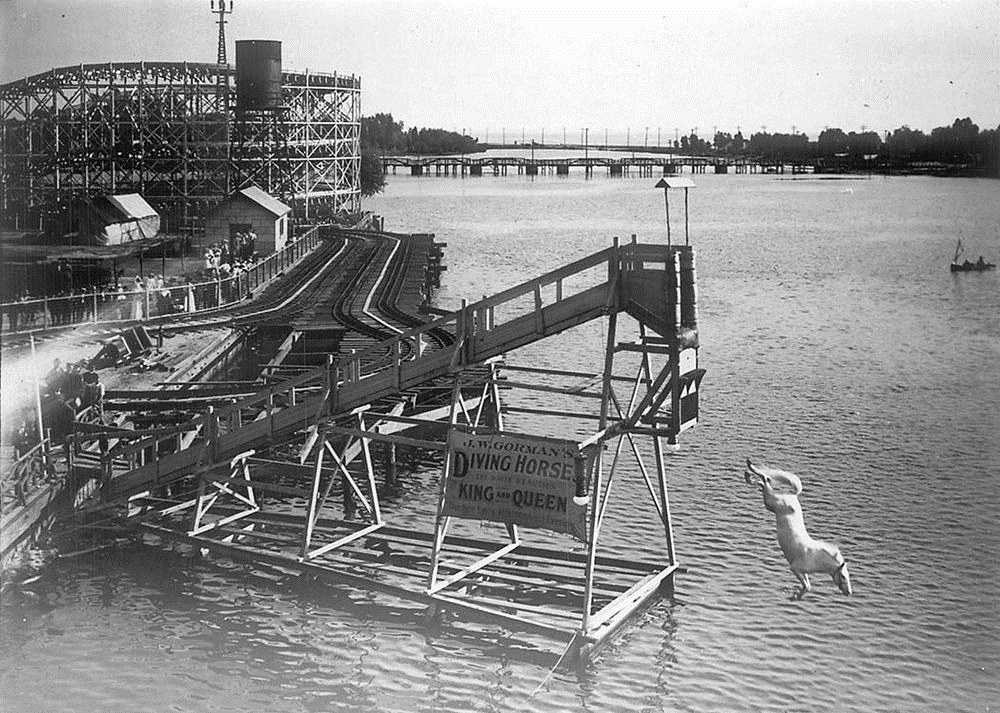
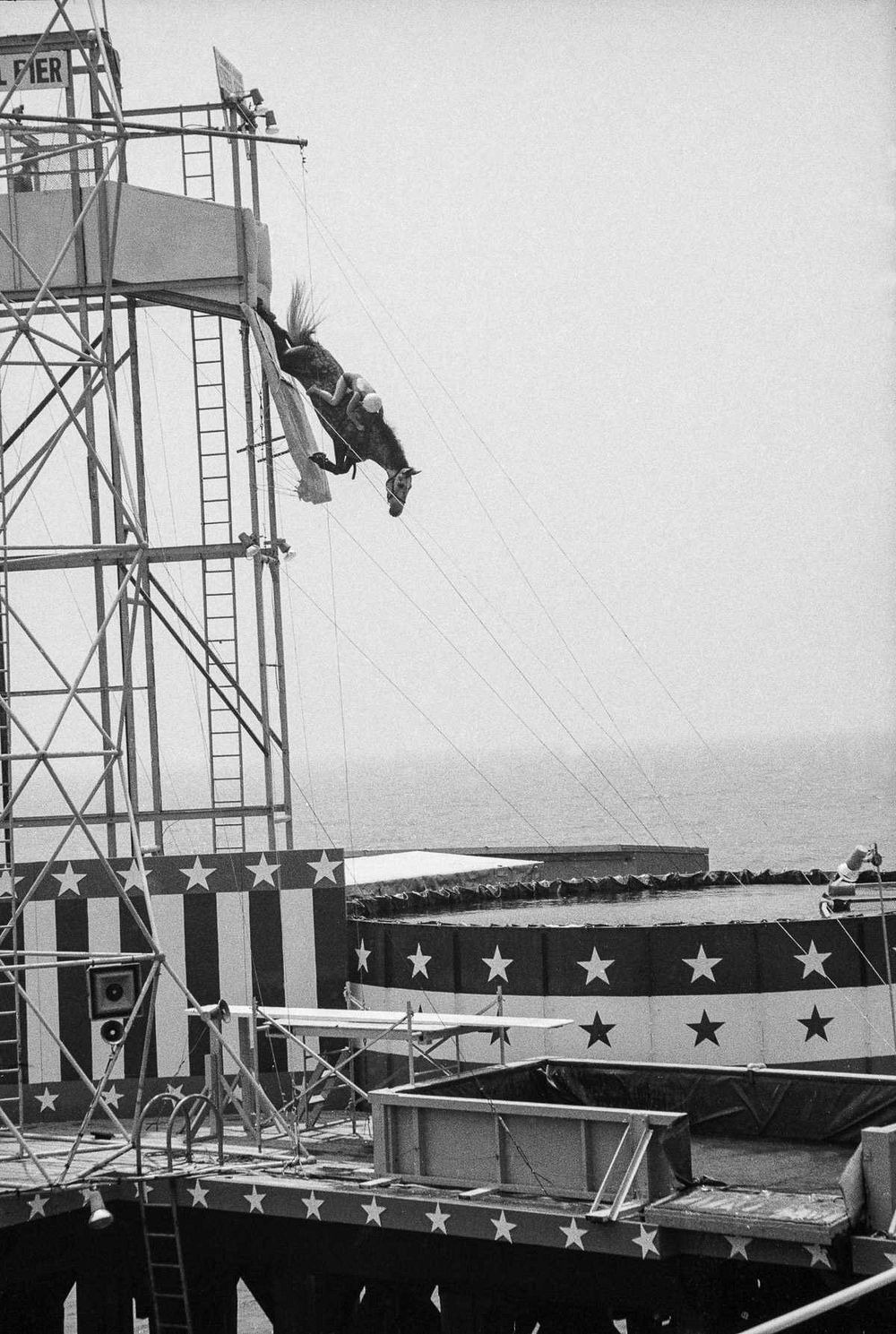
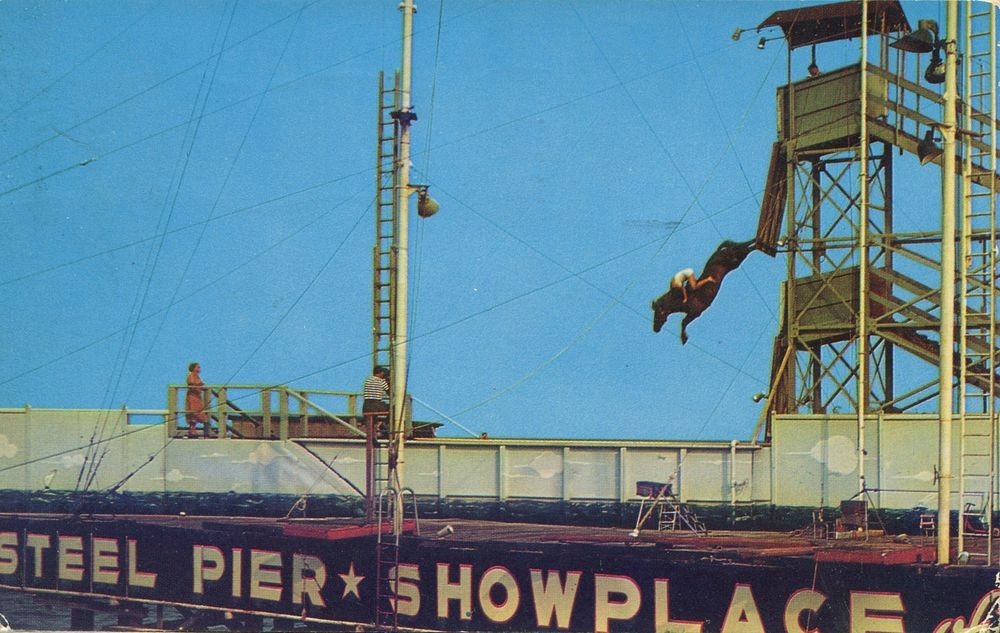
For nearly half a century, Atlantic City, in New Jersey, United States, was home to an attraction almost too fantastical to believe—an apparently fearless horse with a young woman on its back would leap off a tower some 40 feet high into a pool of water below. The stunt took place at Atlantic City’s popular venue Steel Pier, where trained horses took the plunge up to four times a day and seven days a week.
The idea of the diving horse was invented in Texas by ”Doctor” William Frank Carver, a 19th century sharpshooter who toured the wild west organizing shows with trained animals and shooting exhibitions. The story goes that in 1881, Carver was crossing a wooden bridge over Platte River in Nebraska when the bridge gave away, plunging him and his horse into the river. The diving horse franchise grew out this mishap, and over time it became Carver’s most favorite act on his traveling animal shows. His son, Al, helped train and take care of the horses, while his daughter, Lorena, is said to have been the first rider. By the time his future daughter-in-law, Sonora Webster, joined the show in 1923, Carver had two diving teams on the road, each performing in a different city.
The diving horse at the Hanlan’s Point Amusement Park, Toronto, Canada.
Carver died in 1927 due to poor health aggravated by the drowning of his favorite horse. Following Carver’s death, the diving horse show continued with Al Carver at the helm. In 1928 the diving horse show came to Atlantic City and became a permanent fixture at Steel Pier for the next several decades.
Allegedly, in all the years the show ran, there was not one reported incident of injury to any of the high diving horses. However, the same cannot be said for the riders. On average there were two injuries a year, usually a broken bone or a bruise. The most serious injury in the show’s history happened to Sonora Webster, who was the best-known of the horse divers. She joined Carver’s show in 1923 and made her first dive when she was just 15.
In 1931, during a dive, her horse dove into the tank off-balance, causing her to hit the water face first. Sonora failed to close her eyes quickly enough, resulting in detached retinas that left her sightless. Despite being blinded, Sonora continued with the act for eleven more years. Her story became the subject of the 1991 Disney film Wild Hearts Can’t Be Broken.
Later in an interview to the New York Times, Sonora’s younger sister, Arnette Webster, remarked:
The movie made a big deal about having the courage to go on riding after she lost her sight. But, the truth was, riding the horse was the most fun you could have and we just loved it so. We didn’t want to give it up. Once you were on the horse, there really wasn’t much to do but hold on. The horse was in charge.
Horse-diving continued until 1978, when pressure from animal rights groups forced organizers to shutter the show. In 1994, Donald Trump’s organization, which owns Steel Pier now, attempted to bring back the act by featuring diving mules and miniature horses, but public protests once again brought the act to an end.
Sonora Webster, in 1904.
Horse diving into the water at Atlantic City.
Diving horse at Atlantic City Steel Pier, 1959.
Dimah, the world famous diving horse, Atlantic City NJ.

Amsterdam has banned beer bikes amid complaints about rowdy tourists being drunk and disorderly.
A court ruling on Tuesday allowed officials to prohibit their use in the centre of the Dutch city, calling the contraptions a “public order problem”.
The bicycles are a popular way for tourists celebrating group events, such as stag parties, to travel around Amsterdam.
Critics say they have become an example of the problems caused by mass tourism.
The beer bikes are small carts that have been modified with bicycle seats arranged around a bar table.
The ban came into force on Wednesday. A spokesman for the City Hall said operators were no longer allowed to rent out the bikes.
It comes after the Amsterdam District Court said “the beer bicycle may be banned from the city centre to stop it from being a nuisance”.
Last year, about 6,000 locals signed a petition calling on the council to ban the bikes, calling them a “terrible phenomenon”.
At the time, one resident told NOS news: “Our city has become a giant attraction park.”

By Anna Holligan, BBC News
You normally hear them before you see them.
For some tourists these cumbersome contraptions offer the perfect way to see the city. Combining two of its attractions – alcohol and cycling.
The Dutch are famous for their cycling culture but few will miss the inebriated foreigners who commandeer these novelty vehicles, sometimes at the expense of those who use bikes as a practical and sensible way to get on with life.
Amsterdam’s late mayor, Eberhard van der Laan – who died last month – agreed with the residents and instituted a ban on the bikes.
This was challenged in court last year by four beer bike operators, who said that the city was “imposing on people’s freedom”.
Judges struck down the mayor’s ban at the time, saying that it was not properly motivated.
In a ruling on Tuesday, however, the judges at the Amsterdam District Court agreed with the ban.
“The combination of traffic disruptions, anti-social behaviour and the busy city centre justifies a ban,” they said.
The JFK assassination persists as one of the most widely believed conspiracy theories in history. I believed it was the CIA, Cubans and finally the New Orleans mob that did it. I believed this for years. Then one day my friend told me to read a book on the assassination that came out in the mid nineties titled “Case Closed” by Gerald Posner. My friend said it will change your mind, that Lee Harvey Oswald acted alone, and it did. Every other person I know who read the book has also discarded the conspiracy theory.
Posner’s research into the movements of Oswald is truly astounding, he follows him minute by minute. And Oswald was a very strange, yet highly intelligent character. He was in the U.S. Marines, all Marines learn to be very good shots. But nothing will make the believers change their minds.
As the very good article below by Slate Magazine states, conspiracy theories are very powerful ideas indeed.

There’s no space to launch a full rebuttal of the conspiracy theorists. (It took 1,632 pages for Vincent Bugliosi to do that in his 2007 book Reclaiming History.) But it’s worth recounting the conspiracy buffs’ arguments that I found most persuasive—and why they collapse under scrutiny.
The basic facts are these. On Nov. 22, 1963, President Kennedy, Texas Gov. John Connally, and their wives were riding in a slow, open motorcade through Dallas. At 12:30 p.m., as the car turned onto Dealey Plaza, three gunshots rang out. Kennedy and Connally were both shot. The car sped to a nearby hospital, where the president was pronounced dead and the governor treated for wounds. Lee Harvey Oswald was arrested as the suspected gunman and was himself shot to death days later. President Lyndon Johnson appointed a commission, chaired by Supreme Court Chief Justice Earl Warren, to investigate the assassination. The Warren Report concluded that Oswald had fired all three shots from a window on the sixth floor of the Texas School Book Depository, where he worked.
But the case was far from closed. A man named Abraham Zapruder, one of thousands of people standing along the motorcade route that day in Dallas, captured the shootings on his 8mm home-movie camera. At 26 seconds and 486 frames, it would come to be the most thoroughly examined snuff film in history—and a prime piece of evidence for the Warren Commission and the subsequent “conspiracy buffs.”
At first, it was assumed that Kennedy and Connally had been hit by separate bullets. But the Zapruder film threw a wrench in that notion. The Warren Commission’s analysts concluded that JFK was shot sometime between Frames 210 and 225 (a street billboard blocked Zapruder’s view at the crucial moment), while Connally was hit no later than Frame 240. In other words, the two men were hit no more than 30 frames apart. However, FBI tests revealed that Oswald’s rifle could be fired no faster than once every 2.25 seconds—which, on Zapruder’s camera, translated, to 40 or 41 frames. In short, there wasn’t enough time for Oswald to fire one bullet at Kennedy, then another at Connally.
The inference was inescapable. Either there were at least two gunmen—or Kennedy and Connally were hit by the same bullet. The Warren Report argued the latter. The “single-bullet theory,” as it was called, set off a controversy even among the commissioners. Three of them didn’t buy it. Under political pressure to issue a unanimous report (preferably one reassuring the American public that there was only one gunman and he was dead), the skeptics stifled their dissent, at least publicly; in exchange, the report’s authors toned down their assessment of the single-bullet theory from “compelling” (the first draft’s term) to merely “persuasive.”
That section of the Warren Report drew the most biting attacks. Critics drew diagrams tracing the absurd path that a bullet would have had to travel—a midair turn to the right, followed by a squiggly one to the left—in order to rip through Kennedy’s neck, then into Connally’s ribs and wrist.
For many years, long after I’d rejected most of the conspiracy buffs’ claims, the “magic bullet”—as critics called it—remained the one piece of the Dealey Plaza puzzle that I couldn’t fit into the picture; it was the one dissonant chord that, in certain moods, made me think there might have been two gunmen after all.
Then, in November 2003, on the murder’s 40th anniversary, I watched an ABC News documentary called The Kennedy Assassination: Beyond Conspiracy. In one segment, the producers showed the actual car in which the president and the others had been riding that day. One feature of the car, which I’d never heard or read about before, made my jaw literally drop. The back seat, where JFK rode, was three inches higher than the front seat, where Connally rode. Once that adjustment was made, the line from Oswald’s rifle to Kennedy’s upper back to Connally’s ribcage and wrist appeared absolutely straight. There was no need for a magic bullet.
The Grassy Knoll, Part 1: Frame 313
Kennedy was shot twice: first through the neck (by the bullet that went on to pierce Connally), then in the head. The Zapruder film captured this shot too, in Frame 313. The image was deemed so horrifying that it was excised from public viewings of the film until 1975, when President Gerald Ford (who’d served on the Warren Commission) ordered it released. I remember watching the fully restored film on TV. It really was horrifying. You saw the top of President Kennedy’s head literally blown off. But it was creepy for another reason: the blown-off piece of his head blew backward. In other words, it looked like that fatal bullet was fired not from behind Kennedy, like the first bullet, but from in front of him. Were there two gunmen after all—Oswald in the book depository and someone else perched in the area known as the “grassy knoll”?
I went back to the library and scoured the Warren hearings. There I found neurologists testifying that a nerve ending can explode when hit by a bullet and that the two trajectories—where the bullet came from and which way the nerve fragments fly—are not necessarily related. Experiments from the 1940s, in which bullets were fired into the heads of live goats, revealed this fact. So, the evidence of Frame 313 was at least ambiguous; it said nothing, one way or the other, about the plausibility of a second-gunman theory.
However, in 1975, CBS News, which was doing a documentary on the assassination, hired a tech firm to conduct a high-resolution analysis of the Zapruder film, using instruments that hadn’t existed in the Warren Commission’s day. The firm discovered that, on Frame 312, Kennedy’s head slammed a tiny bit forward, and much more quickly than it jolted backward an instant later on Frame 313. The implication: The bullet hit his head from behind, pushing him forward, then a nerve exploded, which happened to push him backward.
The Grassy Knoll, Part 2: The Acoustical Analysis
In 1976, the House of Representatives formed a special committee to reinvestigate the Kennedy assassination. After many hearings and extensive analysis, the panel concluded that there had been a second shooter after all. This surprise conclusion was based on a newly discovered piece of evidence—an audiotape from a radio transmission from a Dallas policeman who’d been escorting JFK’s motorcade. According to the House report, an acoustical analysis of the tape revealed that four gunshots were fired—and that, given the echo patterns and the officer’s location, one of those shots came from the grassy knoll.
The report stirred such commotion that the National Academy of Sciences conducted its own analysis of the tape—and concluded that the House report was hooey. First, it turned out that some of those four gunshot-like sounds were not gunshots. Second, the motorcycle cop in question was not where the House report claimed, so even if the sounds had been gunshots, a revised echo analysis put them someplace other than the grassy knoll. Third, some of the sounds on the tape occurred a minute after the assassination.
Case closed.
The Appeal of Conspiracies
Conspiracy theories thrive—about every big event in history—for several reasons. First, there’s a natural human instinct to fantasize about the hidden. As my Slate colleague Ron Rosenbaum (who’s plumbed these depths as immersively as anyone) put it in his brilliant collection, The Secret Parts of Fortune, “The search for the hidden hand, the hidden springs, the hidden handshake behind history attracts a certain kind of glory seeker, Ancient Mariner, mad scholar, Wandering Jew.”
Second, there is comfort in this search for unseen mainsprings. If horrible events can be traced to a cabal of evildoers who control the world from behind a vast curtain, that’s, in one sense, less scary than the idea that some horrible things happen at random or as a result of a lone nebbish, a nobody. The existence of a secret cabal means that there’s some sort of order in the world; a catastrophic fluke suggests there’s a vast crevice of chaos, the essence of dread.
As the old adage has it, “Big doors sometimes swing on little hinges.” John F. Kennedy’s murder was a big door—had he lived, the subsequent decades might have looked very different—and Lee Harvey Oswald was a preposterously small hinge. The dissonance is wildly disorienting. It makes for a neater fit, a more intelligible universe, to believe that a consequential figure like John Kennedy was taken down by an equally consequential entity, like the CIA, the Mafia, the Soviets, Castro … take your pick.
Finally (and this is a point that some defenders of the Warren Report ignore), there are conspiracies. There’s a reason so many serious people started to reinvestigate the Kennedy assassination in the mid-1970s: that was when Sen. Frank Church’s committee unveiled a long dark history of CIA conspiracies—coups, killings, and other black-bag jobs—that only extremists had ever before imagined possible. What other extreme theories might turn out to be true?
The killing of JFK emerged as an obvious source of renewed curiosity. Back in 1971, not long before he died, a retired Lyndon B. Johnson told the journalist Leo Janos that the Kennedy administration had been “running a damn Murder Incorporated in the Caribbean.” Nobody knew what he was talking about at the time. A few years later, the Church Committee revealed the details of Operation Mongoose—an intense plot by the Kennedy White House and the CIA to assassinate Fidel Castro. Revelations also emerged of the Mafia’s cooperation in Mongoose, of JFK’s affair with a Mafia moll, and of his brother Robert Kennedy’s crusade against the same Mafia kingpins. Could Dallas have been a revenge shooting, mounted by either Castro or the Mafia? Even if Oswald had been the lone gunman, could he have been a recruit in some larger power’s plot?
New suspicions also arose about the Warren Commission. The CIA, it turned out, had accumulated vast files about Oswald’s time in the Soviet Union (he had briefly defected in the late 1950s before returning to the United States) and his visit to the Cuban consulate in Mexico—but the agency turned over none of this material to the Warren staff.
No wonder that even as sober-minded a soul as Secretary of State John Kerry, who was a college student at the time of the assassination, recently told NBC’s Tom Brokaw, “To this day, I have serious doubts that Lee Harvey Oswald acted alone” or that the Warren Commission “got to the bottom” of his “time and influence from Cuba and Russia.”
Yet history plays strange games. The Warren Commission was a compromised outfit from the get-go—and yet, despite a half-century of scrutiny, the report’s central points hold up well. The only remaining mystery, really, is Oswald’s motives—and yet, here too, no convincing evidence has emerged that links his action to the Mafia, the CIA, the Cubans, or anything of the sort. The most persuasive theory I’ve read—first put forth in a New York Review of Books article by Daniel Schorr (later reprinted in his book Clearing the Air)—is that Oswald killed Kennedy, believing the deed would earn him favor with Castro. But who knows? The mystery at the heart of the matter (why did Oswald do it?) remains unsolved. And that of course makes conspiracy theories all the more satisfying.
Bill O’Reilly has seemingly run out of options for blaming others after a series of sexual harassment allegations canned the former Fox News host. From accusers to the news media, the only logical scapegoat left would surely be his Almighty.
During a recent episode of his web series “No Spin News,” O’Reilly spoke candidly about his anger toward God for not protecting him, as more details surrounding allegations have surfaced, according to CNN.

“You know, am I mad at God? Yeah, I’m mad at him,” O’Reilly said. “I wish I had more protection. I wish this stuff didn’t happen. I can’t explain it to you. Yeah, I’m mad at him.”
He also admitted people have it “much rougher” than him and that he’s a “bigmouth.”
The New York Times reported Saturday that O’Reilly paid $32 million to settle accusations with former Fox News contributor Lis Wiehl. Six other agreements have been made by either O’reilly or the network on his behalf.
With this latest rant under his belt, his New York Times bestseller Killing Jesus: A History is beginning to look more like a manifesto.
_
The number of rockers who were taken from us too early in life — whether by accident, violence or misadventure — is obviously far too large. The fact that so many of the biggest and most influential talents in rock history died at the age of 27 is even more bizarre, and when you think about it, downright creepy.
Over the years, the stories behind the deaths of the members of this so called “27 club” have grown more and more inflated and outrageous, with everything from legal cover-ups to elaborate hoaxes and even deals with the devil trotted out to try and make some sense of these tragic losses.
Together with our friends at Loudwire, we try to distinguish fact from fiction regarding these sad stories on the following list of Rockers Who Died at Age 27.
Brian Jones, Jimi Hendrix, Janis Joplin and Jim Morrison all died at the age of 27 between 1969 and 1971. At the time, the coincidence gave rise to some comment but it was not until the death of Kurt Cobain, about two and a half decades later, that the idea of a “27 Club” began to catch on in public perception.
According to Hendrix and Cobain biographer Charles R. Cross, the growing importance of the media—Internet, television and magazines—and the response to an interview of Cobain’s mother were jointly responsible for such theories. An excerpt from a statement that Cobain’s mother, Wendy Fradenburg Cobain O’Connor, made in the Aberdeen, Washington newspaper The Daily World—”Now he’s gone and joined that stupid club. I told him not to join that stupid club.”—referred to Hendrix, Joplin, and Morrison dying at the same age, according to Cross. Other authors share his view. On the other hand, Josh Hunter and Eric Segalstad, writer of The 27s: The Greatest Myth of Rock & Roll, assumed that Cobain’s mother referred to the death of his two uncles and his great uncle, who all committed suicide. According to Cross, the events have led a “set of conspiracy theorists [to suggest] the absurd notion that Kurt Cobain intentionally timed his death so he could join the 27 Club”.
In 2011, seventeen years after Cobain’s death, Amy Winehouse died at the age of 27, and there was a large amount of media attention devoted to the club once again. Three years earlier, she had expressed a fear of dying at that age.
| Name | Date of death | Official cause of death | Fame | Age | |
|---|---|---|---|---|---|
| Levy, Alexandre | January 17, 1892 | Unknown | Composer, pianist and conductor | 27 years, days | |
| Chauvin, Louis | March 26, 1908 | Neurosyphilitic sclerosis | Ragtime musician | 27 years, 13 days | |
| Johnson, Robert | August 16, 1938 | Poisoning (Strychnine) | Blues singer and musician who recorded a very influential set of 29 songs. | 27 years, 100 days | |
| Nat Jaffe | August 5, 1945 | Complications from high blood pressure | Swing jazz pianist | 27 years, 216 days | |
| Jesse Belvin | February 6, 1960 | Traffic collision (car) | R&B singer, pianist and songwriter | 27 years, 53 days | |
| Lewis, Rudy | 01964-05-20-0000May 20, 1964 | Drug overdose | Vocalist of the Drifters | 27 years, 271 days | |
| Henderson, Joe | October 24, 1964 | Heart attack | R&B and gospel singer | 27 years, 183 days | |
| Hale, Malcolm ! | 01968-10-31-0000October 31, 1968 | Poisoning (carbon monoxide) | Original member and lead guitarist of Spanky and Our Gang | 27 years, 166 days | |
| Pride, Dickie | March 26, 1969 | Drug overdose (sleeping pills) | Rock and roll singer | 27 years, 156 days | |
| Jones, Brian | 01969-07-03-0000July 3, 1969 | Drowning(coroner’s report states “death by misadventure”) | Rolling Stones founder, guitarist and multi-instrumentalist | 27 years, 125 days | |
| Wilson, Alan “Blind Owl” | 01970-09-03-0000September 3, 1970 | Drug overdose (barbiturate), possible suicide | Leader, singer and primary composer of Canned Heat | 27 years, 61 days | |
| Hendrix, Jimi | September 18, 1970 | Asphyxiation | Pioneering electric guitarist, singer and songwriter for the Jimi Hendrix Experience and Band of Gypsys | 27 years, 295 days | |
| Joplin, Janis | October 4, 1970 | Drug overdose (probable, heroin) | Lead vocalist and songwriter for Big Brother and the Holding Company, the Kozmic Blues Band and Full Tilt Boogie Band | 27 years, 258 days | |
| Arlester “Dyke” Christian | March 13, 1971 | Murdered | Frontman, vocalist and bassist of Dyke and the Blazers | 27 years, 273 days | |
| Morrison, Jim | 01971-07-03-0000July 3, 1971 | Heart failure | Singer, lyricist, and leader of the Doors | 27 years, 207 days | |
| Jones, Linda | March 14, 1972 | Complications from diabetes | Soul singer | 27 years, 91 days | |
| Harvey, Leslie | May 3, 1972 | Electrocution | Guitarist for Stone the Crows and brother of Alex Harvey | 27 years, 233 days | |
| Ron “Pigpen” McKernan | March 8, 1973 | Gastrointestinal hemorrhage | Founding member, keyboardist and singer of the Grateful Dead | 27 years, 181 days | |
| Roger Lee Durham | July 27, 1973 | Fell off a horse and died from the injuries | Singer and percussionist of Bloodstone | 27 years, 163 days | |
| Yohn, Wallace !Wallace Yohn | 01974-08-12-0000August 12, 1974 | Plane crash | Organ player of Chase | 27 years, 212 days | |
| Alexander, Dave | February 10, 1975 | Pulmonary edema | Bassist for the Stooges | 27 years, 252 days | |
| Ham, Pete | April 24, 1975 | Suicide by hanging | Keyboardist and guitarist, leader of Badfinger | 27 years, 362 days | |
| Thain, Gary | December 8, 1975 | Drug overdose (heroin) | Former bassist of Uriah Heep and the Keef Hartley Band | 27 years, 207 days | |
| Cecilia | August 2, 1976 | Traffic collision (car) | Singer | 27 years, 296 days | |
| Köllen, Helmut | May 3, 1977 | Poisoning (carbon monoxide) | Bassist for 1970s prog rock band Triumvirat | 27 years, 27 days | |
| Bell, Chris | December 27, 1978 | Traffic collision (car) | Singer-songwriter and guitarist of power pop band Big Star and solo | 27 years, 349 days | |
| Miller, Jacob | March 23, 1980 | Traffic collision (car) | Reggae artist and lead singer for Inner Circle | 27 years, 324 days | |
| Boon, D. | December 22, 1985 | Traffic collision (van) | Guitarist, lead singer of punk band the Minutemen | 27 years 266 days | |
| Bashlachev, Alexander | February 17, 1988 | Fall from a height, probable suicide | Poet, rock musician and songwriter | 27 years 266 days | |
| Basquiat, Jean-Michel | August 12, 1988 | Drug overdose (Speedball) | Painter and graffiti artist; formed the band Gray | 27 years, 234 days | |
| de Freitas, Pete | June 14, 1989 | Traffic collision (motorcycle) | Drummer for Echo & the Bunnymen | 27 years, 346 days | |
| Zapata, Mia | July 7, 1993 | Murdered | Lead singer of the Gits | 27 years, 316 days | |
| Cobain, Kurt | April 5, 1994 c. | Suicide by gunshot | Founding member, lead singer, guitarist and songwriter for Nirvana | 27 years, 44 days | |
| Pfaff, Kristen | June 16, 1994 | Drug overdose (heroin) | Bass guitarist for Hole and Janitor Joe | 27 years, 21 days | |
| Edwards, Richey | February 1, 1995 | Disappeared; officially presumed dead November 23, 2008 | Lyricist and guitarist for Manic Street Preachers | 27 years, 41 days | |
| Pat, Fat | February 3, 1998 | Murdered | American rapper and member of Screwed Up Click | 27 years, 61 days | |
| Tah, Freaky | 01999-03-28-0000March 28, 1999 | Murdered | American rapper and member of the hip hop group Lost Boyz | 27 years, 318 days | |
| Kami | June 21, 1999 | Subarachnoid hemorrhage | Drummer for Malice Mizer | 27 years, 140 days | |
| Bueno, Rodrigo | June 24, 2000 | Traffic collision (car) | Cuarteto singer | 27 years, 31 days | |
| Sean Patrick McCabe | August 28, 2000 | Asphyxiation | Lead singer of Ink & Dagger | 27 years, 289 days | |
| Maria Serrano Serrano | November 24, 2001 | Plane crash (Crossair Flight 3597) | Background singer for Passion Fruit | 27 years, 363 days | |
| Ward, Jeremy Michael | May 25, 2003 | Drug overdose (heroin) | The Mars Volta and De Facto sound manipulator | 27 years, 20 days | |
| Ottoson, Bryan !Bryan Ottoson | 02005-04-19-0000April 19, 2005 | Drug overdose (prescription medication) | Guitarist for American Head Charge | 27 years, 32 days | |
| Elizalde, Valentín | November 26, 2006 | Murdered | Mexican banda singer | 27 years, 297 days | |
| Winehouse, Amy | 02011-07-23-0000July 23, 2011 | Poisoning (alcohol) | Singer-songwriter | 27 years, 312 days | |
| Richard Turner | August 11, 2011 | Cardiac arrest | Trumpet player, collaborator with Friendly Fires | 27 years, 12 days | |
| Nicole Bogner | January 6, 2012 | Undisclosed illness | Singer for Visions of Atlantis | 27 years 290 days | |
| Soroush “Looloosh” Farazmand | November 11, 2013 | Murdered | Guitarist for the Yellow Dogs | 27 years, 11 days | |
| Monkey Black | April 30, 2014 | Murdered | Dominican rapper and singer | 27 years 278 days | |
| Slađa Guduraš ! | December 10, 2014 | Road accident | Bosnian pop singer and actress | 27 years, 121 day |

Solar wall
Donald Trump said in July his administration is considering equipping his proposed border wall with solar panels to generate electricity, and explained why the border wall must be see-through.
A reporter on board Air Force One on the way to France, asked Trump whether he was joking about building a “solar wall.”
“No, not joking, no. There is a chance that we can do a solar wall. We have major companies looking at that,” replied Trump.
Trump added that “there is a very good chance” a solar wall could be built, and that “there’s no better place for solar than the Mexico border — the southern border.”
Trump said the wall would have to be see-through, a demand that’s been made by some Border Patrol officials who patrol the border.

Department of Homeland Security (DHS) Secretary John Kelly told Congress in February that officers under his command had asked for a barrier through which they could see the other side.
“You have to be able to see through it. In other words, if you can’t see through that wall — so it could be a steel wall with openings, but you have to have openings because you have to see what’s on the other side of the wall,” said Trump Thursday.
Another see through wall idea

“And I’ll give you an example,” Trump started. “As horrible as it sounds, when they throw the large sacks of drugs over, and if you have people on the other side of the wall, you don’t see them — they hit you on the head with 60 pounds of stuff? It’s over.”
“As cray (sic) as that sounds, you need transparency through that wall,” Trump concluded. “But we have some incredible designs.”
Trump also admitted that his proposed wall wouldn’t cover the entire 2,000-mile border, an apparent reversal from earlier positions.
“And remember this, it’s a 2,000-mile border, but you don’t need 2,000 miles of wall because you have a lot of natural barriers. You have mountains. You have some rivers that are violent and vicious. You have some areas that are so far away that you don’t really have people crossing. So you don’t need that,” said Trump.
Current real wall in California








 The MarkoZen Blog