Unique Airports

Courchevel International Airport (Courchevel, France)

Background:
Getting to the iconic ski resort of Courchevel requires navigating the formidable French Alps before making a hair-raising landing at Courchevel International Airport. The runway is about 1700 feet long, but the real surprise is the large hill toward the middle of the strip.
Why It’s Unique:
“You take off downhill and you land going uphill,” Schreckengast says. He adds that the hill, which has an 18.5 percent grade, is so steep that small planes could probably gain enough momentum rolling down it with no engines to safely glide off the edge. Landing at Courchevel is obviously no easy task, so pilots are required to obtain certification before attempting to conquer the dangerous runway.


Congonhas Airport (Sao Paulo, Brazil)

Background:
Most major cities have an airport, but rarely are they built just 5 miles from the city center, especially in metropolises like Sao Paulo. Congonhas’ close proximity to downtown can be attributed in part to the fact that it was completed in 1936, with the city experiencing rapid development in the following decades.
Why It’s Unique:
While having an airport only 5 miles from the city center may be a convenience for commuters, it places a strain on both pilots and air traffic control crews. “It becomes a challenge in terms of safety to just get the plane in there,” Schreckengast says. “Then you throw on noise restrictions and these terribly awkward arrival and departure routes that are needed to minimize your noise-print and it becomes quite challenging for pilots.” Fortunately, Sao Paulo’s many high-rise buildings are far enough away from the airport that they aren’t an immediate obstacle for pilots landing or taking off.


Don Mueang International Airport (Bangkok, Thailand)

Background:
From a distance Don Mueang International looks like any other midsize airport. However, smack-dab in the middle of the two runways is an 18-hole golf course.
Why It’s Unique:
Schreckengast, who has worked on consulting projects at this airport, says one of the major problems is that the only taxiways were located at the end of the runways. “We recommended that they build an additional taxiway in the middle, from side to side, and they said ‘absolutely not, that will take out a green and one fairway.’” The airport and the course were originally an all-military operation, but have since opened up to commercial traffic. Security threats, however, have limited the public’s access to the greens.


Madeira International Airport (Madeira, Portugal)

Background:
Madeira is a small island far off the coast of Portugal, which makes an airport that is capable of landing commercial-size aircraft vital to its development. This airport’s original runway was only about 5000 feet long, posing a huge risk to even the most experienced pilots and limiting imports and tourism.
Why It’s Unique:
Engineers extended the runway to more than 9000 feet by building a massive girder bridge atop about 200 pillars. The bridge, which itself is over 3000 feet long and 590 feet wide, is strong enough to handle the weight of 747s and similar jets. In 2004, the International Association for Bridge and Structural Engineering selected the expansion project for its Outstanding Structure Award, noting that the design and construction was both “sensitive to environmental and aesthetic considerations.”


Gibraltar Airport (Gibraltar)

Background:
Between Morocco and Spain sits the tiny British territory of Gibraltar. Construction of the airport dates back to World War II, and it continues to serve as a base for the United Kingdom’s Royal Air Force, though commercial flights land on a daily basis.
Why It’s Unique:
Winston Churchill Avenue, Gibraltar’s busiest road, cuts directly across the runway. Railroad-style crossing gates hold cars back every time a plane lands or departs. “There’s essentially a mountain on one side of the island and a town on the other,” Schreckengast says. “The runway goes from side to side on the island because it’s the only flat space there, so it’s the best they can do. It’s a fairly safe operation as far as keeping people away,” he says, “It just happens to be the best place to land, so sometimes it’s a road and sometimes it’s a runway.”


Kansai International Airport (Osaka, Japan)

Background:
Land is a scarce resource in Japan, so engineers headed roughly 3 miles offshore into Osaka Bay to build this colossal structure. Work on the manmade island started in 1987, and by 1994 jumbo jets were touching down. Travelers can get from the airport to the main island of Honshu via car, railroad or even a high-speed ferry.
Why It’s Unique:
Kansai’s artificial island is 2.5 miles long and 1.6 miles wide—so large that it’s visible from space. Earthquakes, dangerous cyclones, an unstable seabed, and sabotage attempts from protestors are just some of the variables engineers were forced to account for. As impressive as the airport is, Stewart Schreckengast, a professor of aviation technology at Purdue University and a former aviation consultant with MITRE, cautions that climate change and rising sea levels pose a very real threat to the airport’s existence. “When this was built, [engineers] probably didn’t account for global warming,” he says. “In 50 years or so, this might be underwater.”

Hare-Force One: Boarding the Playboy plane


bunny3

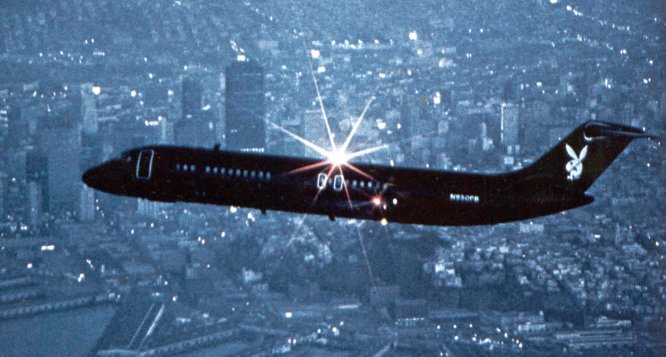
From ferrying a prized ape to a widowed mate, to rescuing refugees from Vietnam in Operation Babylift, Big Bunny – or Hare-Force One as it was otherwise known – served Hugh Hefner and the Playboy family for five years. No doubt it had its fair share of ‘mile-high’ flying exploits…

At its peak, over a quarter of all male American college-goers picked up Playboy magazine every single month. And what does the patriarch of this booming empire, idolised and hated in equal measures by both men and women the world over, do to cement his status as the kingpin of the media world? He buys a private plane; and we’re not talking about a Cessna 172. Nope – in the birth of the hugely exciting jet age, Hugh Hefner bought an airliner for use at his (and several significant others’) convenience.

bunny_in_flight_2

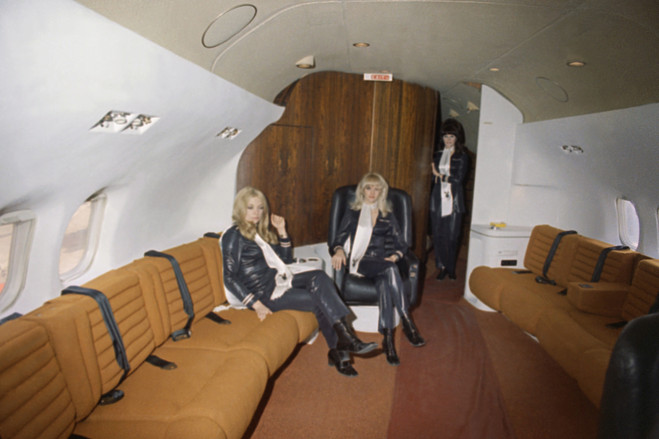
In February 1970, Hugh Hefner took his maiden flight aboard the Playboy plane – a brand-new McDonnell Douglas DC-9-32, bought for an alleged USD 9m (a simply colossal sum at the time). This particular DC-9, though, was worlds away from its commercial brethren. In typical Playboy fashion, it was packed to the rafters with flamboyance and excess. Painted jet-black with Playboy rabbits adorning the tail fin, it was crammed with lavish décor and then-state-of-the-art technology. Those wanting to rest and relax could do so in the 12 folding sleeper chairs, while those in the mood could choose from several recreational activities – dancing in the discotheque or catching a film in the onboard cinema, for example.

bunny4

Mere mortals (playmates and celebrities) entered the jet through the front staircase, while Hugh’s personal boudoir – complete with Tasmanian opossum-fur-covered elliptical waterbed – was entered via a private folding staircase at the rear of the fuselage. There’s no doubt that here is where the proverbial magic happened. It wasn’t all fun and games aboard Big Bunny, though, and with air travel comes serious risk and responsibility, hence Hugh took the liberty of officially training several playmates as air-stewardesses; though the rabbit ears and bushy tails were dispensed with, in favour of knee-high boots and white aviator scarves.

Aside from shuttling Hefner and world-famous celebrities (Elvis, and Sonny and Cher, to name but three) from city to city, Big Bunny took some unusual excursions in the name of publicity. She not only rescued Vietnamese babies following the fall of Saigon, but also ferried a gorilla named Baltimore Jack across America to meet a recently widowed mate. Jack reportedly took a liking to Hefner’s waterbed; make of that what you will. But all good things must come to an end and, in 1975, Big Bunny was gutted and sold to a Venezuelan airline. Of the thousands of passengers who subsequently flew on her, we wonder how many knew of the earlier goings-on aboard Hare-Force One.

bunny2

bunnyx

bunnyx1

bunny9


The Doomsday Jet

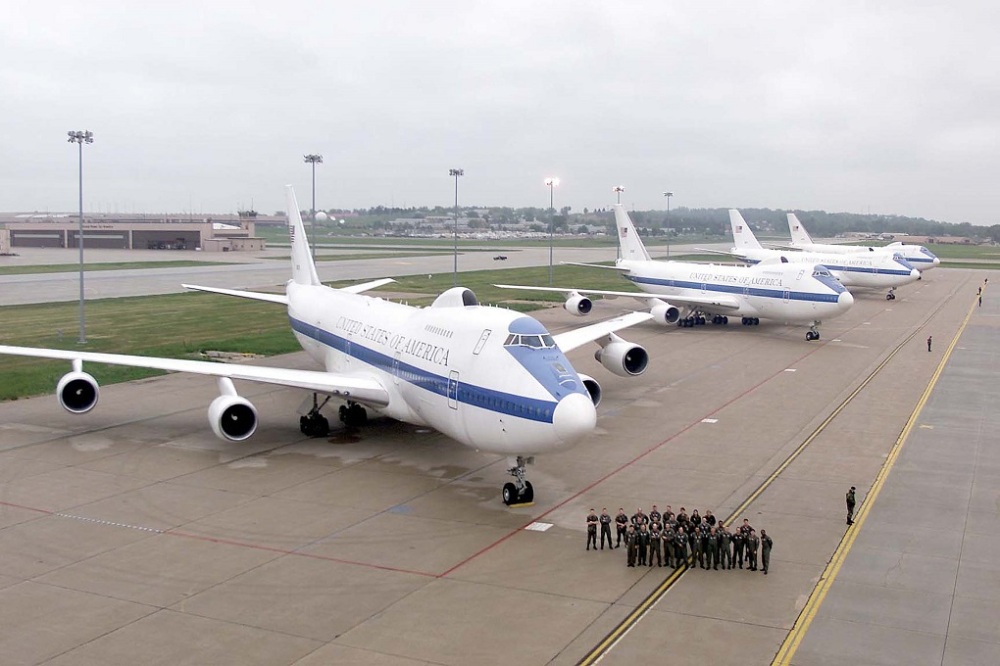
The Boeing E-4 Advanced Airborne Command Post, with the project name “Nightwatch”, is a strategic command and control military aircraft operated by the United States Air Force (USAF). The E-4 series was specially modified from the Boeing 747-200B. The E-4 serves as a survivable mobile command post for the National Command Authority, namely the President of the United States, the Secretary of Defense, and successors. The four E-4Bs are operated by the 1st Airborne Command and Control Squadron of the 55th Wing located at Offutt Air Force Base, near Omaha, Nebraska. An E-4B is denoted a “National Airborne Operations Center” when in action, it is to be a command platform in the event of nuclear war.

e41

 The E-4B is designed to survive an EMP with systems intact and has state-of-the-art direct fire countermeasures. Although many older aircraft have been upgraded with glass cockpits, the E-4B still uses traditional analog flight instruments, as they are less susceptible to damage from an EMP blast.[

The E-4B is capable of operating with a crew up to 112 people including flight and mission personnel, the largest crew of any aircraft in US Air Force history. With in-flight aerial refueling it is capable of remaining airborne for a considerable period (limited only by consumption of the engines’ lubricants and food supplies). In a test flight for endurance, the aircraft remained airborne and fully operational for 35.4 hours, however it was designed to remain airborne for a full week in the event of an emergency. It takes two fully loaded KC-135 tankers to fully refuel an E-4B. The E-4B has three operational decks: upper, middle, and lower.

e44

E-4b

In January 2006, Secretary of Defense Donald Rumsfeld announced a plan to retire the entire E-4B fleet starting in 2009. This was reduced to retiring one of the aircraft in February 2007. The next Secretary of Defense, Robert Gates reversed this decision in May 2007. This is due to the unique capabilities of the E-4B, which cannot be duplicated by any other single aircraft in Air Force service, and the cancellation in 2007 of the E-10 MC2A, which was considered as a successor to the EC-135 and E-8 aircraft, and could also perform many of the same tasks of the E-4B. As of the 2015 federal budget there were no plans for retiring the E-4B. The E-4B airframe has a usable life of 115K hours and 30K cycles, which would be reached in 2039; the maintenance limiting point would occur some time in the 2020s.

All four produced are operated by the U.S. Air Force, and are assigned to the 1st Airborne Command Control Squadron (1ACCS) of the 55th Wing at Offutt Air Force Base, Nebraska. Maintenance and crews are provided by Air Combat Command. Operations are coordinated by the United States Strategic Command.

When the President travels outside of North America using a VC-25A as Air Force One, an E-4B will deploy to a second airport in the vicinity of the President’s destination, to be readily available in the event of a world crisis or an emergency that renders the VC-25A unusable. When the President visits Honolulu, Hawaii, an E-4B has often been stationed 200 miles away at Hilo International Airport on Hawaii Island.

e43

Battle Staff Cabin

e47

E-4_advanced_airborne_command_post_EMP_sim

A right front view of an E-4 advanced airborne command post (AABNCP) on the electromagnetic pulse (EMP) simulator for testing.

e48

e49

An electromagnetic pulse (EMP), also sometimes called a transient electromagnetic disturbance, is a short burst of electromagnetic energy. Such a pulse’s origination may be a natural occurrence or man-made and can occur as a radiated, electric or magnetic field or a conducted electric current, depending on the source.

EMP interference is generally disruptive or damaging to electronic equipment, and at higher energy levels a powerful EMP event such as a lightning strike can damage physical objects such as buildings and aircraft structures. The management of EMP effects is an important branch of electromagnetic compatibility (EMC) engineering.

Weapons have been developed to create the damaging effects of high-energy EMP. These are typically divided into nuclear and non-nuclear devices. Such weapons, both real and fictional, have become known to the public by means of popular culture.

The Baltic Bees

BalticBees_FotoPoork_00005

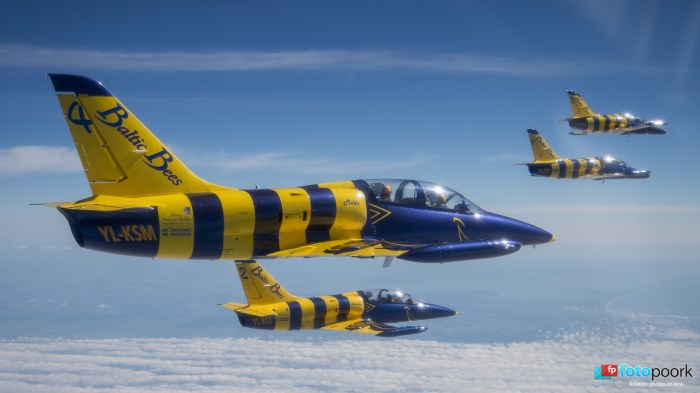
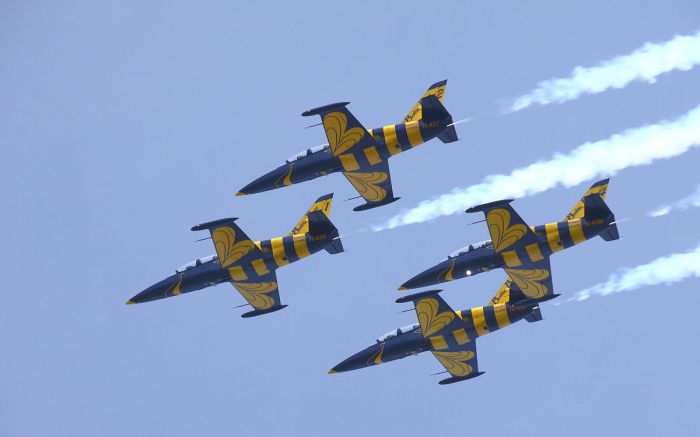
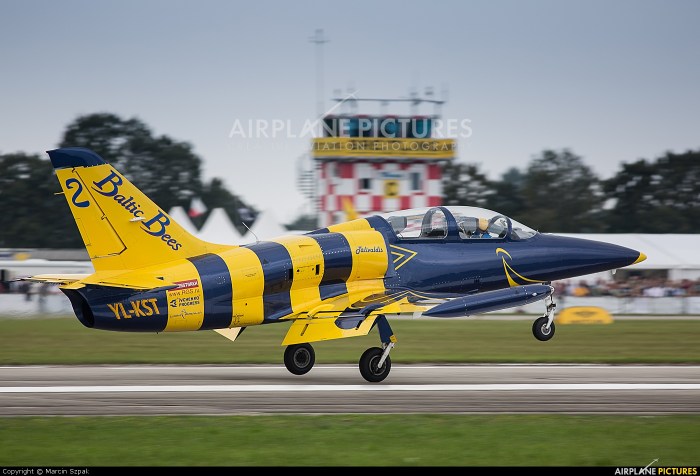
The Baltic Bees is an civilian aerobatic team based at airport of Tukums in the Tukums district in Latvia , it has five Aero L-39C Albatros .

The patrol was founded in 2008 by a private airline company. The first performance was on 26 July 2009 with four aircraft and on August 1 of that year the first participation in a public event at the Tukums Air Show.
The five aircraft currently in use are painted with blue and yellow colors representing a ‘ bee , insect luck in the Baltic countries , and referred to by the name (translated from’ English “Baltic Bees”).

Baltic_Bees_1873

baltic bees


NASA’s Armstrong Flight Research Center

Armstrong Flight Research Center is NASA’s primary center for atmospheric flight research and operations. NASA Armstrong is chartered to research and test advanced aeronautics, space and related technologies that are critical to carrying out the agency’s missions of space exploration, space operations, scientific discovery, and aeronautical research and development.

Located at Edwards, California, in the western Mojave Desert, Armstrong is uniquely situated to take advantage of the excellent year-round flying weather, remote area and visibility to flight test some of the nation’s most unique aircraft and aeronautical systems.

Some examples of the research undertaken: Oblique Wing Research, SST and Sonic Boom Research, Autonomous Formation Flight Control, Atmospheric Research, Vortex study,  Develop Dyna-soar launch pad abort procedures, Variable Sweep Transition flight experiment,  F-15 – Thrust Vectoring, to name a few.

Selected aircraft:

nasa automatic collision avoidance technology

F-16D conducting Automatic Collision Avoidance Technology (ACAT) tests

nasa1

F-14 Tomcat

nasa2

F-15 Eagle

nasa3

F-18

nasa4

F-104 Starfighters

nasa5

Global Hawk Unmanned Aerial Vehicle (this drone is bigger than an F-16)

nasa7

SR-71 Blackbird

nasa8

F-16

nasa9

F-18 Hornet

nasa10

The infamous Predator drone

The current fleet

nasa6


Giant Water Bomber

Blast from the past: 2015.

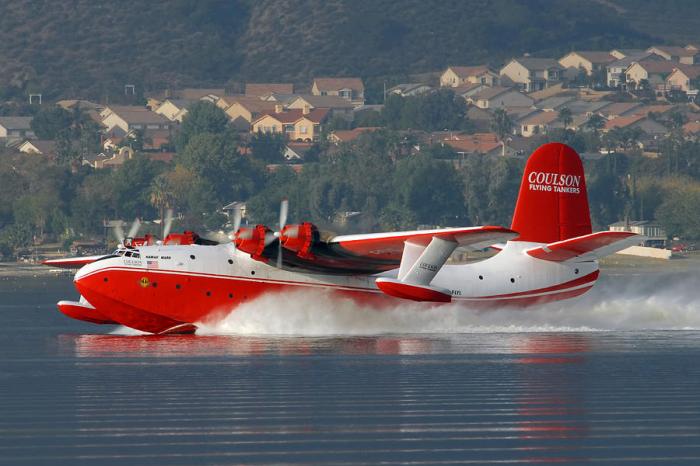
Despite no official deal in place with the B.C. government, one of the largest air water tankers in the world took a test dip in Sproat Lake near Port Alberni, B.C. to ready for action. It operated in 2015.

mars

The last remaining Martin Mars water bomber is “coming out of retirement” to fight the wildfires burning up B.C. this summer, Forests Minster Steve Thomson has confirmed.

About 195 fires are currently burning across the province, with dozens more fires popping up each day.

“Given the extraordinary fire situation this year, and recognizing that public safety is paramount, we need to look at every possible tool in our toolbox,” said Thomson in a statement issued on Wednesday.

The ministry confirmed earlier this week it was in negotiations to use the aging air tanker, but the deal was not confirmed publicly until yesterday

“Today, I’m pleased to announce that we’re entering into a one-month agreement to use the Martin Mars air tanker.”

mars1

mars2

General characteristics

  • Crew: four (with accommodations for a second relief crew)
  • Capacity: JRM Mars – 133 troops, or 84 litter patients and 25 attendants or 32,000 lb (15,000 kg) payload, including up to seven Willys MB jeeps
  • Water/foam load: Mars waterbomber – 60,000 lb (27,000 kg)
  • Length: 117 ft 3 in (35.74 m)
  • Wingspan: 200 ft 0 in (60.96 m)
  • Width: 13 ft 6 in (4.11 m) Hull beam
  • Height: 38 ft 5 in (11.71 m) afloat, 48 ft (15 m) beached
  • Hull draught: 5 ft 6 in (1.68 m)
  • Wing area: 3,686 sq ft (342.4 m2)
  • Empty weight: 75,573 lb (34,279 kg)
  • Gross weight: 90,000 lb (40,823 kg)
  • Max takeoff weight: 165,000 lb (74,843 kg)
  • Fuel capacity: Hawaii Mars: 6,485 US gal (24,550 l; 5,400 imp gal) Philippine Mars: 13,200 US gal (50,000 l; 11,000 imp gal)
  • Powerplant: 4 × Wright R-3350 Duplex-Cyclone 18-cylinder radial engines, 2,500 hp (1,900 kW) each
  • Propellers: 4-bladed Curtiss Electric, 15 ft 2 in (4.62 m) diameter variable-pitch propellers

coulson-flying-tankers-martin-hawaii-mars-brian-lockett

Jet Aerobatic Teams from around the World

Here is a list of some of the top Aerobatic Jet Teams in the world.  Most of these teams are military jet teams, but there are also a few civilian teams.

These teams perform high-speed intricate manoeuvres often involving extremely close precision formations.  It is very dangerous stuff.  The pilots have to know exactly what the other members are doing and where they are at all times.  Accidents have happened with loss of life, but it is very rare.

I have included 10 military teams and 2 civilian teams.  There is no rating as the criteria would not be uniform throughout all the teams.  Some teams, especially the Russian and United States teams, fly top of the line high performance fighters.  While other teams use advanced trainers. 

Lets get this list airborne.

Blue Impulse.  Japan.

Aircraft:  9 Kawasaki T-4’s, Trainer

Turkish Stars.  Turkey.

Aircraft: 10 NF-5A Freedom Fighters.  Fighter.

Patrouille de France

Aircraft:  8 Alpha Jets.  Trainer.

August 1 (aerobatic team).  China.

Aircraft:  6 Chengdu J-10.  Fighter.

Russian Knights

Aircraft:  6 SU-27’s.  Fighter.

Royal Air Force Red Arrows.  United Kingdom.

Aircraft:  9 Hawk T1A’s.  Trainer.

Snowbirds.  Canada.

Aircraft:  11 CT-114 Tutors.  Trainer.

Blue Angels.  United States.

Aircraft:  10 F/A-18 Hornets.  Fighter.

Russian Swifts

Aircraft:  6 Mig-29’s.  Fighter.

Thunderbirds.  United States.

Aircraft:  8 F-16 Fighting Falcons.  Fighter.

Jet aerobatic teams are not exclusive to militaries.  They are several civilian teams from around the world.  Below are two of the most prominent.

Team Breitling.  France.

Aircraft:  5 L-39 Albatross.

jetsx1

Patriots Jet Team.  United States.

Aircraft:  4 L-39 Albatross.

Top 50 countries by number of business jets registered

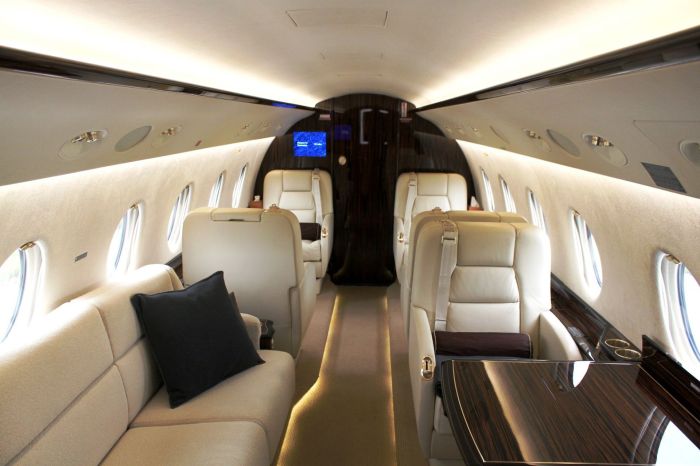
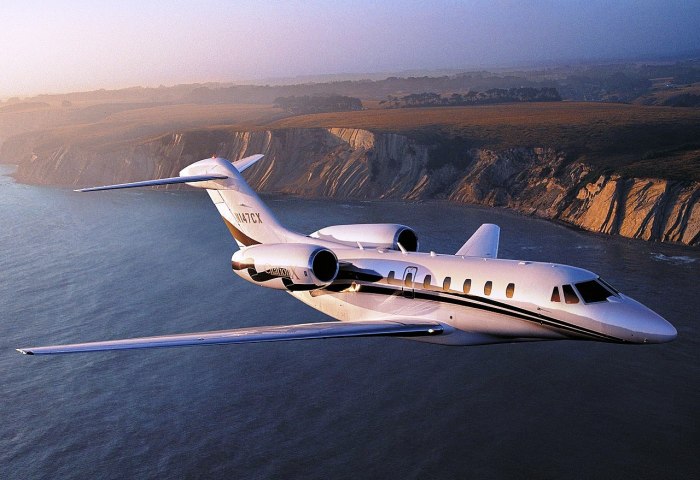
The table below presents the top 50 countries by the number of business jets in operation. It will come as no surprise that the number of aircraft registered in the US is far greater than anywhere else in the world. Out of all of the 50 countries below, the US alone accounts for 67 per cent of business jets and 63 per cent of the global fleet.

00gulfstreamg650_aerial_7_1300_580_70

Gulfstream G650. Highest rated business jet

00Gulfstream-G200-private-jet-interior

In sixth position with 264 aircraft, the Isle of Man, located off the coast of the UK, opened for business in May 2007 and is continuing to be seen as a popular and quick place to register aircraft.

Latin American occupies three places in the top 10, with Brazil and Mexico in second and third Venezuela at number 10. Brazil, in particular, is a vast country that takes time to travel across, so the number of smaller aircraft provide businesses with vital links between towns and cities. Although no age analysis is available, the number of older aircraft in both Mexico and Venezuela is noticeable and with little official information available, it is proved difficult to obtain true numbers of aircraft that are still currently active.

Austria’s position at number seven is partly due to a number of aircraft with Russian owners. Russia’s own import duty and tax payable on aircraft placed on the Russian register makes Austria a very attractive alternative country to register aircraft – something that also benefits the Isle of Man.

The number of business jets registered in China excludes aircraft registered in Hong Kong, Macao and Taiwan, each of which appear under their own entries. If we were to consolidate the three countries, China would jump two places in the list to number seven. Hong Kong, in particular, has a large number of aircraft registered and appear at 35th place with 32 business jet on the register.

Most popular private jet registries

Position Registered Country No. of Aircraft
1 United States 12,051
2 Brazil 764
3 Mexico 704
4 Canada 483
5 Germany 387
6 Isle of Man 264
7 Austria 244
8 United Kingdom 241
9 China 203
10 Venezuela 168
11 South Africa 160
12 Australia 154
13 Argentina 142
14 India 140
15 Portugal 138
16 France 132
17 Switzerland 123
18 Bermuda 117
19 Cayman Islands 114
20 Turkey 110
21 Spain 100
22 Italy 99
23 Denmark 62
24 United Arab Emirates 61
25 Saudi Arabia 56
26 Russian Federation 53
27 Luxembourg 48
28 Belgium 45
29 Aruba 45
30 Nigeria 41
31 Japan 36
32 Sweden 36
33 Malta 35
34 Czech Republic 34
35 Hong Kong 32
36 Philippines 32
37 Indonesia 27
38 Netherlands 27
39 Finland 26
40 Morocco 26
41 Thailand 25
42 Ukraine 24
43 Egypt 23
44 Chile 20
45 Serbia 17
46 Bulgaria 16
47 Kazakhstan 16
48 Colombia 16
49 Greece 15
50 Pakistan 15

Most popular business jet: Cessna Citation series with over 7000 built

00Cessna-Citation-X

Looking for a smaller aircraft, the Honda Jet

00honda-jet-1

00hondajet_04

Nine Incredible Military Aircraft that Never Made it Past the Test Phase

You have to give credit to our American cousins.  They never say never.  The most hair-brained ideas get the go-ahead and millions of dollars will be spent to develop these brainstorms.  But every so often some of these schemes evolve into amazing contraptions that are extremely remarkable. 

Space.com

Ambitious but Flawed Aircraft Concepts

As one would expect, planes have to go through a lot of trial runs before the military is willing to put the money and resources required into their production.

So when an airplane disintegrates in midflight or can only be operated successfully by expert pilots with hours of training, that plane joins hundreds of others that were great in theory, but never made it to mass production. Here we present you with ten of the ambitious and flawed aircraft concepts, and why only a few of them ever got made.


HK-1 Hercules (The Spruce Goose)

While the original idea for the HK-1 Hercules came from Henry J. Kaiser, a shipbuilder during World War II and the U.S. Army, Howard Hughes was the one who brought the ‘Spruce Goose’ into existence in 1947.

The 400,000-pound wooden airplane had a 320-foot wingspan (that’s just 40 feet less than a football field) and was proposed as a way to build a plane that could carry troops and cargo without using precious wartime materials.  The plane had a single large hull, produced thrust with eight engines and by the time it was completed in 1947, had cost the U.S. government $22 million and Hughes $18 million.

Hughes planned for the plane to carry 750 fully equipped troops or one M4 Sherman tank.  The HK-1 was the largest airplane ever built up to that point, in fact, it was three times larger than any plane that came before it. Despite all the money and time that went into its creation, the plane only flew once; it traveled a distance of one mile, at a height of about 33 feet.

HZ-1 Aerocycle

The HZ-1 Aerocycle  – known as the ‘motorcycle of the air’ was one of several single person flying platforms that the U.S. Army looked into during the 1950s and 60s.

The Aerocycle carried a single pilot and its engine on a circular platform, all of which was located just above two 15-foot long rotating propellers.  The craft’s pilot would stand toward the rear of the platform, secured by a tether attached to the steering column.

Single person flying platforms were going to be used for reconnaissance missions. The belief was that they were easy to pilot so little experience was needed to operate one. They learned otherwise during the testing phase when two pilots crashed because the Aerocycle was ‘too hard to steer without experience.

X-13 Vertijet

Its origins sound more like a bet than a Navy contract; the Ryan Company was tasked with seeing if they could develop a plane that could launch from the vertical position like a rocket. The Navy came up with the idea as a way to launch aircraft from a submarine. The nose of the aircraft had a hook on the underside, which was used to hang the Vertijet from the vertical trailer-bed landing platform. From there it was able to take off, achieve horizontal flight and then land back in the vertical position.

The plane was finally tested in 1957, but was never developed further due to a lack of operational requirement. The military simply had no use for it on the battlefield anymore.

XC-120 Packplane

Aeronautic Systems Center History OfficeIn an attempt to create a plane that was easier to unload, Fairchild developed the Packplane, which had removal cargo pods.

The pod was positioned below the fuselage and made getting cargo on and off the plane much quicker – the pod could be removed, a new one placed in and the aircraft would be ready for take off again. The Packplane’s upper component had a flat bottom and could be flown without the cargo hold being attached.

The company only built one XC-120, but the idea was never pursued further as it didn′t really improve that much on airplanes with traditional cargo carrying compartments.

XF-85 Goblin

The XF Goblin resembles a plane you expect to see a video game character piloting. It was conceived during World War Two, and was supposed to be a plane within a plane.

Nicknamed the ‘Flying Egg,’ the Goblin was meant to act as a defender – a parasite fighter – which would be dropped from the bomb bay of the mother ship to deal with enemy fighters while it’s carrier, the Peacemaker B-36, went on its way. Because it needed to fit in the bay of the B-36, there were a lot of size constraints. The Goblin could only be sixteen feet long, and only five feet wide when stowed. Its wings were designed to fold up alongside each side of the fuselage to fit into the B-36.

There were multiple reasons that the Goblin never made it past the testing phases. The little plane was no match for conventional enemy fighters: it was too slow and too lightly armed. In addition, the increasing range of jet escort fighters, thanks to the advent of in-flight refueling, allowed them to accompany bombers on their full missions.

Convair XFY Pogo

Convair’s XFY Pogo looks a lot like a combination between the X-13 Vertijet and the XF-85 Goblin. The Pogo had three wings arranged as a triangle, and three-bladed rotating propellers.

It was an experiment in vertical takeoff and landing. The plane was known as a tailsitter because it launched and landed on its tail.  Its developers believed that this would make it possible to operate them from small warships.

Issues with the Pogo’s design prevented it from leaving the testing phase. Because it was so lightweight and had no spoilers, it lacked the ability to slow down and stop efficiently after moving at high speeds.

Landing also turned out to be a problem. The pilot had to look back behind himself during a landing to properly stabilize the craft. So like the Aerocycle, the Pogo could only be flown by the most experienced pilots.

A-12 Avenger II

Out of all the aircraft on this list, the Avenger II is by far the most futuristic looking. It even looks pretty advanced for today, despite the fact that it was designed 20 years ago.

The A-12 was designed to be an all-weather, carrier-based stealth bomber based from air carriers.  It was shaped like an isocles triangle, with a cockpit at the vertex. Its internal weapons bay would carry smart bombs and other air-to-ground ordnance.

In the end the ‘flying dorito’ as it was nicknamed proved to be too expensive for development. By one estimate the A-12 had become so expensive that it would have consumed up 70 percent of the Navy’s aircraft budget within three years.

F2Y Sea Dart

Disintegrating in midair is a surefire way for an aircraft to be scrapped during the testing phase. Such was the fate of the Sea Dart.

The F2Y was the winner of the Navy’s 1948 competition for a supersonic interceptor aircraft. The Navy was worried about operating supersonic aircraft from the decks of aircraft carriers so the Sea Dart seemed like the perfect solution as it rode on twin hydro-skis for takeoff.

Despite its horrific final flight, the Sea Dart does hold one record as the only seaplane to ever go faster than the speed of sound.

Dyna-Soar

A plane with a name like the Dyna-Soar has to be pretty impressive, and despite never making it beyond a test plane, it was.

Developed in 1957, the X-20 Dyna-Soar (dynamic soarer) was a U.S. Air Force program to develop a space plane that could be used for military missions, such as reconnaissance, bombing, space rescue, satellite maintenance and sabotage of enemy satellites.

While other space planes at that time were based on space capsules, which means they relied on the atmosphere’s drag to slow them down. The Dyna-Soar was much more similar to our space shuttles, which glide to earth under the guidance of a pilot.

The Dyna-Soar never made it beyond a test plane because the Air Force has no clear goal for the aircraft, and its developers were uncertain that the boosters would have the power to effectively launch the plane into space.