The habitat ranges of very dangerous snakes in the U.S.

I’m glad I live in the middle of the Great White North. No venomous snakes! For some inexplicable reason I had a dream about being in Florida the other night. That sounds like a good dream: Disneyworld, Miami Beach and warm temperatures. But what was odd about this dream was that I was in a semi-swampy area where there were hordes of aggressive, large poisonous snakes. It was a freaky dream, lots of running away from snakes. Having snakes crawl from under couches etc. The last I remember about the dream I was attacking some smaller snakes in a motel room with a spade. Crazy dreams!

That dream led me to research deadly snakes in the United States. The bastards are all over the place.

The Eastern Diamondback Rattlesnake.


eastern


aa-eastern-diamonback

This is a big bitch. Up to 8 feet long and 35 pounds. Some think it is the biggest pit viper in the world. Run into this thing while searching for the golf ball in the scrub and I would instantly meet the maker, and that is without getting bitten. Notice it’s throughout Florida.


Western Diamondback Rattlesnake


aa-western-diamondback

Very similar to the Eastern but a lot smaller. Likes the desert as opposed to it’s cousin which likes lush forested areas.


Cottonmouth, also known as the Water Moccasin


cottonmouth


aa-cottonmouth


This is a nasty little bastard. The cottonmouth is one of the most feared venomous snakes in North America. Its powerful cytotoxic venom is so destructive that it can eat away flesh and result in grisly amputations. Their preference for hiding in water and attacking when least expected means that bites are also relatively frequent. Again, another deadly snake that slithers throughout Florida.

Copperhead

copperhead

aa-copperhead

For some reason this snake avoids Florida.

The copperhead is perhaps responsible for the most bites of any snake on this list. It’s not because the snake is inherently more aggressive, but because copperheads tend to “freeze” when met with approaching humans—instead of fleeing like most other, sensible snakes—and will bite when stepped on.

The copperhead also has what is believed to be the weakest venom potency of all pit vipers, which is a happy coincidence for the snake that is otherwise most likely to bite you.


Timber Rattlesnake


aa-timber-rattlesnake

I never realized there were so many rattlesnakes in the east. Florida spared again.


Coral Snakes


aa-coral-snake

Eastern coral snakes are very reclusive and are rarely seen, which is great for hunters and hikers across the American Southeast. The eastern coral snake was once seen as the most dangerous snake in the region. While that reputation hasn’t exactly subsided, experts now say that fatalities from this dangerous species are actually very rare. This is thought to be because the coral snake has very little control of how much venom it can inject into a victim.


Massasauga Rattlesnake


Canada isn’t entirely left out

aa-massasauga-rattlesnake

These pesky rattlesnakes go all the way up to the tip of southern Ontario. To the edges of Canada’s number one city Toronto, at least that is what the residents of Toronto think.


Prairie Rattlesnake


aa-prairie-rattlesnake

More Canadian content here. These critters crawl all the way up to Saskatchewan and Alberta. Florida is spared again!

India puts Gujarat lions on trial after three people killed

asia2

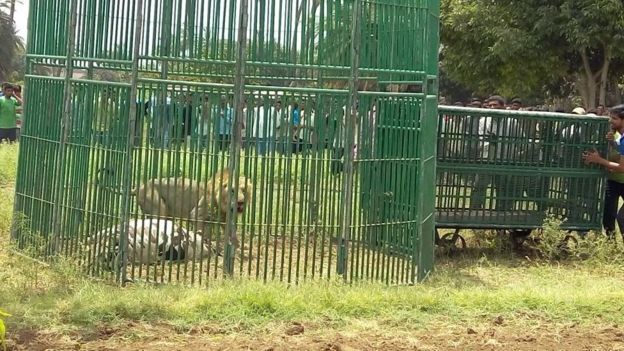
Officials in India have “arrested” 18 lions as they try to find a man eater suspected of killing three people.

Forest officials in Gujarat state will test the lions’ prints and excrement in an attempt to identify the killer.

The “guilty lion” will be kept in a zoo for life while the others will be released back into the Gir sanctuary, the officials told BBC Hindi.

Six attacks on humans have been reported recently near the sanctuary, the only habitat of the Asiatic lion.

Gujarat’s top forest official, JA Khan, said that the lions had been “arrested” over the past two months and were now being held in separate cages while tests were carried out.

“We think we have pinpointed the guilty lion, but we are still awaiting the results of nine more animals,” he said.
asia
Innocent lions will be released back into the Gir forest

Wildlife expert Ruchi Dave told the BBC that the “tests” involved studying the pug marks and faecal matter of the lions.

“The officials are also studying the animals’ behaviour. Man eating lions usually get aggressive at the sight of a human being,” she said.

Another wildlife expert Revtubha Raizada said the man-eating lion would be caged for the rest of its life, as it was too unsafe to release it back into the wild.

Some experts feel that the thriving lion population in Gir forest is to blame for the “unusual” behaviour by the lions.

Govind Patel, the former chief wildlife warden of Gujarat, told the Indian Express newspaper that Gir could accommodate only 270 lions, forcing some prides to settle outside the boundaries of the sanctuary.

India’s Supreme Court has ruled that Gujarat needed to relocate some of its lions to other states to avoid the possibility of disease or other disaster wiping out the entire population.

However the state has expressed reluctance and has not yet complied with the order.


asia1

Six cases of lions attacking humans have been recently reported near the Gir forest

The Asiatic lion (Panthera leo persica), also known as the Indian lion or Persian lion, is a lion subspecies that exists as a single population in India’s Gujarat state. It is listed as Endangered by IUCN due to its small population size. Since 2010, the lion population in the Gir Forest National Park has steadily increased.

In May 2015, the 14th Asiatic Lion Census was conducted over an area of about 20,000 km2 (7,700 sq mi); the lion population was estimated at 523 individuals, comprising 109 adult males, 201 adult females and 213 cubs.

asiatic4


asiatic5

Asiatic lion at Gir Forest National Park.

The Photographer Who Took This Picture Barely Escaped With His Life

Pakistani nature photographer Atif Saeed managed to capture this stunning shot of a lion — just before it leapt at him.

lion

This photograph was snapped by Atif Saeed at a safari zoo park near Lahore. He got out of his jeep to take the photo, but the sound of the lens’s whizzing caught the lion’s attention. Saeed figures the big cat got as close as 10 feet, before he was able to reach the safety of his jeep.

Once safely inside his vehicle, Saeed started to laugh about what had happened. But after some retrospection he came to realize just how close he came to death — and vowed to never do anything quite as reckless again.

lion1

The Death Defying Dam Climbing Alpine Ibex

alpine ibex climbing dams

Alpine Ibex are big mountain goats that live among the peaks in the European Alps where predators cannot reach. They occupy the steep, rocky terrain above the tree line between two to three thousand meters above sea level. But they can’t live there at all times, because there is no food up there. During spring and summer, the Ibex live among the conifers and the meadows where there are plenty of grass to feed. Before the first snow falls, the Ibex has to fatten up and build reserves to help see them through the Alpine winters. Once winter arrives, the Ibex retreats to the safety of their homes in the clouds.

Like many herbivores, the Alpine Ibex lacks salt and other essential minerals in their diet which they can’t get from grass. So the Ibex has to seek out natural salt licks. In springtime, when salt requirements are the highest, the Ibex can be seen licking rock surfaces for leached salts.

Dam walls are another precious source of salts and minerals. Dams are composed of concrete, and concrete releases a calcium-aluminium mineral called ettringite as part of the curing process. Up to twenty percent of hardened concrete is composed of ettringite.

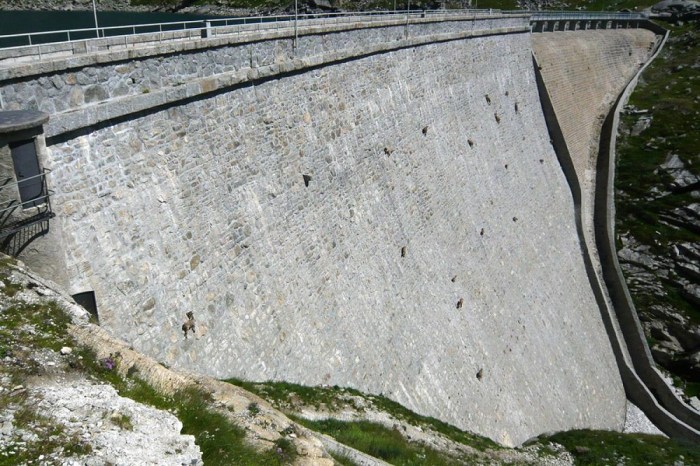
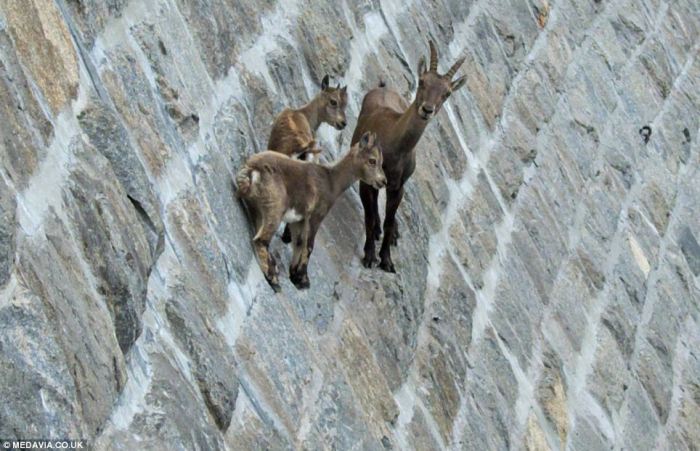
Only the Alpine Ibex can exploit this resource. Being excellent climbers, the Ibex will climb the sheer vertical face of the dam’s wall using the small protruding boulders as foothold to lick ettringite off the wall’s surface. The Ibex can scale such great heights because of their soft, split hooves that can grip any surface like a pincer.

The Cingino Dam in northern Italy, not far from the Swiss border, is one place where you can observe the Alpine Ibex’s gravity-defying stunts—but it’s not the only place. This behavior has also been observed at the Barbellino dam in Lombardy, and Lago della Rossa dam in Valli di Lanzo, Piemonte.

alpine ibex climbing dams


alpine ibex climbing dams


alpine ibex climbing dams


alpine ibex climbing dams


alpine ibex climbing dams


alpine ibex climbing dams


Wildlife Crossings around the World

Rapid deforestation and excessive human intervention into wildlife habitat has lead to frequent straying of wild animals into human habitation. Intrusion into wildlife habitat typically occurs due to illegal encroachment and also when roads, railroads, canals, electric power lines, and pipelines penetrate and divide wildlife habitat. Wild animals attempting to cross roads often find themselves in front of speeding vehicles.

Road mortality has significantly impacted a number of prominent species in the United States and elsewhere, including white-tailed deer, Florida panthers, and black bears. According to a study made in 2005, nearly 1.5 million traffic accidents involving deer occur each year in the United States that cause an estimated $1.1 billion in vehicle damage. In addition, species that are unable to migrate across roads to reach resources such as food, shelter and mates experiences reduced reproductive and survival rates.


Wildlife overpass in Banff National Park. Photo: Joel Sartore 

One way to minimize human-wildlife conflict is to construct wildlife crossings such as bridges and underpasses that allow animals to cross human-made barriers safely. The first wildlife crossings were constructed in France during the 1950s. Since then, several European countries including the Netherlands, Switzerland, Germany, and France have been using various crossing structures to reduce the conflict between wildlife and roads. In the Netherlands alone there are more than 600 tunnels installed under major and minor roads including the longest “ecoduct” viaduct, near Crailo that runs 800 meters.

Wildlife crossings have also become increasingly common in Canada and the United States. The most recognizable wildlife crossings in the world are found in Banff National Park in Alberta where the national park is bisected by a large commercial road called the Trans-Canada Highway. To reduce to effect of the four lane highway, 24 vegetated overpasses and underpasses were built to ensure habitat connectivity and protect motorists. These passes are used regularly by bears, moose, deer, wolves, elk, and many other species.


In the United States, thousands of wildlife crossings have been built in the past 30 years, including culverts, bridges, and overpasses. These have been used to protect Mountain Goats in Montana, Spotted Salamanders in Massachusetts, Bighorn Sheep in Colorado, Desert Tortoises in California, and endangered Florida Panthers in Florida.

The Netherlands contains an impressive number of wildlife crossings – over 600, that includes both underpasses and ecoducts. The Veluwe, a 1000 square kilometers of woods, heathland and drifting sands, the largest lowland nature area in North Western Europe, contains nine ecoducts, 50 meters wide on average, that are used to shuttle wildlife across highways that transect the Veluwe. The Netherlands also boasts the world’s longest ecoduct-wildlife overpass called the Natuurbrug Zanderij Crailo. This massive structure, completed in 2006, is 50 m wide and over 800 m long and spans a railway line, business park, river, roadway, and sports complex.

Ecoduct Borkeld in the Netherlands.

Banff.


Ecoduct Kikbeek in Hoge Kempen National Park, Belgium.


Banff


Elephant underpass in Kenya.


Around the World in 105 Cows

A book of bovine beauty shots seeks to revive the human-cattle bond.

cow

While Werner Lampert was living on an alpine pasture, he discovered that cows have an insatiable appetite for, among many things, poetry. Each morning, he’d clamber up a small hill to the pasture where his bovine neighbors were grazing. There, he’d read aloud the works of the German Romantic poet Friedrich Hölderlin. The cows would gather around him, listening attentively until he finished delivering the poem at hand. “When I stopped … they would soon scatter,” writes Lampert. “But the next morning they would be there waiting for me again.”

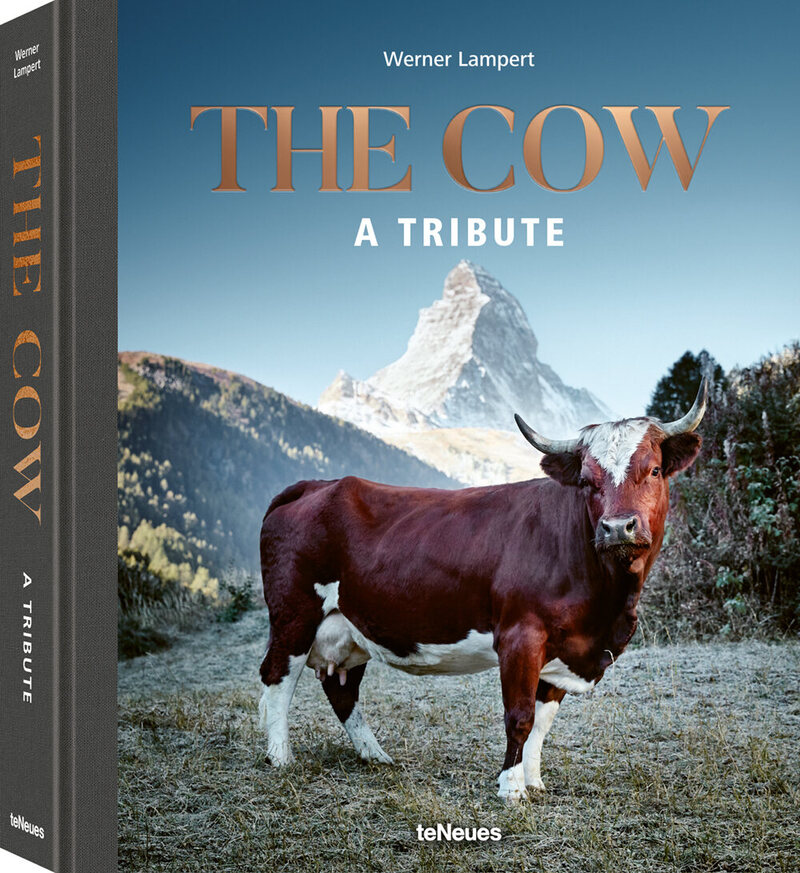
According to Lampert, cows and humans share a special relationship—one that goes way deeper than impromptu poetry readings. That’s why he partnered with a team of photographers to journey around the globe documenting the many breeds of cattle that populate the planet, as well as the humans who look after them, work with them, worship them, and eat them. His forthcoming book, The Cow: A Tribute, is an epic ode to the stunning diversity of cows and the many ways in which they’ve helped humans thrive over the past 10,000 years. From the skyward-pointing horns of Ethiopian Raya-Azebo cattle to the spellbinding eyes of Austrian Montafons, The Cow offers a comprehensive, striking mosaic of the global bovine body and soul. (Yes, Lampert asserts, cows have souls.)

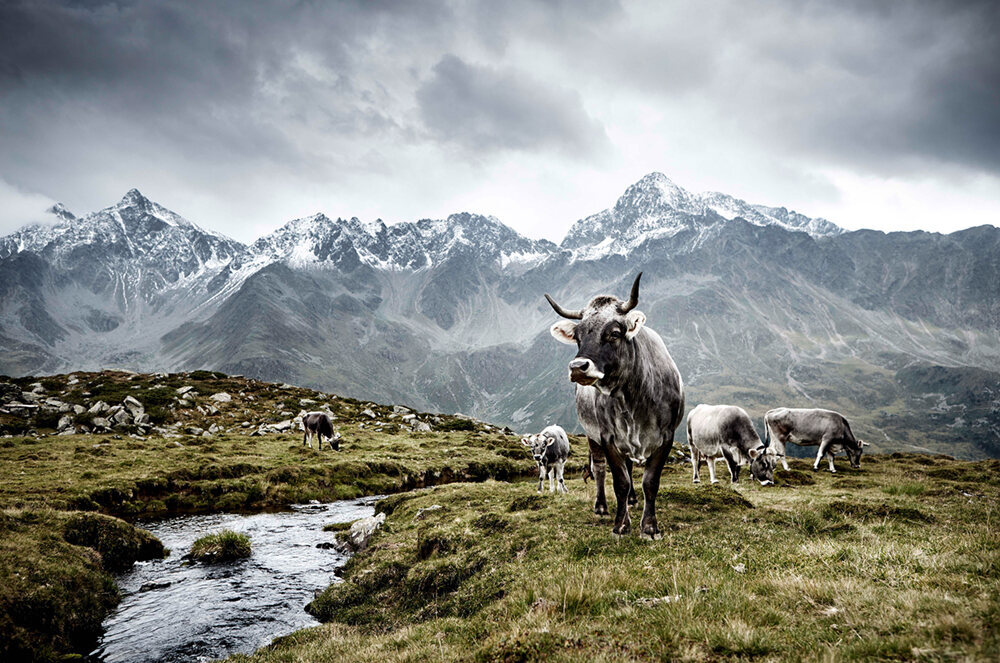
You should probably make this ridiculously stunning Grauvieh picture the background of whatever device you’re reading this article on.

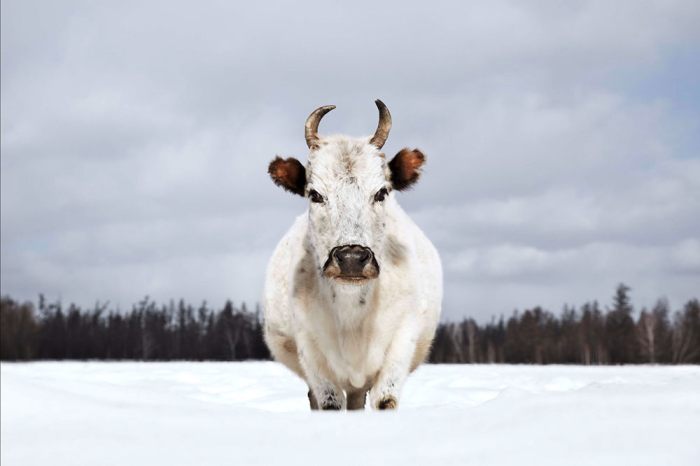
With the help of cows, writes Lampert, humans have been able to successfully inhabit even the most extreme environments. In parts of northeast Siberia, temperatures can dip as low as -90 degrees Fahrenheit. But, with thick, white hair covering its compact body and udder, the gritty Sakha Ynaga can still produce plenty of milk. The Sakha people rely on this high-fat beverage for nourishment and medicinal purposes, and use the Sakha Ynaga’s dung as insulation to keep their homes warm throughout the harsh winter.

The book itself.
The book itself. 

Lampert celebrates not only the resilience, strength, and utility of these age-old beasts of burden, but also the way they’ve shaped human communities, culture, and religion for thousands of years. Cows are spiritually revered within many religious communities, and have been since ancient times. “Sacrificial cattle were the link between man and the gods, a channel for sacred communication between them,” writes Lampert. “Cows were possibly the first sacred animals in human history.”

It’s with a similar tone of reverence that Lampert describes each breed of cow he profiles. He readily admits that an image of Tiroler Grauvieh, the silvery-grey, graceful cows that roam about the eastern Alps, currently features as the background image on his phone. “Of course!” he writes, “so I am reminded of their sheer beauty every day.”

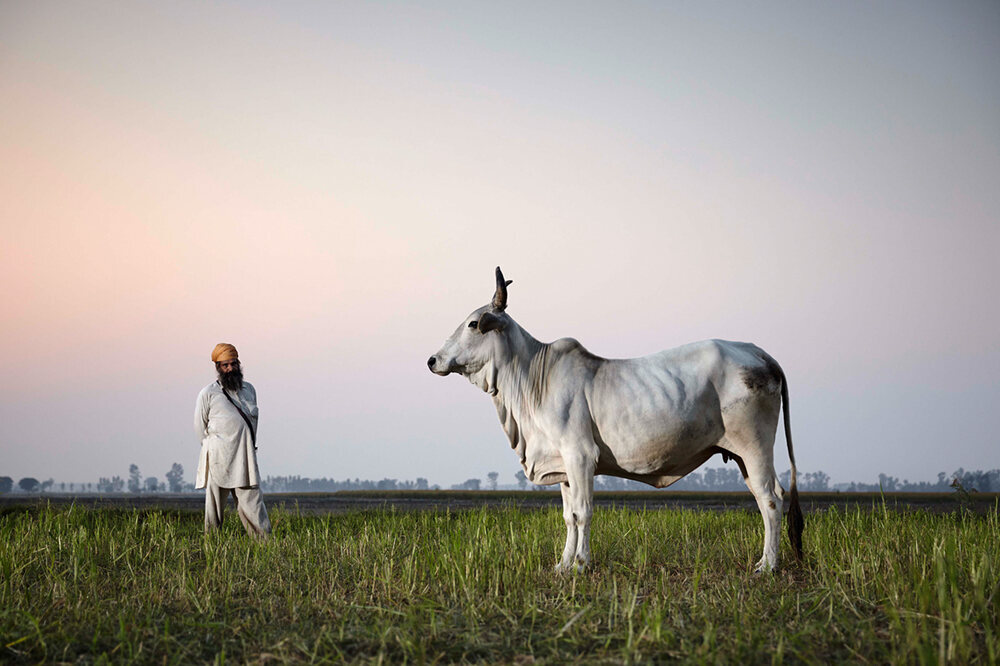
According to Lampert, the Hariana cow (Haryana, India) is a lie detector of a cow, and will “go quite crazy” if someone lies in its presence.
According to Lampert, the Hariana cow (Haryana, India) is a lie detector of a cow, and will “go quite crazy” if someone lies in its presence. WERNER LAMPERT GMBH, PHOTO JUDITH BENEDIKT

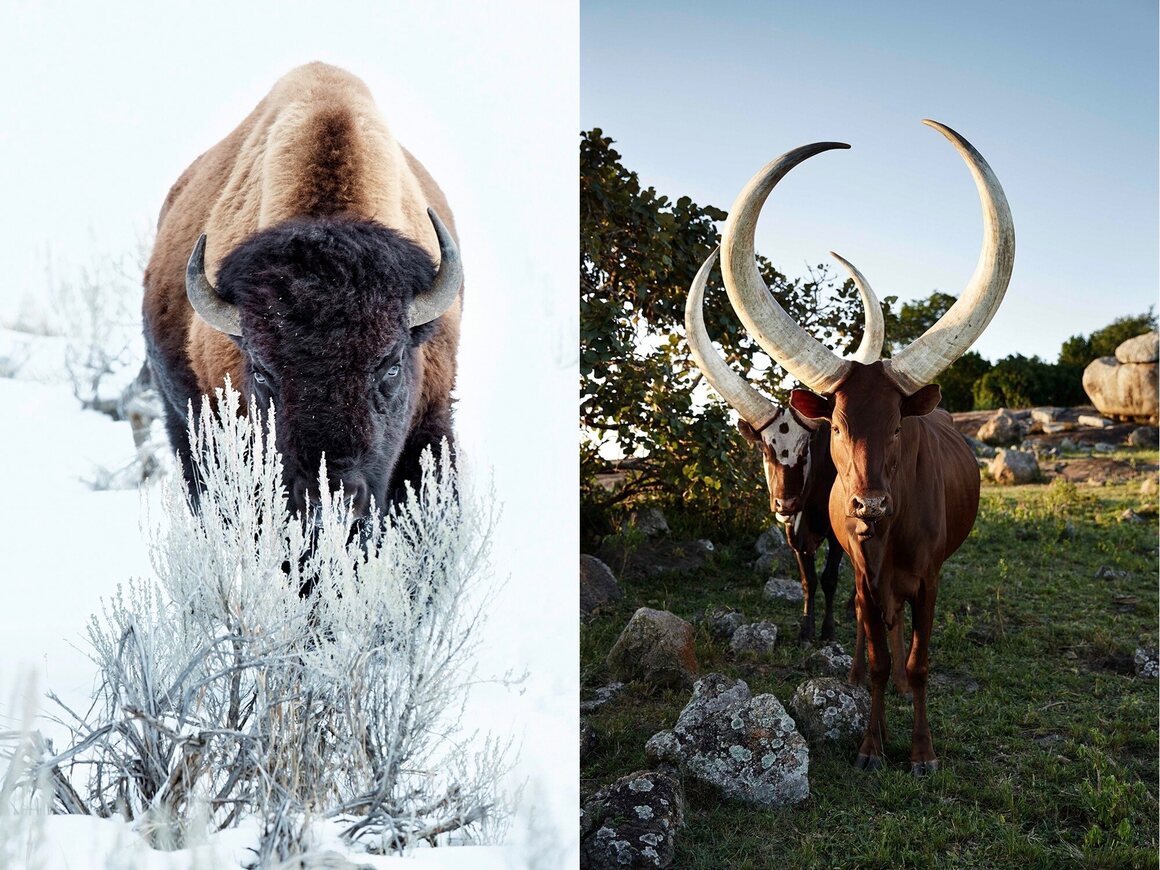
The Ankole, found in Uganda, as well as parts of the Congo, Burundi, Rwanda, and Tanzania, is characterized by its majestic gait and giant, twisting horns. Warm to the touch, the powerful, bony structures are believed to be crucial tools for keeping cool. Filled with supportive tissue, the horns usher in warm, circulating blood, which cools as it flows to the tip of the horn.

Lauded for its striking beauty, the Ankole is also integral to community structure and affairs. According to Lampert, these cows are never sold, but rather included in dowries, offered up as appeasement if someone has broken community rules, or gifted to those who have suffered some kind of misfortune. “Ankoles help maintain equilibrium between people,” writes Lampert.

But while some communities have embraced cattle and bolstered populations, others have essentially destroyed them. This is the history of the North American bison, which once numbered more than 30 million by some estimates, stretching in vast herds across the Great Plains. European colonization and decades of habitat destruction, reckless hunting, and mass killing of the creatures (intended to deprive Native American communities of a food supply), shrunk that number to nearly 1,000 by 1890.

A beautiful, fuzzy bison behind a bush (left) and two Ankoles and their iconic horns (right).
A beautiful, fuzzy bison behind a bush (left) and two Ankoles and their iconic horns (right)

In a way, Lampert’s tribute to the diversity of the world’s cows is also a eulogy. He searches desperately for the Kouprey, a beautiful, elusive, endangered ox believed to be living in the Cambodian jungle. But the team couldn’t find a single one. According to Lampert, they’ve likely fallen victim to poaching and habitat destruction. This is part of a larger trend, he says. According to the Food and Agriculture Organization, of about 1,408 breeds of cattle, 184 are listed as extinct and 490 as at risk.

There was, perhaps, a time when these utterly mystifying ungulates were more than just cash cows to most of us. But, Lampert points out, something in this special human-bovine bond has been broken. We’ve begun to take without giving—or even really appreciating—our bovine companions. We view them as products, not as the fascinating, resourceful, stunning creatures they are.

The cows seem to like music to.

bull1

bull7