With crops on the Canadian prairies still in the early stages of growth it’s a bit early for the farmers to pull out the combines. That that will be happening in 5-7 weeks. Down in the States the harvest will be starting shortly. The most integral part of the harvest today is the combine. And there are many variations when it comes to these giant machines. They come in all colours and sizes. The pictures below illustrate this.
A combine from many years ago

Another old one. No cab for the driver. The driver would have to sit in the dust and chaff for many hours at a time.

The modern combine harvester, or simply combine, is a versatile machine designed to efficiently harvest a variety of grain crops. The name derives from its combining three separate operations comprising harvesting—reaping, threshing, and winnowing—into a single process. Among the crops harvested with a combine are wheat, oats, rye, barley, corn (maize), sorghum, soybeans, flax (linseed), sunflowers, and canola. The waste straw left behind on the field is the remaining dried stems and leaves of the crop with limited nutrients which is either chopped and spread on the field or baled for feed and bedding for livestock.
Combine harvesters are one of the most economically important labour saving inventions, significantly reducing the fraction of the population that must be engaged in agriculture.


Sometimes the beasts operate in packs

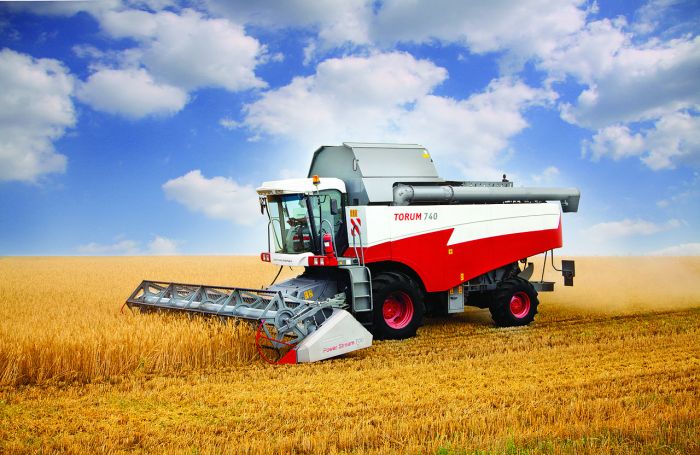 Above- a Russian Rostselmash Combine Torum 740


Conventional combine harvester (cut)
| 1) Reel 2) Cutter bar 3) Header auger 4) Grain conveyor 5) Stone trap 6) Threshing drum 7) Concave 8) Straw walker 9) Grain pan 10) Fan |
11) Top Adjustable sieve 12) Bottom sieve 13) Tailings conveyor 14) Rethreshing of tailings 15) Grain auger 16) Grain tank 17) Straw chopper 18) Driver’s cab 19) Engine 20) Unloading auger 21) Impeller |






 The MarkoZen Blog