Delhi smog: Foul air came from India’s farming revolution

If there was a gold medal for bad air, Delhi would be hard to beat.

Yet, despite high levels of air pollution, more than 30,000 people, many wearing masks, took part in the capital’s half marathon on Sunday. Organisers said they used devices on the route to transmit radio frequency waves to clear the air, but scientists were sceptical of these claims.

Delhi’s marathon, ironically, marked the beginning of the city’s smog season. But it has been creeping up on the capital for a few weeks now.

A fortnight ago, Nagendar Sharma was returning to Delhi from the hill station city of Shimla when he spotted smoke rising from the farms alongside the highway.

It looked like someone had picked up a box of matches and set the earth on fire. Lack of winds meant that the acrid smoke hung in the air.

Mr Sharma, the Delhi-based media adviser to the capital’s chief minister, was driving through Haryana, barely 70km (43 miles) from the capital.

When he stopped his vehicle to investigate he found that the farmers had begun to burn the stubble left over from harvesting rice. They said they had to remove the residue in three weeks to prepare the farms to sow wheat. They were burning the crop stubble as they could not afford the expensive machines that would remove them.
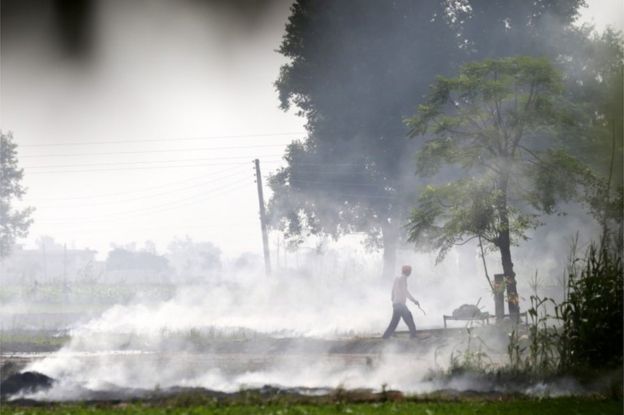
“It’s the same old story. Every year,” Mr Sharma said.

Every year, around this time, residents of Delhi wake up to a blanket of thick, grey smog. Pollution levels reach several times the World Health Organisation’s recommended limit. Last year, doctors declared a state of “medical emergency”; and hospitals were clogged with wheezing men, women and children.

Levels of tiny particulate matter (known as PM 2.5) that enter deep into the lungs reached as high as 700 micrograms per cubic metre in some areas. The WHO recommends that the PM2.5 levels should not be more than 25 micrograms per cubic metre on average in 24 hours.

Last winter Air Quality Index (AQI) recordings consistently hit the maximum of 999 – exposure to such toxic air is akin to smoking more than two packs of cigarettes a day. The city becomes what many call a “gas chamber”.

“This marks the beginning of the Great Smog that goes on to last for about three months, even though the crop residue burning lasts a few weeks. It is during this period that air quality indices hit their maximum possible limits, when visibility drops drastically, when regions even far away – such as Delhi – smell of burning gas,” says Siddharth Singh, energy expert and author of a book soon to be published, The Great Smog of India.

And although there are other reasons – construction dust, factory and vehicular emissions – it’s mainly crop residue that has emerged as one of the main triggers for the smog.

More than two million farmers burn 23 million tonnes of crop residue on some 80,000 sq km of farmland in northern India every winter.

BBC
Dry Dock Flooding

NEWPORT NEWS, Va. (Oct. 29, 2019) Huntington Ingalls Industries today began flooding the dry dock at its Newport News Shipbuilding division where the keel of aircraft carrier John F. Kennedy (CVN 79) was laid in 2015. The controlled process of slowly filling the dry dock with more than 100 million gallons of water takes place over several days, and marks the first time the ship has been in water. Kennedy is expected to join the fleet in 2022.

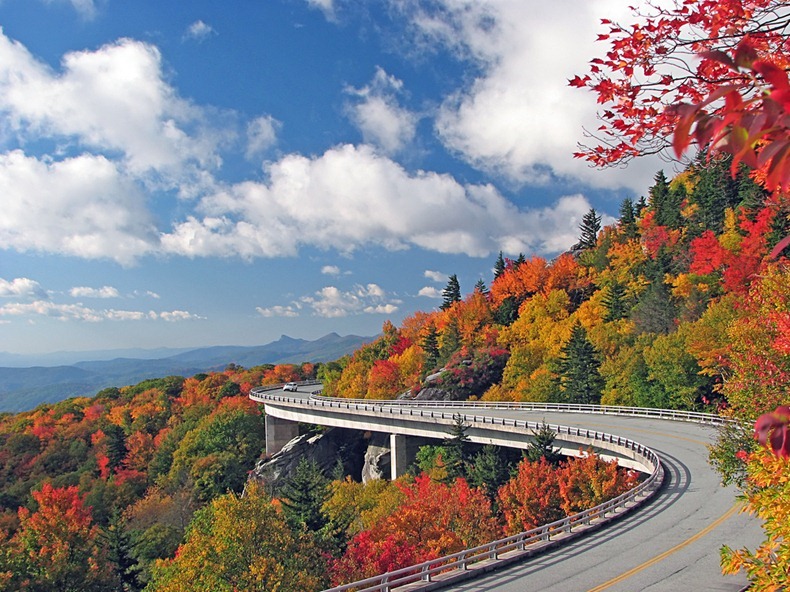
Linn Cove Viaduct

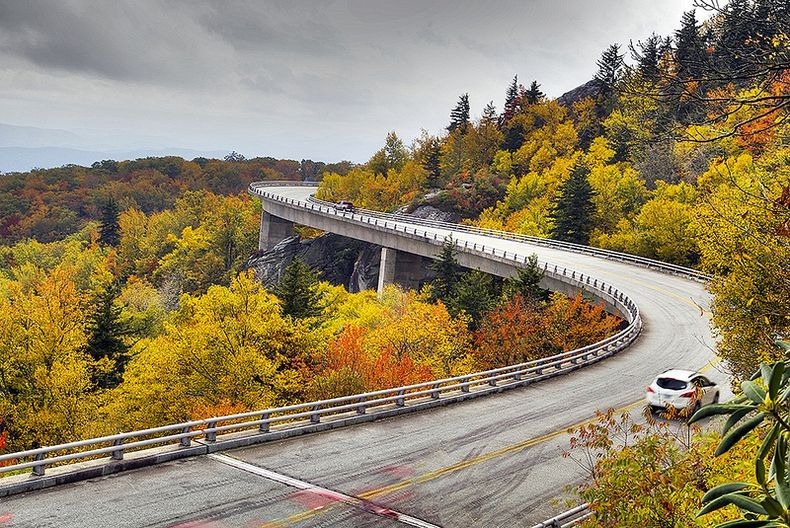
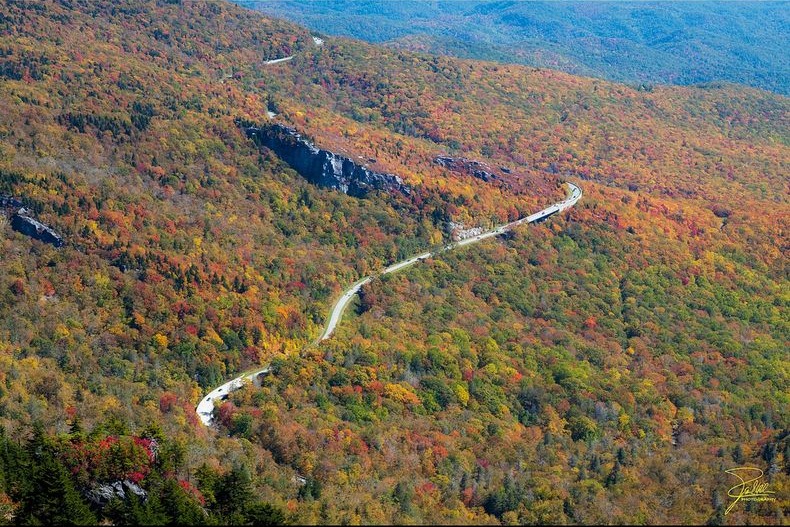
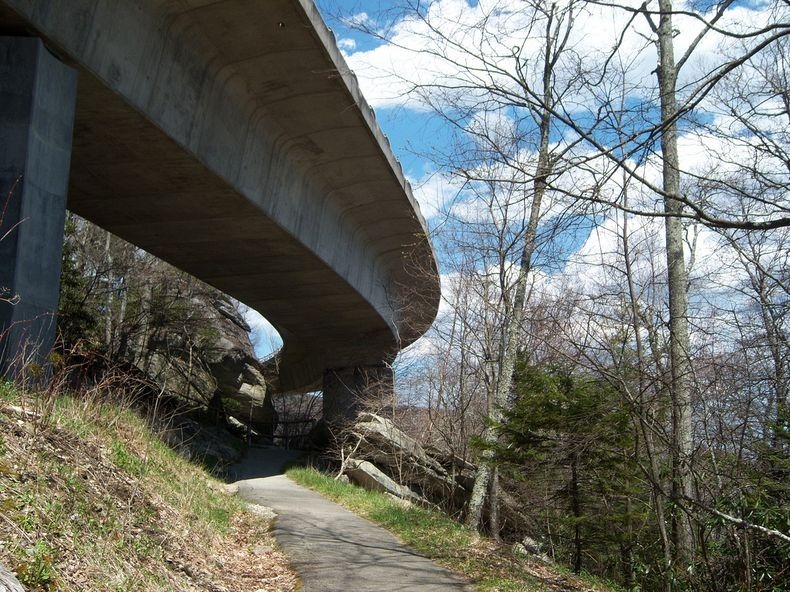
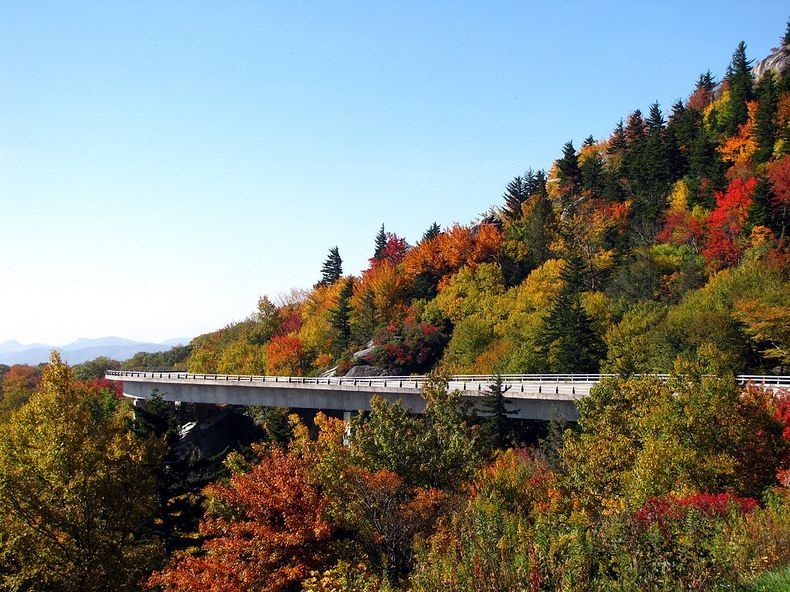
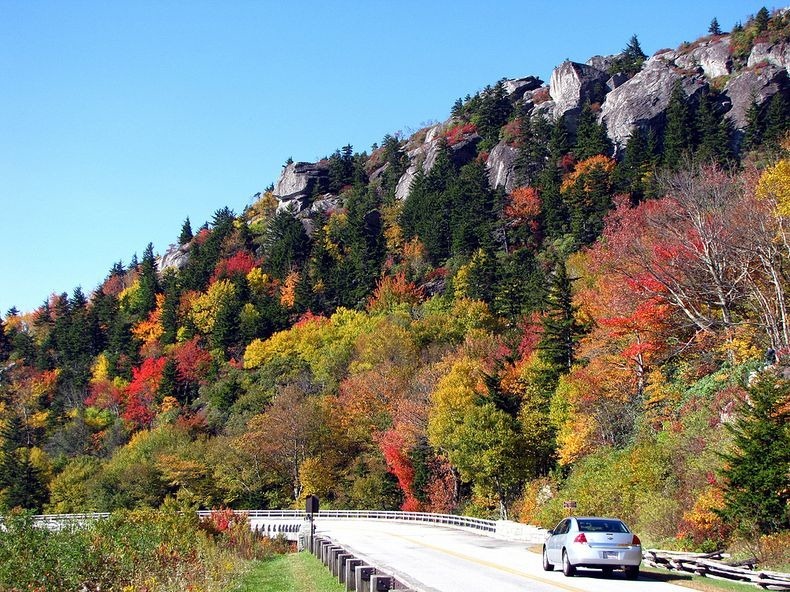
Linn Cove Viaduct is a 379 meter concrete segmental bridge which snakes around the slopes of Grandfather Mountain in North Carolina. Completed in 1987, at a cost of $10 million, it was the last section of the Blue Ridge Parkway to be finished, and considered to be one of the most challenging bridge constructions.

The viaduct was built to minimize the damage that a traditional cut-and-fill road would have caused to Grandfather Mountain. Supported by seven massive pillars, the viaduct almost floats in the air without disturbing the land below. To eliminate damage to the environment, no access roads were built for transporting heavy equipment on the ground. The bridge’s segments were precast at an indoor facility and transported to the bridge site, where each section was lowered into place by a custom crane placed on either edge of the existing structure. The only construction that occurred at ground level was the drilling of foundations for the seven permanent piers on which the Viaduct rests. Exposed rock was covered to prevent staining from concrete, epoxy, or grout. The only trees cut were those directly beneath the superstructure.

linn-cove-viaduct-14

When engineers began constructing the Blue Ridge Parkway in 1935, they knew that building the Parkway that fit the terrain, particularly the Black Rock area of Grandfather Mountain, would be tricky. The whole area consisted of one large mass of boulders, cracked and loose, so conventional road-building practices would not have worked.

A key factor in this controversy was environmental concern. Engineers were faced with a serious question: How to build a road at an elevation of 4,100 feet without damaging one of the world’s oldest mountains? Studies and engineering schemes were done through the early 1970s in search of a plan for routing the Parkway through that area. Finally, the National Park Service landscape architects and Federal Highway Administration engineers agreed the road should be elevated or bridged, where possible, to eliminate massive cuts and fills.

The Linn Cove Viaduct is only the second bridge in history to be built from the end of a span, called a cantilever, which is anchored only at one end. In this case, the cantilever was the road itself. To protect the fragile terrain, all construction was done from the top down and no machinery was allowed more than 50 feet from the base of the piers.

Segments were trucked from a nearby storage area over the completed portion of the bridge to the end of the cantilever. There a stiff-leg crane lifted the segment, swung it out and lowered it to within six inches of the cantilever end. Epoxy was then applied to the joint face and the segment was moved to the cantilever end where the temporary thread bars were installed and stressed.

The contractors developed a special heating system to heat joints for the work to continue through the winter. The concrete used in making the Viaduct was tinted with an iron oxide pigment developed specifically for this project so that the color of the finished bridge would match the color of the one-billion-year-old boulders and cliffs that surround it.

The bridge was completed in November 1987 at a final cost of $10 million. Since then, the bridge has received eleven design awards.

linn-cove-viaduct-0


linn-cove-viaduct-1


linn-cove-viaduct-5


linn-cove-viaduct-6


linn-cove-viaduct-7


linn-cove-viaduct-8


linn-cove-viaduct-9


linn-cove-viaduct-10


linn-cove-viaduct-11


linn-cove-viaduct-12


Space Cookie Oven and Rodents Launch to Space on Powerful Antares Rocket

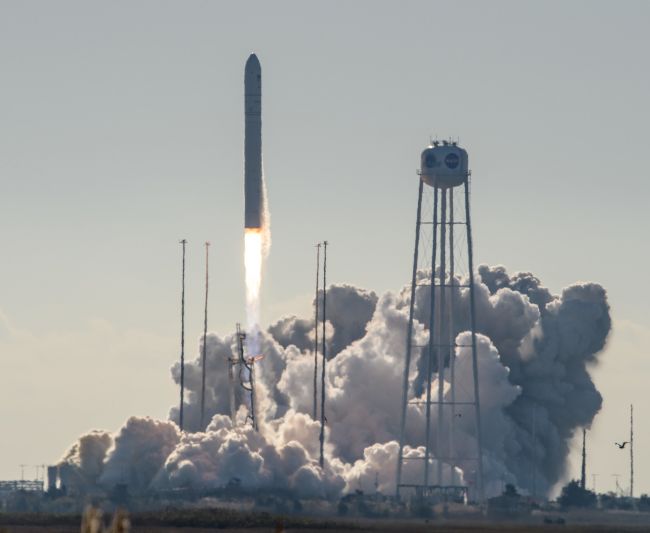
WALLOPS ISLAND, Va. — A space cookie oven launched with rodents to space today (Nov. 2) aboard the most powerful Antares rocket ever built.

At 9:59 a.m. EDT (1359 GMT) this morning, the Cygnus NG-12 spacecraft successfully launched to the International Space Station from Virginia Space’s Mid-Atlantic Regional Spaceport at NASA’s Wallops Flight Facility. The launch carried about 8,200 lbs. (3,700 kilograms) of scientific experiments, hardware and supplies to the space station, where it will arrive on Monday (Nov. 4) to be grappled by NASA astronaut Jessica Meir who will be supported by fellow astronaut Christina Koch.

With nearly perfect weather, including brilliant blue skies and comfortably crisp air, the launch went off without a hitch. “This never gets trivial … the people that I work with day in and day out are all excited and look forward to this every time we get to do this,” Kirk Shireman, the deputy manager of the space station, said during a pre-launch press conference. This was the first launch as part of the second phase of the Commercial Resupply Services (CRS) flights. NASA awarded the contract for this second phase in 2016.

Aboard the Cygnus spacecraft is both equipment to support and sustain existing experiments on the space station as well as new investigations that will be introduced to the six astronauts currently on station.

Of the new investigations headed to space, there are a few that have particularly caught the public’s attention.

One of these experiments will bring the smell of fresh-baked cookies to the space station. A joint collaboration between Zero G Kitchen and NanoRacks has developed and built the first-ever oven designed to work in the microgravity environment on the space station. The astronauts on the station will conduct the first experiment with the oven by baking chocolate chip cookies. While food on the space station now is primarily reheated or heated with the addition of hot water, this will be the first instance of baking in space.

Another investigation, Microgravity as a Disruptor Of The 12-hour Circatidal Clock (Rodent Research-14) will use rodent models to study how phases of light and dark can affect liver health.

‘Carrie’ Costume Causes Confusion at Car Crash

An Ohio college student who hit a deer while driving home from a Halloween event inadvertently caused quite a bit of confusion at the scene of the accident due to her ‘bloody’ Carrie costume. The strange incident reportedly occurred last Saturday evening after Sidney Wolfe had attended a haunted house attraction dressed as the title character of the famed Stephen King novel Carrie. Assuming that the trip back to her house would be uneventful, she opted to make the drive while still in costume, which lead to an amusing series of events.

Shortly into her drive home, she struck a deer that had dashed out into the road, killing the unfortunate creature and doing considerable damage to her vehicle. Although dazed by the accident, Wolfe soon realized that her attire was likely to cause a commotion when first responders arrived on the scene. “Holy crap, I’m head-to-toe dressed in blood makeup. They’re going to freak out,” she recalled thinking from the driver’s seat of the smashed car. According to her, the confusion began when a person who witnessed the collision came up to her vehicle and was stunned by what he saw. “I remember his face,” she said, “and he looked horrified.”

To her credit, Wolfe attempted to warn the authorities about her appearance when she called 911 to report the accident, telling the dispatcher “I look like I have blood on me. It’s fake blood, so I don’t want ambulances to be freaking out.” Be that as it may, it would seem that the first responders did not get the message as they were initially stunned by her gruesome-looking ‘blood-covered’ condition. Fortunately, Wolfe was able to explain the strange circumstances she found herself in and the emergency personnel “thought it was hilarious.”

She later had to relay the tale to police officers who arrived on the scene and were bewildered by the fact that there was a young woman who appeared to be badly hurt yet was cheerfully chatting with the first responders. Wolfe later shared the tale on Twitter, where it quickly went viral with a whopping 20 million people learning about her remarkable story. With any luck, all of the attention that her odd misadventure has received will somehow lead to Wolfe winding up with a new car.

California fires: Goats help save Ronald Reagan Presidential Library

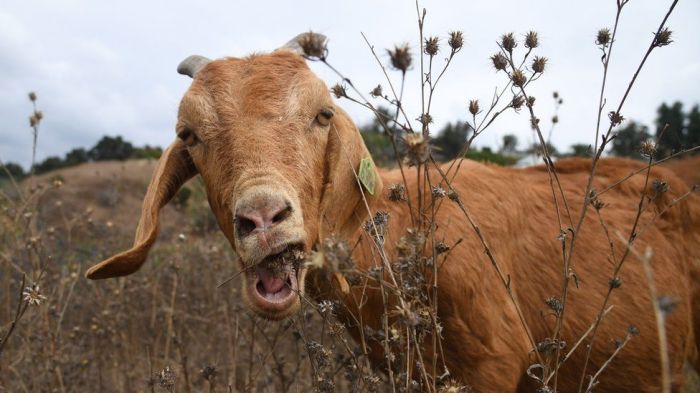
A goat grazes in South Pasadena last month as part of fire prevention efforts

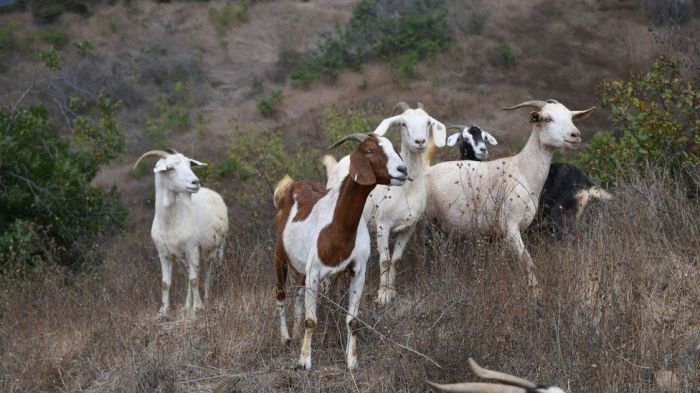
A hungry herd of 500 goats has helped save the Ronald Reagan Presidential Library from the California wildfires.

In May, the library hired the goats to clear flammable scrub surrounding the complex as a preventative measure.

The goats ate the brush, creating a fire break that slowed the flames and gave firefighters extra time to react.

The library near Los Angeles was threatened by the Easy Fire, the latest in a spate of fires causing evacuations and power cuts across the state.

The caprine contractors included Vincent van Goat, Selena Goatmez and Goatzart. They helped save exhibits including an Air Force One jet and a piece of the Berlin Wall.

“We were told by one of the firefighters that they believe that fire break made their job easier,” Melissa Giller, a library spokeswoman, told Reuters.

Goat grazing is one way of removing highly flammable brush

The goats were hired from a local company – 805 Goats – to clear around 13 acres of land.

Scott Morris started the company last November and charges around $1,000 (£771) per acre of land.

As California continues to have more wildfires, Mr Morris says he will need to double his herd to meet demand.

Another large southern California institution – the Getty Museum in Los Angeles – was also protected this week by scrub-clearing work carried out by staff.

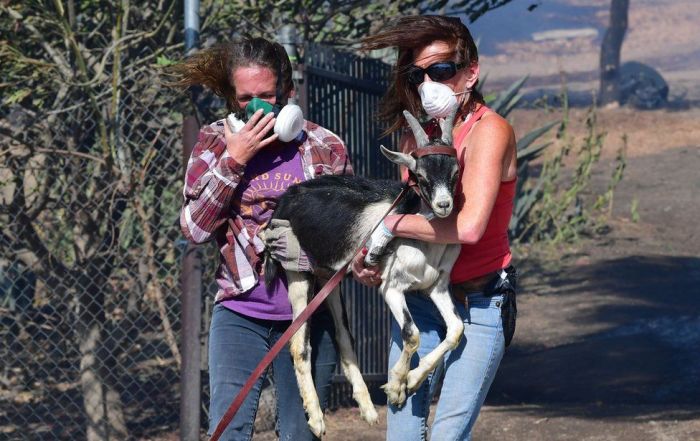
Goats from a ranch near the Reagan Library were also rescued from the Easy Fire

What has happened to animals caught in the path of fires?

Ranchers and volunteers have been scrambling to evacuate farm animals, carrying them away on trailers, dropping them somewhere safe, and then turning around to rescue more.

In some cases, when the flames move too quickly for trailer rescues, the animals are simply let loose in the hope they can escape on their own and be recovered later.

People attempt to load a frightened horse into a trailer in Canyon Country

BBC

Historic Black and White photos colourized

colorized-history-226colorized-history-17

Powerhouse Mechanic by Lewis W. Hine (1921)


colorized-history-22

W.H. Murphy and his associate demonstrating their bulletproof vest on October 13, 1923.


colorized-history-52

Big Jay McNeely driving the crowd at the Olympic Auditorium into a frenzy, Los Angeles, 1953.


colorized-history-82

Kyūdōka, Japanese Archers c.1860.


colorized-history-162

Hindenburg Disaster – May 6, 1937.


colorized-history-18[1]

Elizabeth Taylor – Giant (1956 film).


colorized-history-252

Albert Einstein, summer 1939 – Nassau Point, Long Island, NY


color1

Winston Churchill


color2

Butch Cassidy and the Wild Bunch. The Sundance Kid seated far left, Butch seated far right.
color3

United States Atomic weapons test Bikini Atoll, South Pacific, 1948

Photos immersed in amazing colours

I can’t recall ever seeing such bold use of patterns—entirely excessive, but somehow it works. These images come from the 2019 calendar for Splash, a Dubai-based company reputed to be “the Middle East’s largest fashion retailer.” The meticulously conceived pics are the work of Tejal Patni, an Indian photographer and filmmaker who works out of Dubai. He’s done the last four calendars for Splash, but this last one is on a whole new level.


calendar

calendar1

calendar2

calendar3

calendar4


calendar6