Year: 2019
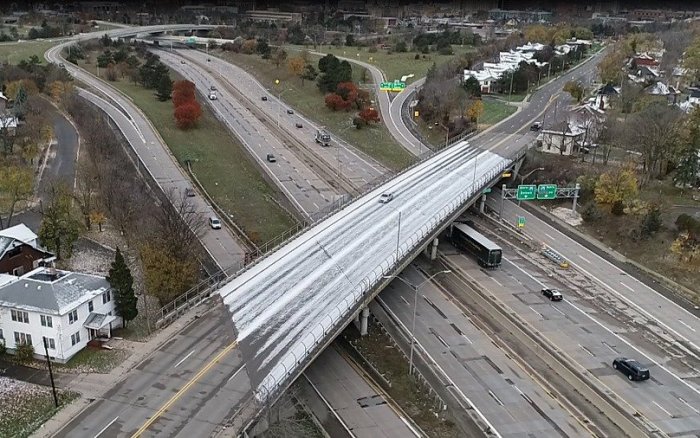
Bridge Ices Up
“Bridge Ices Before Road” (downtown Flint yesterday morning)

Technology and the Environment
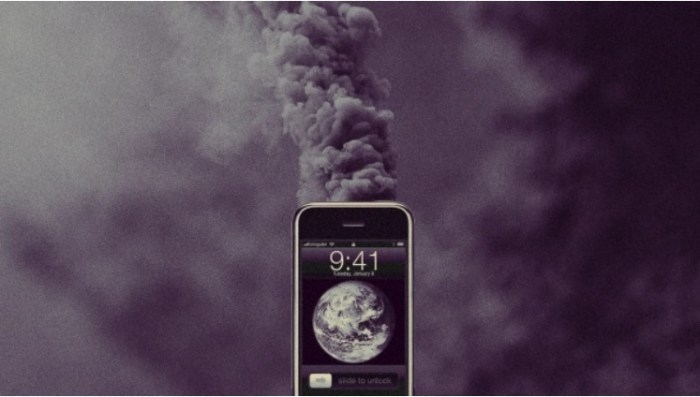
Smartphones Are Killing The Planet Faster Than Anyone Expected
Researchers are sounding the alarm after an analysis showed that buying a new smartphone consumes as much energy as using an existing phone for an entire decade.
Before you upgrade your next iPhone, you may want to consider a $29 battery instead. Not only will the choice save you money, it could help save the planet.
A new study from researchers at McMaster University published in the Journal of Cleaner Production analyzed the carbon impact of the whole Information and Communication Industry (ICT) from around 2010-2020, including PCs, laptops, monitors, smartphones, and servers. They found remarkably bad news. Even as the world shifts away from giant tower PCs toward tiny, energy-sipping phones, the overall environmental impact of technology is only getting worse. Whereas ICT represented 1% of the carbon footprint in 2007, it’s already about tripled, and is on its way to exceed 14% by 2040. That’s half as large as the carbon impact of the entire transportation industry.
Smartphones are particularly insidious for a few reasons. With a two-year average life cycle, they’re more or less disposable. The problem is that building a new smartphone–and specifically, mining the rare materials inside them–represents 85% to 95% of the device’s total CO2 emissions for two years. That means buying one new phone takes as much energy as recharging and operating a smartphone for an entire decade.
Yet even as people are now buying phones less often, consumer electronics companies are attempting to make up for lost profits by selling bigger, fancier phones. The researchers found that smartphones with larger screens have a measurably worse carbon footprint than their smaller ancestors. Apple has publicly disclosed that building an iPhone 7 Plus creates roughly 10% more CO2 than the iPhone 6s, but an iPhone 7 standard creates roughly 10% less than a 6s. So according to Apple, the trend is getting better, but the bigger phones companies like Apple sell seem to offset some gains. Another independent study concluded that the iPhone 6s created 57% more CO2 than the iPhone 4s. And despite the recycling programs run by Apple and others, “based on our research and other sources, currently less than 1% of smartphones are being recycled,” Lotfi Belkhir, the study’s lead author, tells me.
In any case, keeping a smartphone for even three years instead of two can make a considerable impact to your own carbon footprint, simply because no one has to mine the rare materials for a phone you already own. It’s a humbling environmental takeaway, especially if you own Samsung or Apple stock. Much like buying a used gasoline-fueled car is actually better for the environment than purchasing a new Prius or Tesla, keeping your old phone is greener than upgrading to any new one.
Smartphones represent a fast-growing segment of ICT, but the overall largest culprit with regards to CO2 emissions belongs to servers and data centers themselves, which will represent 45% of ICT emissions by 2020. That’s because every Google search, every Facebook refresh, and every dumb Tweet we post requires a computer somewhere to calculate it all in the cloud. (The numbers could soon be even worse, depending on how popular cryptocurrencies get.) Here, the smartphone strikes again. The researchers point out that mobile apps actually reinforce our need for these 24/7 servers in a self-perpetuating energy-hogging cycle. More phones require more servers. And with all this wireless information in the cloud, of course we’re going to buy more phones capable of running even better apps.
As for what can be done on the server end, Belkhir suggests that government policies and taxes might make a difference–whatever needs to be done to get these servers migrated over to renewable energy sources. Google, Facebook, and Apple have all pledged to move to 100% renewable energy in their own operations. In fact, all of Apple’s servers are currently run on renewable power. “It’s encouraging,” says Belkhir of these early corporate efforts. “But I don’t think it’d move the needle at all.”
If this all sounds like bad news, it’s because it absolutely is bad news. To make matters worse, the researchers calculated some of their conclusions conservatively. The future will only get more dire if the internet of things takes off and many more devices are hitting up the cloud for data.
“We are already witnessing internet-enabled devices, ranging from the smallest form factor such as wearable devices, to home appliances, and even cars, trucks and airplanes. If this trend continues . . . one can only wonder on the additional load these devices will have on the networking and data center infrastructures, in addition to the incremental energy consumption incurred by their production,” the team writes in the study. “Unless the supporting infrastructure moves quickly to 100% renewable power, the emergence of IoT could potentially dwarf the contribution of all the other traditional computing devices, and dramatically increase the overall global emissions well beyond the projections of this study.”
Indeed, tech’s carbon footprint is beyond what any one designer, one company, or even one government regulator can contain. As consumers, we have more reason than ever to hesitate when it comes to our next shiny tech splurge. The bottom line is that we need to buy less, and engage less, for the health of this entire planet.
Fastcompany.com
What Really Happened at Roswell
The Roswell UFO incident refers to an event in mid 1947, when a United States Air Force surveillance balloon crashed at a ranch near Roswell, New Mexico, prompting claims alleging the crash was of an extraterrestrial spaceship.
After an initial spike of interest, the military reported that the crash was merely of a conventional weather balloon. Interest subsequently waned until the late 1970s when ufologists began promulgating a variety of increasingly elaborate conspiracy theories, claiming that one or more alien spacecraft had crash-landed, and that the extraterrestrial occupants had been recovered by the military who then engaged in a cover-up.
In the 1990s, the US military published reports disclosing the true nature of the crashed Project Mogul balloon. Nevertheless, the Roswell incident continues to be of interest in popular media, and conspiracy theories surrounding the event persist. Roswell has been called “the world’s most famous, most exhaustively investigated, and most thoroughly debunked UFO claim”.

Many people have made lots of money perpetuating the ‘Roswell Myth’. Stanton Friedman fed his family for years lying about the incident. People are unscrupulous, they will lie through their teeth to make money.
One example of the contradiction: Jesse Marcel says the debris material brought back to his house couldn’t be broken or bent, it was indestructible. Yet witnesses at the crash site said the debris field was hundreds of meters long, covered in thousands of pieces of metal-like fragments. So much for the material being indestructible.
The sequence of events was triggered by the crash of a Project Mogul balloon near Roswell. On July 8, 1947, the Roswell Army Air Field (RAAF) public information officer Walter Haut, issued a press release stating that personnel from the field’s 509th Operations Group had recovered a “flying disc”, which had crashed on a ranch near Roswell.
The military decided to conceal the true purpose of the crashed device – nuclear test monitoring – and instead inform the public that the crash was of a weather balloon. Later that day, the press reported that Commanding General of the Eighth Air Force Roger Ramey had stated that a weather balloon was recovered by the RAAF personnel. A press conference was held, featuring debris (foil, rubber and wood) said to be from the crashed object, which matched the weather balloon description. Historian Robert Goldberg wrote that the intended effect was achieved: “the story died the next day”.
Subsequently the incident faded from the attention of UFO enthusiasts for more than 30 years.
On June 14, 1947, William Brazel, a foreman working on the Foster homestead, noticed clusters of debris approximately 30 miles (50 km) north of Roswell, New Mexico. This date—or “about three weeks” before July 8—appeared in later stories featuring Brazel, but the initial press release from the Roswell Army Air Field (RAAF) said the find was “sometime last week”, suggesting Brazel found the debris in early July. Brazel told the Roswell Daily Record that he and his son saw a “large area of bright wreckage made up of rubber strips, tinfoil, a rather tough paper and sticks.” He paid little attention to it but returned on July 4 with his son, wife and daughter to gather up the material. Some accounts have described Brazel as having gathered some of the material earlier, rolling it together and stashing it under some brush. The next day, Brazel heard reports about “flying discs” and wondered if that was what he had picked up. On July 7, Brazel saw Sheriff Wilcox and “whispered kinda confidential like” that he may have found a flying disc. Another account quotes Wilcox as saying Brazel reported the object on July 6.
Wilcox called RAAF Major Jesse Marcel and a “man in plainclothes” accompanied Brazel back to the ranch where more pieces were picked up. “[We] spent a couple of hours Monday afternoon [July 7] looking for any more parts of the weather device”, said Marcel. “We found a few more patches of tinfoil and rubber.”
As described in the July 9, 1947 edition of the Roswell Daily Record,
The balloon which held it up, if that was how it worked, must have been 12 feet long, [Brazel] felt, measuring the distance by the size of the room in which he sat. The rubber was smoky gray in color and scattered over an area about 200 yards in diameter. When the debris was gathered up, the tinfoil, paper, tape, and sticks made a bundle about three feet long and 7 or 8 inches thick, while the rubber made a bundle about 18 or 20 inches long and about 8 inches thick. In all, he estimated, the entire lot would have weighed maybe five pounds. There was no sign of any metal in the area which might have been used for an engine, and no sign of any propellers of any kind, although at least one paper fin had been glued onto some of the tinfoil. There were no words to be found anywhere on the instrument, although there were letters on some of the parts. Considerable Scotch tape and some tape with flowers printed upon it had been used in the construction. No strings or wires were to be found but there were some eyelets in the paper to indicate that some sort of attachment may have been used.
A telex sent to a Federal Bureau of Investigation (FBI) office from the Fort Worth, Texas office quoted a Major from the Eighth Air Force (also based in Fort Worth at Carswell Air Force Base) on July 8, 1947 as saying that “The disc is hexagonal in shape and was suspended from a balloon by cable, which balloon was approximately twenty feet in diameter. Major Curtan further advises that the object found resembles a high altitude weather balloon with a radar reflector, but that telephonic conversation between their office and Wright field had not [UNINTELLIGIBLE] borne out this belief.”
Early on Tuesday, July 8, the RAAF issued a press release, which was immediately picked up by numerous news outlets:
The many rumors regarding the flying disc became a reality yesterday when the intelligence office of the 509th Bomb group of the Eighth Air Force, Roswell Army Air Field, was fortunate enough to gain possession of a disc through the cooperation of one of the local ranchers and the sheriff’s office of Chaves County. The flying object landed on a ranch near Roswell sometime last week. Not having phone facilities, the rancher stored the disc until such time as he was able to contact the sheriff’s office, who in turn notified Maj. Jesse A. Marcel of the 509th Bomb Group Intelligence Office. Action was immediately taken and the disc was picked up at the rancher’s home. It was inspected at the Roswell Army Air Field and subsequently loaned by Major Marcel to higher headquarters.
Colonel William H. Blanchard, commanding officer of the 509th, contacted General Roger M. Ramey of the Eighth Air Force in Fort Worth, Texas, and Ramey ordered the object be flown to Fort Worth Army Air Field. At the base, Warrant Officer Irving Newton confirmed Ramey’s preliminary opinion, identifying the object as being a weather balloon and its “kite”, a nickname for a radar reflector used to track the balloons from the ground. Another news release was issued, this time from the Fort Worth base, describing the object as being a “weather balloon”.
Wishful thinking

Growing interest, 1978–1994
Between 1978 and the early 1990s, UFO researchers such as Stanton T. Friedman, William Moore, Karl T. Pflock, and the team of Kevin D. Randle and Donald R. Schmitt interviewed several hundred people who claimed to have had a connection with the events at Roswell in 1947. Hundreds of documents were obtained via Freedom of Information Act requests, along with other documents such as Majestic 12 that were supposedly leaked by insiders. Their conclusions were at least one alien spacecraft crashed near Roswell, alien bodies had been recovered, and a government cover-up of the incident had taken place.
Over the years, books, articles, and television specials brought the 1947 incident significant notoriety. By the mid-1990s, public polls such as a 1997 CNN/Time poll, revealed that the majority of people interviewed believed that aliens had indeed visited Earth, and that aliens had landed at Roswell, but that all the relevant information was being kept secret by the US government.
According to anthropologists Susan Harding and Kathleen Stewart, the Roswell Story was the prime example of how a discourse moved from the fringes to the mainstream according to the prevailing zeitgeist: public preoccupation in the 1980s with “conspiracy, cover-up and repression” aligned well with the Roswell narratives as told in the “sensational books” which were being published.
Friedman’s initial work
In 1978, nuclear physicist and author Stanton T. Friedman interviewed Jesse Marcel, the only person known to have accompanied the Roswell debris from where it was recovered to Fort Worth where reporters saw material which was claimed to be part of the recovered object. The accounts given by Friedman and others in the following years elevated Roswell from a forgotten incident to perhaps the most famous UFO case of all time.
Books
The Roswell Incident (1980)
The first conspiracy book about Roswell was The Roswell Incident (1980) by Charles Berlitz and William Moore, authors who had previously written popular books on the Philadelphia Experiment and on the Bermuda Triangle.
Historian Kathy Olmsted writes that the material in this book has come to be known as “version 1” of the Roswell myth. Berlitz and Moore’s narrative holds that an alien craft was flying over the New Mexico desert observing US nuclear weapons activity, but crashed after being hit by lightning, killing the aliens on board; a government cover-up duly followed.
The authors claimed to have interviewed over ninety witnesses. Though he was uncredited, Friedman carried out some research for the book. The Roswell Incident featured accounts of debris described by Marcel as “nothing made on this earth.” Additional accounts by Bill Brazel, son of Mac Brazel, neighbor Floyd Proctor and Walt Whitman Jr., son of newsman W. E. Whitman who had interviewed Mac Brazel, suggested the material Marcel recovered had super-strength not associated with a weather balloon. The book introduced the contention that debris which was recovered by Marcel at the Foster ranch, visible in photographs showing Marcel posing with the debris, was substituted for debris from a weather device as part of a cover-up. The book also claimed that the debris recovered from the ranch was not permitted a close inspection by the press. The efforts by the military were described as being intended to discredit and “counteract the growing hysteria towards flying saucers”. Two accounts of witness intimidation were included in the book, including the incarceration of Mac Brazel. The book also introduced the secondhand stories of civil engineer Barney Barnett and a group of archeology students from an unidentified university seeing alien wreckage and bodies while in the desert.
Berlitz and Moore’s narrative was dominant until the late 1980s when other authors, attracted by the commercial potential of writing about Roswell, started producing rival accounts.
UFO Crash at Roswell (1991)
In 1991, Kevin Randle and Donald Schmitt published UFO Crash at Roswell. They added 100 new witnesses, altered and tightened the narrative, and included several “sinister” new twists.
Some new details were included, including accounts of a “gouge […] that extended four or five hundred feet” at the ranch and descriptions of an elaborate cordon and recovery operation. Several witnesses in The Roswell Incident described being turned back from the Foster ranch by armed military police, but extensive descriptions were not given. The Barnett accounts were mentioned, though the dates and locations were changed from the accounts found in The Roswell Incident. In the new account, Brazel was described as leading the Army to a second crash site on the ranch, at which point the Army personnel were supposedly “horrified to find civilians [including Barnett] there already.”
Glenn Dennis was produced as a supposedly important witness in 1989, after calling the hotline when an episode of Unsolved Mysteries featured the Roswell incident. His descriptions of Roswell alien autopsies were the first account that said there were alien corpses at the Roswell Army Air Base.
Randle and Schmitt’s book sold 160,000 copies.
Crash at Corona (1992)
In 1992, Stanton Friedman re-entered the scene with his own book Crash at Corona, co-authored with Don Berliner – an author of books on space and aviation. Goldberg writes that Friedman too introduced new “witnesses”, and that he added to the narrative by doubling the number of flying saucers to two, and the number of aliens to eight – two of which were said to have survived and been taken into custody by the government.
The Truth about the UFO Crash at Roswell (1994)
Randle and Schmitt responded with another book, updating their previous narrative with several new details, including the claim that alien bodies were taken by cargo plane to be viewed by Dwight D. Eisenhower, who was curious about their appearance.
The Day After Roswell (1997)
Former Lt. Col. Philip J. Corso reported in his autobiographical book that the Roswell Crash did happen and that when he was assigned to Fort Riley (Kansas) in July 1947, 5 trucks of 25 tons and some semi trailers entered the base from Fort Bliss Texas. He claimed while he was patrolling the base he was brought into the medical facilities by Sgt. Brown and shown the remnants of bodies that were from an “air crash”. Philip Klass analyzed his claims line by line and exposed many inconsistencies and factual errors.
Competing accounts
The existence of so many differing accounts by 1994 led to a schism among ufologists about the events at Roswell. The Center for UFO Studies (CUFOS) and the Mutual UFO Network (MUFON), two leading UFO societies, disagreed in their views of the various scenarios presented by Randle–Schmitt and Friedman–Berliner; several conferences were held to try to resolve the differences. One issue under discussion was where Barnett was when he saw the alien craft he was said to have encountered. A 1992 UFO conference had attempted to achieve a consensus among the various scenarios portrayed in Crash at Corona and UFO Crash at Roswell, however, the publication of The Truth About the UFO Crash at Roswell had “resolved” the Barnett problem by simply ignoring Barnett and citing a new location for the alien craft recovery, including a new group of archaeologists not connected to the ones the Barnett story cited.
Don Schmitt held that variations in narratives between different writers was not however an essential problem, commenting by way of comparison “We know Jesus Christ was crucified, we just don’t know where.”
Problems with witness accounts
Hundreds of people were interviewed by the various researchers, but critics point out that only a few of these people claimed to have seen debris or aliens. Most witnesses were repeating the claims of others, and their testimony would be considered hearsay in an American court of law and therefore inadmissible as evidence. Of the 90 people claimed to have been interviewed for The Roswell Incident, the testimony of only 25 appears in the book, and only seven of these people saw the debris. Of these, five handled the debris. Pflock, in Roswell: Inconvenient Facts and the Will to Believe (2001), makes a similar point about Randle and Schmitt’s UFO Crash at Roswell. Approximately 271 people are listed in the book who were “contacted and interviewed” for the book, and this number does not include those who chose to remain anonymous, meaning more than 300 witnesses were interviewed, a figure Pflock said the authors frequently cited. Of these 300-plus individuals, only 41 can be “considered genuine first- or second-hand witnesses to the events in and around Roswell or at the Fort Worth Army Air Field,” and only 23 can be “reasonably thought to have seen physical evidence, debris recovered from the Foster Ranch.” Of these, only seven have asserted anything suggestive of otherworldly origins for the debris.
As for the accounts from those who claimed to have seen aliens, critics identified problems ranging from the reliability of second-hand accounts, to credibility problems with witnesses making demonstrably false claims, or multiple, contradictory accounts, to dubious death-bed confessions or accounts from elderly and easily confused witnesses. Pflock noted that only four people with supposed firsthand knowledge of alien bodies were interviewed and identified by Roswell authors: Frank Kaufmann; Jim Ragsdale; Lt. Col. Albert Lovejoy Duran; Gerald Anderson. Duran is mentioned in a brief footnote in The Truth About the UFO Crash at Roswell and never again, while the other three all have serious credibility problems. A problem with all the accounts, charge critics, is they all came about a minimum of 31 years after the events in question, and in many cases were recounted more than 40 years after the fact. Not only are memories this old of dubious reliability, they were also subject to contamination from other accounts the interviewees may have been exposed to. The shifting claims of Jesse Marcel, whose suspicion that what he recovered in 1947 was “not of this world” sparked interest in the incident in the first place, cast serious doubt on the reliability of what he claimed to be true.
In The Roswell Incident, Marcel stated, “Actually, this material may have looked like tinfoil and balsa wood, but the resemblance ended there […] They took one picture of me on the floor holding up some of the less-interesting metallic debris […] The stuff in that one photo was pieces of the actual stuff we found. It was not a staged photo.” Timothy Printy points out that the material Marcel positively identified as being part of what he recovered is material that skeptics and UFO advocates agree is debris from a balloon device. After that fact was pointed out to him, Marcel changed his story to say that that material was not what he recovered. Skeptics like Robert Todd argued that Marcel had a history of embellishment and exaggeration, such as claiming to have been a pilot and having received five Air Medals for shooting down enemy planes, claims that were all found to be false, and skeptics feel that his evolving Roswell story was simply another instance of this tendency to fabricate.
Air Force reports, 1994–1997
In response to these reports, and after United States congressional inquiries, the General Accounting Office launched an inquiry and directed the Office of the United States Secretary of the Air Force to conduct an internal investigation. The result was summarized in two reports. The first, released in 1994, concluded that the reported recovered material in 1947 was likely debris from Project Mogul. The second report, released in 1997, concluded reports of recovered alien bodies were likely a combination of innocently transformed memories of military accidents involving injured or killed personnel, innocently transformed memories of the recovery of anthropomorphic dummies in military programs like Operation High Dive conducted in the 1950s, and hoaxes perpetrated by various witnesses and UFO proponents. The psychological effects of time compression and confusion about when events occurred explained the discrepancy with the years in question.
The Air Force reports were dismissed by UFO proponents as being either disinformation or simply implausible, though skeptical researchers such as Philip J. Klass and Robert Todd, who had been expressing doubts regarding accounts of aliens for several years, used the reports as the basis for skeptical responses to claims by UFO proponents. After the release of the Air Force reports, several books, such as Kal Korff’s The Roswell UFO Crash: What They Don’t Want You To Know (1997), built on the evidence presented in the reports to conclude “there is no credible evidence that the remains of an extraterrestrial spacecraft was involved.” In the 1990s, skeptics and even some social anthropologists saw the increasingly elaborate accounts of alien crash landings and government cover ups as evidence of a myth being constructed.
Recent interest
Evidence
Although there is no evidence that a UFO crashed at Roswell, believers firmly hold to the belief that one did, and that the truth has been concealed as a result of a government conspiracy. B. D. Gildenberg has called the Roswell incident “the world’s most famous, most exhaustively investigated, and most thoroughly debunked UFO claim”.
Pflock said, “[T]he case for Roswell is a classic example of the triumph of quantity over quality. The advocates of the crashed-saucer tale […] simply shovel everything that seems to support their view into the box marked ‘Evidence’ and say, ‘See? Look at all this stuff. We must be right.’ Never mind the contradictions. Never mind the lack of independent supporting fact. Never mind the blatant absurdities.” Korff suggests there are clear incentives for some people to promote the idea of aliens at Roswell, and that many researchers were not doing competent work: “[The] UFO field is comprised of people who are willing to take advantage of the gullibility of others, especially the paying public. Let’s not pull any punches here: The Roswell UFO myth has been very good business for UFO groups, publishers, for Hollywood, the town of Roswell, the media, and UFOlogy […] [The] number of researchers who employ science and its disciplined methodology is appallingly small.”
B. D. Gildenberg wrote there were as many as 11 reported alien recovery sites and these recoveries bore only a marginal resemblance to the event as initially reported in 1947, or as recounted later by the initial witnesses. Some of these new accounts could have been confused accounts of the several known recoveries of injured and dead servicemen from four military plane crashes that occurred in the area from 1948 to 1950. Other accounts could have been based on memories of recoveries of test dummies, as suggested by the Air Force in their reports. Charles Ziegler argued that the Roswell story has all the hallmarks of a traditional folk narrative. He identified six distinct narratives, and a process of transmission via storytellers with a core story that was created from various witness accounts, and was then shaped and molded by those who carry on the UFO community’s tradition. Other “witnesses” were then sought out to expand the core narrative, with those who give accounts not in line with the core beliefs being repudiated or simply omitted by the “gatekeepers.” Others then retold the narrative in its new form. This whole process would repeat over time.
Roswellian Syndrome
Prominent skeptics Joe Nickell and co-author James McGaha identified a myth-making process, which they called the “Roswellian Syndrome”. In this syndrome a myth is proposed to have five distinct stages of development: Incident, Debunking, Submergence, Mythologizing, and Reemergence and Media Bandwagon Effect. The authors predicted that the Roswellian Syndrome would “play out again and again”, in other UFO and conspiracy-theory stories.
Shoddy research revealed; witnesses suspected of hoaxes
The Air Force reports on the incident suggested that basic research that was claimed to have been carried out was not in fact carried out, a fact verified in a 1995 Omni magazine article.
Glenn Dennis, who testified that Roswell alien autopsies were carried out at the Roswell base, and that he and others were the subjects of threats, was deemed one of the “least credible” Roswell witnesses by Randle in 1998. In Randle and Schmitt’s 1991 book UFO Crash at Roswell, Dennis’s story was featured prominently. Randle said Dennis was not credible “for changing the name of the nurse once we had proved she didn’t exist.” Dennis’s accounts were also doubted by researcher Pflock.
Some prominent UFOlogists including Karl T. Pflock, Kent Jeffrey William L. Moore, have become convinced that there were no aliens or alien space craft involved in the Roswell crash.
Alien autopsy hoax
In 1995, film footage purporting to show an alien autopsy and claimed to have been taken by a US military official shortly after the Roswell incident was released by Ray Santilli, a London-based video entrepreneur. The footage caused an international sensation when it aired on television networks around the world.
In 2006, Santilli said that the film was mostly a reconstruction, but continued to claim it was based on genuine footage now lost, and some original frames that had supposedly survived. A fictionalized version of the creation of the footage and its release was retold in the comedy film Alien Autopsy (2006).

Project Mogul (sometimes referred to as Operation Mogul) was a top secret project by the US Army Air Forces involving microphones flown on high-altitude balloons, whose primary purpose was long-distance detection of sound waves generated by Soviet atomic bomb tests. The project was carried out from 1947 until early 1949. The project was moderately successful, but was very expensive and was superseded by a network of seismic detectors and air sampling for fallout, which were cheaper, more reliable, and easier to deploy and operate.
Project Mogul was conceived by Maurice Ewing who had earlier researched the deep sound channel in the oceans and theorized that a similar sound channel existed in the upper atmosphere: a certain height where the air pressure and temperature result in minimal speed of sound, so that sound waves would propagate and stay in that channel due to refraction. The project involved arrays of balloons carrying disc microphones and radio transmitters to relay the signals to the ground. It was supervised by James Peoples, who was assisted by Albert P. Crary.
One of the requirements of the balloons was that they maintain a relatively constant altitude over a prolonged period of time. Thus instrumentation had to be developed to maintain such constant altitudes, such as pressure sensors controlling the release of ballast.
The early Mogul balloons consisted of large clusters of rubber meteorological balloons, however, these were quickly replaced by enormous balloons made of polyethylene plastic. These were more durable, leaked less helium, and also were better at maintaining a constant altitude than the early rubber balloons. Constant-altitude-control and polyethylene balloons were the two major innovations of Project Mogul.
Project Mogul was the forerunner of the Skyhook balloon program, which started in the late 1940s, as well as two other espionage programs involving overflights and photographic surveillance of the Soviet Union in the mid-1950s, Project Moby Dick and Project Genetrix. The spy balloon overflights raised storms of protest from the Soviets. The constant-altitude balloons also were used for scientific purposes such as cosmic ray experiments.
Echoes of Mogul’s experimental infrasound detection of nuclear tests exist today in ground-based detectors, part of so-called Geophysical MASINT (Measurement And Signal INTelligence). In 2013, this world-wide network of sound detectors picked up the large explosion of the Chelyabinsk meteor in Russia. The strength of the sound waves was used to estimate the size of the explosion.
Mogul type balloon

Just because the object that crashed at Roswell has been proven to be a man-made, it doesn’t mean there are no UFO’s out there. There are some very intriguing incidents. The Phoenix Lights, the Japan airliner over Alaska that was followed by a huge UFO, and was also tracked on radar, the Texas flap a few years ago, and many more very strange incidents.
I believe there is something to these events, that are unexplainable. However, the military is just as perplexed as the UFO enthusiasts. With the many highly sophisticated sensors both on earth and circling overhead on satellites, the US defense establishment must have amazing information on this strange phenomena. But I am almost sure that they can’t make heads or tails of what the hell it is. That is why the military won’t release this information, the phenomena is so advanced and unexplainable, that a release of the information could panic the general public.
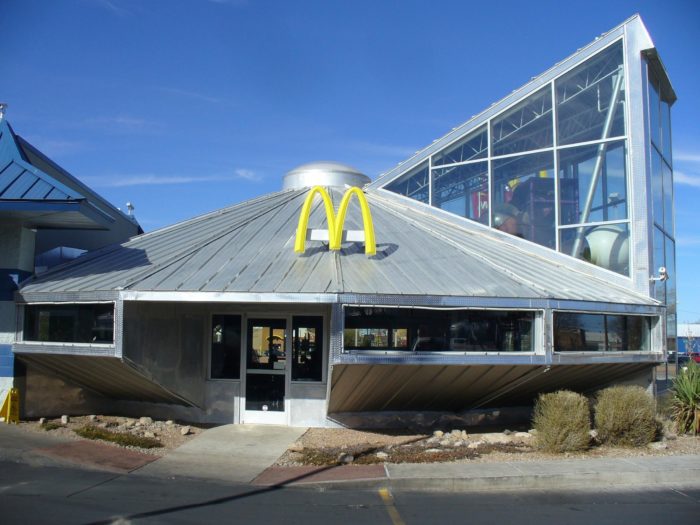
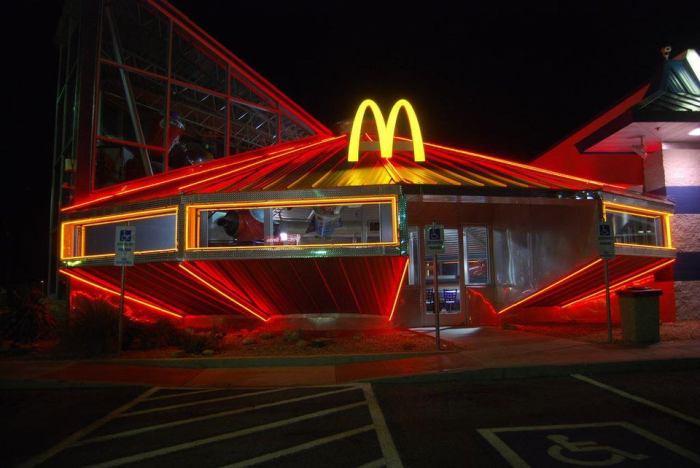
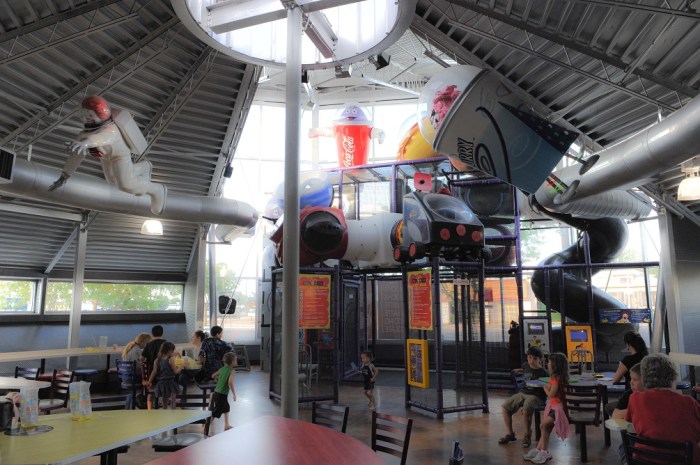
Flying Saucer Mcdonald’s at Roswell, New Mexico
This is the world’s only McDonald’s shaped like a flying saucer. Its aerodynamic qualities have been compromised by its need to enclose a Playland, but there’s no mistaking its distinctive saucer shape, enhanced during daylight by its metal skin and at night by its judicious used of neon piping around its window frames and ridge lines.


Environment Concern Song from 1971.
Woo ah, mercy mercy me
Ah things ain’t what they used to be, no no
Where did all the blue skies go?
Poison is the wind that blows from the north and south and east
Woo mercy, mercy me, mercy father
Ah things ain’t what they used to be, no no
Oil wasted on the ocean and upon our seas, fish full of mercury
Ah oh mercy, mercy me
Ah things ain’t what they used to be, no no
Radiation under ground and in the sky
Animals and birds who live nearby are dying
Oh mercy, mercy me
Ah things ain’t what they used to be
What about this overcrowded land
How much more abuse from man can she stand?
Oh, na na…
My sweet Lord… No
My Lord… My sweet Lord
Lyrics by Marvin Gaye. Released 1971.
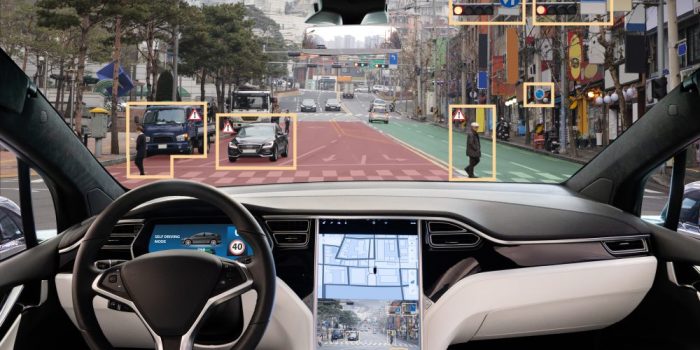
Uber’s Self-Driving Car Didn’t Know Pedestrians Could Jaywalk
The National Transportation Safety Board releases hundreds of pages related to the 2018 crash in Tempe, Arizona, that killed Elaine Herzberg.
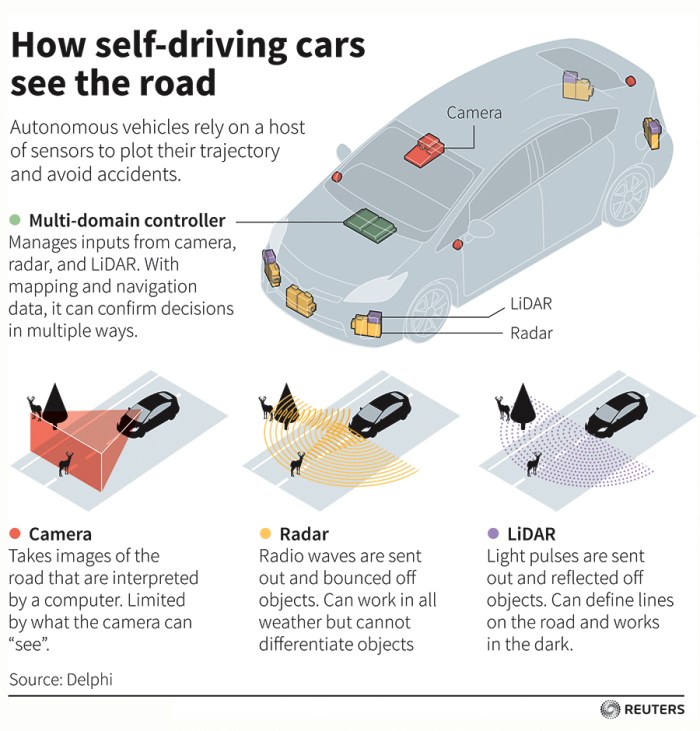
The software inside the Uber self-driving SUV that killed an Arizona woman last year was not designed to detect pedestrians outside of a crosswalk, according to new documents released as part of a federal investigation into the incident. That’s the most damning revelation in a trove of new documents related to the crash, but other details indicate that, in a variety of ways, Uber’s self-driving tech failed to consider how humans actually operate.
The National Transportation Safety Board, an independent government safety panel that more often probes airplane crashes and large truck incidents, posted documents on Tuesday regarding its 20-month investigation into the Uber crash. The panel will release a final report on the incident in two weeks. More than 40 of the documents, spanning hundreds of pages, dive into the particulars of the March 18, 2016 incident, in which the Uber testing vehicle, with 44-year-old Rafaela Vasquez in the driver’s seat, killed a 49-year-old woman named Elaine Herzberg as she crossed a darkened road in the city of Tempe, Arizona. At the time, only one driver monitored the experimental car’s operation and software as it drove around Arizona. Video footage published in the weeks after the crash showed Vasquez reacting with shock during the moments just before the collision.
The new documents indicate that some mistakes were clearly related to Uber’s internal structure, what experts call “safety culture.” For one, the self-driving program didn’t include an operational safety division or safety manager.
The most glaring mistakes were software-related. Uber’s system was not equipped to identify or deal with pedestrians walking outside of a crosswalk. Uber engineers also appear to have been so worried about false alarms that they built in an automated one-second delay between a crash detection and action. In addition, the company chose to turn off a built-in Volvo braking system that the automaker later concluded might have dramatically reduced the speed at which the car hit Herzberg, or perhaps avoided the collision altogether. (Experts say the decision to turn off the Volvo system while Uber’s software did its work did make technical sense, because it would be unsafe for the car to have two software “masters.”)
Much of that explains why, despite the fact that the car detected Herzberg with more than enough time to stop, it was traveling at 43.5 mph when it struck her and threw her 75 feet. When the car first detected her presence, 5.6 seconds before impact, it classified her as a vehicle. Then it changed its mind to “other,” then to vehicle again, back to “other,” then to bicycle, then to “other” again, and finally back to bicycle.
It never guessed Herzberg was on foot for a simple, galling reason: Uber didn’t tell its car to look for pedestrians outside of crosswalks. “The system design did not include a consideration for jaywalking pedestrians,” the NTSB’s Vehicle Automation Report reads. Every time it tried a new guess, it restarted the process of predicting where the mysterious object—Herzberg—was headed. It wasn’t until 1.2 seconds before the impact that the system recognized that the SUV was going to hit Herzberg, that it couldn’t steer around her, and that it needed to slam on the brakes.
That triggered what Uber called “action suppression,” in which the system held off braking for one second while it verified “the nature of the detected hazard”—a second during which the safety operator, Uber’s most important and last line of defense, could have taken control of the car and hit the brakes herself. But Vasquez wasn’t looking at the road during that second. So with 0.2 seconds left before impact, the car sounded an audio alarm, and Vasquez took the steering wheel, disengaging the autonomous system. Nearly a full second after striking Herzberg, Vasquez hit the brakes.
Wired.com

 The MarkoZen Blog