Built in France 1509.

Built in France 1509.

Manitoba has seen more than its fair share of UFOs over the years.
The report, which has been compiled from Canadian and US government records, suggests that people have been seeing strange things in the skies over North America for several centuries.
“It’s not a phenomenon that’s a product of television and movies that are going on right now,” said researcher Chris Rutkowski. “These things go back quite a number of years. People have been fascinated with things in the sky and wondering, ‘Are we alone in the universe?’”
The earliest documented Manitoba sighting dates back to 1792 when two explorers reported witnessing a strange object cascading from the sky which “struck the river ice, with a sound like a mass of jelly, was dashed into innumerable luminous pieces and instantly expired.”

Another report, this time from 1967, detailed how Stefan Michalak had observed two disc-shaped objects landing on a flat rock near Falcon Lake. When he approached he heard what he thought were human voices and was instantly hit by an explosion of hot gas which set his clothes on fire.
In 1989 a family had been visiting the Fort Whyte Nature Center when they encountered a white boomerang-shaped object hanging in the sky over Winnipeg. They later recalled how they had watched the craft slowly rotate in the air and noted that it had a peculiar bulge on its underside.
One of the most recent sightings was in 2012 when two witnesses, again in Winnipeg, saw a disc-shaped object with red lights all around its perimeter. As they watched it the craft suddenly swooped towards their vehicle before turning and zooming off in to the distance.
“That doesn’t mean that aliens are invading Canada in any way, but it simply means there are unusual reports of things in the sky,” said Rutkowski.
“It certainly says that we probably are not alone in the universe and that there probably are some sort of alien civilizations out there somewhere but there is no proof of that.”

The Charlie Redstar Flap
The Charlie Redstar Flap is one of the best documented UFO cases in Canadian History. The events of 1975-1976 are a great and entertaining read. I think you will enjoy the information below, it has about everything in that you could imagine, multiple groups of witnesses, drunken teenagers, news crews filming UFOs, radioactive ground material, possible crop circles, crafts of different shapes, sizes, colors and much more.
Charlie Redstar was a name given to some UFOs sighted across Manitoba in 1975–1976, many of them near the town of Carman, Manitoba. It was described as a red fireball, sometimes stationary and sometimes speeding off rapidly, and similar fireballs were also dubbed Charlie’s “friends” and “cousins”. Other similar UFOs were reported as flying saucers or “Ferris wheel”-shaped. It was often described as playful, friendly, or mischievous by witnesses.

May 16, 1975, near Stephenfield, Manitoba – Three drunk youths were at a party north of Boyne River, when one of them saw a stationary moon-sized red light. After ten minutes, it shone a white searchlight-like beam onto the lake. An underwater object shone below the beam that made the lake bottom visible, then moved towards the shore, creating ripplets. One youth threw a rock at the object, which broke into four, then separated and individually moved “like a conveyor belt” towards the beam of light. The lights in the objects went out, then the hovering object was observed to break in half and the halves moved away from each other in opposite directions. Although they admitted to being drunk, hallucination seemed unlikely as they each saw the same event.
Photo of Charlie


By the end of April 1976 the UFOs seemed to have left the area, There were some sporadic distant sightings but nothing similar two what had occurred in the previous two years. The Charlie Redstar Flap is one of the best documented UFO cases in Canada but one that is rarely discussed or written about today.
Markozen has a first cousin who lives in Notre Dame De Lourdes, not far from Carman, he was a teacher in 1975. He ultimately became the principle of the high school in Notre Dame. In the fall of 1975 he saw a glowing red light that was above the horizon a few hundred meters to the right of his car. For 10 miles it kept pace with the vehicle. His wife was with him and she collaborates the story. He has no explanation as to what it could have been.
Famous Monsters of Filmland is a genre-specific film magazine started in 1958 by publisher James Warren and editor Forrest J Ackerman.
Famous Monsters of Filmland directly inspired the creation of many other similar publications, including Castle of Frankenstein, Cinefantastique, Fangoria, The Monster Times, and Video Watchdog. In addition, hundreds, if not thousands, of FM-influenced horror, fantasy and science fiction movie-related fanzines have been produced, some of which have continued to publish for decades, such as Midnight Marquee and Little Shoppe of Horrors.

Famous Monsters of Filmland was originally conceived as a one-shot publication by Warren and Ackerman, published in the wake of the widespread success of the package of old horror movies syndicated to American television in 1957. But the first issue, published in February 1958, was so successful that it required a second printing to fulfill public demand. Its future as part of American culture was immediately obvious to both men. The success prompted spinoff magazines such as Spacemen, Famous Westerns of Filmland, Screen Thrills Illustrated, Creepy, Eerie, and Vampirella.
FM offered brief articles, well-illustrated with publicity stills and graphic artwork, on horror movies from the silent era to the current date of publication, their stars and filmmakers. Warren and Ackerman decided to aim the text at late pre-adolescents and young teenagers.


Currently there is somewhere between 10-15 reality ghost shows on TV. I have tried to watch them but they never go anywhere. No concrete empirical evidence is ever uncovered. It’s all about asking the ghost to identify itself, big burly men asking “is anybody here? Please identify yourself. Please make a noise if you are here” etc. Bunch of nonsense, a lot like religion, just wishful thinking. Now researchers have come up with a theory that all the hauntings may be hallucinations caused by bad air.

It has also been proposed that many hauntings could be hallucinations caused by steel beds. The steel causes changes in gravity, also known as EIF (experience inducing fields). In early research at Muncaster Castle in Cumbria, suitable conditions were discovered for the production of EIFs at a haunted location. If anyone moved slightly in the ‘haunted bed’ (where several independent witnesses have reported hearing a child crying) they could induce EIFs in their brain. This is because the bed was found to cause a strong distortion to the local magnetic field. This distortion leads to a high magnetic gradient across the bed so that anyone moving, even slightly, will be subjected to significantly varying fields.
National Post
The truth behind ‘haunted’ houses? Toxic moulds can cause severe psychosis and hallucinations, researchers say
Think your house is haunted? You may just have a mould problem.
That’s what one group of researchers believe could be the cause of many spectral sightings.
Shane Rogers, associate professor of civil and environmental engineering at Clarkson University in Potsdam, N.Y., is a big fan of ghost stories, and wanted to apply some of his research to the field.
“Hauntings are very widely reported phenomena that are not well-researched,” he said. “They are often reported in older-built structures that may also suffer poor air quality.”
The idea is that certain toxic moulds or fungi, like the rye ergot fungus, are able to cause severe psychosis in people who breathe in the hard-to-detect fumes they project. When the air is contaminated, the brain can play subtle tricks on you — a sudden chill, a movement in the corner of your eye, or potentially other ghastly and hallucinatory illusions.
“Similarly, some people have reported depression, anxiety and other effects from exposure to biological pollutants in indoor air,” Rogers said.
Rogers, along with Thomas O’Rourke and Daniel Schwab, two undergraduates, will be testing the air quality in several notoriously haunted locations in the North Country region of New York State.

One particular location they have their eyes on is the Frederic Remington Art Museum in Ogdensburg. The museum is believed to be haunted by one Madame America Vespucci, a woman who lived with one of the early founders of Ogdensburg. The story goes that she was scorned by other ladies of the town but sought after by local gentlemen. She later died in Paris but her ghost provides a chilling atmosphere for those who visit.
Remington museum curator Laura A. Foster spoke with the Watertown Daily Times, a local paper, and said she welcomes the researchers with open arms. She also said she was reassured that the air-quality reports for all the locations they visit would remain anonymous.
“Unfortunately, there were no flashing lights or whirring mechanisms to signal an exciting collection,” she said.
By comparing samples to “non-haunted” locations, Rogers hopes to find what sets these locations apart and find similarities in the mould microbiome between the haunted locations that could point to a less supernatural culprit.
“What I do hope is that we can provide some real clues as to what may lead to some of these phenomena and possibly help people in the process,” he said
National Geographic
HOW ANIMALS PERCEIVE the world around them is still a mystery to us in so many ways.
That’s true even for smart, social animals like goats, whose charisma has inspired a whole YouTube sub-genre: dozens of videos that highlight funny and cute goat moments and have racked up millions of views. Sanctuaries like Goats of Anarchy that care for neglected goats have hundreds of thousands of highly engaged followers on Instagram.
It can be tempting to anthropomorphize these expressive and gregarious animals. But in truth, we still know very little about what—and how—non-human animals think and feel. Little by little, however, our window into animal cognition may be opening.
A new study published in Frontiers in Zoology on July 10, 2019 has confirmed that goats can differentiate between other goats’ happiness or displeasure by listening to their voices. In other words, they can tell how one another is feeling. This finding carries potential implications for how goats in captivity—whether they’re kept for meat, milk, wool, or companionship—are treated.

At the most basic level, says Luigi Baciadonna, the study’s lead author, it shows that “they’re aware of the environment they’re living in.” They join the ranks of horses, primates, sheep, and others as non-human animals capable of perceiving emotion in their kin.
Researchers involved in the study had previously concluded that goats can express emotion through their voices. Next, a larger team decided to explore whether goats can detect it in others. “If you’re not actually studying the effect of emotions on others, we’re missing an important social aspect,” says Luigi Baciadonna, postdoctoral research assistant at the Queen Mary University of London and lead author of the study.
The group worked with 24 goats at Buttercups Sanctuary for Goats in Kent, England, which rescues abandoned and abused goats in and around the southeast part of the country.
Researchers recorded calls that individual goats made when expressing happiness—upon being approached with food—and when expressing mild frustration—with being isolated from the herd for five minutes, or with watching other goats eating without being able to reach the food.
Then they played back the vocalizations to different goats outfitted with heart monitors. They found that the goats became more attentive when the emotions in the vocalizations changed, indicating they can detect a difference. And listening to happy vocalizations correlated to a greater variation in the length of time between heartbeats—a sign of positive wellbeing in mammals.
The researchers didn’t put the “frustrated” goats through particularly distressing scenarios, and so the sounds they made were far from anguished cries, says Baciadonna. To the human ear, they sound almost identical to the happy sounds. Yet goats were more attentive to the negative sounds than the positive sounds.
It’s logical, says Baciadonna. “You should be more vigilant with [potential] danger than if you’re at a party eating with friends.”
Kristina Horback, an assistant professor in the Department of Animal Science at the University of California, Davis, isn’t surprised at all by the findings. “This just makes evolutionary sense,” she says via email. She points out that it’s beneficial for all animals, including humans, to be able to rely on cues from others “that communicate something is in the environment”—whether good or bad—“that can impact their survival.”
What this means for goats
The key, Baciadonna says, is to next try to determine if emotions are contagious in any way. For instance, when a goat recognizes that another goat is in distress, would the first goat start to feel stress as well?
If the answer is yes, he wonders what people who care for and raise goats might do with that information. “If we treat an animal in bad conditions,” he says, triggering a call of distress, “there could be consequences…that could [potentially] spread in a group of animals. It’s up to us if we want to use that in a positive or negative way.”
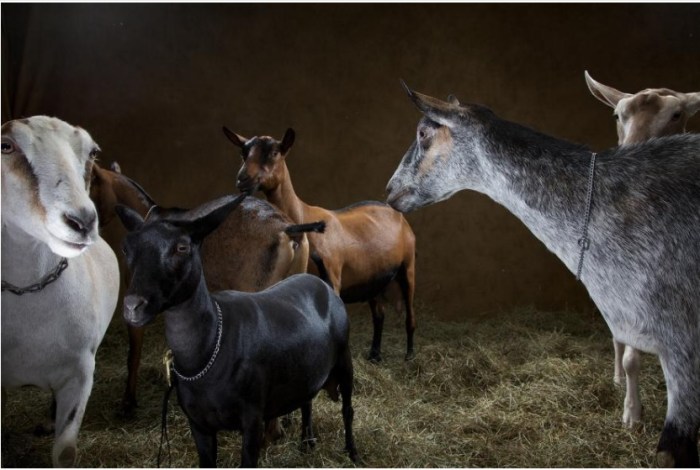
Baciadonna hopes the study helps further highlight the complexity of goats and can be a building block for further research into how they communicate and the relationships they have with each other. “It’s not unusual that we see the same goats hanging out together for the rest of their lives,” he says.
Empathy and animals
There’s also a question of empathy—the ability to not just sense but vicariously understand another’s emotions. Entire studies have been done on just how difficult it is to evaluate empathy in non-human animals. Some studies have shown that many animals, including rats, chickens, and dogs, at least appear to exhibit signs of empathy. But other studies question whether these animals experience empathy as we do.
Leanne Lauricella, founder of Goats of Anarchy, a sanctuary for special-needs goats in New Jersey, would not be surprised in the least if further studies prove that goats can feel each others’ emotions. She has countless stories about the complex relationships her rescued goats have formed with each other.
“They feed off each other. The bonded pairs or groups eat together, play together, and lay in the sun together,” she says. “When one of our baby twins lost her twin sister, another one of our goats laid next to her and snuggled and comforted her.”
“The abilities of goats are sometimes underestimated,” Baciadonna says.
Onlookers on a boat watched as a huge pod of dolphins – known as a super- or megapod – swam alongside them for 25 minutes off the coast of Laguna Beach. The estimate was approximately a 100 dolphins in the megapod.
Discovery channel has another Shark Week on the air. Sharks feeding, killing and basically just being the hungry creatures that they are. In tribute to Shark Week Markozen has included the following images:

Nice drumsticks there!
Winnipeg Rivers



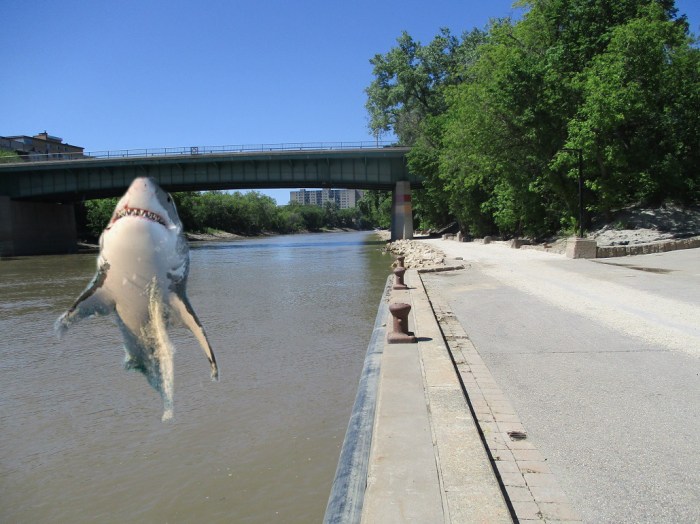


Now what we need is another Sharknado movie.

A fugitive bear likened to a superhero for its daring escape over an electric pen in northern Italy is being hunted by forest rangers.
The brown bear, named M49, was snared in the Trentino region on Sunday.
Italian authorities had ordered the wild bear’s capture after deeming it a danger to humans and farm animals.
But the animal fled just hours after it was caught, reportedly scaling three electric fences and a 13ft (4m) high barrier.

The runaway bear (not pictured here) is believed to be roaming the Marzoil woods near Trento
Park rangers with sniffer dogs are hunting the animal, which is currently believed to be in the Marzoil woods near Trento.
Trentino’s governor Maurizio Fugatti gave forestry authorities permission to “shoot it down”, saying the bear’s escape over an electric fence “carrying 7,000 volts shows how dangerous it is”.
But his orders provoked fury among animal rights activists and were rebuked by Italy’s environment ministry.
“M49’s escape from the enclosure cannot justify an action that would cause its death,” said Environment Minister Sergio Costa.
WWF Italy, a global conservation organisation, questioned how the bear was able to climb the electrified fence, suggesting the structure was probably “not working properly, since bears do not fly”.
Italy’s League for the Abolition of Hunting (LAC) gave the bear credit for a getaway Italian media have compared to the 1963 WWII film, The Great Escape.
“Evidently, M49 is an escape genius… gifted with superpowers akin to a hero of Marvel Comics,” it said.
Michela Vittoria Brambilla, president of the Italian Defence League for Animals, told M49 to “run and save yourself!”

The bear has received support on social media, too.
The hashtag #fugaperlaliberta – meaning #escapeforfreedom in Italian – has been shared widely on Twitter as animal lovers cheer on the runaway bear.
Although WWF Italy insisted the animal’s “danger to people is still to be demonstrated”, there was a case of a brown bear attack in 2017.
A female bear was shot dead by foresters in the Alps after it seriously mauled an elderly man walking his dog.
M49 is part of the Life Ursus conservation project, and is one of around 50 to 60 brown bears living in the Trentino region.
Since the 1990s, conservationists have worked to reintroduce brown bears into the region, where they had been exterminated by hunters.
BBC







 The MarkoZen Blog