
Year: 2019
Haunted Doll Moves On Its Own
Recently posted video shows what appears to be the creepy moment a World War 2-era ventriloquist doll moves on its own. In the footage the 1940s dummy, known as Mr Fritz, is seen locked in a glass box which creaks open before the doll begins moving its eyes and its mouth. Owner Michael Diamond claims the clip is real and made because he kept finding the case’s door unlatched. “I wouldn’t say I’m scared of Mr Fritz but I am wary of it,” he said.
That could be hoaxed pretty easily I reckon.






The House Hippo
The house hippo is the subject of a Canadian television public service announcement (PSA) produced by Concerned Children’s Advertisers (now known as Companies Committed to Kids) in May 1999 and reintroduced by MediaSmarts in 2019. The original sixty-second clip was directed by Tim Hamilton of Avion Films. Effects were produced by Spin Productions.
The narration of the piece is spoken in the style of a Hinterland Who’s Who spot, showing footage and describing the behaviour of the “North American house hippo”, a fictional animal found “throughout Canada, and the eastern United States.” The hippo is shown foraging for the crumbs of peanut butter toast in a kitchen, escaping from a house cat, and making a nest from lost mittens to go to sleep.
Their stated intent is to educate children about critical thinking with regard to what they see in television advertising, and remind them that “it’s good to think about what you’re watching on TV, and ask questions”. Nevertheless, some viewers on social media have expressed that as children, they completely believed that house hippos were real based on this commercial.

A Rock band ahead of its time named Death!
Death was a garage rock and protopunk demo band formed in Detroit, Michigan, in 1971 by the brothers Bobby (bass, vocals), David (guitar), and Dannis (drums) Hackney. The African American trio started out as an R&B band but switched to rock after seeing an Alice Cooper show. Music critic Peter Margasak (incorrectly denoting the youngest brother) retrospectively wrote of their musical direction: “The youngest of the brothers, guitarist David, pushed the group in a hard-rock direction that presaged punk, and while this certainly didn’t help them find a following in the mid-70s, today it makes them look like visionaries.” The band broke up by 1977 but reformed in 2009 when the Drag City label released their 70s demos for the first time.
Delightful Porn Star Names

Amber Waves
April Fills
Lance Romance
Punani Lova
Pimpin Hairpies
Michael J. Cocks
Buck Naked
Beverly Hills
Peter North
Dixie South
Bronc Johnson
Lance Alot
Johny Cockring
Harry Dickensider
Jack Hammer
Billy Club
Dick Fitzwell
Miles Long
Betsy Onnerback
Alfred Hugecock
Buster Hyman
Ivana Bigone
Ivana Spankin
Lady Likesitfast
Mike McCrank
Sharon Partners
Sharon Peters
Sharen Cox
Holden McGroin
Ben Withmany

Johnny Depth
Lott O’Toole
Cherry McGee
Holden McGroyne
Poke My Hontas
Dick Rambone
Rocky Balboner
Bill Clitton
Ben Dover
Cherry Poppins
Rod Longstaff
Justine Beaver
.
This bear couldn’t break into a pot shop’s dumpster — so it took the whole thing
Bud Depot employee nicknames the bear Cheeseburger ‘because of all the good food he’s been trying to get’
When a Colorado black bear was unable to pry open a dumpster behind a cannabis shop, the animal made off with the whole thing instead.
Surveillance footage from The Bud Depot in Lyons., Colo., caught the hungry creature bursting through a locked fence door to access the garbage bin.
After trying in vain to get through the dumpster’s metal locks, the bear stands up on its hind legs and carefully drags it through the fence door and out into the alley for several metres before finally giving up.
“Seeing the video of that definitely blew my mind,” Bud Shop employee Nikko Garza told As It Happens guest host Megan Williams.
Garza says he’s seen the bear — or at least one like it — around the area a few times in the small mountain town.
Usually, he said, it goes for the nearby restaurant dumpster, because The Bud Depot keeps its trash behind a locked fence.
But this time, he said, the bear burst through the door like Jack Nicholson in The Shining.
“But I imagine he’s a lot friendlier,” he said. “Instead of running toward you, he’ll run away.”
Garza has nicknamed the bear Cheeseburger “just because of all the good food he’s been trying to get.”
“He loves this grease trap back there,” Garza said, referring to the restaurant’s dumpster. “He loves just rubbing up against that.”
And it’s a snack the bear was after at the Bud Depot too. Garza confirmed it wasn’t trying to score the shop’s weed supply.
“I imagine he could probably smell something from the shop, but as far as the dumpster goes, we don’t have any cannabis products in there.”
The animal ran off, but Garza says he’s spotted another bear, or possibly the same one, once more since the dumpster incident.
Local wildlife officials say they are keeping an eye out for more.
New Canadian Coin Commemorates Legendary Shag Harbour UFO Incident

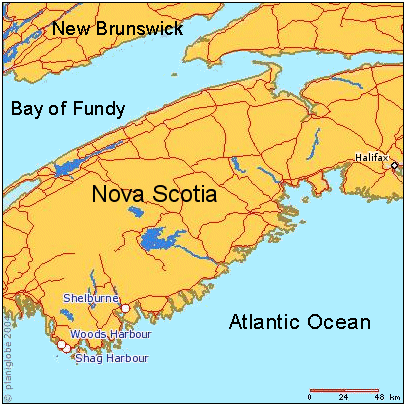
The legendary UFO case known as the Shag Harbour Incident is being commemorated by way of a new glow-in-the-dark coin that was released this week. Dubbed ‘Canada’s Roswell’ by many researchers and media outlets, 1967 event saw a mysterious glowing object fall from the sky and sink to the depths of the waters off the coast of Nova Scotia’s Shag Harbour. A subsequent search by Royal Canadian Navy divers was shrouded in secrecy and spawned a number of fantastic rumors suggesting that something ‘out of this world’ was witnessed by the submerged observers.
Thanks to a plethora of official government documents concerning the incident which have been uncovered by diligent researchers, the Shag Harbour event has been heralded by UFO investigators as one of the strongest cases for the reality of the phenomenon ever recorded. To that end, the true nature of what occurred that October night over five decades ago remains a mystery to this day and, in recent years, awareness of the case has increased exponentially thanks to a number of books, documentaries, and an annual conference as well as a museum located at Shag Harbour.
Pre-incident aerial phenomenon
Air Canada flight 305
En route to Toronto while flying over Sherbrooke and Saint-Jean, Quebec at 3658 m, from the Halifax International airport, Air Canada Capt. Pierre Charbonneau on Flight 305 pointed out to co-pilot Bob Ralphington that there was something strange out the left side of the aircraft at 7:15PM. In his report the captain reported an object tracking along on a parallel course a few miles away. He describes it as a brilliantly lit, rectangular object with a string of smaller lights trailing the object. At 7:19, the pilots noticed a sizeable silent explosion near the large object; two minutes later, a second explosion occurred which faded to a blue cloud around the object.
Yellow object
Darrel Dorey, his sister Annette, and his mother were sitting on their front porch in Mahone Bay, when they noticed a large object manoeuvring above the southwestern horizon. The next day Darrell wrote a letter to RCAF Greenwood Base Commander asking what was flying over the water that evening, as he had never seen anything like it.
MV Nickerson of Sambro, Nova Scotia
While standing at the wheelhouse of his vessel, Capt. Leo Howard “No Mercy” Mersey was looking at four blips on his Decca radar that were stationary. When he looked up about 28 km from the vessel’s windows he could see the four bright objects situated in a roughly rectangular formation. The entire crew of nearly twenty fishermen stood on deck and watched the object in the northeastern sky. Mersey radioed the rescue coordination centre and the harbour master in Halifax asking for an explanation, and filed a report with the Lunenburg RCMP outlining his sighting when they arrived in port.
Halifax Harbour sightings
The Chronicle-Herald and local radio stations reported a glowing object that had been seen by many people who had called their newsroom. They reported witnessing strange glowing objects flying around Halifax at around 10:00 PM.
Initial events
On the night of October 4, 1967, at about 11:20 p.m. Atlantic Daylight Time, it was reported that something had crashed into the waters of Shag Harbour. At least eleven people saw a low-flying lit object head towards the harbour. Multiple witnesses reported hearing a whistling sound “like a bomb,” then a “whoosh,” and finally a loud bang. The object was never officially identified, and was therefore referred to as an unidentified flying object (UFO) in Government of Canada documents. The Canadian military became involved in a subsequent rescue/recovery effort. The initial report was made by local resident Laurie Wickens and four of his friends. Driving through Shag Harbour, on Highway 3, they spotted a large object descending into the waters off the harbour. Attaining a better vantage point, Wickens and his friends saw an object floating 250 to 300 m (820 to 980 ft) offshore in the waters of Shag Harbour. Wickens contacted the RCMP detachment in Barrington Passage and reported he had seen a large airplane or small airliner crash into the waters off Shag Harbour.
A rescue mission was quickly assembled. Within half an hour of the crash, local fishing boats went out to the crash site in the waters of the Gulf of Maine off Shag Harbour to look for survivors. No survivors, bodies or debris were taken, either by the fishermen or by a Canadian Coast Guard search and rescue cutter, which arrived about an hour later from nearby Clark’s Harbour.
By the next morning, RCC Halifax had determined that no aircraft were missing. While still tasked with the search, the captain of the Canadian Coast Guard cutter received a radio message from RCC Halifax that all commercial, private and military aircraft were accounted for along the eastern seaboard, in both Atlantic Canada and New England.
The same morning, RCC Halifax also sent a priority telex to the “Air Desk” at Royal Canadian Air Force headquarters in Ottawa, which handled all civilian and military UFO sightings, informing them of the crash and that all conventional explanations such as aircraft, flares, etc. had been dismissed. Therefore, this was labeled a “UFO Report.” The head of the Air Desk then sent another priority telex to the Royal Canadian Navy headquarters concerning the “UFO Report” and recommended an underwater search be mounted. The RCN in turn sent another priority telex tasking Fleet Diving Unit Atlantic with carrying out the search.
Two days after the incident had been observed, a detachment of RCN divers from Fleet Diving Unit Atlantic was assembled and for the next three days they combed the seafloor of the Gulf of Maine off Shag Harbor looking for an object. The final report said no trace of an object was found.
 The MarkoZen Blog