
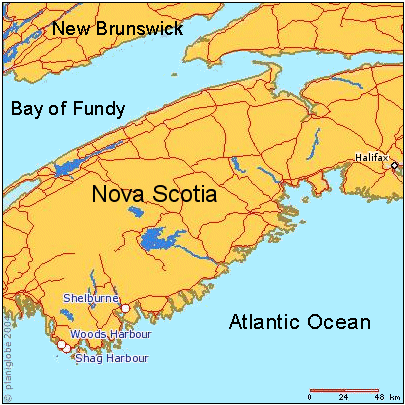
The legendary UFO case known as the Shag Harbour Incident is being commemorated by way of a new glow-in-the-dark coin that was released this week. Dubbed ‘Canada’s Roswell’ by many researchers and media outlets, 1967 event saw a mysterious glowing object fall from the sky and sink to the depths of the waters off the coast of Nova Scotia’s Shag Harbour. A subsequent search by Royal Canadian Navy divers was shrouded in secrecy and spawned a number of fantastic rumors suggesting that something ‘out of this world’ was witnessed by the submerged observers.
Thanks to a plethora of official government documents concerning the incident which have been uncovered by diligent researchers, the Shag Harbour event has been heralded by UFO investigators as one of the strongest cases for the reality of the phenomenon ever recorded. To that end, the true nature of what occurred that October night over five decades ago remains a mystery to this day and, in recent years, awareness of the case has increased exponentially thanks to a number of books, documentaries, and an annual conference as well as a museum located at Shag Harbour.
Pre-incident aerial phenomenon
Air Canada flight 305
En route to Toronto while flying over Sherbrooke and Saint-Jean, Quebec at 3658 m, from the Halifax International airport, Air Canada Capt. Pierre Charbonneau on Flight 305 pointed out to co-pilot Bob Ralphington that there was something strange out the left side of the aircraft at 7:15PM. In his report the captain reported an object tracking along on a parallel course a few miles away. He describes it as a brilliantly lit, rectangular object with a string of smaller lights trailing the object. At 7:19, the pilots noticed a sizeable silent explosion near the large object; two minutes later, a second explosion occurred which faded to a blue cloud around the object.
Yellow object
Darrel Dorey, his sister Annette, and his mother were sitting on their front porch in Mahone Bay, when they noticed a large object manoeuvring above the southwestern horizon. The next day Darrell wrote a letter to RCAF Greenwood Base Commander asking what was flying over the water that evening, as he had never seen anything like it.
MV Nickerson of Sambro, Nova Scotia
While standing at the wheelhouse of his vessel, Capt. Leo Howard “No Mercy” Mersey was looking at four blips on his Decca radar that were stationary. When he looked up about 28 km from the vessel’s windows he could see the four bright objects situated in a roughly rectangular formation. The entire crew of nearly twenty fishermen stood on deck and watched the object in the northeastern sky. Mersey radioed the rescue coordination centre and the harbour master in Halifax asking for an explanation, and filed a report with the Lunenburg RCMP outlining his sighting when they arrived in port.
Halifax Harbour sightings
The Chronicle-Herald and local radio stations reported a glowing object that had been seen by many people who had called their newsroom. They reported witnessing strange glowing objects flying around Halifax at around 10:00 PM.
Initial events
On the night of October 4, 1967, at about 11:20 p.m. Atlantic Daylight Time, it was reported that something had crashed into the waters of Shag Harbour. At least eleven people saw a low-flying lit object head towards the harbour. Multiple witnesses reported hearing a whistling sound “like a bomb,” then a “whoosh,” and finally a loud bang. The object was never officially identified, and was therefore referred to as an unidentified flying object (UFO) in Government of Canada documents. The Canadian military became involved in a subsequent rescue/recovery effort. The initial report was made by local resident Laurie Wickens and four of his friends. Driving through Shag Harbour, on Highway 3, they spotted a large object descending into the waters off the harbour. Attaining a better vantage point, Wickens and his friends saw an object floating 250 to 300 m (820 to 980 ft) offshore in the waters of Shag Harbour. Wickens contacted the RCMP detachment in Barrington Passage and reported he had seen a large airplane or small airliner crash into the waters off Shag Harbour.
A rescue mission was quickly assembled. Within half an hour of the crash, local fishing boats went out to the crash site in the waters of the Gulf of Maine off Shag Harbour to look for survivors. No survivors, bodies or debris were taken, either by the fishermen or by a Canadian Coast Guard search and rescue cutter, which arrived about an hour later from nearby Clark’s Harbour.
By the next morning, RCC Halifax had determined that no aircraft were missing. While still tasked with the search, the captain of the Canadian Coast Guard cutter received a radio message from RCC Halifax that all commercial, private and military aircraft were accounted for along the eastern seaboard, in both Atlantic Canada and New England.
The same morning, RCC Halifax also sent a priority telex to the “Air Desk” at Royal Canadian Air Force headquarters in Ottawa, which handled all civilian and military UFO sightings, informing them of the crash and that all conventional explanations such as aircraft, flares, etc. had been dismissed. Therefore, this was labeled a “UFO Report.” The head of the Air Desk then sent another priority telex to the Royal Canadian Navy headquarters concerning the “UFO Report” and recommended an underwater search be mounted. The RCN in turn sent another priority telex tasking Fleet Diving Unit Atlantic with carrying out the search.
Two days after the incident had been observed, a detachment of RCN divers from Fleet Diving Unit Atlantic was assembled and for the next three days they combed the seafloor of the Gulf of Maine off Shag Harbor looking for an object. The final report said no trace of an object was found.



 The MarkoZen Blog