Loch Ness DNA Study Suggests ‘Monster’ May be a Giant Eel

locness

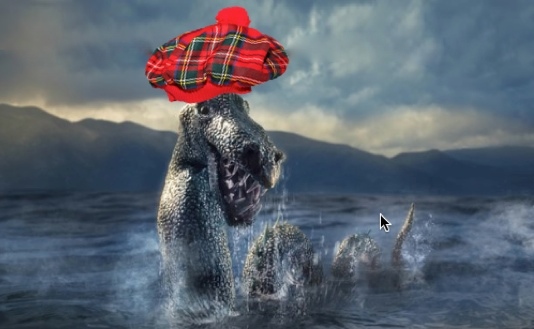
The highly-anticipated results of an environmental DNA study of Loch Ness indicate that the legendary ‘monster’ said to reside at the site could be a giant eel. The ambitious project, which generated considerable excitement in scientific and cryptozoological circles when it was first announced in April of 2017, was the brainchild of geneticist Neil Gemmell of New Zealand. During the summer of 2018, he and a team of researchers took 250 water samples from throughout Loch Ness. This material was then shipped off to labs around the world where any DNA that could be found in those samples was extracted and compared against genetic databases of known creatures.

Following a few headline-making hints earlier this year, the findings of the project were finally revealed in an announcement on Thursday. For fans of the idea that the Loch Ness Monster could be a remnant aquatic dinosaur somehow still living at the location, Gemmell had some disappointing news. “We can’t find any evidence of a creature that’s remotely related to that in our environmental-DNA sequence data,” he said, “So, sorry, I don’t think the plesiosaur idea holds up based on the data that we have obtained.”

Remarkably, the research team was also able to rule out a sizeable number of other possible suspects for Nessie, including sharks, catfish, and sturgeon. According to Gemmel, the water samples from Loch Ness did not contain any DNA from those various creatures which have, in the past, been suggested by investigators for what might be behind the monster mystery. However, one long-standing theory for the nature of Nessie did remain viable and was perhaps even strengthened by the study: a giant eel.

“Eels are very plentiful in Loch Ness, with eel DNA found at pretty much every location sampled – there are a lot of them,” revealed Gemmel. He went on to note that their data does not provide any indication of the size of the creatures, just that they are there in Loch Ness. With that in mind, he mused that “the sheer quantity of the material says that we can’t discount the possibility that there may be giant eels in Loch Ness. Therefore we can’t discount the possibility that what people see and believe is the Loch Ness Monster might be a giant eel.”

It’s unlikely that this conclusion will come as much of a surprise to Nessie aficionados as the proverbial ‘eel hypothesis’ has largely been considered the most plausible scenario for quite some time and, these days, the possibility that the creature could be a plesiosaur mostly only resides in the minds of children, advertisers, and a handful of very imaginative researchers. Be that as it may, the findings from the study have already spawned a slew of news stories declaring that the Loch Ness Monster mystery has been solved once and for all.

While that very well may wind up being the case, short of draining Loch Ness and finding ‘nothing’ there, the legend of a mysterious creature said to lurk at the site is probably not going to die anytime soon. Tourists will continue to visit the location in the hopes of spotting something strange, puzzling videos of enigmatic oddities appearing on the water will still pop up online every few months, and depictions of ‘monster’ will, without question, go unchanged from the iconic plesiosaur image that we have all come to know and love, even if Nessie really is just a big eel.

I have been a supporter of the giant eel hypothesis for years.
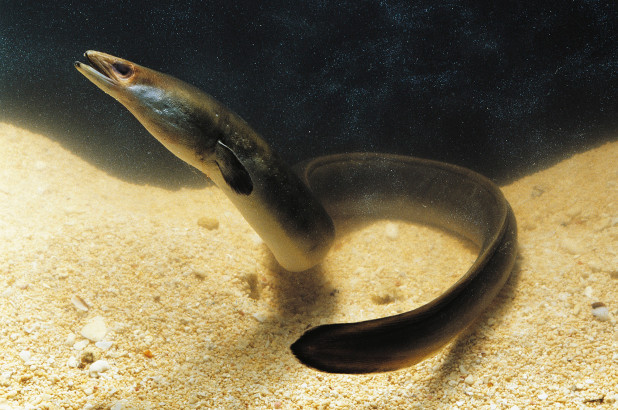
loch-ness-eel-171

Polar Bear goes for a big swim, a very big swim!

BBC

A polar bear swam continuously for over nine days, covering 687km (426 miles), a new study has revealed.

Scientists studying bears around the Beaufort sea, north of Alaska, claim this endurance feat could be a result of climate change.

Polar bears are known to swim between land and sea ice floes to hunt seals.

But the researchers say that increased sea ice melts push polar bears to swim greater distances, risking their own health and future generations.

In their findings, published in Polar Biology, researchers from the US Geological Survey reveal the first evidence of long distance swimming by polar bears (Ursus maritimus).

“This bear swam continuously for 232 hours and 687 km and through waters that were 2-6 degrees C,” says research zoologist George M. Durner.

“We are in awe that an animal that spends most of its time on the surface of sea ice could swim constantly for so long in water so cold. It is truly an amazing feat.”

Although bears have been observed in open water in the past, this is the first time one’s entire journey has been followed.

By fitting a GPS collar to a female bear, researchers were able to accurately plot its movements for two months as it sought out hunting grounds.

The polar bear is the largest terrestrial carnivore, being more than twice as big as the Siberian Tiger.  It shares the title of largest land predator (and largest bear species) with the Kodiak bear.  Adult males weigh 350–680 kg (770–1500 lbs) and measure 2.4–3 m (7.9–9.8 ft) in length.   Adult females are roughly half the size of males and normally weigh 150–249 kg (330–550 lb), measuring 1.8–2.4 metres (5.9–7.9 ft) in length. When pregnant, however, they can weigh as much as 499 kg (1,100 lb).

Polar Bear swimming underwater at San Diego Zoo.

As of 2008, the World Conservation Union (IUCN) reports that the global population of polar bears is 20,000 to 25,000, and is declining.  In 2006, the IUCN upgraded the polar bear from a species of least concern to a vulnerable species.  It cited a “suspected population reduction of >30% within three generations (45 years)”, due primarily to global warming. Other risks to the polar bear include pollution in the form of toxic contaminants, conflicts with shipping, stresses from recreational polar-bear watching, and oil and gas exploration and development.  The IUCN also cited a “potential risk of over-harvest” through legal and illegal hunting.

This Russian takes Crazy to a whole new level

Charges for Russian after stunts atop Toronto skyscraper

An “urban explorer” has been charged after he was seen in an online video leaping and doing somersaults atop a downtown Toronto skyscraper.

In a video posted to YouTube, Russian stuntman Oleg Cricket can be seen leaping, sliding and rolling on the ledge of a skyscraper. In another shot, he appears to be jumping between beams, with the CN Tower as his backdrop. In one of the final shots, Cricket is shown doing a handstand on a ledge, high above city streets.

Police arrested Cricket on Nov. 12, 2016. He has been charged with breaking and entering and mischief, Toronto police say.

Cricket is well-known for his vertigo-inducing acrobatic feats atop skyscrapers in various cities. He records his stunts and puts them on YouTube and other social media channels, where his followers number in the hundreds of thousands.

Another man who was allegedly with Cricket is facing the same charges.

The Building, 8 Mercer St

8-mercer


Sailing through Rock – Sailors Encounter Pumice Island the Size of Manhattan

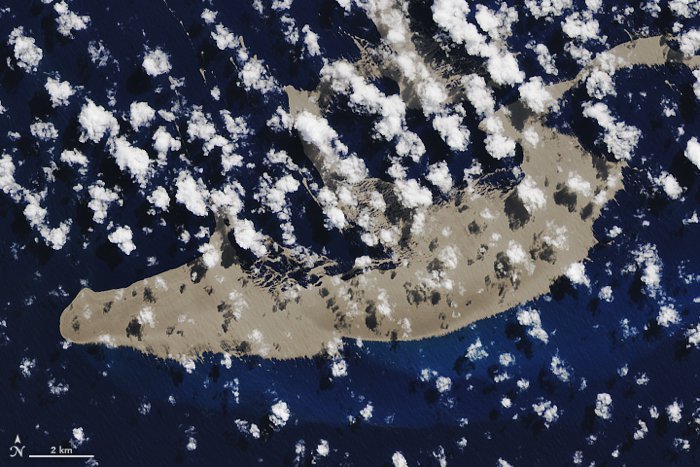
An Australian couple sailing their catamaran towards Fiji, in the Pacific Ocean, encountered a 150-square-kilometer pumice raft drifting towards Australia.

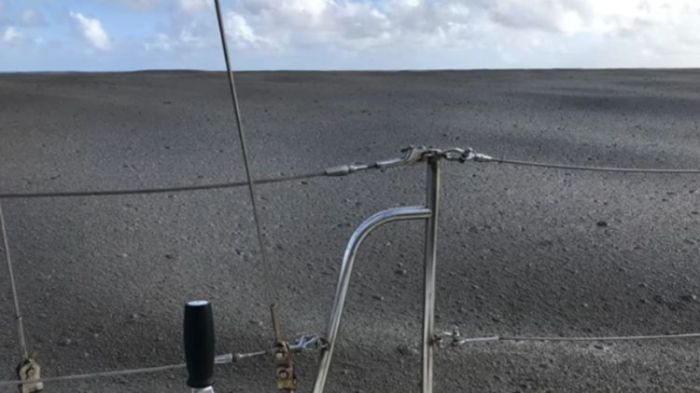
Believed to have been produced by an underwater volcanic eruption near the island of Tonga, the pumice raft is over 20,000 football fields in size and several inches thick. Its existence was first reported on August 16, by a couple who encountered it while sailing towards Fiji. The vast expanse of floating volcanic rock slowed their catamaran to a speed of one knot and completely covered the ocean surface as far as the eye could see.

pumice

Photo: video screengrab

“We entered a total rock rubble slick made up of pumice stones from marble to basketball size,” Michael Hoult and Larissa Brill wrote on Facebook. “The waves were knocked back to almost calm and the boat was slowed to 1 knot. The rubble slick went as far as we could see in the moonlight and with our spotlight.”

The steering of the vessel reportedly became temporarily jammed by rocks between rudders and hull, but the couple somehow managed to clear the rubble and war other boats.

Another couple steering their yacht through the pumice raft described sound as “a cement mixer” and constant “grinding”.

“We sailed through a pumice field for 6–8 hours, much of the time there was no visible water,” sailor Shannon Lenz said. “It was like ploughing through a field. We figured the pumice was at least 6 inches thick.”

Pumice stone is a highly porous, lightweight volcanic rock, so even though the giant raft was a least six-inches-thick, it was very buoyant. But its most fascinating characteristic is that of temporary home for billions of marine organisms, like barnacles, crabs and snails. As it drifts towards the Australian coast, experts are hopeful that it will help revitalize the Great Barrier Reef.

“Based on past pumice raft events we have studied over the last 20 years, it’s going to bring new healthy corals and other reef dwellers to the Great Barrier Reef,” technology geologist Scott Bryan said. “It’s the right timing. So it will be able to pick up corals and other reef building organisms, and then bring them into the Great Barrier Reef.”

Time Travel

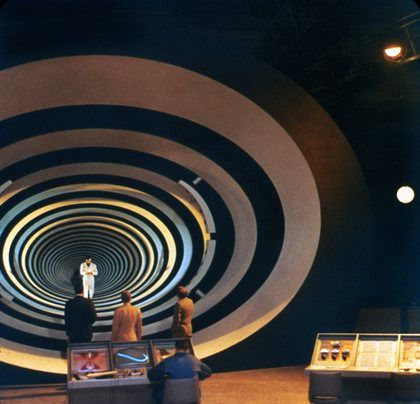
The Time Tunnel is an American color science-fiction TV series, written around a theme of time travel adventure and starring James Darren and Robert Colbert. The show was inspired by the 1964 movie The Time Travelers (AIP/Dobil), and was creator-producer Irwin Allen’s third science-fiction television series, released by 20th Century Fox Television and broadcast on ABC. The show ran for one season of 30 episodes. A pilot for a new series was produced in 2002, but did not proceed to a series. A history of the series by Martin Grams Jr., was published in 2012.

The underground facility with the time tunnel.

tunnel

tunnel1

tunnel2

tunnel3

tunnel4

tunnel5

Fussy Old Bat

Australian woman sues neighbours over barbecue use

A woman in Western Australia has tried to stop her neighbours from using their barbecues by suing them in court.

Perth woman Cilla Carden claimed that their activities – among them barbecuing and smoking -as well as their noisy children, breached residential laws.

She sought legal orders to prevent the alleged nuisances from continuing.

A tribunal, and the state’s highest court, rejected her claims as unreasonable and lacking in evidence.

Her list of demands also included orders for a family living next door, and another neighbour, to reduce their patio lighting, silence their pets and to replace plants in the common garden.

barbi

She alleged that wafting smells of cigarettes and barbecues had caused “undue offence” to her in her home in the Perth suburb of Girrawheen, according to a Supreme Court of Western Australia judgement published in July.

“They’ve put [the barbecue] there so I smell fish – all I can smell is fish,” Ms Carden, who is a vegan, told Nine News on Monday.

“I can’t enjoy my backyard, I can’t go out there,” she said.

‘They are living in their home as a family’

The State Administrative Tribunal of Western Australia rejected her demands in a case hearing in February – including a request for her neighbour’s children to be quiet when playing outside.

“The Tribunal does not accept that [the parents], by allowing their children to play in the backyard… use the patio for small scooters or toys, constitutes reasonably a nuisance,” the tribunal said.

“What they are doing is living in their backyard and their home as a family.”

The tribunal also noted that the same family had already moved their barbecue prior to the hearing in an attempt to appease Ms Carden.

“[They] have not allowed the children out at night, have not used the patio at night, and have not turned on the lights for several months for fear of reprisals from the applicant,” the tribunal said.

Ms Carden challenged the tribunal’s decision in the Supreme Court of Western Australia in March.

In handing down his rejection in July, the judge noted that she had submitted close to 400 pages in her appeal.

“The volume of material that she has produced… suggests that these matters have to an extent become somewhat overwhelming,” Chief Justice Peter Quinlan said.

Ms Carden told Australian media she plans on taking further legal action.