John Glenn Military Flight History

john_glenn_portrait


John Herschel Glenn Jr. (July 18, 1921 – December 8, 2016) was an American aviator, engineer, astronaut, and United States Senator from Ohio. In 1962 he became the first American to orbit the Earth, circling three times. Before joining NASA, he was a distinguished fighter pilot in both World War II and Korea, with six Distinguished Flying Crosses and eighteen clusters to the Air Medal.

Glenn was one of the “Mercury Seven” group of military test pilots selected in 1959 by NASA to become America’s first astronauts. On February 20, 1962, he flew the Friendship 7 mission and became the first American to orbit the Earth and the fifth person in space. Glenn received the Congressional Space Medal of Honor in 1978, was inducted into the U.S. Astronaut Hall of Fame in 1990, and was the last surviving member of the Mercury Seven.

After he resigned from NASA in 1964, Glenn planned to run for a U.S. Senate seat from Ohio. A member of the Democratic Party, he first won election to the Senate in 1974 where he served through January 3, 1999.

He retired from the Marine Corps in 1965, after twenty-three years in the military, with over fifteen medals and awards, including the NASA Distinguished Service Medal and the Congressional Space Medal of Honor. In 1998, while still a sitting senator, he became the oldest person to fly in space, and the only one to fly in both the Mercury and Space Shuttle programs as crew member of the Discovery space shuttle. He was also awarded the Presidential Medal of Freedom in 2012.


Photograph of John Glenn in the cockpit his F8U-1P Crusader during the "Project Bullet" record breaking transcontinental flight, 1957

Photograph of John Glenn in the cockpit his F8U-1P Crusader during the “Project Bullet” record breaking transcontinental flight, 1957


John Glenn was born on July 18, 1921, in Cambridge, Ohio, the son of John Herschel Glenn, Sr. (1895–1966) and Clara Teresa (née Sproat) Glenn (1897–1971). He was raised in nearby New Concord.

After graduating from New Concord High School in 1939, he studied Engineering at Muskingum College. He earned a private pilot license for credit in a physics course in 1941. Glenn did not complete his senior year in residence or take a proficiency exam, both requirements of the school for the Bachelor of Science degree. However, the school granted Glenn his degree in 1962, after his Mercury space flight.

When the Japanese attack on Pearl Harbor brought the United States into World War II, Glenn quit college to enlist in the U.S. Army Air Corps. However, he was never called to duty, and in March 1942 enlisted as a United States Navy aviation cadet. He went to the University of Iowa for preflight training, then continued on to NAS Olathe, Kansas, for primary training. He made his first solo flight in a military aircraft there. During his advanced training at the NAS Corpus Christi, he was offered the chance to transfer to the U.S. Marine Corps and took it.

Upon completing his training in 1943, Glenn was assigned to Marine Squadron VMJ-353, flying R4D transport planes. He transferred to VMF-155 as an F4U Corsair fighter pilot, and flew 59 combat missions in the South Pacific. He saw combat over the Marshall Islands, where he attacked anti-aircraft batteries on Maloelap Atoll. In 1945, he was assigned to NAS Patuxent River, Maryland, and was promoted to captain shortly before the war’s end.

Glenn flew patrol missions in North China with the VMF-218 Marine Fighter Squadron, until it was transferred to Guam. In 1948 he became a flight instructor at NAS Corpus Christi, Texas, followed by attending the Amphibious Warfare School.


F4U Corsair

glenn2


During the Korean War, Glenn was assigned to VMF-311, flying the new F9F Panther jet interceptor. He flew his Panther in 63 combat missions, gaining the nickname “magnet ass” from his alleged ability to attract enemy flak. On two occasions, he returned to his base with over 250 holes in his aircraft. For a time, he flew with Marine reservist Ted Williams, a future Hall of Fame baseball player for the Boston Red Sox, as his wingman. He also flew with future Major General Ralph H. Spanjer.

Glenn flew a second Korean combat tour in an interservice exchange program with the United States Air Force, 51st Fighter Wing. He logged 27 missions in the faster F-86F Sabre and shot down three MiG-15s near the Yalu River in the final days before the ceasefire.

For his service in 149 combat missions in two wars, he received numerous honors, including the Distinguished Flying Cross (six occasions) and the Air Medal with eighteen award stars.


F9F Panther

glenn1


glenn47

Glenn’s USAF F-86F that he dubbed “MiG Mad Marine” during the Korean War, 1953


Glenn returned to NAS Patuxent River, appointed to the U.S. Naval Test Pilot School (class 12), graduating in 1954. He served as an armament officer, flying planes to high altitude and testing their cannons and machine guns. He was assigned to the Fighter Design Branch of the Navy Bureau of Aeronautics (now Bureau of Naval Weapons) as a test pilot on Navy and Marine Corps jet fighters in Washington, D.C., from November 1956 to April 1959, during which time he also attended the University of Maryland.

Glenn had nearly 9,000 hours of flying time, with approximately 3,000 hours in jet aircraft.

On July 16, 1957, Glenn completed the first supersonic transcontinental flight in a Vought F8U-3P Crusader. The flight from NAS Los Alamitos, California, to Floyd Bennett Field, New York, took 3 hours, 23 minutes and 8.3 seconds. As he passed over his hometown, a child in the neighborhood reportedly ran to the Glenn house shouting “Johnny dropped a bomb! Johnny dropped a bomb! Johnny dropped a bomb!” as the sonic boom shook the town. Project Bullet, the name of the mission, included both the first transcontinental flight to average supersonic speed (despite three in-flight refuelings during which speeds dropped below 300 mph), and the first continuous transcontinental panoramic photograph of the United States. For this mission Glenn received his fifth Distinguished Flying Cross.


F8U-3P Crusader

f-8e_vmf-212_cva-34_1965_cropped


Glenn wasn’t finished. He went on to flying much higher.

glennxx

John Glenn in his Mercury spacesuit

The World’s Southernmost City

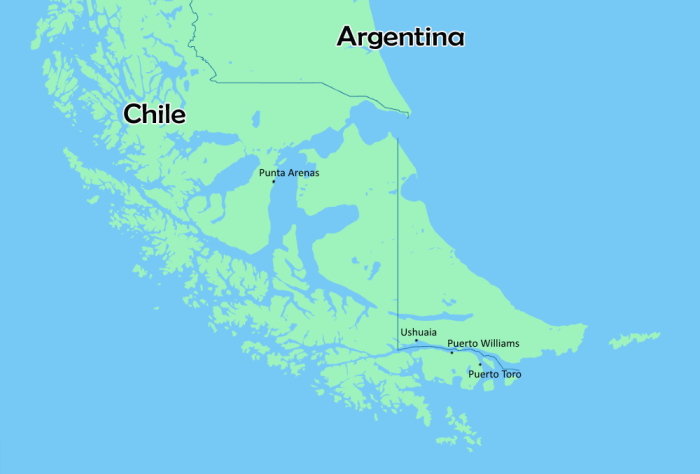
The southern part of South America is fractured into a number of small islands collectively known as Tierra del Fuego. Located roughly between 52° and 55° latitudes, these islands constitute some of the most distant landmasses on earth measured from the equator.

The region is sparsely populated, but there are two major population centers here—Ushuaia and Río Grande—both located on Isla Grande de Tierra del Fuego, the largest island of the archipelago. This island is shared by Argentina and Chile, and while the Chilean part is geographically larger, the Argentinean side is more populous. Both Ushuaia and Río Grande are similarly sized, but Ushuaia is located further south, a position that has allowed it to claim the title of the “southernmost city in the world,” although it is not the only town who claims so.

world's southermost cities

Ushuaia is the administrative capital of Tierra del Fuego, an industrial port and a tourist hub. Almost all tourist trips to Antarctica start from here. People from all over the world fly in to Ushuaia, disembark and immediately proceed to board one of the cruise ships that line the dock, for the voyage south. Few actually stop to explore the city.

Ushuaia has a sizable population of 71,000 and the infrastructure to call itself a city. There is a settlement called Puerto Williams further south, but it has a population of only 2,800. Puerto Williams is the capital of the Chilean Antarctic Province, and it too claims the title of world’s southernmost city. But because of the town’s small size and population, that claim is not taken too seriously.

southermost city Ushuaia


Ushuaia’s claim is challenged by Punta Arenas, the capital city of Chile’s southernmost region, Magallanes and Antartica Chilena. Punta Arenas is among the largest cities in the entire Patagonian Region with a population of 127,000, as of 2012. The city is located north of Ushuaia, but Chilean authorities claim that Punta Arenas is a truer city than Ushuaia being vastly larger than Ushuaia both in population and area. Ushuaia is only 23 square kilometers, while Punta Arenas is more than seventeen thousand square kilometers. This makes Punta Arenas a strong candidate to the title of the “world’s southernmost city”.

southermost city Punta Arenas


If size is not a criteria, than Puerto Toro is the world’s southernmost settlement having a permanent population of 36—mostly fishermen and their families. It is the only such community on Earth that is situated below the 55th parallel south. It is also the only Chilean locality and port with coasts and waters belonging to the Atlantic Ocean.

Puerto Toro was founded in 1892 during the Tierra del Fuego Gold Rush and was once one of the most important towns in the region. Once the gold prospect diminished, people moved out and Puerto Toro became a small hamlet.

southermost city Puerto Toro


200,000 UFO Fans Plan to Storm Area 51?

Area 51 (Groom Lake, Dreamland) File Photo near Rachel, Nevada (Photo by Barry King/WireImage)

A bizarre online campaign suggesting that UFO enthusiasts storm Area 51 in search of alien secrets hidden at the infamous base has seemingly garnered the support of nearly 200,000 people. The wild idea is reportedly the brainchild of a group of online agitators who created a Facebook event titled ‘Storm Area 51, They Can’t Stop All of Us.’ Although the proposed gathering appears to have been just a joke, the concept captured the imagination of the masses online.

To date, a whopping 181,000 people have declared that they are ‘attending’ the event and another 200 thousand individuals have expressed interest in joining in on the action which is set to take place on Friday, September 20th at 3 AM. Of course, as anyone who has haphazardly accepted an online invitation to a distant relative’s art gallery opening or dance recital can attest, the vast majority of the people who indicated plans to join in the horde almost certainly will not be in attendance when the big day arrives.

That said, there’s a very real possibility that some foolhardy individuals may genuinely make an effort to storm Area 51 on September 20th when organizers allegedly plan to “meet up at the Area 51 Alien Center tourist attraction and coordinate our entry.” Aside from the installation’s incredibly stringent security measures which prevent unauthorized visitors, the very fact that the date and time of the planned surge is public knowledge is a pretty good indication that the daring gambit will prove futile. It could also wind up being criminal should would-be trespassers push the proverbial envelope and really try to gain entry to the base.

Area 51 researcher George Knapp, who famously broke the story that Area 51 existed back in 1989, responded to the idea on Twitter by noting that “this plan has been proposed multiple times over the last 30 years. Then, as now, it’s a really bad idea.” To that end, he stressed that “there are no aliens at Area 51, no alien tech either” and that “base security is more than capable of handling Winnebago trespassers.” With that in mind, it would undoubtedly be wise for the idea to remain in the daydreams of UFO enthusiasts sitting at their computer rather than being put into practice.


An F-22 Raptor from the 27th Fighter Squadron out of Langley Air Force Base, Va., participates in Red Flag 13-3 March 5, 2013, at Nellis AFB, Nev. Red Flag is a realistic combat training exercise involving the air forces of the United States and its allies. During the exercise, aircrews and ground crews train to fight, survive and win together. (U.S. Air Force photo by Senior Airman Matthew Lancaster)

An F-22 Raptor from the 27th Fighter Squadron out of Langley Air Force Base, Va., participates in Red Flag 13-3 March 5, 2013, at Nellis AFB, Nev. Red Flag is a realistic combat training exercise involving the air forces of the United States and its allies. During the exercise, aircrews and ground crews train to fight, survive and win together. (U.S. Air Force photo by Senior Airman Matthew Lancaster). Area 51 in red circle.


If there are no Aliens at the base, then what in the hell are these?

51a


51e


51g


What the hell is this then?

51b