


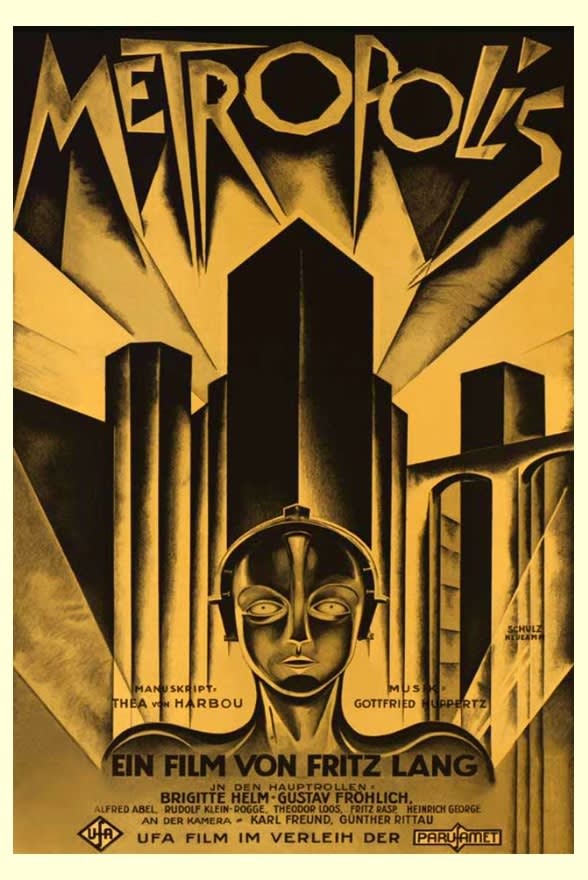
The only poster on this list not from the latter half of the 20th century, and for good reason. Fritz Lang’s seminal silent classic jump-started the modern science fiction genre with its elaborate sets, fantastical cityscapes, and deep-rooted themes of social criticism. Heinz Schulz-Neudamm used the matte paintings of the city seen in the film as a touchstone for the vertical, Art Deco-inspired background, and the robotic Maria in the foreground was unlike anything audiences had ever seen. Coupled with the bizarre, sporadically geometric font of the title, Metropolis’ poster was and continues to be a unique achievement for poster design, inspiring countless filmmakers and visual artists to this day.

Say what you will about his consistency—or his insane plan to make four Avatar sequels in a row—but James Cameron is a true visionary, birthing The Terminator, The Abyss, and, yes, Avatar, and forever changing the film industry with each. However, his biggest contribution to the field of movie posters is for his Oscar-winningest, highest-grossing movie, Titanic. The image of the titular ocean liner splitting the screen keeps the imminent danger of the disaster ever-present against the seminal romance between Jack and Rose, whose floating heads in the upper third of the poster spawned an entire subgenre of romantic posters.
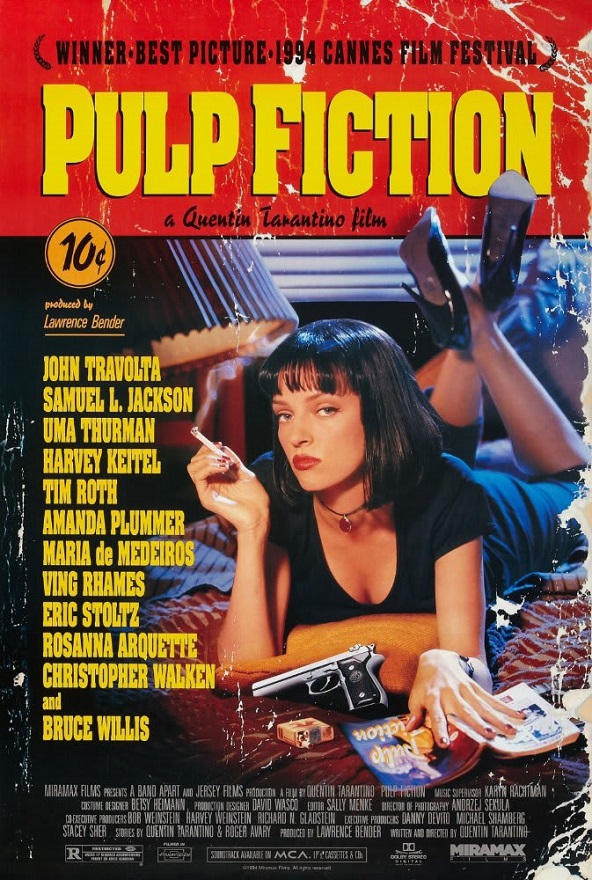
The genius of the poster for Pulp Fiction is that it’s not really a poster for Pulp Fiction. James Verdesoto’s poster has little in common with the film other than Uma Thurman’s Mia Wallace, which is exactly what a film inspired by pulp novels needed to be. The beat-up design, 10 cent sticker, and poorly shopped-in props recall the novels from which Tarantino drew inspiration and add a nostalgic air of mystery around what you’re going to discover as soon as you turn the page. Add to it a stacked cast list and a distinct title font and you’ve got a poster that echoes the shocks Pulp Fiction sent through the film industry when it came out.

For a slacker who skips class and spends all his time hanging around with an old man, Marty McFly is really, really cool, and the incredibly prolific and influential Drew Struzan’s poster captures that in spades. Marty’s 80s streetwear, the DeLorean’s gullwing door, and the two trails of fire get equal share and sum up the incredible style of Robert Zemeckis’ film in gorgeous fashion while leaving just enough mystery as to the contents of the time-traveling plot: “He was never in time for his classes…he wasn’t in time for his dinner…then one day…he wasn’t in his time at all.”
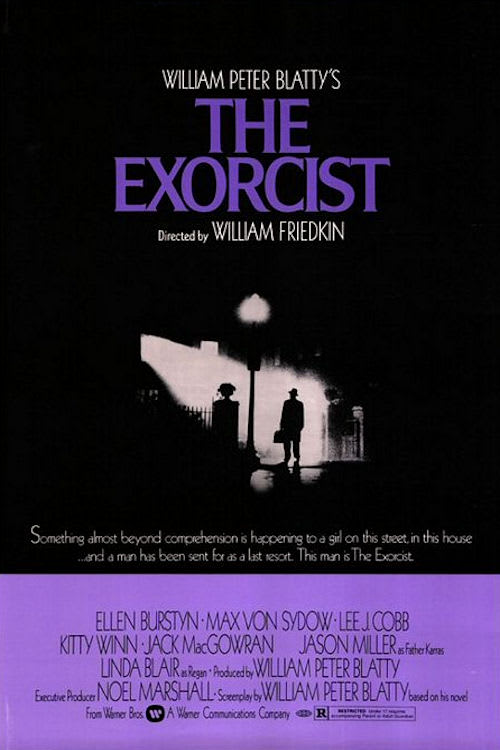
Promoting what is arguably the greatest horror film of all time, Bill Gold’s poster for The Exorcist just oozes dread in every inch, from its single image of Max von Sydow’s Father Merrin arriving at the MacNeil house to the purple font and lower third, to the two-sentence-long plot synopsis: “Something almost beyond comprehension is happening to a girl on this street, in this house…and a man has been sent for as a last resort. This man is The Exorcist.” You can practically hear the piano begin to play.
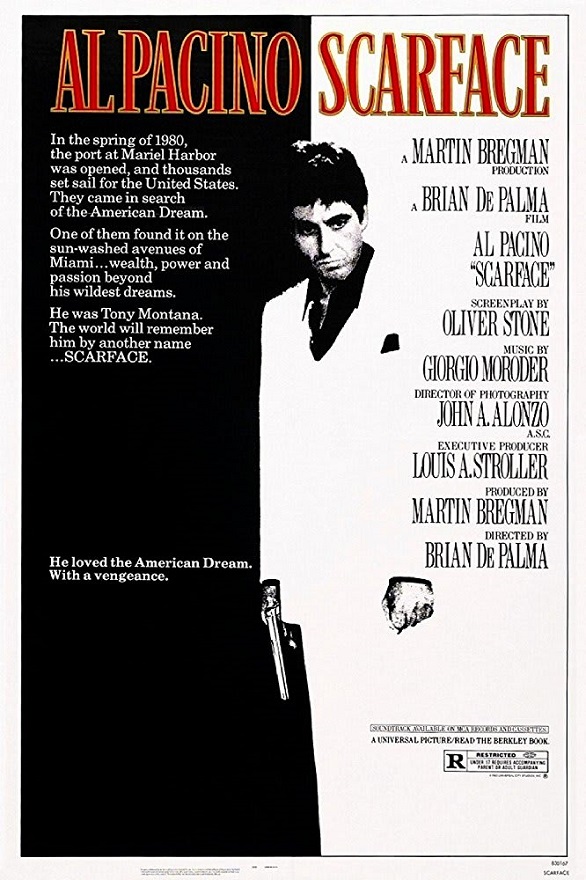
In his designs of the poster for Brian de Palma’s ode to 1980s Miami drug-money opulence, art director Ed Richardson opted for minimalism to make perhaps the single most ubiquitous dorm-room movie poster. The contrast between the black and white halves splitting Tony Montana in two not only pays homage to Howard Hawks’ seminal 1932 original, demonstrates Tony’s internal moral struggles, and creates a strikingly unique image—it also looks, for lack of a more eloquent adjective, really badass, summing up the intense intentions behind seminal lines such as “You cockroaches wanna play rough? Okay, I’m reloaded!” and “Don’t fuck me, Tony. Don’t you ever try to fuck me” with only two colors.
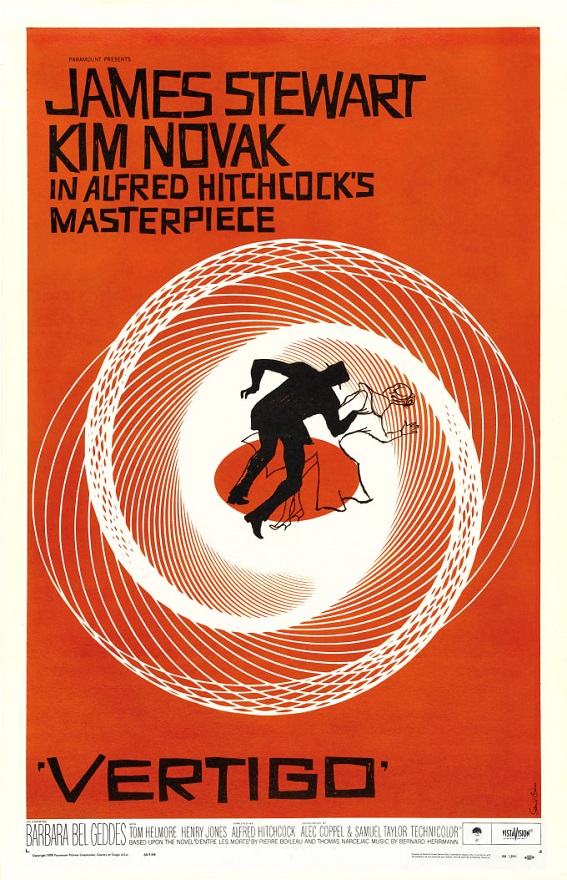
While its status as the greatest Hitchcock film is somewhat debatable, Saul Bass’ striking poster for Vertigo is, without a doubt, the greatest Hitchcock poster. Bass, who also designed many of Hitchcock’s title sequences, was known for his offbeat minimalism in his designs, and the Vertigo poster is no exception. Utilizing a deep orange background and a spirograph that calls to mind a descent into madness, Bass nearly puts the audience in the perspective of the man dressed in black at the center of the frame, chasing after a ghastly female figure. The poster promotes the fact that the film is Alfred Hitchcock’s masterpiece, but it’s plain to see that it is itself a masterwork.

Comparing this poster to those of the Alien sequels, particularly 2017’s misguided Alien Covenant shows just how effective Frankfurt Gips Balkind’s Xenomorph-less poster is. Consistently ranking at the top of the greatest movie taglines of all time, “In space, no one can hear you scream” is all you need to know about what this movie is going into it: a terrifying experience set on a space station with some kind of monster. If that wasn’t enough to get butts into seats in 1979, when audiences were being inundated with a cavalcade of family-friendly Star Wars rip-offs, the sight of the horrifying alien egg just beginning to crack certainly was, making Alien a hit and essentially kicking off an entire genre of sci-fi horror.
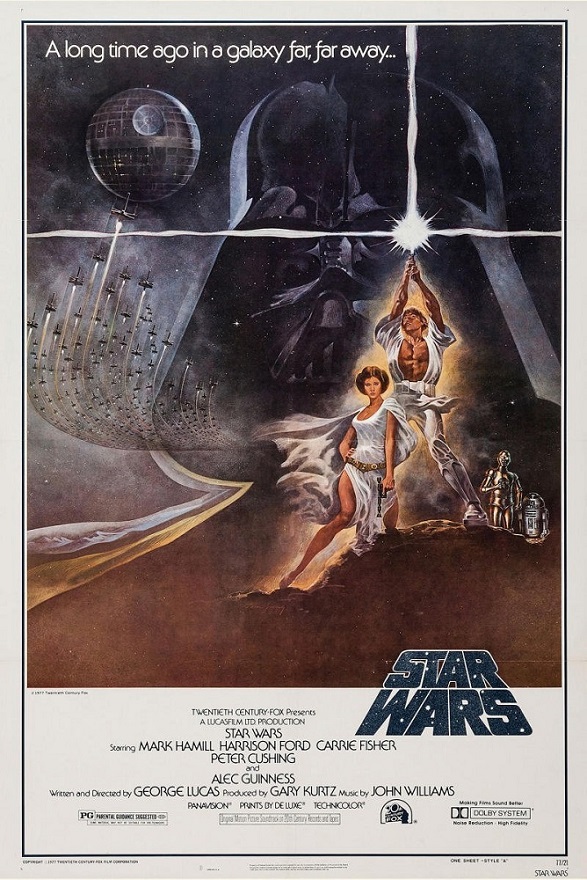
By all accounts, Star Wars should have been a colossal failure on all accounts. The special effects artists were winging it, George Lucas was winging it, Harrison Ford was especially winging it. Obviously, the film became the biggest deal in the history of anything, which is why we’ll keep getting Star Wars films until the inevitable heat death of the universe, but part of that is due to the winging it of Tom Jung, whose poster for the film, despite Luke’s generously rendered abs and Leia’s skimpy outfit, pulls together the themes of good and evil in such a brilliant way that it’s no wonder the movie became an instant mega-blockbuster. Like the film itself, the poster has been copied, recycled, and retooled again and again, but nothing will top the classic original.
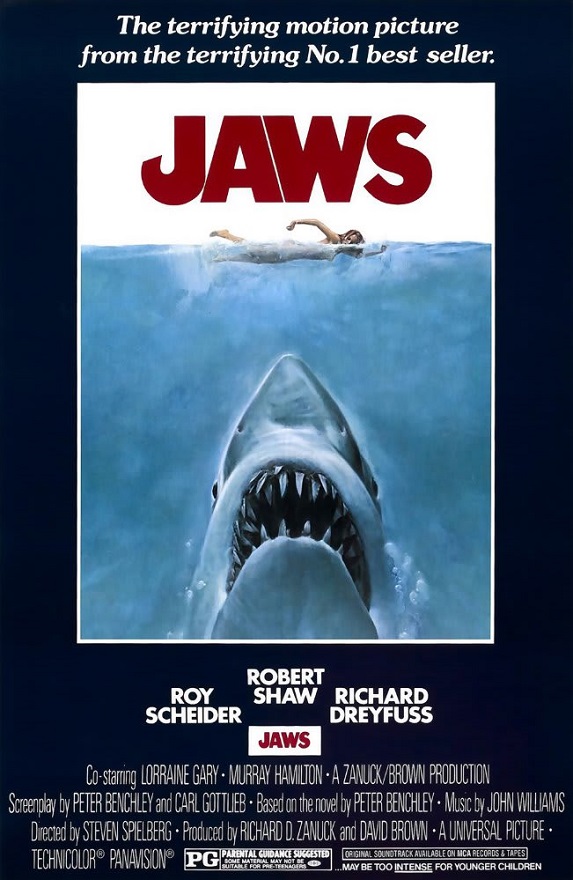
The depth of Steven Spielberg’s filmography is only rivaled by the sheer number of iconic posters his films have spawned: the nostalgic portraiture of Indiana Jones and the Raiders of the Lost Ark, the wonder and hope of E.T., the mystique of Jurassic Park, but not even these can come close to the poster for Jaws. Eschewing any pictures of the film’s stars or lines explaining the film’s plot, Roger Kastel’s painting is masterful in its simplicity, with the naked girl’s blissful ignorance to the giant, killer shark lurking just below the surface summarizing the film’s plot and conflict in miraculous clarity. Just as Jaws changed the landscape of Hollywood forever, its poster became a landmark so iconic that it is relentlessly analyzed and imitated by marketers over forty years later. It’s no wonder people were so afraid of the ocean.
Rainier Tower is a 31-story, 156.67 m (514.0 ft) skyscraper in the Metropolitan Tract of Seattle, Washington, at 1301 Fifth Avenue. It was designed by Minoru Yamasaki, who designed the World Trade Center in New York City as well as the IBM Building, which is on the corner across the street from Rainier Tower to the southeast. Its construction was completed in 1977.
The skyscraper has an unusual appearance, being built atop an 11-storey, 37 m (121 ft) concrete pedestal base that tapers towards ground level, like an inverted pyramid.

The tower occupies only 25% of its site at ground level, with a normal-sized tower balanced on an extremely narrow pedestal.


Some TV channels are obsessed with airing ghost shows. They are supposed to be reality based shows where the paranormal investigators come across strange things. Usually it is some quiet crack or thump that could be caused by anything, wind or pipes cracking etc. One of the most widely used gimmicks is “Did you hear that!?”
List of some shows: Ghost Mine, Haunted Hospitals, Ghost Adventures, Ghost Hunters, Paranormal 911, Help! My House is Haunted, World’s Scariest Hauntings, Paranormal State, The Dead Files and My Worst Nightmare to name but a few. There are many more.
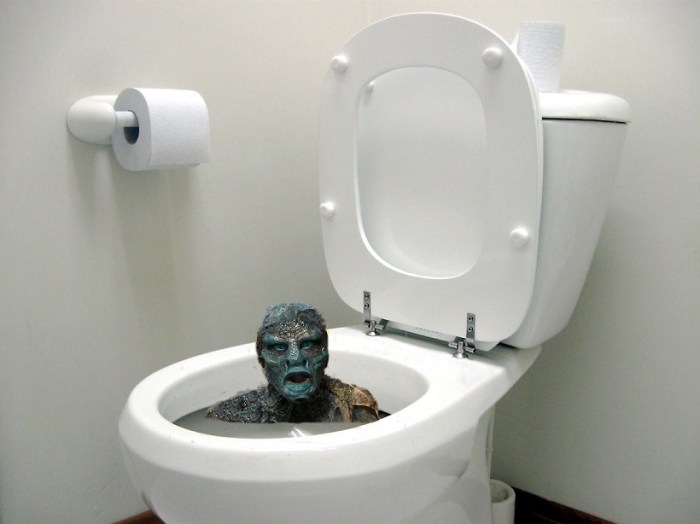
Sewer ghost creature
In folklore, a ghost (sometimes known as an apparition, haunt, phantom, poltergeist, shade, specter or spectre, spirit, spook, and wraith) is the soul or spirit of a dead person or animal that can appear to the living. In ghostlore, descriptions of ghosts vary widely from an invisible presence to translucent or barely visible wispy shapes, to realistic, lifelike visions. The deliberate attempt to contact the spirit of a deceased person is known as necromancy, or in spiritism as a séance.
The belief in the existence of an afterlife, as well as manifestations of the spirits of the dead, is widespread, dating back to animism or ancestor worship in pre-literate cultures. Certain religious practices—funeral rites, exorcisms, and some practices of spiritualism and ritual magic—are specifically designed to rest the spirits of the dead. Ghosts are generally described as solitary, human-like essences, though stories of ghostly armies and the ghosts of animals rather than humans have also been recounted. They are believed to haunt particular locations, objects, or people they were associated with in life. According to a 2009 study by the Pew Research Center, 18% of Americans say they have seen a ghost.
The overwhelming consensus of science is that ghosts do not exist. Their existence is impossible to falsify, and ghost hunting has been classified as pseudoscience. Despite centuries of investigation, there is no scientific evidence that any location is inhabited by spirits of the dead. Research has indicated that ghost sightings may be related to degenerative brain diseases such as Alzheimer’s disease. Older reports linked carbon monoxide poisoning to ghost-like hallucinations.
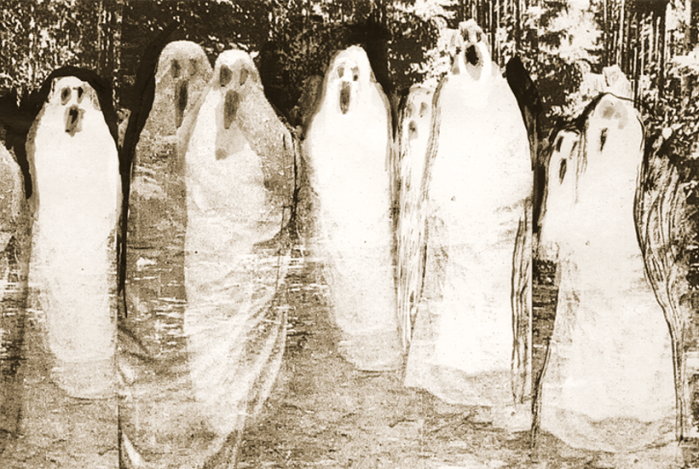
Joe Nickell of the Committee for Skeptical Inquiry wrote that there was no credible scientific evidence that any location was inhabited by spirits of the dead. Limitations of human perception and ordinary physical explanations can account for ghost sightings; for example, air pressure changes in a home causing doors to slam, humidity changes causing boards to creak, condensation in electrical connections causing intermittent behavior, or lights from a passing car reflected through a window at night. Pareidolia, an innate tendency to recognize patterns in random perceptions, is what some skeptics believe causes people to believe that they have ‘seen ghosts’. Reports of ghosts “seen out of the corner of the eye” may be accounted for by the sensitivity of human peripheral vision. According to Nickell, peripheral vision can easily mislead, especially late at night when the brain is tired and more likely to misinterpret sights and sounds. Nickell further states, “science cannot substantiate the existence of a ‘life energy’ that could survive death without dissipating or function at all without a brain… why would… clothes survive?'” He asks, if ghosts glide, then why do people claim to hear them with “heavy footfalls”? Nickell says that ghosts act the same way as “dreams, memories, and imaginings, because they too are mental creations. They are evidence – not of another world, but of this real and natural one.”
Benjamin Radford from the Committee for Skeptical Inquiry and author of the 2017 book Investigating Ghosts: The Scientific Search for Spirits writes that “ghost hunting is the world’s most popular paranormal pursuit” yet, to date ghost hunters can’t agree on what a ghost is, or offer proof that they exist “it’s all speculation and guesswork”. He writes that it would be “useful and important to distinguish between types of spirits and apparitions. Until then it’s merely a parlor game distracting amateur ghost hunters from the task at hand.”
According to research in anomalistic psychology visions of ghosts may arise from hypnagogic hallucinations (“waking dreams” experienced in the transitional states to and from sleep). In a study of two experiments into alleged hauntings (Wiseman et al. 2003) came to the conclusion “that people consistently report unusual experiences in ‘haunted’ areas because of environmental factors, which may differ across locations.” Some of these factors included “the variance of local magnetic fields, size of location and lighting level stimuli of which witnesses may not be consciously aware”.
Some researchers, such as Michael Persinger of Laurentian University, Canada, have speculated that changes in geomagnetic fields (created, e.g., by tectonic stresses in the Earth’s crust or solar activity) could stimulate the brain’s temporal lobes and produce many of the experiences associated with hauntings. Sound is thought to be another cause of supposed sightings. Richard Lord and Richard Wiseman have concluded that infrasound can cause humans to experience bizarre feelings in a room, such as anxiety, extreme sorrow, a feeling of being watched, or even the chills. Carbon monoxide poisoning, which can cause changes in perception of the visual and auditory systems, was speculated upon as a possible explanation for haunted houses as early as 1921.
People who experience sleep paralysis often report seeing ghosts during their experiences. Neuroscientists Baland Jalal and V.S. Ramachandran have recently proposed neurological theories for why people hallucinate ghosts during sleep paralysis. Their theories emphasize the role of the parietal lobe and mirror neurons in triggering such ghostly hallucinations.
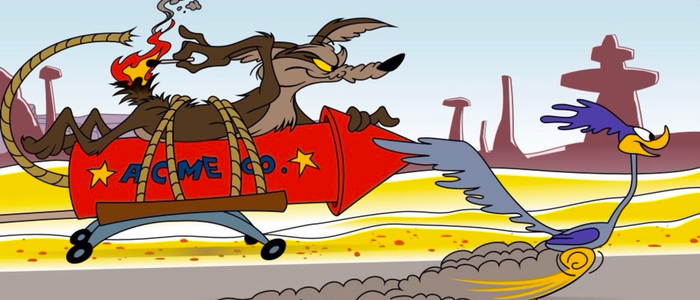
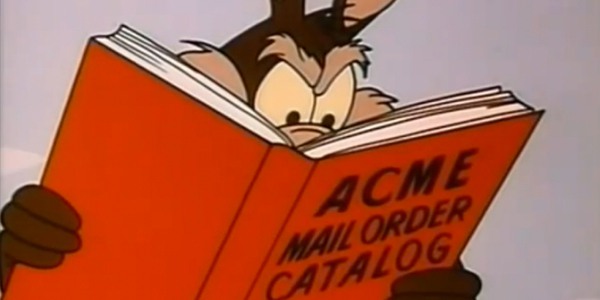
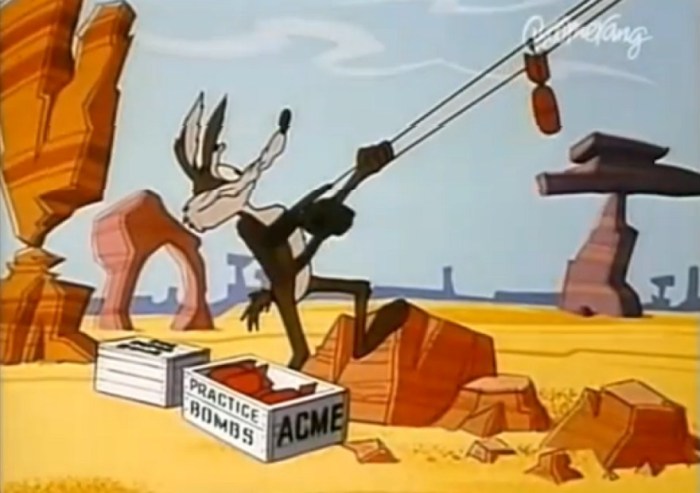
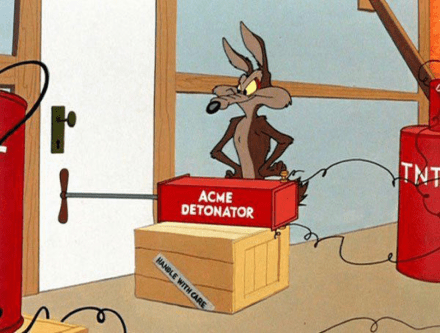
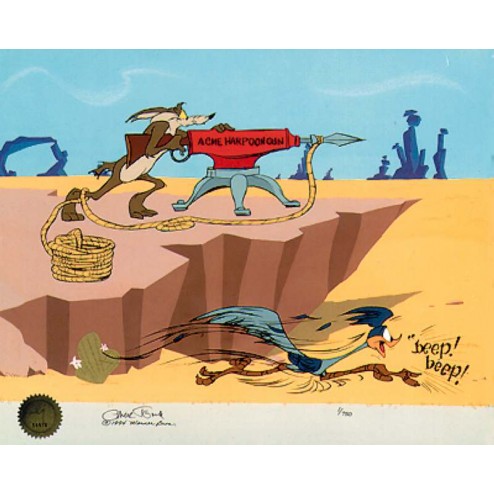
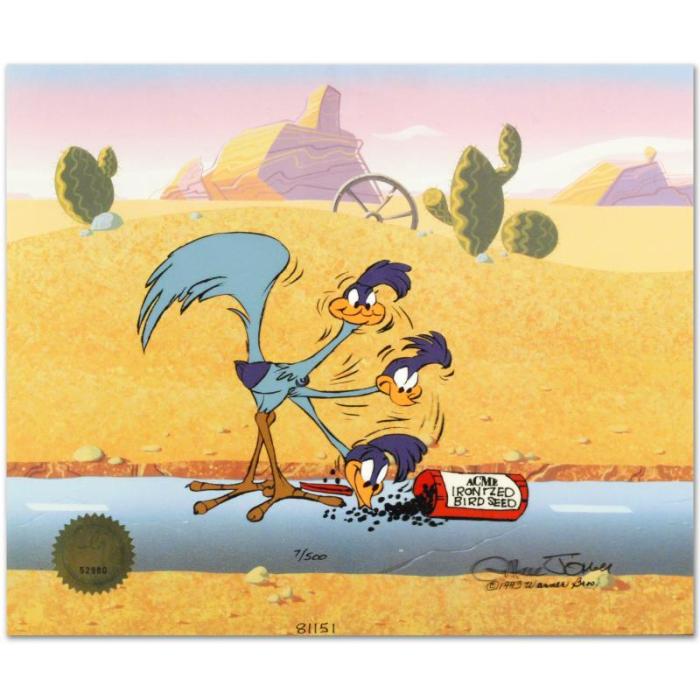
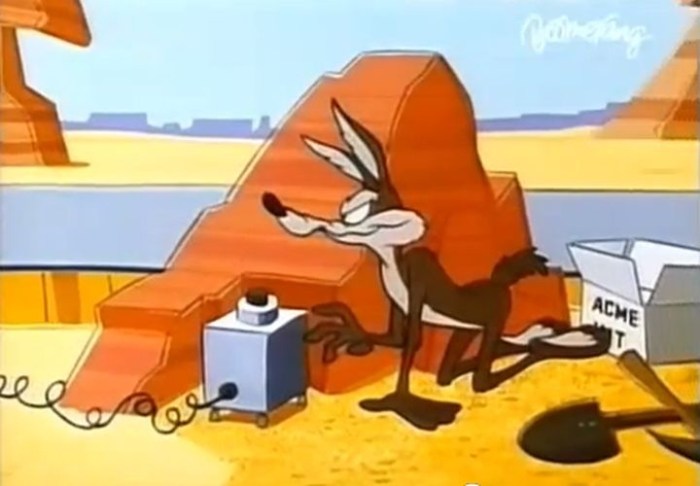
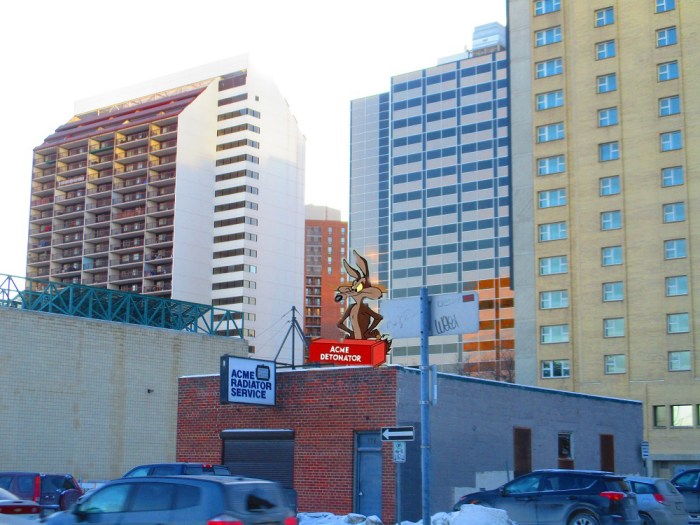
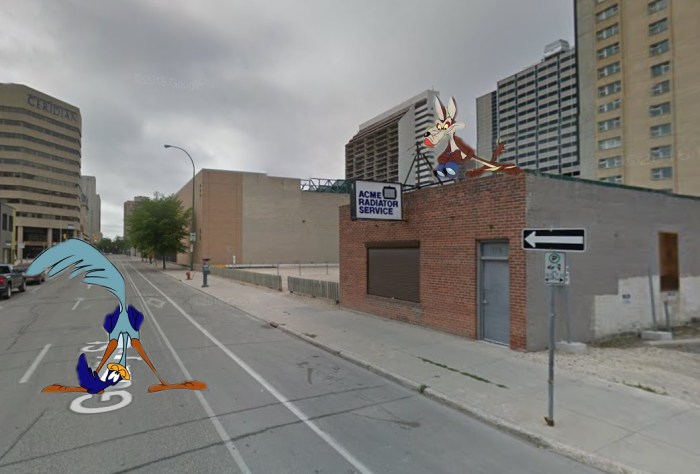
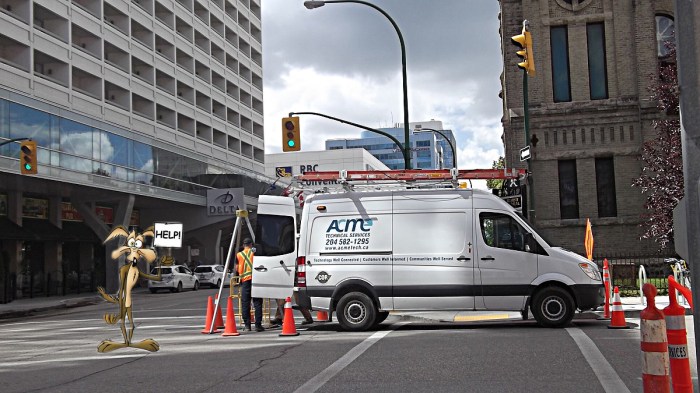
The Acme Corporation is a fictional corporation that features prominently in the Road Runner/Wile E. Coyote animated shorts as a running gag featuring outlandish products that fail or backfire catastrophically at the worst possible times. The name is also used as a generic title in many cartoons, especially those made by Warner Bros., and films, TV series, commercials and comic strips.
The company name in the Road Runner cartoons is ironic, since the word acme is derived from Greek (ακμή; English transliteration: akmē) meaning the peak, zenith or prime, yet products from the fictional Acme Corporation are often generic, failure-prone, and/or explosive.


“Time To Go”
[Chorus:]
Go! Go! Black and gold!
Old-time hockey, bar the door
Clear the track it’s all-out war
Light the lamp, throw a hit
Black and gold never quit
The barn is full, our team’s in town
So put ’em up boys, knock ’em out (knock ’em down)
Drop the puck, it’s time to go (time to go)
Bust outta work, it’s quarter-past five
Time to round up the gang
and take the Red to the Orange line
Head for the street and the Causeway crowd
You can feel it in the air, when the team’s in town
[Chorus]
Rancourt’s ready, it’s time to take to the ice
So tie down the jersey ’cause it could get ugly tonight
Top corner, five hole, off the post and in
On a quest for the cup, and we’re ready to win
[Chorus]
Go! Go! Black and gold!
Drop the puck, it’s time to go






 The MarkoZen Blog