10,000 Bedroom Nazi Hotel intended to give workers a holiday at the beach

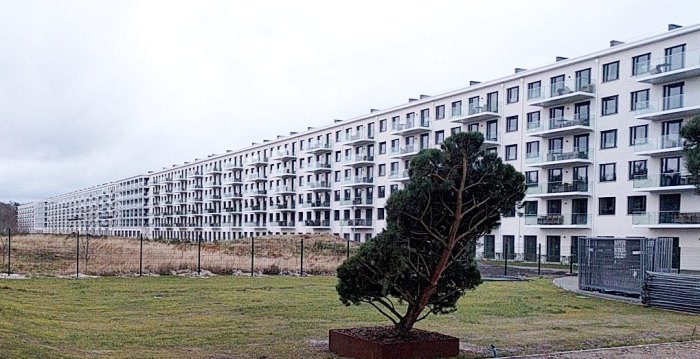
Stretching for over three miles along the white sandy beach on Germany’s Baltic Sea island of Ruegen, lies the world’s biggest hotel with 10,000 bedrooms all facing the sea. But for 70 years since it was built, no holiday maker has ever stayed there. This is hotel Prora, a massive building complex built between 1936 and 1939 by the Nazis as part of their “Strength through Joy” (“Kraft durch Freude,” KdF) programme. The aim was to provide leisure activities for German workers and spread Nazi propaganda. Locals call Prora the Colossus because of its monumental structure.

Prora lies on an extensive bay between the Sassnitz and Binz regions, known as the Prorer Wiek, on the narrow heath (the Prora) which separates the lagoon of the Großer Jasmunder Bodden from the Baltic Sea. The complex consist of eight identical buildings that extend over a length of 4.5 kilometres and are roughly 150 metres from the beach. A workforce of 9,000 took three years to build it, starting in 1936, and the Nazis had long-term plans for four identical resorts, all with cinema, festival halls, swimming pools and a jetty where Strength Through Joy cruise ships would dock.


prora-16[6]


Dr. Robert Ley envisaged Prora as a parallel to Butlins – British “holiday camps” designed to provide affordable holidays for the average worker. Prora was designed to house 20,000 holidaymakers, under the ideal that every worker deserved a holiday at the beach. Designed by Clemens Klotz (1886–1969), all rooms were planned to overlook the sea, while corridors and sanitation are located on the land side. Each room of 5 by 2.5 metres (16’5″ x 8’3″) was to have two beds, an armoire (wardrobe) and a sink. There were communal toilets and showers and ballrooms on each floor.

Hitler’s plans for Prora were much more ambitious. He wanted a gigantic sea resort, the “most mighty and large one to ever have existed”, holding 20,000 beds. In the middle, a massive building was to be erected. At the same time, Hitler wanted it to be convertible into a military hospital in case of war. Hitler insisted that the plans of a massive indoor arena by architect Erich Putlitz be included. Putlitz’s Festival Hall was intended to be able to accommodate all 20,000 guests at the same time. His plans included two wave-swimming pools and a theatre. A large dock for passenger ships was also planned.

During the few years that Prora was under construction, all major construction companies of the Reich and nearly 9,000 workers were involved in this project. With the onset of World War II in 1939, building on Prora stopped and the construction workers transferred to the V-Weapons plant at Peenemünde. The eight housing blocks, the theatre and cinema stayed as empty shells, and the swimming pools and festival hall never materialised. During the Allied bombing campaign, many people from Hamburg took refuge in one of the housing blocks, and later refugees from the east of Germany were housed there. By the end of the war, these buildings housed female auxiliary personnel for the Luftwaffe.

Beach side

Prorax


In 1945 the Soviet Army took control of the region and established a military base at Prora. The Soviet Army’s 2nd Artillery Brigade occupied block 5 of Prora from 1945 to 1955. The Soviet military then stripped all usable materials from the building.  In the late 1940s two of the housing blocks – one on the North and one on the South – were demolished and the remains mostly removed.

In the late 1950s the East German military rebuilt several of the buildings. Since the buildings had been stripped to the bare brick in the late 1940s, most of the exterior and interior finish that can be seen today was done under East German control. After the formation of the German Democratic Republic’s (GDR’s) National Peoples Army in 1956, the buildings became a restricted military area housing several East German Army units. The most prominent were the elite 40. Fallschirmjägerbataillon Willi Sänger (40th Parachute Battalion “Willi Sänger”) which was housed in block 5 from 1960 to 1982. Block 4 on the north side was used for urban combat training by the Parachute Battalion and others. Large sections remain as ruins to this day. Also housed in the building from 1982 to 1990 was the East German Army Construction Battalion “Mukran”, where conscientious objectors served as noncombatant Construction Soldiers (Bausoldaten) to meet their military service obligation. A part of the building also served as the East German Army’s “Walter Ulbricht” convalescent home.

prora-3[2]


prora-13[5]

Vladimir Putin’s War Room makes Dr. Strangelove War Room look Puny

Vladimir Putin’s massive, triple-decker war room revealed


war room

MOSCOW — “Gentlemen. You can’t fight in here. This is the war room!”

It could have been a scene straight out of “Dr. Strangelove” when President Vladimir V. Putin stepped into the Russian Ministry of Defense’s brand new, three-tiered, multibillion-dollar control center this week, for a war briefing that had its fair share of movie-like pageantry.

The fortified National Control Defense Center was Putin’s first stop after officials confirmed that the Russian charter jet crash that claimed 224 lives last month was the result of an act of terror.

On movie-theater-size screens, live broadcasts showed long-range strategic bombers taking off from Russian air bases to fly sorties over Syria. Putin instructed commanders in Syria to “make contact with the French and work with them as allies” as Russia seeks a central role in a proposed anti-terrorist coalition.

war room1


war room2


But the real star of the show may have been the building itself, which is designed to be a new nerve center for the Russian military that will coordinate military action around the world, including ballistic missile launches and strategic nuclear deployments.

The building is roughly the equivalent of the U.S. National Military Command Center used by the Pentagon, but as one Russian state news agency noted in a breathless headline this week, “Russian Defense Data Center Outperforms US Facility Threefold: Official.”

The center, which is fortified and said to sit on top of a maze of underground tunnels, is on the Frunze Naberezhnaya on the left bank of the Moscow river, a little over two miles from Red Square.


room


It was finished in 2014 and is part of a massive, decade-long modernization of Russia’s army, which has cost hundreds of billions of dollars, but has also produced noted improvements, from the expertise of Russian troops deployed during the Crimea operation to the recent cruise missile strikes launched from the Caspian Sea.

The new national defense center also includes a helicopter pad that was deployed on the Moscow River late last year and can accommodate Russia’s Mi-8 transport helicopter. In case of a war, it would be the country’s premier communications center, and one Russian commander compared it to the military headquarters of the Soviet Union during World War II.


war room3

Another room with a large round table and more giant monitors.

war room4


war room5


Minister of Defense Sergei Shoigu said that the center is a step toward “forming a single information space for solving tasks in the interests of the country’s defense.”

As Worldviews noted during Russia’s International Army Games in August, Russia’s military has sought to raise its public profile through savvy media branding.

At the briefing, army personnel sat in color-coded rows with matching headsets and water bottles bearing the Russian army brand (their flagship store recently opened on Tverskaya Street here, Moscow’s equivalent of Fifth Avenue). The briefing was covered on Russian national television from at least four distinct camera angles.

Andrei Kolesnikov, a reporter who has covered Putin for the past 15 years and is known for his lyrical, fawning reports of the Russian president, waxed introspective as he covered the briefing Tuesday.

“When this building and this room were opened a year ago, I was somewhat perplexed: Yes, it all looks very persuasive, and the Pentagon might even only dream of something like this, if only in a nightmare. But why? Who will need these screens the size of small soccer fields with grandstands for viewers?


war room3a

“And here was the answer. Every spot was filled. Russia’s entire high army command were the viewers. Or was it like the warming bench, and at any moment everyone was ready to go on the field …”

Later in the piece, he added: “My soul of course was not filled with delight and trembling at the hellish power of this armada. But I was perturbed, yes, I was.”

The War Rooms from the movies take a backseat to this giant high-tech cavern.

Dr. Strangelove

war room7 strangelove

WarGames 1983

war room6 wargames

‘You Only Live Twice”, James Bond.

war room8 you only live twice


Shark Family

“Baby Shark” likely originated from a campfire song or chant. Some sources have mentioned traditional myths as a basis, others camping origins in the early 20th century, and some see it as possibly developed by camp counselors inspired by the movie Jaws. It became a campfire song where each member of a family of sharks is introduced with different hand motions. Also several different versions of the song have the sharks hunting fish, eating a sailor, or killing people who then go to heaven.

Uncle Shark

red5

STUDY PROVES MOST SPACE ALIENS ARE DWARFS

By Erik Van Datiken on February 28, 2019


aliensc

Most aliens who visit Earth are dwarfs who stand less than 4 feet tall! So says physicist David Webb.

Dr. Webb analyzed nearly 2,000 close encounters and found that aliens fall into three classes.

“Most numerous are those in the dwarf class,” he said. “Generally, they wear helmets and metallic reflecting suits. Very often they are seen in pairs gathering samples from the ground and trees. They don’t generally communicate with humans.”

The second group is comprised of human-like beings from 5 to 6 feet tall, said Dr. Webb.

“They are seen in groups of three or more and involved in the so-called abduction cases. There is often communication with humans.”

In the final category are the giants that appear to be at least 7 feet tall, he said.

“All of these classes of aliens tend to wear one-piece coveralls or jumpsuits that are tight-fitting all the way down to the hands,” continued Dr. Webb.

“Not too many carry weapons but generally these extraterrestrials tend to control the situation.

“They are seen in groups of three or more and involved in the so-called abduction cases. There is often communication with humans.”

“Sometimes a witness is paralyzed by an apparent ray gun device,” he said. “But often he’s just paralyzed without any obvious weapon.”

Dr. Webb found that of the nearly 2,000 cases:

  • 26 percent involved aliens seen entering or leaving a UFO.
  • 17 percent involved aliens observed in a UFO.
  • 17 percent involved an alien near a spacecraft.
  • 16 percent involved seeing an alien but not a UFO.
  • 10 percent involved witnesses who were actually taken aboard a UFO.
  • 7 percent involved an alien seen in the area where UFO sightings have previously occurred.
  • 2 percent involved communication with the alien.

The remaining 5 percent don’t fit into any categories.

Rainbow Taxi Fleet

Unlike the rest of the world, where taxis are usually yellow and black, Bangkok’s taxis come in a full range of colors. There are pink taxis, orange taxis, purple taxis, green taxes, yellow taxis and taxis in various combinations. While taxi color in other countries signify nothing in particular, Bangkok’s taxis are actually color coded. The single-color are company taxis, personal taxis in cooperation or alliance and rental company taxis. These color include bright green, bright sky blue, red, orange, yellow, blue, pink, purple, violet and tan. The bi-colored taxis are in 3 kinds including yellow-green, red-blue and yellow-orange. The yellow-green are the personal private taxi. The red-blue are the rental taxi. The yellow-orange are the company taxi. Taxis are abundant in Bangkok so you can pick any color you like, but the yellow-green taxis are generally reckoned to be better, being owned and driven by the owners themselves.


bang

bang2

bang4

Traffic more or less looks like a free for all

Bangkok’s colored transportation isn’t limited to just taxis; the buses are colored too and each color signify a different fare, route, ownership and whether or not it has air-conditioning. The non-air conditioned regular buses are colored a combination of red and cream. These are operated by Bangkok Mass Transit Authority (BMTA) and are the cheapest bus service in the city. With the air pollution and heat in Bangkok, traveling on these buses can be a trying experience, especially during daytime and rush hours. The white-blue color buses are no better – non-air conditioned – and the fares are slightly higher.

bangkok-bus23

The cream-blue color air-conditioned buses, also operated by the BMTA, are slightly more convenient than the regular buses. The yellow-orange color Euro II buses are also air-conditioned and relatively new. Purple or red colored are micro-buses that are privately owned and offers an alternative bus service to the population. They are air-conditioned, have a fixed fare regardless of the distance travelled and only stops if there are still vacant seats available, so every passenger is guaranteed a seat.

The Very Strange Story of Jim Sullivan

Jim was a musician and had an album named Alien Abduction.

abduction

James Anthony Sullivan (August 13, 1940 – disappeared March 6, 1975) was an American singer-songwriter and guitarist who released two albums before he disappeared without a trace in New Mexico.

Sullivan grew up in the Linda Vista area of San Diego, California, where his Irish-American parents had moved from Nebraska to work in the defense industry. A tall man, he was a high school quarterback. According to self-written liner notes on his first LP, he “grew up in a government housing project with a bunch of other Okies and Arkies,” and decided to play music after listening to local blues groups. He married, and played guitar in a local rock band, the Survivors, with his sister-in-law Kathie Doran. He and a friend bought a bar near to their college, but it lost money, and in 1968 he moved with his wife Barbara and young son to Los Angeles.

While his wife worked at Capitol Records, Sullivan wrote songs and performed in increasingly prestigious clubs in the Los Angeles area. In particular, he became established at the Raft club in Malibu, where he became friends with Hollywood figures including Lee Majors, Lee Marvin, and Harry Dean Stanton. He appeared as an extra in the movie Easy Rider, and performed on the José Feliciano television show. His friends contributed the funding that allowed him to record an album of his songs with leading Los Angeles session musicians, keyboard player Don Randi, drummer Earl Palmer, and bass player Jimmy Bond, who was also the record’s arranger and co-producer. After Nick Venet at Capitol turned down the opportunity to release the record, it was issued by Sullivan’s friend Al Dobbs on a small record label, Monnie, a label he set up for that purpose. The album, U.F.O., was released in 1969, and featured Sullivan’s songs in a style blending folk, rock and country that has been compared with Fred Neil, Tim Hardin, Gene Clark and Joe South, with arrangements in the style of David Axelrod.

The album was remixed and reissued by Century City Records in 1970, and the track “Rosey” was issued as a single, but they made little impact at the time. Sullivan continued to perform in clubs. In 1972, he recorded a second album, Jim Sullivan, arranged by Jim Hughart, produced by Lee Burch and released by Playboy Records. Again, however, the record was unsuccessful. As Sullivan increasingly turned to alcohol and his marriage began to disintegrate, he decided in 1975 to travel to Nashville, where Kathie Doran was working as a singer and songwriter, and try to find success there.

Sullivan left Los Angeles on March 4, 1975, to drive to Nashville alone in his Volkswagen Beetle. The next day, after being cautioned by a highway patrol officer regarding his driving, he checked into the La Mesa Motel in Santa Rosa, New Mexico. Later reports suggest he did not sleep there, and left his key inside the room, and that he bought vodka at the town store. He was seen the following day about 26 miles (42 km) away, at a remote ranch owned by the Gennetti family. His car was later found abandoned at the ranch, and he was reportedly last seen walking away from it. The car contained Sullivan’s money, papers, guitar, clothes, and a box of his unsold records.

He was never seen again, and reports have variously attributed his disappearance to being murdered, becoming disoriented and lost, or, particularly in the light of the title of his first album, alien abduction. Search parties failed to find any trace of him. A decomposed body resembling Sullivan was later found in a remote area several miles away, but was determined not to be his.

Sullivan’s records, especially U.F.O., developed a cult following in later years, partly because of their rarity and obscurity. In 2010, Matt Sullivan (no relation), the founder of Light in the Attic Records, decided to reissue U.F.O., and made serious attempts to uncover the mystery of Sullivan’s disappearance, interviewing many of those who knew him and those involved in his recordings, but revealing little new information. The album was issued on CD in 2011.

Shakin like a leaf on the desert heat,
his daddy’s got a bog that’s hard to beat
Bought me a ticket got a front row seat.
I’m checkin out the show with a glassy eye.
Looking at the sun dancing through the sky.
Did he come by UFO?
Lotta tricks were pulled in a book I read.
Only man I know that got up from the dead.
Lotta people living by the words that he said.
I’m checkin out the show with a glassy eye.
Looking at the sun dancing through the sky.
Did he come by UFO?
Think he’ll ever come again a different way
and maybe he has come and gone while I was away.
Too much goodness is a sin today.
I’m checkin out the show with a glassy eye.
Looking at the sun dancing through the sky.
Did he

Giant Presidential Heads

prez3

In Croaker, Virginia stands a sight that would make just about anyone stop in their tracks. 43 ghostly effigies of presidents past crowd together in the tall grass. Some of the 18-to-20-foot busts have crumbling noses. Tear-like stains fall from the eyes of others. All have bashed-in heads to some degree. This could be a scene from the world’s most patriotic horror movie, but it’s all too real—and Howard Hankins’ family farm is just the latest stop on the busts’ larger-than-life journey from iconic pieces of art to zombie-like markers of America’s past.
prez

The busts are all that remains of Virginia’s Presidents Park, a now-defunct open-air museum where visitors could once walk among the presidential heads. Presidents Park first opened in nearby Williamsburg in 2004, the brainchild of local landowner Everette “Haley” Newman and Houston sculptor David Adickes, who was inspired to create the giant busts after driving past Mount Rushmore in South Dakota.

But their presidential visions soon (literally) went bust. The park, which cost about $10 million to create, went belly-up due to a lack of visitors in 2010. Doomed in part by location—it was hidden behind a motel and slightly too far away from colonial Williamsburg’s tourist attractions, the park went into foreclosure.

That’s where Hankins, who helped build the park, comes in. Before the land was auctioned off, Newman asked him to destroy the busts. But Hankins didn’t feel right about it, and instead offered to take the heads and move them to his 400-acre farm. And so began the laborious process of moving 43 giant presidents, each weighing in between 11,000 and 20,000 pounds, to a field ten miles away. Hankins estimates the weeklong process cost about $50,000—not including the damage done to each sculpture during the move.


prez1


prez2


headz